Skip to content
DevMeme
1181 of 7435
When the Cybersecurity Blue Team Gets Hardcore
Security Post #1318, on Apr 16, 2020 in TG

When the Cybersecurity Blue Team Gets Hardcore

Why is this Security meme funny?

Level 1: Secret Clubhouse Code

Imagine you walk into a playground and see a group of kids who’ve formed a secret club. They’re all wearing the same color shirt, they’ve got a special handshake, and they use made-up words or gestures to communicate. If you’re not in the club, it looks totally confusing — almost like they’re speaking gibberish or using some secret code language. But to those kids, each gesture and word has a very specific meaning (“meet at the treehouse” or “we’re playing a prank on the teacher”). They might wiggle their hands in a certain way or say a funny password to signal things only they understand.

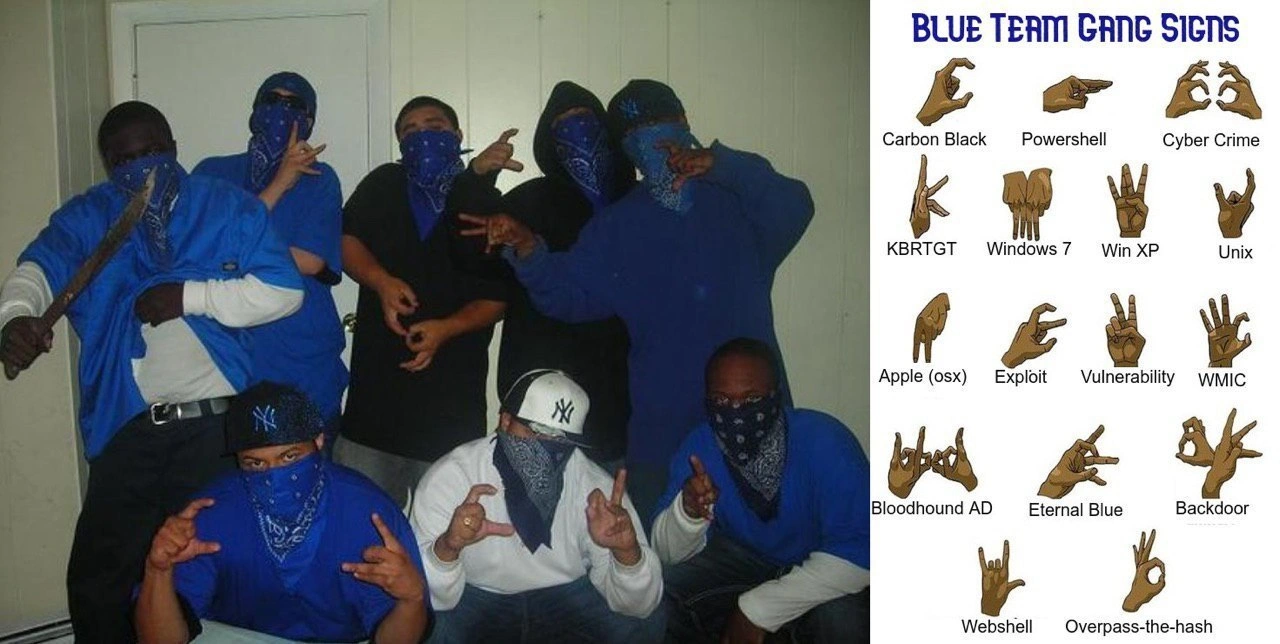
This meme is just like that, but for grown-ups in a computer security team. The people in the picture with blue bandanas are like the kids in the club wearing the same color. They’re pretending to be a “gang” (a super tight group) of security experts. And instead of normal words, they’re using what looks like hand signs to talk about important tools and tricks in their world. To someone not in their group, those hand signs (and the labels like “Eternal Blue” or “Webshell”) mean nothing — it’s like secret gibberish. But to the security folks, each one is like an inside joke or code word that instantly tells a whole story.

It’s funny on a basic level because we don’t expect serious computer people to act like a street gang, right? Wearing bandanas and flashing hand signals is something we see in movies about tough gangs. Here, the security team is joking that they’re so tight-knit and have so much secret lingo, they might as well be a gang with their own sign language. It’s a way to show pride in their group and laugh at how outsiders might see them. Just like kids in a clubhouse feel cool with their own secret rules, these security “blue team” folks feel a bit like a secret club too.

So the simple idea is: tech security people have their own language and it can look as strange as gang signs to everyone else. It makes us laugh because we can relate to the idea of an insider club with special signals. Even if you don’t know what “Carbon Black” or “Overpass-the-hash” are, you can get the joke that these are like the club’s magic words. It’s saying, “We’re the good guys defending the computers, but we have our own swag and style, almost like we’re in a cool gang.” In other words, it’s highlighting that feeling of belonging to a team that has secrets only the members get – just like having a secret handshake on the playground.

Level 2: Security Sign Language

So, what exactly are all these Blue Team gang signs? Let’s decode this cybersecurity meme into plain English. In cybersecurity parlance, teams are often color-coded: Blue Team refers to the defenders – the folks securing systems, monitoring for intrusions, and responding to attacks. They’re the digital security guards of an organization. Red Team, by contrast, are the “attackers” (often internal professionals or hired consultants who simulate real attacks to test the defenses). Think of a war game: blue defends the castle, red tries to breach it. In our meme, the Blue Team is depicted literally like a gang wearing blue, which is a playful nod to that color-coding. The idea is that Blue Teamers have their own sign language – a bunch of jargon and tools – that might look like secret signals to someone not in the security field.

Let’s break down some of the terms flashing on that right-hand panel, as if each was a vocabulary word in the defensive_security dictionary:

  • Carbon Black – Despite sounding like a cool code name, this is actually a popular cybersecurity tool. Carbon Black is an Endpoint Detection and Response (EDR) system. Think of it as an advanced alarm system and CCTV for computers. It sits on each computer (endpoint) in a company and continuously watches for suspicious activity, like a guard dog sniffing out intruders. If malware tries something sneaky—say, injecting into another process or reaching out to a weird server—Carbon Black can alert the security team or even stop the action. In the meme, Carbon Black is given a hand sign, meaning it’s a badge of the Blue Team. If someone “throws the Carbon Black sign,” they’re basically saying “we have eyes on all our PCs, don’t try anything!” It’s one of those tools Blue Teams brag about because it gives them an upper hand catching hackers. (Fun fact: It’s named after a chemical, carbon black, used in inks; here it’s like covering everything in an organization with invisible ink that exposes bad guys under the right light.)

  • PowerShell – This one is a bit of a double-edged sword. PowerShell is a legitimate Windows command-line shell and scripting language, sort of like a Swiss Army knife for automating tasks on Windows. System administrators love it because you can do almost anything with a few scripts – manage users, fetch system info, deploy software, you name it. However, because it’s so powerful, hackers love it too. They use PowerShell scripts to run malware entirely in memory (avoiding dropping files on disk), or to download malicious code from the internet on the fly. This is called “living off the land”, where attackers use built-in tools so as not to raise suspicion. Blue Teams learned to be very wary of unusual PowerShell usage. If they see, for example, powershell.exe -nop -encodedCommand ... in the logs, it’s a red flag that someone might be executing encoded malicious commands. In our gang sign meme, PowerShell gets a sign because it’s practically the symbol of how hackers turn the defenders’ tools against them. When a Blue Teamer makes a PowerShell sign (figuratively), they mean “we’re onto those script-based tricks.” In simpler terms: PowerShell is like a kitchen knife – very useful for good folks, but scary if a bad guy grabs it. The Blue Team has to keep an eye on it all the time, as if monitoring who’s holding the knife.

  • Cyber Crime – This is a broad term, basically the reason Blue Teams have a job in the first place. It refers to criminal activities conducted via computers or the internet. That includes things like hacking, identity theft, spreading viruses, ransomware attacks, etc. If someone shows a Cyber Crime sign, they’re just representing the whole underworld that Blue Teams battle every day. It’s like putting up a symbol for “the bad guys” collectively. Blue Teamers joke about it because to them, fighting cyber crime is just Tuesday at work. It’s the constant backdrop of their operations – a bit like doctors might dryly joke about “disease” or cops about “crime” in general, the defenders here have a sign for the entire category of threats.

  • KRBTGT – Now this one is truly insider-y. It stands for Kerberos Ticket Granting Ticket, but in practice KRBTGT is the name of a special user account in Microsoft Active Directory domains. Active Directory (AD) is the system many companies use to manage user logins and permissions across their network (it’s like the master directory of who’s who and what they can access). Kerberos is the protocol AD uses for authentication (kind of like an ID-checking service that gives you tickets to access resources). The KRBTGT account is essentially the “Kerberos service account” – it holds the cryptographic keys that sign all those login tickets. Why do Blue Teams care about this gnarly acronym? Because if attackers compromise KRBTGT, they can perform what’s known as a Golden Ticket attack. Imagine if you could print an unlimited all-access pass for any computer in the domain, that’s what Golden Tickets are. The attacker forges login tickets that the system will trust completely (since they can sign them with the stolen KRBTGT key). This is like stealing the master key to every door in a building. It’s incredibly serious – basically game over for security until the organization does the difficult process of resetting the KRBTGT (which is non-trivial and can disrupt authentication). So in meme terms, a KRBTGT gang sign is showing off the knowledge of “the ultimate heist” in Windows networks. It’s not something thrown around lightly; only someone deep into Active Directory security would even drop this term. Blue Teamers kind of use “KRBTGT” as shorthand for “protect the core of our authentication system” or “we might have a serious breach if this is in play.”

  • Windows 7 & Windows XP – These are older versions of the Windows operating system (released in 2009 and 2001, respectively). By 2020, Windows 7 had just gone out of official support, and Windows XP was long out (it’s so old that Microsoft stopped providing security updates for XP in 2014, except some very special cases). However, many organizations still had computers running these versions, which is a security headache. Outdated OSes no longer get patched for new vulnerabilities, so they accumulate un-fixed holes that attackers can exploit. To a Blue Team, an unpatched Windows XP or 7 machine on their network is like a crumbling part of a castle wall: it practically invites invaders. Such machines often can’t be updated easily (maybe they run legacy software that doesn’t work on newer Windows), so they become the bane of defenders who must apply extra protections around them. In the meme, giving these OS their own signs is poking fun at how prominent they are in security discussions. A newbie might think, “Why do they have signs for old Windows versions?” But a junior security analyst quickly learns: legacy systems are some of the biggest risks. They’ll hear seniors groan about that “one Windows XP box we can’t get rid of” or “the CEO’s laptop still on Windows 7 for some reason.” This is why we patch and upgrade: to reduce vulnerabilities. Blue Teams treat old systems like VIPs at a party who need constant babysitting so they don’t cause a scene. The signs for Win7 and WinXP in the meme signify “we know these old guys can cause trouble.”

  • Unix & Apple (OSX) – These represent other operating system platforms. Unix is actually a family of operating systems; many modern systems (like Linux and macOS) derive from Unix concepts. It often symbolizes Linux or other Unix-like systems in this context. Apple (OSX) refers to macOS, the operating system for Apple’s Mac computers (OSX was the former name, now it’s just macOS, but security folks often still say OS X out of habit). Blue Teams cover these systems too, even if Windows tends to get more attention in enterprise security (because most corporate networks are Windows-heavy). Unix/Linux servers run critical infrastructure (like web servers, databases, etc.), and Apple laptops are common especially among developers or executives. Each has its own security tools and issues – for instance, Linux doesn’t get ransomware as often, but misconfigurations can expose data; macOS is Unix-based but had some unique malware, etc. By including these in the “gang signs,” the meme acknowledges that a well-rounded Blue Team isn’t just Windows-focused. A junior learning security might start on Windows incidents, but soon they’ll hear about securing Linux servers or managing Macs (perhaps with MDM solutions). So the sign for Unix says “we speak Linux too” and the Apple sign says “yup, even Macs get malware – don’t forget about them.” It broadens the defender’s world beyond one OS.

  • Exploit – In simple terms, an exploit is the tool or method used to take advantage of a security weakness. If a vulnerability is a weakness in armor, an exploit is the specific arrow that finds that chink and pierces through. Exploits can be code, scripts, or even manual techniques. For example, if there’s a known flaw that “if you send a really long name to this server it crashes,” an exploit will be a program that sends that long name and maybe even injects malicious instructions in that crash. Blue Teamers talk about exploits all the time: zero-day exploits (newly discovered, no patch yet), known exploits (for which patches exist), and exploit kits (collections of exploits often used by malware). The meme giving “Exploit” a sign is basically labeling the very act of hacking as part of the lingo. It’s like having a sign for “trouble.” For someone new to security, understanding what an exploit is, is foundational. It explains why just having a vulnerability isn’t the end of the world – it’s when someone develops an exploit for it that things get dangerous, which is why patching is urgent.

  • Vulnerability – This is the flip side: the weakness itself. A vulnerability could be a coding error, a design flaw, or a configuration mistake that allows something bad to happen. Think of a bank vault with a fragile hinge – the hinge is a vulnerability. In software, it might be a buffer overflow possibility, a default password left unchanged, or missing encryption. The industry even assigns identifiers to notable vulnerabilities (like CVE-2020-0796 for a Windows 10 bug or CVE numbers for others). Blue Teams are in the constant practice of vulnerability management – finding and fixing those weak points before attackers exploit them. So giving “Vulnerability” a gesture in the meme is like saying “that’s one of our core concerns.” For a junior, it’s important to differentiate: a vulnerability is not the attack itself, just the opening that makes an attack possible. Not every vulnerability gets exploited, but every exploit targets a vulnerability. Security 101!

  • WMIC – This stands for Windows Management Instrumentation Command-line. It’s a mouthful, but basically WMIC is a tool that lets admins (or scripts) manage Windows systems in all sorts of ways, especially remotely. For example, using WMIC, an admin can query software installed on a remote machine, or start a process on another computer if they have permission. Attackers realized, “Hey, if I hack one machine and want to move laterally (jump to another machine), I can use WMIC with stolen admin credentials to execute my malware on that next machine – no need to download fancy hacker tools when Windows already has this swiss army knife!” Thus WMIC became a LOT (Living-off-the-land) favorite for bad actors. Blue Teams learned to detect unusual WMIC usage. If in the middle of the night dozens of systems start running wmic process call create ... commands launching unknown scripts, it’s a sign someone is spreading an attack internally. A junior analyst might not recognize a WMIC command line right away, but they soon will – it appears in many incident reports. The meme including WMIC is almost chuckle-worthy because it is such an obscure thing to non-IT people (“wimmik? what’s that?”), but in security it’s notorious enough to get its own gang sign. This highlights how even normal administrative tools can be threats if misused. Blue Teams have to almost think like attackers, knowing all these little tools and tricks so they can catch the intruders who use them.

  • Bloodhound AD – Bloodhound is an open-source tool (usually used by penetration testers and red teams) to graph out the relationships and paths in Active Directory domains. In an AD environment, users, groups, and computers have permissions and trust relationships which can be complex. Bloodhound uses graph theory to find paths like “User X is a local admin on Machine Y, which has a service running as Domain Admin – so if I compromise X, I can move to Y, then get Domain Admin.” It’s a map of attack routes. Now, why would Blue Teamers care about it? Two reasons: One, they often use it themselves to find and fix risky configurations (better we find it than the enemy). Two, if an attacker or red teamer is running Bloodhound in your network, it often leaves a trace (like unusual LDAP queries). Blue Teams can detect that and say “someone’s doing reconnaissance on AD.” For a junior defender, Bloodhound might be introduced by a teammate saying, “Let’s run Bloodhound and see what an attacker would target if they got a foothold.” The meme giving it a sign is definitely an in-joke. It’s saying “we even have a sign for when someone’s sniffing around our Active Directory.” It’s an important concept: Active Directory is often the crown jewel in corporate networks (it controls login to everything), so tools like Bloodhound represent the advanced threats to that realm.

  • Eternal Blue – Arguably one of the most famous exploits ever. If you’re new to security, this is one to know. EternalBlue is the nickname for a vulnerability (and its exploit) in the SMB (Server Message Block) protocol on Windows. SMB is used for file and printer sharing. EternalBlue was like a skeleton key exploit: just by sending certain data to a vulnerable machine, an attacker could make that machine execute their code (no login needed!). The exploit was developed by the NSA (as part of a toolkit called “Equation Group”), but it was leaked in 2017 by a group called the Shadow Brokers. Shortly after, hackers misused EternalBlue to launch the WannaCry ransomware outbreak, encrypting data in hundreds of thousands of computers worldwide, especially hurting hospitals and businesses. Not long after, another destructive attack NotPetya used it too. So EternalBlue forced everyone, even those outside security, to pay attention to patching and network security. By the time of this meme (2020), saying “EternalBlue” to a Blue Teamer would get a knowing sigh – it’s the classic example of why you patch your systems. It’s like a legend. That’s why it has a spot on the Blue Team gang sign chart. It stands for “massive vulnerability that caused chaos.” A junior who hasn’t heard of it would likely get a quick history lesson from a senior: “Oh, EternalBlue? That’s the exploit behind one of the worst ransomware events – make sure all our SMB services are patched, okay?” Basically, it’s shorthand for a big deal vulnerability and by extension a reminder that neglected systems can bite you hard.

  • Backdoor – In security, a backdoor is any method that bypasses normal security to gain access. Imagine a house with a strong front door (locks, alarm) but the attacker finds an open window in the back and gets in – that window is the backdoor. Backdoors can be deliberately left by developers (e.g., an undocumented admin account for troubleshooting that attackers discovered) or placed by attackers (e.g., after hacking a server, they might leave a secret account or a hidden remote access program so they can get back in later, even if the initial flaw is fixed). For Blue Team, finding a backdoor is a big deal: it means the bad guy was here and might come again. Common examples include webshells (which is a type of backdoor on a web server), or something like a malicious service set to start on boot to reopen a connection to the hacker’s system. In everyday terms, a backdoor is like a spare key under the doormat—but one placed by a burglar, not the homeowner. The meme giving “Backdoor” its own sign acknowledges how prevalent and scary this concept is in cybersecurity. It’s like saying “one of our gang signs is literally ‘we found the hidden key’.” For a newcomer, learning about backdoors is illuminating: you realize that stopping an attacker isn’t just kicking them out once, but also removing any secret ways they left to get back in.

  • Webshell – A webshell is indeed one kind of backdoor, specifically targeting web servers. It’s usually a small piece of code (could be in PHP, ASP, JSP, etc. depending on the server) that opens up a command interface via the web. For example, an attacker might upload a file called shell.php to a website (maybe through a vulnerable file upload feature). If they then visit http://site.com/shell.php in their browser, it might give them a prompt to run commands, list files, or do other nefarious actions on that server, as if they were logged in. It essentially turns the web server into their remote terminal. Webshells have names like “c99.php”, “webadmin.asp”, or could be as subtle as hiding in an image file name. Blue Teams worry about webshells whenever there’s an indication a web server was compromised. They’ll often scan file systems looking for any odd files, or monitor outbound traffic from web servers for signs that it’s connecting to an attacker’s system. A junior analyst might learn about webshells the first time they respond to a website defacement or an alert of weird process activity on a web server – and they find some unknown file allowing remote access. In the meme context, to have a gang sign for “Webshell” is both funny and telling: it’s that common in discussions that it deserves a gesture. It’s like the secret gang meaning for “someone planted a bug in our turf.”

  • Overpass-the-hash – Finally, this mouthful term is an advanced attack method. As mentioned above, it’s related to pass-the-hash, but specifically about leveraging a hash to get Kerberos tickets. To try to simplify: Windows networks have two main authentication methods – NTLM (older challenge-response, uses password hashes) and Kerberos (newer ticket system). They usually aren’t directly interchangeable, but there’s a clever trick: one of the Kerberos encryption types (RC4-HMAC) uses the user’s NTLM hash as the key. So if an attacker has your NTLM hash, they can pretend to be you to the Kerberos system by basically saying “I know the key” without ever knowing your actual password. They can generate a valid Ticket Granting Ticket (TGT) for you on the fly or inject it into their session – voila, they are you as far as the network is concerned. Overpass-the-hash is essentially passing the hash into the Kerberos world. For a Blue Team, detecting this is tricky; they might notice odd log entries or use specialized detection that monitors for abnormal ticket creation or use of certain encryption types. Now, if you’re just getting into security, this might sound very complex – and it is! It’s one of those advanced attacks that shows up in penetration tests and sophisticated breaches. But that’s exactly why it’s on the gang sign list: it’s like advanced-level lingo. For a junior, hearing it the first time might be intimidating (“Over-what the hash?”). Over time, you’d learn it and it becomes another concept in your toolbox. The meme having a hand sign for it is almost both a joke and a gatekeeper: are you enough of a security geek to get this reference? If yes, welcome to the gang! If not, no worries – it’s an encouragement to learn these deeper tricks.

In summary, the “Blue Team Gang Signs” cheat sheet (as shown on the right side of the meme) is a playful visual glossary of cybersecurity defense terms. Each term is something important in the day-to-day of defending networks: from tools we use (Carbon Black), to techniques attackers use (PowerShell abuse, WMIC misuse), to the fundamentals of the field (exploits & vulnerabilities), to specific notorious events or methods (EternalBlue, Overpass-the-hash). The humor comes from imagining security pros literally gesturing these to each other – which of course they don’t do in reality; they speak them or write them. But it captures the feeling that this jargon might as well be a secret hand signal because outsiders won’t get it. For someone early in their security career (or a developer just peeking into the security world), this meme is both amusing and a handy list of “things I should probably Google.” Each item here has extensive stories and knowledge behind it. In a way, this meme is inviting newbies: learn these signs and you, too, can be in the Blue Team gang.

Level 3: Throwing Signs in Blue

For seasoned security pros, this meme is a chef’s kiss of insider humor. It juxtaposes actual gang culture visuals with the blue_team defender culture in cybersecurity. In the left image, the crew decked out in blue bandanas looks like a tight-knit gang posing with pride (and maybe a makeshift weapon). On the right, instead of the usual gang hand gestures like a “Westside W” or other gang signs, we have hand signs labeled with defensive_security terms. It’s funny because to outsiders, Blue Team talk might as well be cryptic gang slang. But to those in the know, each gesture on that chart instantly conjures up a battle story or a tool in their arsenal. The meme screams: “We’re the Blue Team, and here’s how we rep our set!” – with each term being a badge of honor (or a war wound).

Why these terms? They’re essentially a greatest-hits list of Blue Team concerns and nightmares. An experienced SOC (Security Operations Center) analyst or incident responder has likely grappled with every single one:

  • Carbon Black – mention this, and a senior Blue Teamer recalls long nights fine-tuning an EDR policy. Carbon Black (now part of VMware’s suite) is an Endpoint Detection and Response tool, basically the baseball bat in the defender’s toolkit. Seeing it as a gang sign in the meme is hilarious because it implies “I’ve got my neighborhood on lock with Carbon Black watching every endpoint.” In a way, flashing that sign is saying “Don’t mess with me, I’ve got telemetry and I’m not afraid to use it.” It’s an inside joke among cyber defenders – a nod to those who’ve wrestled with its alerts at 3 AM.

  • PowerShell – a harmless administrative shell turned notorious hacker playground. Blue Teamers talk about PowerShell abuse so often it’s practically a meme of its own. Attackers love using powershell.exe for fileless malware, living-off-the-land style attacks. So when a Blue Teamer throws the PowerShell gang sign, they’re basically saying “I know all your sneaky command line tricks.” It’s the equivalent of a street gang member flashing a sign to indicate they can fight dirty; the Blue Team has to anticipate every dirty trick built into Windows itself. An experienced defender has likely written dozens of detection rules for suspicious PowerShell usage (like base64-encoded commands or spawning weird child processes). The humor is in how a mundane tool becomes a symbol of cyber crime when it’s abused by attackers – and Blue Teams treat it with a mix of respect and suspicion, much like a volatile ally.

  • WMIC – another benign Windows admin utility (Windows Management Instrumentation Command-line) that doubles as an attacker’s remote control for lateral movement. If you’ve been on defense, you’ve chased weird WMIC commands executing on servers that definitely shouldn’t be doing that. Seeing WMIC given a hand sign in this meme is comically accurate: only an insider would recognize the threat behind that innocuous acronym. It’s a bit like a secret gang sign for “we know someone’s been snooping around.” Blue Teamers who catch an attacker using WMIC to deploy malware across machines might joke later, “They were throwing WMIC signs all over our network logs.”

  • Windows 7 and Win XP – nothing unites veteran security folks like the shared trauma of legacy systems. 😅 These older operating systems (especially Windows XP, which is long past its expiration date) often linger around in corporate environments out of necessity or neglect. They are the weak spots in the territory, the turf that rival gangs (hackers) love to claim because of unpatched vulnerabilities. A Blue Team gang sign for Windows XP is like a pain symbol – “pour one out for my homies still defending XP machines.” It’s both fond and exasperated: we laugh so we don’t cry about the inherent vulnerabilities. Windows 7 hit end-of-life in January 2020, so by April 2020 (when this meme was posted) it was a fresh wound – Blue Teams everywhere were pushing to upgrade or isolate Win7 boxes. An insider sees that sign and nods knowingly: outdated systems are the black sheep of security, often the source of breaches, yet they stubbornly persist (looking at you, that one ancient SCADA server running XP that nobody dares touch). Including them as gang signs says “These OSs are basically notorious figures in our world.”

  • Unix and Apple (OSX) – Blue Teams don’t just defend Windows. These signs represent other corners of the environment. Unix (and by extension Linux) underpins a lot of servers, and macOS has become common on corporate laptops. They might not grab as many breach headlines as Windows, but vulnerabilities exist everywhere. A senior Blue Teamer might chuckle seeing “Unix” and “Apple” thrown in; it’s like saying “yeah, we haven’t forgotten about those boxes either.” It broadens the gang analogy: the Blue Team’s turf spans multiple neighborhoods (operating systems), and they have signs for each. It’s a gentle poke at how defenders must be polyglots—speaking Windows event logs one minute, Linux syslogs the next, and maybe parsing Mac console logs after that. Each OS has its quirks and security gaps, and a true Blue Team veteran can “flash the sign” that they know how to handle all of them.

  • Exploit & Vulnerability – These are general terms, almost the philosophical core of security. A vulnerability is a weakness in the system, and an exploit is what turns that weakness into a concrete attack. By giving them hand signs, the meme personifies the fundamental threats. It’s as if saying “we throw up signs for the very concepts of getting hacked.” For an experienced defender, exploits and vulns are the daily discussion – from the latest critical CVE to the internal pentest findings. The humor here is a bit meta: imagine literal hand gestures for something abstract like “a misconfigured S3 bucket” or “SQL injection” – absurd, right? But Blue Teamers really do have an informal lexicon and shorthand among themselves for these things. They might not wiggle their fingers in real life, but drop the terms casually like codewords. Seeing them depicted as gestures just exaggerates the clique feeling. It reminds senior folks of how impenetrable their conversations can sound to non-security colleagues: “We found a new privilege escalation exploit leveraging an unpatched vuln in Jenkins” – might as well be gang codes to someone from marketing.

  • BloodHound AD – Now this one is a tasty deep cut. BloodHound is a tool used by Red Teams (the attacker simulation guys) to map out Active Directory relationships and find the fastest path to domain admin. If a Blue Teamer is referencing BloodHound, it means they’re onto the tactics of those sneaky attackers. It’s almost like the Blue gang learning the rival Red gang’s graffiti tags and symbols. A seasoned defender knows that if they spot signs of BloodHound (like its typical queries in log files), something’s up. Having a hand sign for “BloodHound AD” in the meme is both funny and a bit ominous – it signifies game recognizes game. The Blue Team that can throw that sign is saying, “We see you, red teamers or hackers, trying to sniff out our Active Directory secrets.” It also hints that Blue Teamers themselves run BloodHound in a controlled way to audit their own networks (catching misconfigurations before the bad guys do). So it’s a flex: we can use the hacking tools too. The gang analogy would be like intercepting the rival gang’s signals and tossing them back as a taunt.

  • Eternal Blue – A veteran’s eyes will either roll or widen at this. This exploit is practically legend in cyber security lore. It was part of the leaked NSA toolkit (Eternal family) and was infamously used in the WannaCry and NotPetya outbreaks. Mentioning EternalBlue in Blue Team circles is like mentioning that one massive battle everyone remembers. It’s PTSD and pride rolled into one – many Blue Teamers spent a frantic week in 2017 patching everything that moved and tracking infections because of this single exploit. As a gang sign, Eternal Blue is like flashing a symbol for “citywide emergency.” It unites defenders because even if your org wasn’t hit, you likely sweated over it. And if you were hit… oh boy, you earned your stripes. The absurdity of giving it a hand sign on the chart underscores how common it became in conversation. It went from a codename to practically shorthand for “a really bad day for defenders.” Seasoned pros remember it as a turning point that forced companies to wake up to patch management and network segmentation. So in the meme, a Blue Team member throwing the Eternal Blue sign is basically saying “I’ve survived a cyber catastrophe.” It’s both a boast and a battle scar. It also cheekily nods to the word “Blue” in the name – EternalBlue wasn’t named after Blue Team, but it sure makes a fitting gang nickname for the havoc it caused.

  • Backdoor & Webshell – These are the uninvited guests Blue Teams hunt for after an initial breach. In gang terms, if your turf is compromised, the intruder tags a wall or leaves a secret entrance only they know. A backdoor is exactly that in cyber terms: a hidden way back into a system (could be a hardcoded password, an extra user account, or a piece of malware that opens a secret port). A webshell is a specific kind of backdoor that lives on a web server – essentially a simple webpage or script that gives the attacker remote control over the server via a browser. When an IR (incident response) veteran finds a webshell, it’s both “aha!” and “uh-oh” – aha, we found how they’re getting in; uh-oh, how long has it been there and what have they done? These things often look innocuous (maybe a small .asp or .php file with a few lines of code) but allow an attacker to issue commands like system gang signs from afar. Seeing them given their own hand signs on the chart is darkly funny – like they’re notorious gang members with monikers. An experienced Blue Teamer will chuckle because they’ve spent hours combing through server directories for weird files or tracing suspicious outbound connections that eventually led to discovering a tiny webshell stashed in an uploads folder. It’s the digital equivalent of finding a secret tunnel into your fortress. By equating “Webshell” to a hand gesture, the meme acknowledges how prevalent and recognizable these sneaky tactics have become in defender culture.

  • Overpass-the-hash – Let’s talk about this one from a senior viewpoint (leaving the deep crypto aside, which we did in Level 4). If someone on the Blue Team mentions an “overpass-the-hash” attempt, the rest of the team will immediately perk up – it means the attackers are in the kingdom and are trying to escalate to the crown jewels. This technique is essentially an evolution of the classic pass-the-hash. In a pass-the-hash attack, an attacker who obtains the hashed password of a user can use that hash to authenticate as that user, without cracking it. Overpass-the-hash is taking it a step further: using that hash to get Kerberos tickets (like converting a single-use key into a multi-use skeleton key). In practice, if Blue Teamers detect unusual Kerberos ticket-granting events or see Mimikatz usage that correlates with this, they know it’s go-time. In the meme’s gangland framing, Overpass-the-hash getting a sign means “someone tried the high-level heist in our territory.” It’s not an everyday thing like scanning or phishing – it’s a specific, advanced move, which is why it’s hilarious to imagine it as a casual hand gesture. It’s like a gang sign that only high-ranking members would even know, signifying a particularly bold attack. Seasoned defenders find that funny because, truly, your average IT person might never hear of overpass-the-hash, but in a hardcore intrusion, it could be the linchpin maneuver. Only the initiated “gang” members (the security specialists) understand the gravity of it.

All these terms are insider references that bond the Blue Team community. The meme cleverly captures the feeling that being in security is joining a gang or secret society of sorts. You have your colours (blue, of course), your lingo (exploits, tools, CVEs, LOLBins), your turf wars (defending your network from intruders), and yes, even your hand signs – albeit usually just spoken or written jargon rather than literal gestures. The joke lands so well for an experienced audience because it’s satirically true: talk to a bunch of security analysts and you’ll hear a flurry of these terms tossed around with casual confidence, almost like listening to an exchange in a different language.

There’s also an underlying commentary: to outsiders (like new hires, other IT staff, or friends from different fields), such conversations are as impenetrable as gang code. Ever overhear two malware analysts chat? “I saw Mimi hitting LSASS with that DCsync, so I pulled the Zeek logs and caught the C2 traffic over DNS-tunneling.” Huh?! To them, it’s a normal Tuesday status update; to everyone else, it might as well have been ancient Sumerian. This meme exaggerates that concept by implying Blue Teamers literally flash signs to each other to communicate threats or victories.

From a cultural perspective, it highlights the camaraderie and maybe a bit of the us-vs-them mentality that can develop in security teams. Blue Team folks sometimes do feel like they’re in the trenches of a gang war: it’s them (and their tools) against hordes of attackers (or against the red team during an exercise). The environment can be high-pressure, with stakes ranging from breaches of millions of records to ransomware taking down an entire business. That pressure cooker forges tight bonds – lots of gallows humor, war stories, and yes, a vibrant meme culture to blow off steam. So showing them as a literal gang, complete with bandanas and poses, satirizes that “combat unit” vibe. It says: we’re proud, we’re in this together, and we speak a language only we get.

Notice one guy in the left image brandishing a makeshift weapon (a wooden stick or machete). In the meme’s narrative, that’s like a Blue Teamer armed with a favorite tool or script – maybe his trusty packet capture tool or a script that slices through petty malware. It’s an absurd visual that matches the absurdity of how seriously we sometimes take our tools and exploits. After all, security conferences are full of T-shirts with edgy slogans, hacker handles, and references only the initiated get. That’s basically gang signs on apparel. (If you’ve seen folks sporting DefCon or Black Hat conference badges covered in mysterious hacker pins and stickers, it’s a very similar subculture vibe.)

In essence, the meme works on multiple levels for the experienced crowd: it’s a funny visual analogy, it’s a checklist of “things we’ve all seen or dealt with” (bringing that oh yes, been there laughter), and it’s a nod to the unique culture of Blue Team life. It turns the serious, stressful work of cyber defense into something you can chuckle at, by comparing analysts to gang members who boast about the exploits they’ve faced down. And ironically, there’s truth to it – share this image with a random group of developers, and many will be baffled; share it with a bunch of incident responders, and you’ll get knowing smirks and maybe a story or two (“Remember when we found that webshell on the old SharePoint server? Classic.”). It’s a celebration of esoteric knowledge, wrapped in a tongue-in-cheek gangster motif.

Level 4: Secret Crypto Handshakes

Deep inside enterprise networks, authentication protocols and exploits form a kind of secret handshake—much like a clandestine gang greeting, but between machines. One prime example is the Overpass-the-hash technique. This attack abuses the cryptographic dance between NTLM and Kerberos in Active Directory. Normally, Kerberos tickets prove your identity in a Windows domain (like a VIP pass signed by a secret key). The KRBTGT account is the master of that secret key, effectively the domain's bouncer that signs every ticket. In a Golden Ticket attack, if an adversary steals the KRBTGT credentials, they can forge tickets at will, granting themselves unfettered access anywhere—a free pass to “own” the domain. It’s as if a gangster got hold of the police chief’s badge stamp and now can issue unlimited “get out of jail free” cards. The Overpass-the-hash tactic is a clever variant: Windows still supports older crypto (like RC4-HMAC) where the user’s NTLM hash is the encryption key for Kerberos. An attacker with a stolen NTLM hash doesn’t even need the plaintext password—they can cryptographically “prove” identity and obtain a valid Kerberos ticket. It’s a brainy abuse of backward compatibility: using a hash (normally one type of credential) to complete the Kerberos handshake and sneak into systems. Essentially, the attacker skips learning the secret handshake by replaying a captured token that the system trusts. In gang terms, it’s like flashing a counterfeit but indistinguishable badge to get into a rival’s clubhouse.

On the exploit side, consider EternalBlue, the infamous vulnerability in Microsoft’s SMB protocol. Under the hood, EternalBlue was a buffer overflow in the Windows kernel driver for file sharing. By sending specially crafted network packets, attackers overran a buffer and injected malicious machine code into memory. This is hacking at the binary level – taking advantage of how computers manage memory. The exploit gave remote code execution with SYSTEM privileges (the highest level, effectively king of the castle access on that machine). In the cryptic handshake analogy, it’s less about credentials and more about literally shoving malicious instructions into a space they don’t belong, convincing the system to run them. It’s akin to speaking a secret language so fast and overflowing the conversation that the other person accidentally agrees to your demands. The result? One compromised machine can lead to a worm that self-propagates (as WannaCry did), spreading through networks like an uncontrollable gang turf war in cyberspace. Blue Team defenders at a deep technical level understand these exploits are not just buzzwords: they’re emergent properties of complex systems—flaws in protocols and code that attackers weaponize. The humor of calling them “gang signs” belies the serious, theoretically rich challenges they pose: from cryptographic trust models (Kerberos tickets and NTLM hashes) to operating system internals (memory management and permissions). Each “sign” in that panel is a symbol for a whole category of security knowledge, as arcane as any secret society’s rituals. The Blue Team gang might joke in jargon, but behind each joke is a story of nights spent unraveling some deep exploit or a digital heist foiled (or sometimes suffered) at the protocol level.

Description

This meme humorously juxtaposes street gang imagery with the world of cybersecurity. On the left side of the image, there is a photograph of several individuals dressed in blue clothing and bandanas, posing with what appear to be gang-related hand signs. On the right side, there's a chart titled 'BLUE TEAM GANG SIGNS' in a bold, blue font. This chart displays 16 different hand signs, each labeled with a specific term from the field of defensive cybersecurity (the 'Blue Team'). Some of the terms include 'Carbon Black', 'Powershell', 'Cyber Crime', 'KBRTGT' (Kerberos Ticket Granting Ticket), 'Windows 7', 'Win XP', 'Unix', 'Apple (osx)', 'Exploit', 'Vulnerability', 'WMIC', 'Bloodhound AD', 'Eternal Blue', 'Backdoor', 'Webshell', and 'Overpass-the-hash'. The joke lies in re-imagining the highly technical and corporate world of cybersecurity defenders as a street gang with its own secret language of hand signs, which are actually common tools, vulnerabilities, and techniques they deal with daily

Comments

7
Anonymous ★ Top Pick The Red Team thinks they're infiltrating a corporate network, but they don't know this Blue Team settles pull request disputes with a knife fight in the parking lot
  1. Anonymous ★ Top Pick

    The Red Team thinks they're infiltrating a corporate network, but they don't know this Blue Team settles pull request disputes with a knife fight in the parking lot

  2. Anonymous

    You know your SOC is battle-hardened when flashing the “KRBTGT” sign clears the room faster than a fire drill - nothing like an impromptu key rotation to start the day

  3. Anonymous

    The only gang where throwing up "Windows XP" signs gets you jumped by your own compliance team for running unsupported infrastructure

  4. Anonymous

    When your SOC team's threat modeling sessions get so intense that you need hand signals to communicate which APT group just triggered your SIEM alerts - because saying 'EternalBlue' out loud three times summons the ghost of unpatched Windows XP boxes from the finance department's closet

  5. Anonymous

    When the SOC throws signs for Carbon Black, WMIC and KRBTGT, you know “defense in depth” really means fluency in attacker TTPs while half the estate still runs Win7

  6. Anonymous

    In our SOC, the KRBTGT hand sign means rotate twice and cancel PTO; the EternalBlue sign is just shorthand for “we deferred patching to Q4… again.”

  7. Anonymous

    Blue Team gang signs: flashing Bloodhound when juniors ask 'how'd they pivot?' saves hours of graph walkthroughs

Use J and K for navigation