Skip to content
DevMeme
1180 of 7435
The Moment of Bug Discovery
Bugs Post #1316, on Apr 15, 2020 in TG

The Moment of Bug Discovery

Why is this Bugs meme funny?

Level 1: Hide-and-Seek Victory

Imagine you are playing a game of hide-and-seek. You’ve been searching all over the house for your friend who is really good at hiding. You look under the bed, behind the curtains, in the closet – but you just can’t find them and it’s getting frustrating. You spend a long time looking and you start feeling a little upset because they’re so hard to find. Then, suddenly, you notice the curtain move just a tiny bit. You quickly peek and there they are, curled up hiding behind the curtain! Found you! You get really excited and point at them and maybe shout out, because finally the hard search is over.

That feeling of “Yes! I did it!” is exactly how a programmer feels when they find a bug (which is like a little mistake hiding in a giant pile of code) after searching for a long time. The programmer might not actually shout, but inside they’re as happy as finding a lost toy or winning a hide-and-seek game. The meme shows a person pointing excitedly at a TV – that’s like the programmer pointing at the computer screen saying “I found the problem!” It’s a moment of joy and relief, just like finding your hiding friend after a tough search.

Level 2: Catching the Culprit

Let’s break this down in simpler terms. This meme is about debugging – which means finding and fixing errors (called bugs) in your code. In software, a “bug” is a mistake or problem in the program that makes it behave in unexpected or wrong ways. Debugging can sometimes be quick, like instantly noticing a missing semicolon, but other times it’s a long investigation. The caption on the meme says, “When you finally find the bug in your code after multiple hours of debugging.” That describes the scenario: you’ve been searching through your code for hours trying to figure out why something is broken. You’re tired and frustrated, but then at last you discover the exact spot or reason things went wrong. It’s like shining a flashlight in a dark attic and suddenly seeing the shiny glint of what you were looking for. In coding terms, maybe you realize you used the wrong variable name, or an if condition was written incorrectly, or you forgot to handle a certain case. For a newer developer, spending hours debugging a single issue might sound daunting, but it’s actually a common experience – and that moment of discovery feels amazing.

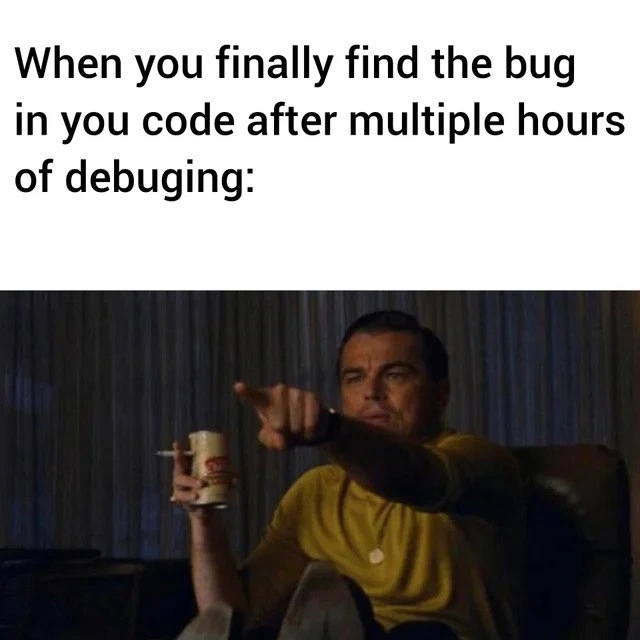
The image part of the meme – the bottom half – is a well-known reaction image of actor Leonardo DiCaprio pointing excitedly at a TV screen. It’s from a movie scene that has become a popular meme to represent the feeling of “Look! I recognize that!” or “There it is!”. In our context, it perfectly captures a developer’s reaction upon finally spotting the bug in their code. Imagine staring at your screen a long time, trying many things, and then suddenly a line of code or a value stands out and practically screams, “I’m wrong, fix me!” The developer (you) might literally lean forward and point at the screen, maybe even say aloud, “Found it!” That’s the exact pose Leonardo is doing – leaning in, holding his drink, finger pointing sharply as if to say “Ah-ha!”. The meme creator chose this image because it visually communicates the triumphant recognition. It’s an emotional reaction GIF in static form, showing excitement and relief.

Now, the top text of the meme has a couple of spelling mistakes – it says “you code” instead of “your code” and “debuging” instead of “debugging.” These typos are likely intentional, a little joke in themselves. In a meme about finding a bug (mistake), the text contains its own minor bugs. It’s a playful way to reinforce the theme: even a meme can have errors. For someone newer to programming, it also shows that nobody’s perfect, and small errors can creep in anywhere! In fact, in coding, a huge amount of debugging time is often spent on very tiny mistakes that are hard to spot. A missing letter or an extra space in code can sometimes break everything, and you have to hunt it down. So the typo in “debuging” kind of represents the kind of small oversight that can lead to hours of DebuggingAndTroubleshooting in real life. And when you do finally see it, it’s so obvious in hindsight.

To give a clearer picture of what those “hours of debugging” might involve: a developer will run the program and see it’s not working right. Then they’ll try to find where in the code it’s going wrong. This could involve using a debugger, which is a tool that lets you pause the program at a certain point (setting a breakpoint) and then step through the code line by line to inspect what’s happening. For example, you might check the value of variables at each step to see where it deviates from what you expect. Alternatively, many beginners (and even experienced devs) use print statements inserted into the code, like console.log("Reached here, x =", x) or print(f"Value of y: {y}"), to trace the program’s execution. It’s like leaving breadcrumbs to see which parts of the code run and what values are being handled. Over multiple hours, you might try different approaches: adding logs, reading error messages, Googling symptoms, maybe even rubber duck debugging (explaining your code line-by-line to a rubber duck or an inanimate object, which often helps you spot the issue yourself!). It can be tiring and a bit frustrating – hence tags like DebuggingPain or CodingFrustration often accompany discussions about debugging.

This meme lands as relatable humor because every programmer has been there: scratching their head for ages, thinking “Is it the database? Is it my logic? Is the server misconfigured?” and then finally facepalming when they see the real problem. For a junior dev, it’s important to know that this is normal. Debugging is a skill that improves with practice, but even veterans get stuck on tricky bugs. The key is persistence and systematic checking. And the payoff is that Eureka! feeling – exactly what the meme shows. You feel proud and relieved and maybe a bit silly that it took so long. In that moment, you might as well be a character in a movie having a big breakthrough, which is why the dramatic pointing Leonardo image is so funny and apt. It dramatizes what is usually an unseen, solitary victory.

Also worth noting is the meme format: This is a classic two-panel meme. The top panel (usually white background with bold black text) sets up the scenario, often phrased as “When you [something relatable]:”. The bottom panel is an image (often from a movie, TV, or a viral video) that conveys the emotional reaction. Developers use this format a lot to share experiences. It’s part of our tech meme culture to express complicated feelings (like frustration and joy) with simple image macros like this. In this case, the scenario is “multiple hours of debugging” and the reaction image is pure triumph. Even if someone doesn’t know the exact movie, the meaning comes through: that guy in the yellow shirt is us, developers, at the exact second we spot the bug in our code. He’s literally pointing at it on the screen, which is what it feels like we do internally.

In summary, this meme is explaining that special mix of frustration, persistence, and payoff that comes with debugging software. It makes a joke out of the emotional rollercoaster:

  • Hours of frustration: facepalms, “why is this happening?!” moments, maybe lots of coffee.
  • The sudden clue: something clicks, or you see an odd value or an error line that you hadn’t noticed.
  • Eureka moment: you find the bug – maybe a tiny typo or a forgotten step. You basically react like “Yes, I found it!”.
  • Celebration: possibly just you smiling at your screen, but internally it’s like fireworks.

The meme shows that final celebration. And because every coder has felt this, it’s instantly recognizable and funny. It’s a little celebratory nod to all those who wrestle with code: you’re not alone, we all do the pointing-at-the-screen victory when we finally fix that bug.

Level 3: Breakpoint Breakthrough

At the highest technical level, this meme taps into the universal debugging saga that even senior engineers know too well. It's depicting that cathartic moment when, after slogging through call stacks and combing logs for hours, the culprit line of code finally stands out – like a guilty line highlighted by your debugger’s breakpoint. The top caption sets the scene: “When you finally find the bug in you[r] code after multiple hours of debuging:” (typos and all). In true developer fashion, the meme text itself contains tiny bugs (misspelled "you" and "debuging"), a wink to the fact that no matter how careful you are, small mistakes slip through. This self-referential gag resonates with seasoned devs: a meme about a bug has a bug. It’s the kind of tongue-in-cheek detail you notice at 3 AM while fixing a production issue, chuckling darkly that the irony is so on point.

The image below the text is the famous Leonardo DiCaprio pointing at the TV reaction (a scene from Tarantino’s Once Upon a Time in Hollywood). In meme culture, Leonardo’s character (Rick Dalton) leans forward with a cigarette and beer, suddenly pointing in excited recognition at something on the screen. Here he embodies every developer’s “Aha! there it is!” epiphany. After enduring prolonged DebuggingFrustration and CodingPain, we practically leap in our chairs and point at the screen when that elusive bug finally reveals itself. It’s a moment of triumphant clarity: the variable that was null, the loop index off by one, or the missing return statement finally becomes glaringly obvious. In a complex codebase, finding such a bug feels like spotting Waldo on a chaotic page – once you see it, you can’t unsee it, and you wonder how it was ever hidden. The meme humorously captures this breakpoint breakthrough: the exact second a developer identifies the offending code after a marathon debugging session.

From a senior engineer’s perspective, the humor cuts deep because it satirizes the debugging journey that often starts with confidence and ends in desperation — until that sudden reversal. We’ve all chased a Heisenbug (a bug that vanishes when you try to investigate it) or groaned at a one-line fix that took all day to discover. The meme’s scenario is painfully familiar: maybe you spent the whole afternoon suspecting the database, blaming the framework, or questioning your sanity, only to find a typo in a config file or a <= instead of < in a loop. When you finally spot it, that surge of adrenaline and vindication is real. You might even talk to the code out loud.

Developer at 2 AM:GOTCHA! So it was index <= length causing the overflow!” (points at screen)

This reaction image nails that vibe perfectly. In the dull glow of a monitor in a dark room (like the dimly lit living room background behind Leonardo), a weary coder suddenly transforms into that pointing figure. It’s both hyperbolic and true-to-life. The emphatic pointing gesture mirrors the way a developer might physically jab a finger at the screen or holler to a coworker on a video call, “I found the bug!” It’s a mix of relief, triumph, and exasperation all at once. Every experienced dev has had that moment of developer euphoria after a grind of debugging – it’s practically a rite of passage in the DeveloperExperience_DX. The shared understanding that this moment is hard-earned is what makes the meme so RelatableHumor. We laugh because we’ve lived it. It’s a brief victory in the ongoing war against BugsInSoftware, and boy, does it feel satisfying when it happens.

On a meta level, the meme also highlights a couple of insider points about debugging culture. The fact that the caption has blatant typos could be an intentional joke by the meme creator – demonstrating that after hours of debugging (or perhaps due to bleary-eyed exhaustion) even a meme about code isn’t immune to mistakes. This is extra funny to devs because we often discover that the root cause of a bug is a similarly small oversight like a misspelled variable name or a off-by-one error. Additionally, the format itself – text on top describing a situation, and a pop-culture reaction image at the bottom – is a staple of TechMemes and online developer humor. It’s an instant setup and punchline. Here, the punchline isn’t a text joke but the image of a character excitedly pointing, which any programmer instantly associates with the feeling of finally isolating that bug. Essentially, the meme says without words: “Look! There it is! The bug!” – capturing in a single frame what normally is an invisible intellectual victory. This clever visual metaphor turns a niche DeveloperPainPoint (spending half a day on a bug) into a moment of comedy gold that unites programmers across languages and domains. After all, no matter if you code in Python, Java, or C, the exhilaration of conquering a pesky bug is a universal high-five moment among developers. And the senior folks know that while today’s bug was vanquished, tomorrow’s bug is lurking – but at least we’ll have another meme for that one too.

Description

A two-panel meme. The top panel has black text on a white background that reads, 'When you finally find the bug in you code after multiple hours of debugging:'. There is a typo in the text, using 'you' instead of 'your'. The bottom panel features a popular reaction image of actor Leonardo DiCaprio, as Rick Dalton in the film 'Once Upon a Time in Hollywood'. He is sitting in a chair, holding a drink and a cigarette, pointing assertively at something off-screen with a look of intense recognition and accusation. This meme perfectly captures the 'eureka!' moment for a developer. After a long and often frustrating process of troubleshooting, the instant of identifying the root cause of a bug feels like spotting a culprit in a lineup. For senior engineers, it’s a universally understood feeling of relief, triumph, and sometimes, a little bit of anger at the simplicity or absurdity of the bug that caused so much trouble

Comments

7
Anonymous ★ Top Pick The bug is never where you think it is. It's in that one line of code you were absolutely certain was correct, mocking you silently from the commit history
  1. Anonymous ★ Top Pick

    The bug is never where you think it is. It's in that one line of code you were absolutely certain was correct, mocking you silently from the commit history

  2. Anonymous

    Breakpoint 127: after four thread dumps, two heap analyses, and one existential crisis, you finally spot the unsynchronized static map from 2008 - cue the DiCaprio point as git blame highlights ‘vendor-sdk.jar’

  3. Anonymous

    After six hours of debugging distributed traces across seventeen microservices, you discover the root cause was a timezone conversion in a library that got silently updated three sprints ago - and suddenly you understand why the senior architect drinks

  4. Anonymous

    That sublime moment when you finally trace the production outage to a single missing semicolon in a 50,000-line monorepo - after ruling out distributed tracing anomalies, cache invalidation issues, and a suspected race condition in your message queue. You've earned that pointing gesture of vindication, even if the bug was introduced by your own 3 AM commit from last Tuesday

  5. Anonymous

    Finally found it: the debug log in the hot path that “fixed” the race - Schrödinger’s bug only reproduces when you stop observing it

  6. Anonymous

    Six hours wiring OpenTelemetry across nine services; root cause: prod was reading .env.example - rename, +1/-0, ship

  7. Anonymous

    After 12 hours tracing a monolith heisenbug, it's just a stale cache key from that one unversioned config - feels like slaying a dragon with a toothpick

Use J and K for navigation