Skip to content
DevMeme
3032 of 7435
The Great Binary Tree Pants Debate
CS Fundamentals Post #3347, on Jun 29, 2021 in TG

The Great Binary Tree Pants Debate

Why is this CS Fundamentals meme funny?

Level 1: If Trees Wore Pants

Imagine a tree trying to wear pants – it sounds silly, right? The joke here is asking how exactly the tree would do it if it could. One idea is that every place where the tree splits into two branches, the tree would put a tiny pair of pants on, covering those two little branches like legs. So it would have lots of little pants hanging all over it. The other idea is that the whole tree would just wear one gigantic pair of pants at the bottom, with the two biggest branches acting as the tree’s two legs. In other words, would the tree dress each pair of branches individually, or just cover its bottom two branches with one big pair of pants? It’s a funny mental image because trees don’t wear clothes at all – we’re treating a tree like a person for the sake of a goofy question. The humor comes from picturing this impossible scenario and deciding which looks more “logical” for a tree. It’s like asking, if a tree were a person, how would it put its pants on? There’s no real answer, of course; it just makes people laugh to think about something so absurd.

Level 2: Branching Outfits

Let’s break down what’s going on here. In computer science, a binary tree is a type of data structure where each element is called a node, and each node can link to up to two other nodes. Those two subordinate nodes are fittingly called its children (and the node is their parent). Typically, we draw a binary tree with the single top-most node as the root (at the top of the diagram) and the nodes at the very bottom with no children as leaves. Each connection between a parent and a child is an edge, often drawn as a line. So overall, a binary tree looks like an upside-down botanical tree or a family genealogy chart, branching downward in this case. It’s a foundational data structure you learn in CS classes (hence the CS_Fundamentals tag) and it shows up everywhere in algorithms.

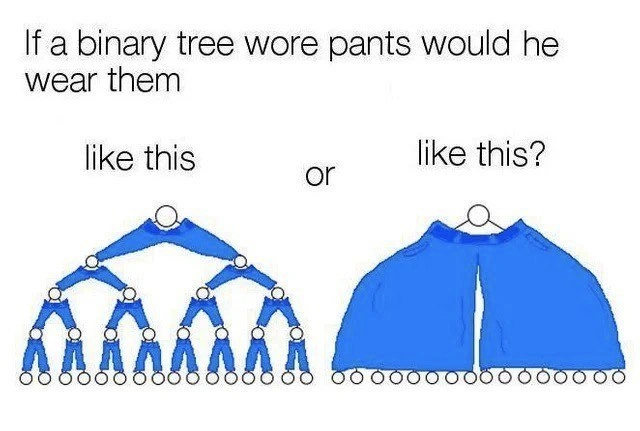
Now, this meme asks a ridiculous question: “If a binary tree wore pants, would it wear them like this or like this?” accompanied by two drawings. It's a parody of a famous internet question about a dog wearing pants. In that original meme, people debated whether a four-legged dog would wear pants on just its hind legs (covering two legs and the dog's rear end) or on all four legs (covering the entire lower half of the dog’s body). Here, the same format is applied to a binary tree diagram, which is a perfect candidate because a binary tree always has two branching parts at each split, much like a dog has four legs (or like a person has two legs).

In the left drawing, there are many small blue pants drawn on the tree. Specifically, every node that has two children has a tiny blue pair of pants straddling its two child branches. Picture each parent node acting like a little stick figure torso, with its left and right child branches as its "legs" that need covering. So the tree ends up with multiple pairs of pants, one for each branching point. By contrast, in the right drawing, there is only one enormous pair of blue pants at the very bottom of the tree. The pants span across the two large bottom sections of the tree, as if the entire tree has just two big legs total – the left subtree and the right subtree – and the root node at the top is the shared waist holding up this single pair of pants. This implies treating the whole tree as one being that only needs one pair of pants.

The humor comes from anthropomorphism – giving a non-human (in this case, a non-living abstract structure) human characteristics. We’re essentially asking, "Is a binary tree like a person with one body and two legs, or is it like a bunch of little persons stacked together?" It’s a visual gag playing on the tree’s topology (how the tree is shaped). Each fork in the tree looks a bit like a pair of legs branching out, so the question is whether every fork gets its own trousers or only the topmost fork does. For someone learning data structures, this meme is also a lighthearted way to revisit what a binary tree structure looks like. You can identify the root node (the hanger or belt area for the one big pant on the right, for example) and the child nodes (which serve as the “legs”). It’s definitely not a serious algorithm question – it’s pure tech humor for fun – but it creatively uses the properties of a binary tree (two children, hierarchical levels) in a joke format. And because binary trees are such a common example in textbooks, seeing one in a goofy context like this is both surprising and amusing. It shows that even basic CS concepts can be fodder for jokes in the developer community.

Also worth noting, this meme format ties into general developer humor by referencing that older dog pants meme (a piece of internet culture many people remember). Developers often remix popular memes with programming in-jokes. So here we have the straightforward question "like this or like this?" above two options, which is instantly recognizable as that meme template, but the subject is a binary tree – a nod to our niche ComputerScienceHumor. If you’re not familiar with binary trees or the original dog meme, the image might look confusing at first. But once you know the context, it’s a great example of how programmers can find something laugh-out-loud funny in the esoteric world of data structures. It’s essentially an inside joke that combines fundamental CS knowledge with a dash of absurdity.

Level 3: Bifurcated Britches

At first glance, this meme hilariously merges computer science fundamentals with a classic viral debate about animals wearing clothing. In place of a dog, we have a binary tree – a foundational data structure – and the question is how it would wear a pair of pants. For seasoned developers and CS enthusiasts, the humor hits on multiple levels. First, there's the sheer absurdity of anthropomorphizing an algorithmic structure: we’re taking something purely abstract (nodes and pointers in memory) and giving it human attire. This playful perspective is surprisingly common in developer humor – we often talk about processes "giving birth" to child processes or threads "dying," so why not a tree trying on some slacks? The meme format directly riffs on the classic "If a dog wore pants, would it wear them like this or like this?" question that stormed the internet. By substituting a binary tree (a rooted data structure) into the scenario, it pokes fun at how developers can apply human logic to even the most dry computer science concepts.

Digging deeper, the meme actually encodes a tiny debate about the topology of a tree structure. In the left illustration, every internal node of the tree sports its own miniature pair of pants across its two child branches. It's as if each node considers itself an individual with two “legs” (its left and right children) to cover. In the right illustration, the entire tree shares one gigantic pair of pants, treating the two main branches as the tree’s collective legs stemming from a single “waist” at the root. Seasoned devs recognize this as a tongue-in-cheek commentary on how we conceptualize a tree: either as one whole organism (the entire tree has a body) or as a recursive set of sub-organisms (each node is a little being). This mirrors the recursive nature of binary trees in theory – every node can be seen as the root of a subtree. If you think in recursive terms, of course each node might need pants! But if you think of the tree as one cohesive data structure, then only the top needs a single pair. This dual perspective is what makes the question so delightfully nerdy.

There’s also a sly nod to the fact that much of computer science terminology for trees is already anthropomorphic or organic. We talk about root nodes (like a tree’s root), child nodes, parent nodes, and leaves at the bottom – as if a data structure were a living family tree or a real tree growing upside-down. Experienced programmers instantly appreciate the irony: we’ve always described data structures in human or natural terms, so why stop at family relationships? Let’s give them clothing too! The tree topology (the shape and structure of connections) naturally lends itself to this gag: a binary tree always splits into two, just like a pair of pant legs. The meme exaggerates this split visually. It’s the kind of harmless, nerdy debate developers might have after spending all day debugging – a bit of surreal comic relief. In a way, it also highlights a common quirk in the developer community: we love taking a trivial or fantastical question (how would a tree wear pants?) and applying strict logical reasoning or rules to it, as if solving a coding problem. The result is equal parts silly and intellectually satisfying.

Description

A popular tech meme that poses a humorous, philosophical question about data structures. The image has text at the top that reads, 'If a binary tree wore pants would he wear them like this or like this?'. Below the text are two illustrations. On the left, a diagram of a complete binary tree is shown where each parent node and its two children are linked by a small pair of blue pants, creating a recursive, nested pattern of pants down the hierarchy. On the right, the entire binary tree is enveloped in one single, giant pair of blue pants, with the root node at the waist and the two main branches forming the legs, covering all the leaf nodes at the bottom. This meme is a playful thought experiment that applies a mundane, human concept to an abstract computer science structure. The humor resonates with developers as it absurdly visualizes the tree's recursive and hierarchical nature, sparking a debate that's more about creative thinking than finding a correct answer

Comments

15
Anonymous ★ Top Pick The left is a microservices architecture with pants-as-a-service for each node, the right is the monolith. Both have terrible CI/CD pipelines for getting dressed
  1. Anonymous ★ Top Pick

    The left is a microservices architecture with pants-as-a-service for each node, the right is the monolith. Both have terrible CI/CD pipelines for getting dressed

  2. Anonymous

    Wardrobe design review: one pair at the root is the monolith - simple until the tree needs rebalancing; per-node pants are microservices - scalable, but now you’re debugging distributed tailors at 3 AM

  3. Anonymous

    The left approach has O(2^n) fabric complexity - perfect for when your tree needs pants but your memory allocation needs a therapist. Meanwhile, the right side is just breadth-first fashion with constant space complexity

  4. Anonymous

    This is the kind of existential question that keeps data structure professors up at night - right after they finish debugging their recursive tree traversal that somehow became O(n²). The real answer? Neither. A proper binary tree would obviously wear a self-balancing AVL suit with red-black accessories, because fashion, like good code, requires constant rebalancing to avoid looking lopsided

  5. Anonymous

    Left leg left child, right leg right - anything else is a degenerate case begging for rotation

  6. Anonymous

    Depends on your invariants: left is recursively well typed (pants(node) = trousers + pants(left) + pants(right)); right is a leaf-cut optimization that looks fine until you perform an AVL rotation and tear the seams

  7. Anonymous

    Binary tree pants go on the root - two legs for left/right; the leaf-wide jeans are just BFS denim with an O(n) waistband

  8. @karumsenjoyer 5y

    this meme is the same age as the channel admin

    1. @kehlerr 5y

      12?

    2. @nuntikov 5y

      25?

      1. @Dobreposhka 5y

        admin is 7 yo btw

    3. @yoyatayo 5y

      Embryo?

  9. @mmddvg 5y

    i don't think it would be appropriate for these many children to share the same pant

  10. @fffff80240d322f9 5y

    He? That's a brave statement in 2021 lol

  11. @Dexconv 5y

    Do you wear different pairs of pants on every joint of your body? Obviously right

Use J and K for navigation