Skip to content
DevMeme
890 of 7435
A Computer Scientist's Unfiltered Christmas Observations
CS Fundamentals Post #1007, on Jan 29, 2020 in TG

A Computer Scientist's Unfiltered Christmas Observations

Why is this CS Fundamentals meme funny?

Level 1: Nerdy Christmas Joke

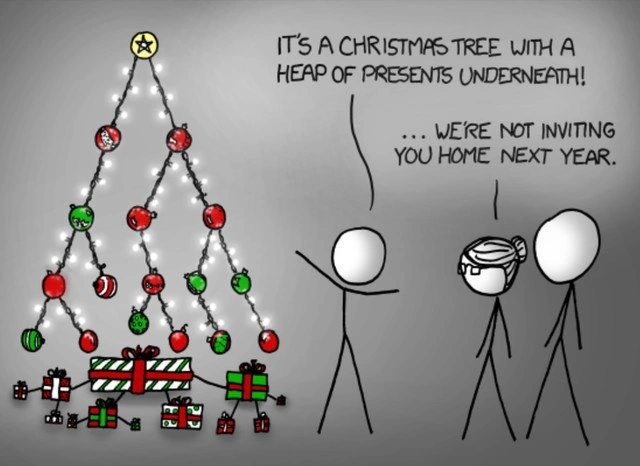
This meme is showing a simple holiday scene that got turned into a nerdy joke. One person sees a Christmas tree with a big pile of gifts under it and excitedly says it’s a tree with a “heap” of presents. They’re using the word “heap” in a cheeky way. Normally, heap just means a big pile (and there really is a big pile of gifts there!). But this person also learned that Heap is the name of a special thing in computers – a way to organize data, kind of like how you might stack things in a certain order. So they made a pun, mixing the normal idea of a heap of gifts with the computer idea of a Heap. It’s as if they have this secret double meaning that only they and other computer folks can see. The second person in the picture isn’t amused and says, “We’re not inviting you home next year.” That’s a joking way of saying, “That was such a bad nerd joke, we don’t want to hear more of those!” So basically, the first person is super excited about a clever computer-science pun, and everyone else is just rolling their eyes because they don’t get it (or if they do get it, they think it’s silly). It’s funny because it shows how people who are really into something (like computers) can find connections and make jokes about it everywhere – even under a Christmas tree – and how those jokes sometimes make the rest of the family say, “Oh no, not again!” In other words, a regular Christmas scene turned into a geeky joke, and the humor comes from the difference between how the nerd sees it and how everyone else does.

Level 2: Unwrapping the Joke

Let’s unwrap why this meme is funny by explaining the pieces. It’s a classic play on computer science terms from the world of DataStructures. The Christmas tree in the picture isn’t just a tree – it’s drawn to look like a binary tree, one of the fundamental structures you learn in computer science. In a binary tree, each element (called a node) can have up to two other elements connected below it (these are the children nodes). The very top node is called the root, and nodes with no children are called leaves. If you’ve seen a family tree or an organization chart, you get the idea: there’s one person at the top, and each person can branch out to a couple of people below them, and so on. In the drawing, the star at the top of the Christmas tree is like the root node, and each ornament below marks a branching point where the tree splits into two. The strings of lights act like the lines we draw between nodes to show the parent-child connections. So, essentially, the artist turned a normal Christmas tree into a little computer science diagram, with the decorations representing a BinaryTrees structure.

Now, what about the “heap” part with the presents? The word heap in everyday language just means a big pile of stuff – for example, you might say "I have a heap of laundry to do," meaning a large pile of clothes. And indeed, in the picture, there’s a heap (a big pile) of presents under the tree. That by itself is totally normal: people put lots of gifts under a Christmas tree, and you could casually describe that as a heap of presents. But here’s the twist: in computer science, a heap is also the name of a specific data structure. A heap (in CS) is typically implemented as a binary tree as well, but with a special rule called the heap property. This rule means each parent node in the tree is either greater than or equal to its children (that would be a max-heap, where the largest value is on top) or less than or equal to its children (a min-heap, where the smallest value is on top). The result is a tree where you always know the top element is the biggest or smallest of the bunch. For example, imagine you have some numbers and you organize them into a max-heap; if you look at the root of that heap, you’ll see the highest number of all. Heaps are super useful for things like priority queues (where you always want to quickly get the “highest priority” item) and for heap-sort algorithms. The main thing to remember is: heap = a kind of ordered tree structure in coding.

So the joke is all about that double meaning. When the first stick figure excitedly says, “It’s a Christmas tree with a heap of presents underneath!”, everyone else just hears a normal phrase: heap of presents = lots of presents. But fellow nerds hear an extra meaning: heap = that thing from coding class! The character is basically labeling the pile of gifts with a computer science term, as if those gifts are elements in a heap data structure. And since the Christmas tree is drawn like a binary tree, it sounds like he’s describing a technical scenario: a heap data structure under a tree data structure. It’s like he’s turned a sweet holiday image into a scene from a coding textbook. This is why the other character (the one with glasses) responds with a sarcastic, “We’re not inviting you home next year.” That line implies: “Your joke was way too nerdy; you’ve worn out our patience.” In other words, the family might be jokingly “banning” the punny person for making everything about computers again. It’s an exaggeration, meant to be funny, because in reality most families would just roll their eyes or laugh it off. But the meme pushes it further for comedic effect, showing the glasses-wearing character essentially disowning the joker for that cringey pun.

For a junior developer or someone just learning this stuff, the meme is basically saying: “See these computer concepts you’re studying? We find ways to joke about them in real life, even at Christmas!” It connects the abstract ideas from class to something tangible and silly. Binary trees and heaps are usually taught early in computer science, often with little node-and-arrow diagrams on the board. Here, those concepts escape the classroom: the binary tree is now a Christmas tree, and the heap is literally a pile of gifts. If you know the terms, the joke clicks instantly — you feel kind of proud for spotting it. If you don’t know them yet, the meme just looks like a goofy holiday picture with a weird caption. That’s why the second character’s annoyed reaction is part of the joke: it acknowledges that this kind of humor only works for people “in the know.” In sum, it’s a fun, nerdy pun that ties a seasonal dev joke into the real world. It teaches us that even something as simple as setting up a Christmas tree can remind a programmer of their code. And hey, once you learn about heaps and binary trees, you might catch yourself making similar jokes — just maybe choose your audience wisely unless you want to get disinvited from next year’s party! 🎁🎉

Level 3: Heap-y Holidays

This cartoon delivers pure CSFundamentals holiday humor by combining two classic data structures with a festive scene. The Christmas tree is literally drawn as a glowing binary tree diagram – a yellow star at the top serves as the root node, strings of white lights act like pointers connecting levels, and each red or green bauble sits at a branching point like a node in a tree. Beneath this structure is a neatly arranged pile of wrapped gifts, which our over-eager stick figure gleefully calls out as a “heap of presents.” Why is that funny? Because the word heap has a double meaning here: in everyday English it means a big pile (which is exactly what you see under any Christmas tree), but in computer science a heap is also a specific kind of binary tree. So this excited character sees a normal holiday scene and immediately interprets it in geek terms: a heap data structure sitting underneath a tree data structure. It’s a perfectly structured pun (pun intended) that blends Christmas cheer with algorithmic thinking. Experienced developers recognize this as a clever heap data structure pun that only those who know their BinaryTrees from their Santa trees will catch. It’s the kind of niche ComputerScienceHumor that makes you grin and groan at the same time.

What really sells the joke is the dialogue. The first stick figure is practically bouncing with nerdy excitement, shouting, “IT’S A CHRISTMAS TREE WITH A HEAP OF PRESENTS UNDERNEATH!” You can almost hear the pride in their voice as they spot this textbook reference in real life. The second stick figure (with glasses, playing the part of the long-suffering sibling or friend) replies, “...We’re not inviting you home next year.” Ouch! That deadpan comeback is hilariously relatable to any coder who’s tried slipping an algorithm joke into family dinner. It implies this seasonal dev joke was the final straw in a whole holiday of groan-worthy puns. The subtext: “Alright, we’ve had enough of your geekiness for one Christmas.” Of course, it’s exaggerated for effect – they’re not literally banishing the poor nerd – but it captures that classic scenario where a developer’s TechHumor doesn’t quite land with the non-tech crowd. Seasoned programmers reading this meme are nodding knowingly: we’ve all either been that person making the joke, or the one facepalming at a friend who did. The humor comes from shared experience: the clash between enthusiastic code speak and blank stares from family. The meme lets us laugh at that social disconnect, while also secretly feeling a bit proud that we get the joke.

On a deeper level, the image itself is an inside joke for developers. Notice how the tree’s shape is a perfect triangle of lights and ornaments – just like a complete binary tree with all its levels filled. In computer science, a binary heap (often used for priority queues and sorting algorithms) is typically implemented as a binary tree that is as balanced as possible, forming a nice triangular structure. The star at the top of the tree is essentially the root of the tree (the very first node). In a max-heap (a heap where the largest element is always on top), you’d find the biggest value at the root. Fittingly, the star is the “brightest” or most important ornament, sitting above all the others – just like a max-heap’s top node dominates the rest. The presents “underneath” could be seen as the lower levels of the tree (child nodes) or even as the heap stored in an array under the hood. It’s a fun visual analogy: the heap of gifts forms the base of the tree, much as a data-structure heap is conceptually under the root in a tree diagram. The artist basically turned a computer science diagram into a Christmas decoration, and any programmer can appreciate how spot-on that is. We spend so much time in code dealing with abstract trees and heaps that seeing one in the real world (with tinsel and lights!) is both surreal and satisfying.

There’s also a wink at how we name things in computing. We borrow a ton of terms from everyday language – trees, heaps, stacks, queues, etc. – and give them very specific technical meanings. That’s why these puns are possible in the first place. Here, the phrase “heap of presents” is something you might hear from any parent describing Christmas morning chaos, but to a coder it instantly evokes a mental image of heap algorithms and binary tree nodes. The meme plays on that dual meaning expertly. It reminds us of those early computer science classes where you first learned about a binary tree (maybe drawing nodes and pointers on a whiteboard) and a heap (maybe visualizing the array indices of a heap tree for a heapsort). It’s likely bringing back a bit of nerdy nostalgia – who knew those dry textbook diagrams could be turned into something so festive? For the experienced dev, the humor isn’t just the pun itself, but the recognition of “hey, I remember struggling with heaps and now it’s a Christmas joke!” There’s a sense of community in that laugh: only people who’ve wrangled with these concepts truly appreciate how delightfully silly this mashup is.

And let’s not forget the social dynamic captured here. The enthusiastic pun-maker is basically the archetype of the developer who can’t “turn off” their tech brain, even at a holiday party. We’ve all been there (or seen it): you’re standing around the Christmas tree, someone says “Look at all those presents,” and the coder in the room chimes in with a grin, “Actually, that’s a heap.” 🤓 Cue the collective groan. The other character’s snarky response – not inviting the punster next year – is an exaggeration that pokes fun at how extra these moments feel. It’s humor at the expense of our inability to resist a good (or bad) tech pun. Yet, secretly, we’re a little proud of that cleverness. The meme is basically giving a high-five to every programmer who’s made a joke about binary trees or sorting algorithms in regular life and gotten blank looks. It says, “We see you, we’ve been you, and yeah, that joke was terrible… ly awesome.” And if you chuckled at the phrase “heap of presents under the tree”, congratulations: you’re definitely one of us, and you’ve earned both the laugh and the eye-roll. In the end, the meme celebrates that intersection of coding and real life – where even a Christmas tree can set the stage for an inside joke about algorithms. (Time complexity of telling this joke to your family? Probably O(1) for you to say it, and O(n) groans from everyone else. Heap-y holidays indeed! 🎄)

Description

This is a classic XKCD comic by Randall Munroe, depicted in his signature stick-figure style against a grey, vignetted background. On the left, a Christmas tree is drawn not as a pine, but as a perfect binary tree data structure. A yellow star sits at the root node, and lines of Christmas lights connect red and green ornaments (nodes) down the levels. Underneath, presents of various sizes are arranged in a heap data structure, with parent nodes connected to children. A stick figure, presumably a computer scientist, waves excitedly, exclaiming, 'IT'S A CHRISTMAS TREE WITH A HEAP OF PRESENTS UNDERNEATH!'. To his right, two other stick figures, likely his unimpressed family, stand together. One of them says, '... WE'RE NOT INVITING YOU HOME NEXT YEAR.' The humor stems from the character's inability to switch off their analytical, CS-oriented brain, applying technical jargon to a traditional holiday scene, which completely alienates their non-technical family

Comments

7
Anonymous ★ Top Pick His family is just lucky he didn't try to optimize the gift distribution with a greedy algorithm
  1. Anonymous ★ Top Pick

    His family is just lucky he didn't try to optimize the gift distribution with a greedy algorithm

  2. Anonymous

    Built a min-heap of gifts under the binary Christmas tree so the kids can ExtractMin() in O(log n). Apparently labeling their presents with priority values violates the “holiday spirit” SLA

  3. Anonymous

    The real tragedy here isn't the social rejection - it's that they used a binary tree instead of a B+ tree for optimal present retrieval performance. And don't even get me started on the O(n log n) complexity of sorting those gifts by recipient

  4. Anonymous

    The real tragedy here isn't the social rejection - it's that they built a binary tree when the presents clearly needed a min-heap for optimal gift distribution. At least they maintained O(log n) height, though I suspect the balancing factor is going to be a problem once Aunt Susan adds her oversized gift boxes. And let's not even discuss the memory overhead of storing all those ornament pointers when a simple array-based representation would have sufficed

  5. Anonymous

    Told the family Santa uses a max‑heap priority queue - gift insertion is O(log n); my invite got garbage‑collected

  6. Anonymous

    When your heapify ruins the family tree - uninvited in O(1) time

  7. Anonymous

    Holiday architecture: a complete binary tree with a star at the root and a heap of wrapped exceptions underneath; gift retrieval is O(log n), family comprehension is O(n^2)

Use J and K for navigation