Engineer's Dress Code: Ready for a Different Kind of Scrum
Why is this CorporateCulture meme funny?
Level 1: Feeling Out of Place
Imagine you go to school on a day when everyone is supposed to wear their uniform or nice clothes for class pictures, but you didn’t know that. You walk into class wearing your favorite superhero costume – cape, mask, and all! Can you picture how much you’d stick out? You’d probably feel pretty awkward because you’re not dressed like anyone else. That’s what’s happening in this picture (just with adults at work). One person is dressed completely differently from everyone around them, so it’s super obvious he’s not fitting in with the group. It’s funny to see, because we all know that “uh-oh” feeling of suddenly realizing you’re the odd one out. The meme makes us laugh at that situation without anyone actually getting hurt – except maybe someone’s pride!
Level 2: The Odd Engineer Out
In a product meeting, the team talks about what features to build next, what the timeline looks like, and how those features might make customers happy or bring in revenue. Usually, the people leading this discussion are product managers – folks focused on the product’s success from a business point of view. They’re often nicknamed "the suits" because, especially in more traditional companies, they might literally wear suits and ties (plus it symbolizes that they represent the business side).
Now imagine you’re an engineer invited to one of these meetings. Engineers usually come at things differently – we’re focused on how to actually build those features, what could go wrong in the code, and how long things realistically take to implement. We also tend to dress pretty casually (t-shirts, jeans, hoodies), since our daily work doesn’t require formal attire. So if you walk into a meeting where everyone else is in a dark suit and you’re rocking a Star Wars tee and sneakers, you’re going to feel a bit out of place. In the meme, the engineer is literally wearing a bright hockey jersey among suits to highlight this: he doesn’t fit the dress code at all, just like his technical mindset might not fit with the business talk going on around him.
This difference often leads to a communication gap. The product folks might speak in terms of user needs, deadlines, and business goals. They’ll use buzzwords and marketing terms like “synergy” (working smoothly together) or “growth hacking” (clever tricks to quickly gain users). The engineer, on the other hand, talks about things like technical limitations and development effort. We use terms such as “refactoring” (rewriting or cleaning up code), “scalability issues” (worries about whether the system can handle more users or data), or “tech debt” (technical debt – the extra work you’ll create later by taking coding shortcuts now). It’s almost like two different languages in the same room. If nobody tries to translate, the product side might not get why an idea that sounds simple is actually hard to build, and the engineer might feel frustrated that their warnings are met with blank stares.
If you’re a junior developer, don’t be surprised if you experience this. It’s the classic management vs. engineering situation. You could be the only coder in a room of marketing, sales, or product strategy people. It might feel intimidating or even isolating at first. You might think, “Uh oh, do I belong here? Do they all think I’m being difficult?” But remember: you were invited for a reason. You provide the reality check about what can be done and how. While the business side might push for more features fast (because they have pressure from clients or upper management), you’re there to explain what’s actually involved in building those features well. Over time, you’ll get more comfortable speaking a bit of “business,” and they’ll get better at understanding the tech basics. The meme exaggerates the scenario (in real life, no one’s literally wearing a hockey uniform to a meeting!), but it perfectly captures that feeling. It’s basically saying, “Being an engineer in a business meeting can make you feel like you showed up to the wrong party.” And sooner or later, every developer learns exactly what that means.
Level 3: Uniform Code Violation
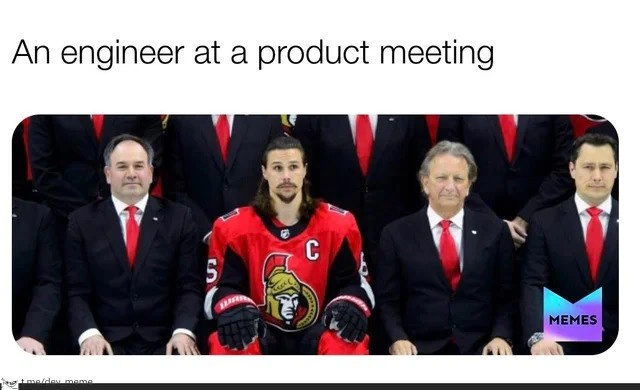
In a high-level product strategy meeting, one engineer sits among a flock of product managers and executives – the proverbial lone coder in a sea of suits. The meme’s image encapsulates this perfectly: an engineer decked out in a bright Ottawa Senators hockey jersey (complete with a captain’s "C" and the number 65) is surrounded by men in identical dark business suits with red ties. This exaggerated contrast is a visual punchline about developer culture versus corporate culture. And oh boy, every seasoned techie has been there.
Dress Code & Culture Clash: The suits all look cloned in their formal attire, symbolizing the polished, uniform front of the business side. Meanwhile, the engineer’s flamboyant jersey screams individuality and comfort. It’s a corporate camouflage fail – much like a developer who shows up to a formal meeting in a Marvel t-shirt or hoodie. The attire mismatch is comedic shorthand for deeper differences: the engineering team tends to value authenticity and practicality (code and comfort over formality), while the business side often adheres to professional norms and optics. This is developer humor at its finest: pointing out how out-of-place a coder can feel in the buttoned-up world of product strategy.
Communication Gap: Beyond clothes, the meme highlights a classic communication gap in cross-functional meetings. Picture the conversation: the product folks are excitedly dropping terms like "market penetration," "OKRs," and "user engagement," expecting enthusiastic nods. The engineer, however, is mentally parsing how on earth those big ideas translate into
API callsandsprints. It’s a meeting humor scenario where both sides are speaking different languages. The business side talks in KPI-infused PowerPoint slides; the engineer talks in technical realities, constraints, and edge-case scenarios. So the poor engineer often ends up feeling like that hockey player in a boardroom – visibly and mentally out of place.Misaligned Expectations: This one-against-many setup is fertile ground for misaligned expectations. The product side might be unanimously optimistic about launching five new features by Q4 ("It’s just adding buttons, how hard can it be?"). The engineer, the sole voice of tech, knows those “simple” features could involve refactoring half the codebase or scaling the database. Surrounded by non-technical stakeholders, they struggle to inject a dose of reality. If you've ever heard an engineer in such a meeting say, "Well, technically...", you know they’re about to gently torpedo an overly rosy plan. The humor (tinged with pain) comes from how predictably this plays out: everyone else nods along with big ideas while the engineer debates whether to bring up the technical debt issue now or save it for the hallway chat later.
Real-World Relatability: The reason developers are cackling at this meme is because it’s too real. We’ve all been that token techie at a meeting of MBAs, feeling like a Martian in a corporate boardroom. Maybe it was that planning session where everyone was eager to implement the latest buzzword ("Let's blockchain it!") and you were the only one grimacing. Or that time sales promised a client an absurdly unrealistic feature and you had to explain (to a room of confused faces) why it simply couldn’t happen by Friday. It’s uncomfortable in the moment, sure, but later it makes for great war stories over coffee with fellow developers. This joke taps into our shared developer culture experience: swapping tales of being misunderstood or outnumbered by the business side. The meme nails that feeling with one perfect, ridiculous photo.
"Management vs Engineering" Dynamic: Notice how all the suits in the photo share the same posture and attire, as if they’re aligned on a single mission. They even match the engineer’s jersey in color (all that red!), yet he still doesn’t blend in. That visual says a lot about how management and engineering can be on the same team officially, but still feel worlds apart. The lone engineer often has to act as a translator, turning lofty product requests into technical tasks and pushing back when the laws of software (or physics) won’t cooperate with marketing’s dreams. The suits might see the engineer as a naysayer, while the engineer sees the suits as detached from the gritty reality of implementation. This culture mismatch is both hilarious and painfully true. As a battle-scarred dev might joke, it’s a case of “same company, different planets.”
In short, the meme is a spot-on satire of being the odd one out in a meeting — not just in outfit, but in mindset. It’s funny because any engineer who’s had to defend a realistic timeline to a room of “ASAP, please” execs has lived this scenario. The guy in the hockey jersey isn’t just a dress-code rebel; he’s every developer who ever realized mid-meeting that no one else in the room speaks Git. And that epiphany stands out about as much as a bright red jersey in a boardroom full of suits.
Description
A meme with the caption 'An engineer at a product meeting'. The image below is a group photograph, featuring several men in formal black suits with red ties, presumably executives or management. Seated prominently in the center of this group is a professional hockey player, Erik Karlsson, wearing his full Ottawa Senators jersey, complete with shoulder pads and gloves. His casual, athletic attire and intense gaze create a stark, humorous contrast with the corporate environment of the others. The joke satirizes the cultural gap between engineers and product/business teams, particularly the often more relaxed and functional dress code of developers compared to the formal attire in corporate meetings. It plays on the stereotype of engineers being outsiders in business-centric discussions, dressed for a different kind of 'action'
Comments
7Comment deleted
The product team is discussing synergistic roadmaps, while the engineer is just wondering if this meeting will be over before his IDE finishes indexing
I show up to the roadmap review in full hockey gear because every “quick UX tweak” from product turns into sudden-death overtime against 15 years of legacy code
Everyone else is discussing synergies and KPIs while you're just trying to explain why we can't "just add blockchain" to fix the legacy monolith that's held together by a Perl script nobody understands anymore
This perfectly captures that moment when you're the only engineer in a product prioritization meeting, trying to explain why 'just add AI to it' isn't a two-week sprint while everyone else is already planning the press release. You're suited up for technical battle - ready to discuss system architecture, scalability constraints, and technical debt - while the room wants to debate whether the button should be 'sky blue' or 'ocean blue' and why we can't ship all 47 features by next Tuesday
At roadmap review, PMs bring OKRs; I bring pads - every 'tiny tweak' becomes full-contact scope creep and I’m still on-call for the SLO
PMs pitching hockey-stick growth; engineer in jersey knows it'll flatline like a prod deploy gone wrong
At the product meeting, the C on my jersey stands for “Consistency”; the suits keep reading it as “Committed by Q4.”