Skip to content
DevMeme
104 of 7435
Dev vs. Ops Poetry Slam: The Blame Game
DevOps SRE Post #134, on Feb 15, 2019 in TG

Dev vs. Ops Poetry Slam: The Blame Game

Why is this DevOps SRE meme funny?

Level 1: It Wasn't Me

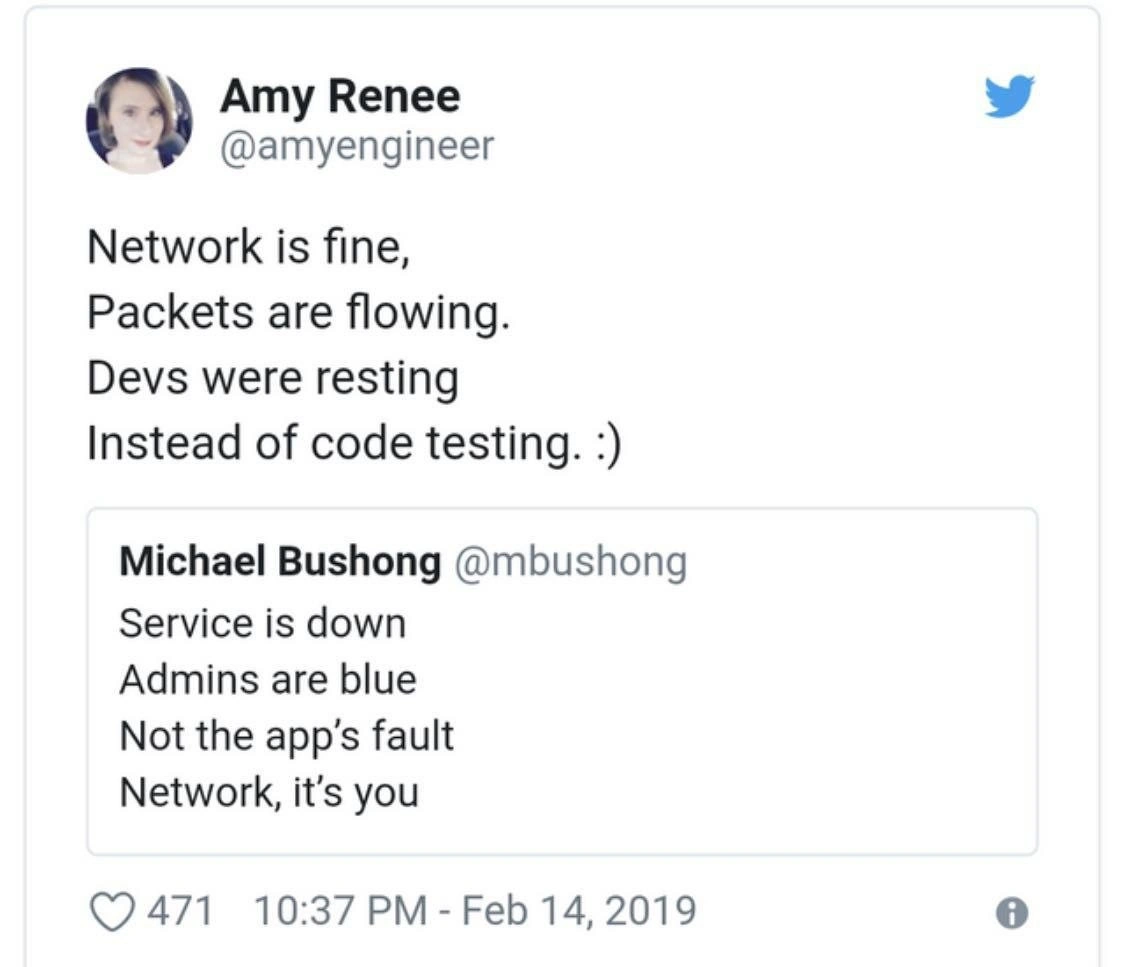
The website broke, and two people wrote little rhyming poems blaming each other — like two kids standing next to a broken vase, each pointing at the other in song. The first poem says "it's not my toy that broke it, it's the hallway it rolled through." The second poem answers "the hallway is fine, sweetie — you just never checked if your toy worked. :)" It's funny because grown-up engineers really do argue exactly like this whenever something breaks, and the smiley face at the end is the politest possible way of saying this is completely your fault.

Level 2: Packets, Blame, and the Missing Tests

The technical vocabulary of the feud:

  • The network — the infrastructure (routers, switches, firewalls, DNS) carrying data between machines. To app developers it's an abstraction that occasionally betrays them; to network engineers it's a precision instrument slandered daily.
  • Packets — data travels chopped into small chunks called packets. "Packets are flowing" means the network's job — delivery — is demonstrably happening, so any failure must be in what the applications do with those packets.
  • Admins are blue — the sysadmins/ops folks paged when the service died. They're "blue" both for the rhyme and because they're the ones awake.
  • Code testing — Amy's counter-accusation. Untested code is the classic actual root cause hiding behind "must be the network": the deploy that worked on the dev's machine, the unhandled timeout, the connection pool nobody sized.

The early-career lesson encoded here: when your service can't reach something, the network is the first thing you'll suspect and the last thing it usually is. The professional move — which both poems skip, that's the joke — is to bring evidence before blame: check whether you can reach the dependency (curl, ping, traceroute), check your own logs, then open the ticket. The ticket you write after checking gets answered with help. The ticket that just says "network's broken" gets answered with a poem and a smiley.

Level 3: The Blame Game, in Verse

Two professional tribes, one Valentine's Day, four lines each. Michael Bushong (@mbushong) opens with the application team's oldest hymn, dressed as a roses-are-red poem:

Service is down Admins are blue Not the app's fault Network, it's you

And Amy Renee (@amyengineer) — handle doing exactly what it says — quote-tweets the network team's equally ancient response:

Network is fine, Packets are flowing. Devs were resting Instead of code testing. :)

This exchange is a complete incident postmortem compressed into greeting-card meter, and it's funny because both poems are load-bearing clichés. "Blame the network" is the application developer's first-line defense for a reason: the network is the one dependency that's invisible, owned by another team, and historically flaky enough to be plausible. It's the corporate descendant of "it's always DNS." Meanwhile, "the packets are flowing" is the network engineer's canonical exoneration — the interface counters are clean, the pings return, latency graphs are flat, therefore the problem lives above layer 4, in your code, with your missing tests. The smiley at the end of Amy's poem is the most passive-aggressive single character on the internet; every ops engineer who has ever attached a screenshot of a green dashboard to a blame-y ticket knows that :) intimately.

The structural truth underneath: this war exists because organizational boundaries are drawn along the OSI stack. The app team can't see the switches; the network team can't see the stack traces. When a service dies, each side has perfect visibility into its own innocence and zero visibility into the other's guilt, so blame flows along the path of least observability. The whole modern reliability movement — distributed tracing, blameless postmortems, putting devs and ops in one on-call rotation under the DevOps flag — is essentially an attempt to make this poem battle impossible to have. It mostly hasn't worked, because the incentive remains: whoever's component is blamed owns the 2 AM fix.

The Valentine's framing (the tweet is stamped Feb 14, 2019) is the perfect bow on it: the dev/ops relationship really is a marriage — long-term, codependent, conducted largely through terse messages, and at its most poetic exactly when assigning fault.

Description

A screenshot of a Twitter conversation where two tech professionals write short poems to blame each other for a service outage. The first tweet, from Michael Bushong (@mbushong), is a quatrain that reads: "Service is down, Admins are blue, Not the app's fault, Network, it's you," which squarely blames the network infrastructure. The reply tweet from Amy Renee (@amyengineer) counters with her own poem: "Network is fine, Packets are flowing. Devs were resting, Instead of code testing. :)". This interaction humorously captures the classic finger-pointing and tribalism that often occurs between development and operations/sysadmin teams during production incidents. The joke resonates with anyone who has been in a war room, trying to identify the root cause of a failure while different teams defend their domains

Comments

8
Anonymous ★ Top Pick The quickest way to get developers and network admins to agree on something is to suggest the problem might be DNS
  1. Anonymous ★ Top Pick

    The quickest way to get developers and network admins to agree on something is to suggest the problem might be DNS

  2. Anonymous

    Blameless RCA bingo: network claims “packets pristine,” devs counter “CI all green,” SRE circles “transient DNS anomaly,” and we all silently raise the retry budget again

  3. Anonymous

    The best part of any production incident is watching two teams prove the other is at fault using completely different observability stacks that both show everything is working perfectly

  4. Anonymous

    Incident retro haiku: it's not DNS / there's no way it's DNS / fine, the devs skipped tests - somehow that's still the network team's pager

  5. Anonymous

    Ah yes, the eternal dance of distributed systems troubleshooting: developers insist their code is perfect and packets are flowing, while network admins point to clean tcpdumps and blame application logic. The truth? It's usually a race condition in a microservice that only manifests under production load, triggered by a subtle MTU mismatch that neither team thought to check. But sure, let's write poetry about it instead of implementing proper observability and distributed tracing

  6. Anonymous

    Blameless postmortem: network was innocent; our L7 retries without jitter turned a transient blip into a self‑DDoS

  7. Anonymous

    If packets flow and the service doesn’t, congratulations - you’ve built a distributed system where the only reliable transport is blame

  8. Anonymous

    Classic outage choreography: Devs pirouette around untested code, while neteng spotlights the app's CAP theorem surrender

Use J and K for navigation