Skip to content
DevMeme
6402 of 7435
The Oracle of Redmond on AI's Next Leap
AI ML Post #7019, on Aug 11, 2025 in TG

The Oracle of Redmond on AI's Next Leap

Why is this AI ML meme funny?

Level 1: Just an Upgrade, Not Magic

Imagine you have a really cool toy robot that can do a bunch of tricks. Now, a new version of this robot is going to come out. All the kids on the playground start saying, “This new robot will be so amazing, it’ll basically be alive and do all our homework!” They’re talking about it like it’s a superhero from a story. But then your wise grandparent, who’s seen lots of toys come and go, says, “It’ll probably just be a little better than the one you have, don’t count on it being able to clean your room.” In this scenario, the kids are treating the new robot like a magical hero (just like people hyping up GPT-5 as a kind of tech messiah), and the grandparent is being realistic (like Bill Gates saying the next AI model will only be a bit better). The meme is funny because it’s as if someone took a serious news quote saying “the new robot won’t be much better” and put it next to a scene from a fantasy movie where everyone is waiting for a promised hero. It’s a jokey way to say: sometimes we get over-excited about new things, imagining a miracle, when really it’s just an upgrade – cool, but not magical.

Level 2: Hype vs Reality in AI

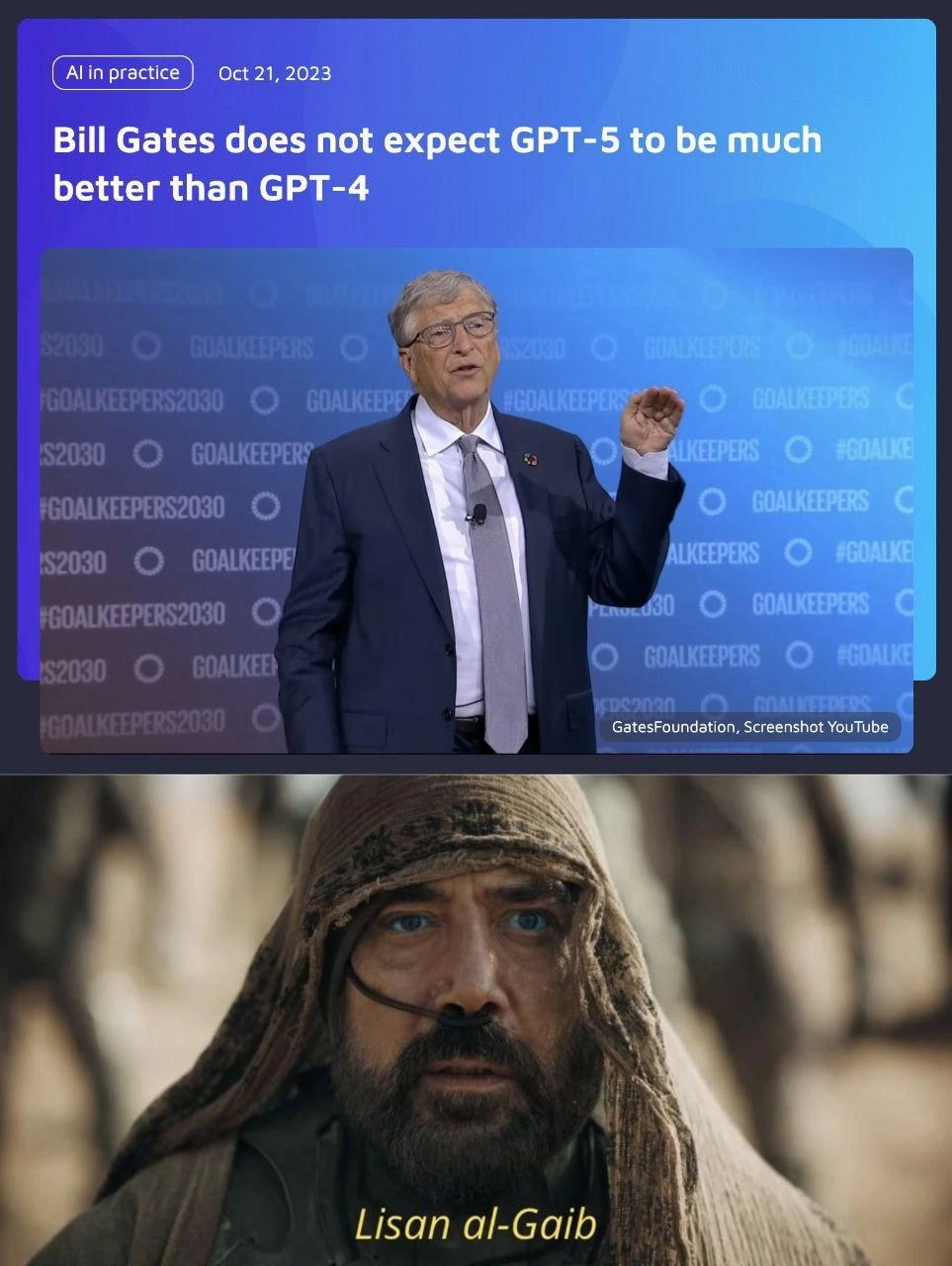
Let’s break down the meme’s references in simpler terms. The top panel shows Bill Gates (Microsoft’s co-founder, famous tech veteran) speaking at a conference (you can see the Goalkeepers event backdrop). The headline reads, “Bill Gates does not expect GPT-5 to be much better than GPT-4.” GPT-4 is a large language model – the AI system behind things like ChatGPT – known for its ability to generate text and answer questions. So, GPT-5 would be the next version of this AI model. Gates is basically saying: “I don’t think the next version (GPT-5) will be dramatically better than the current one (GPT-4).” That sets a realistic, low-key expectation. Now, contrast that with the bottom panel: a scene from Dune (a famous science fiction novel and movie). In Dune, the desert people (Fremen) have a prophecy about a messiah-like figure who will come from outside and lead them to freedom. They call this figure “Lisan al-Gaib,” which roughly means “outsider prophet” or “voice from another world.” The image shows a Fremen character with the subtitle “Lisan al-Gaib,” implying he’s recognizing someone as that long-foretold savior. How does this relate to AI? Well, in the tech world, especially in AI and machine learning, there’s often a ton of hype (excitement and big claims) around new breakthroughs. Some people (including excited engineers and product folks) talk about GPT-5 as if it’s going to be unbelievably transformative – almost like a mythical hero arriving. They expect it to solve all the hard problems that GPT-4 still can’t, perhaps even reaching AGI (Artificial General Intelligence), which is AI that’s as generally smart as a human. This is the “messianic expectation” the meme mentions – basically treating GPT-5 like a prophesied savior of tech. On the other hand, Bill Gates’s comment is the voice of experience and caution: he’s indicating we might only see a small improvement, a reality check. So the meme humorously pairs a tech news snippet (with a sober prediction) against an epic sci-fi reference (with almost religious undertones) to highlight the gap between practical expectations and hyped-up fantasies. It speaks to a common pattern in industry trends: we often go through a hype cycle – at first everyone has sky-high hopes for a new technology (the peak of inflated expectations), and then reality sets in with a more modest outcome. Developers familiar with this cycle will recognize the irony: the latest AI isn’t magic, but people hype it up like it’s legendary. By using the Dune “Lisan al-Gaib” scene, the meme implies that some in the tech community are behaving like the Fremen, eagerly awaiting a foretold hero (GPT-5), while veterans like Gates play the role of the pragmatist saying “let’s stay realistic.” In short, it’s comparing AI hype vs. reality in a nerdy, clever way – grounding our wild hopes for the next big model back to Earth.

Level 3: Not Our First False Prophet

Veteran developers can’t help but smirk at this juxtaposition. On the top, Bill Gates – an industry elder statesman – cautiously downplays the next big AI model. Below, a desert nomad from Dune stares out, captioned “Lisan al-Gaib” (meaning The Voice from the Outer World, a messianic figure). Why is this funny? Because it nails a classic AI hype vs reality scenario. We have a measured, data-driven prediction on one side, and almost religious fervor on the other. Seasoned AI practitioners have seen this pattern before: grand predictions of a tech messiah that will change everything, followed by the sobering reality of incremental improvements. The meme mirrors countless cycle-of-hype stories in tech. Bill Gates’s quote (from Oct 2023 on that Goalkeepers 2030 stage) is a calm reality check – essentially saying “Don’t expect miracles from GPT-5.” But many engineers and product managers can’t resist treating each new model like the chosen one. It’s reminiscent of all those times a new framework or algorithm was hailed as the savior: from chatbots to blockchain, some folks always proclaim the next big thing as if it were prophecy. Here GPT-5 is being anointed Lisan al-Gaib, the Fremen’s prophesied outsider savior in Dune lore, highlighting how absurdly high expectations have become. The humor bites especially for AI_ML insiders who recall past busts — the “AI winter” after 80s expert systems hype, or how IBM Watson was supposed to revolutionize healthcare (spoiler: it didn’t). The meme’s two panels capture a friction: Gates’s grounded forecast versus the quasi-mystical hopes pinned on new tech. It satirizes our industry’s tech prophecy habit. We want each generation of AI to be a leap to Artificial General Intelligence (that mythical human-level AI), but veterans know that progress is usually incremental. The Dune reference underscores how some treat GPT-5 like a fated liberator of all our coding woes, while the battle-scarred devs recall every “messiah” that turned out to be a mild upgrade. It’s a wink to those who’ve been through the hype cycle wringer: this isn’t our first false prophet, and it won’t be the last. The meme is basically an industry in-joke saying, “Sure, AI hype is fun, but let’s not drink the sandworm Kool-Aid just yet.”

Level 4: Myth vs Math

At the highest technical tier, this meme pokes at the diminishing returns in modern AI scaling. Seasoned ML engineers recognize an almost asymptotic trend: as we crank up model size from GPT-4 to an anticipated GPT-5, performance gains tend to plateau rather than skyrocket. This reflects known research on scaling laws in deep learning – early on, bigger models yield impressive leaps, but eventually improvements shrink to a trickle (an S-curve of model capability). Bill Gates’s tempered forecast (“GPT-5 won’t be much better than GPT-4”) hints at this model capability plateau. It’s as if the math underlying large language models imposes natural limits unless a fundamentally new breakthrough occurs. Each additional billion parameters or trillion training tokens might only eke out marginal boosts in accuracy or coherence. In practical terms, the compute and data required to noticeably surpass GPT-4 could rise exponentially, while real-world returns inch forward linearly – classic diminishing returns. This isn’t mere pessimism; it’s grounded in the gritty physics of silicon and the economics of model training. We’re nearing the edge of what current transformer architectures and available data can deliver within reasonable cost. In other words, the mythical expectations for GPT-5 as an AI messiah collide with the cold, hard math of scaling constraints. The humor emerges from that tension: the code and calculus under the hood don’t care about prophecies. They obey only equations, budgets, and limits – a reality-check to any grandiose tech prophecies of unlimited AI progress.

Description

A two-panel meme contrasting a tech prediction with a reverent pop culture reaction. The top panel features a screenshot of an online article with the headline: 'Bill Gates does not expect GPT-5 to be much better than GPT-4'. The image shows Bill Gates speaking at a 'GOALKEEPERS 2030' event. The bottom panel is a still frame of the character Stilgar from the movie 'Dune', looking on with a serious and awe-filled expression. The subtitle reads 'Lisan al-Gaib'. The humor is derived from applying the 'Lisan al-Gaib' (a messianic prophecy from the Dune universe) to a statement from Bill Gates. It satirizes the way the tech community often treats the pronouncements of industry titans as infallible prophecies, humorously elevating a prediction about incremental AI improvement to the status of a divine revelation
Comments

9
Anonymous ★ Top Pick The community treats this like a prophecy, but senior engineers know it's just the architect's way of saying the tech debt from GPT-4 will take at least two versions to pay down
  1. Anonymous ★ Top Pick

    The community treats this like a prophecy, but senior engineers know it's just the architect's way of saying the tech debt from GPT-4 will take at least two versions to pay down

  2. Anonymous

    Even if GPT-5 only bumps the BLEU score by 3%, some VP will still declare it the ‘Lisan-al-Gaib’ destined to auto-refactor our 20-year-old COBOL - right after freezing the AI budget

  3. Anonymous

    After spending billions on Azure OpenAI infrastructure, Gates discovers the real scaling law: each GPT version delivers logarithmically diminishing improvements while exponentially increasing the compute bill - truly the Kwisatz Haderach of technical debt

  4. Anonymous

    When Bill Gates suggests GPT-5 won't be a revolutionary leap, developers respond with Dune references - because apparently we've moved from 'move fast and break things' to 'the spice must flow, but only incrementally.' It's the classic tension between the hype cycle's exponential promises and the sigmoid reality curve that every senior engineer has seen play out across frameworks, architectures, and now transformer models. We've been through enough 'next big things' to know that sometimes the most disruptive prediction is simply 'it'll be marginally better' - which, ironically, might be the most honest take in an industry built on 10x claims

  5. Anonymous

    Turns out the LLM messiah was Lisan al‑GAIB: Generally Acceptable Incremental Benefits

  6. Anonymous

    Scaling laws hit diminishing returns; the only thing compounding is the cloud bill - cue marketing to rebrand prompt templates as Lisan-as-a-Service and call it GPT-5

  7. Anonymous

    Bill Gates as goal keeper: blocking GPT-5 hype before it scores, because scaling laws eventually face diminishing returns like every enterprise forecast

  8. @a_646_man 11mo

    640K ought to be enough for anybody 🌚

  9. @zherud 10mo

    I mean... Does anyone though? I would argue however that even being not worse is good enough

Use J and K for navigation