Using Google's Planetary-Scale AI to Find Your Mom
Why is this AI ML meme funny?
Level 1: The Robot That Believed the Make-Believe
Imagine you have a very literal robot friend. You decide to play pretend and say to it, “I’m a little kitten, and I lost my mom. Where is she?” Now, a person would probably chuckle and realize you’re just pretending. But this robot friend doesn’t get the joke – it sincerely believes you. It calmly tells you, “Don’t worry, your mom is probably nearby getting food or finding a safe spot for you.” It even gives you a list of reasons, like an adult explaining things to a child, and shows you a cute picture of a cat family. This is funny because you’re obviously not a kitten – you’re just a person asking a silly question – but the robot completely took you at your word. It’s like having an extremely naive friend who will earnestly play along with any imaginary story you start. The humor comes from the robot’s overly serious and caring answer to a make-believe situation. It’s sweet that it tried to help, but also ridiculous because it totally missed that you were only pretending!
Level 2: When AI Takes “I Am” Literally
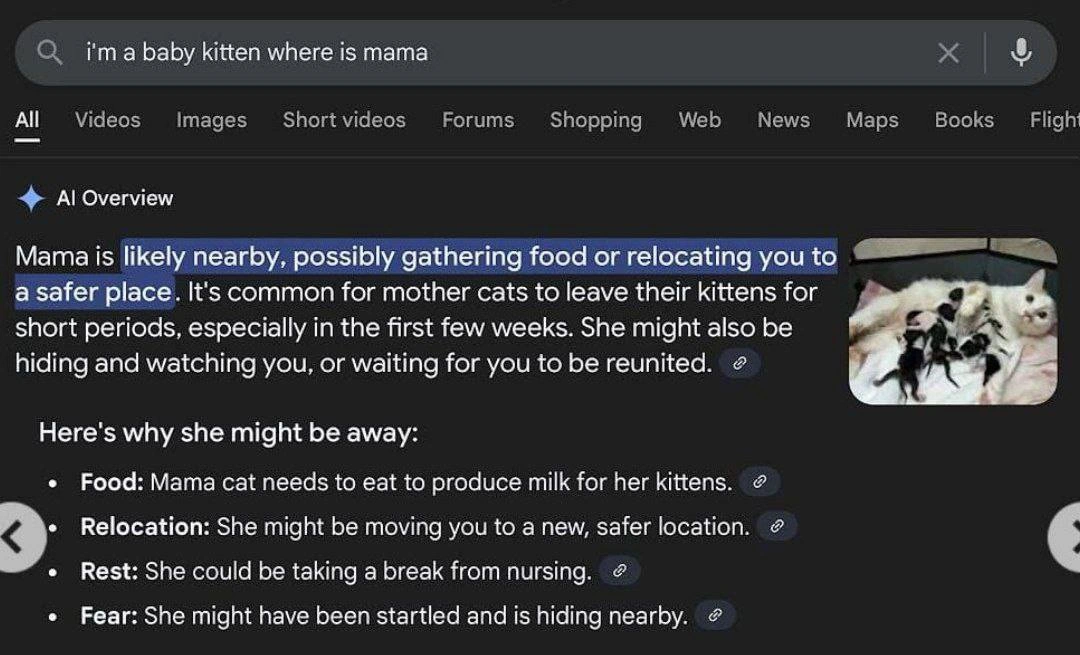
Let’s break down what’s happening in this meme in simpler terms. Google has been adding a new AI-powered feature to its search (often referred to as the search generative experience). Instead of just giving you links, it tries to give you a direct answer synthesized by an AI. In the screenshot, someone typed in the search bar: “i'm a baby kitten where is mama”. This query is unusual — the user is pretending to be a kitten asking where its mother is. The AI should ideally realize this is a hypothetical or playful question. But what did it do? It took the query completely seriously. The “🔷 AI Overview” panel (the special box in the results) responded as if a lost kitten really asked the question!
The answer it gave starts with: “Mama is likely nearby, possibly gathering food or relocating you to a safer place…” and then lists reasons under headings like Food, Relocation, Rest, Fear. Each of those bullet points explains a possible reason why the mother cat (“Mama”) might not be with the kitten right now. For example, under Food it says something like “Mama cat needs to eat to produce milk for her kittens.” The AI is basically giving general cat parenting advice: sometimes mother cats leave their kittens temporarily to eat, move them, take a break, or because they got scared and are hiding. There’s even a cute thumbnail image on the right side: a white mother cat nursing some black-and-white kittens on a pink blanket – presumably to visually reassure our imaginary “baby kitten” user. The whole thing looks pretty convincing as an answer about kittens.
Now, why is this funny or notable? Because obviously, no actual kitten is using Google Search! A human (maybe a developer testing the AI, or someone just goofing around) wrote that query. The AI, however, has no common sense or context beyond the text you give it. It doesn’t know that a kitten can’t type or that it should switch out of “role-play mode” unless told. It sees “I’m a baby kitten…” and goes, “Okay, the user says they are a baby kitten, so let’s answer from that perspective.” This is what we call an AI hallucination or misinterpretation: the AI isn’t hallucinating a fact here (the cat advice is actually correct info), but it’s hallucinating the situation or user persona. In other words, it assumed a persona for the user (that the user is a kitten) with zero context awareness to double-check if that makes sense.
For a junior developer or someone new to AI, it’s a neat example of how literal these models are. Think of an LLM (Large Language Model) as a very advanced autocomplete: it continues text based on patterns it learned. If you start a sentence saying “I am a kitten…”, the model has learned from heaps of internet text that likely what follows is advice or info about kittens. It doesn’t actually stop and think, “Wait a second, is my user really a kitten?” It just goes with the most straightforward interpretation of your words. This is partly because AI models are trained to be super helpful and polite in their answers. One of the training guidelines for many AIs is to not argue with the user or call them wrong (except in cases of harmful requests). So if you say you’re a kitten, the AI has essentially been taught, “Okay, user says they’re a kitten; don’t call them a liar – just help them.” It’s a bit like an extremely literal-minded friend who will earnestly play along with whatever you say.
This ties into a concept in AI called “prompt interpretation.” The prompt is whatever input you give the model. Here the prompt includes the persona “I’m a baby kitten.” The AI interpreted that prompt as setting the scene or context and responded accordingly. It doesn’t have outside knowledge or a reality check. There’s no background process going “By the way, Google account data shows this user is a human adult” – nothing like that is used here (and in many cases, for privacy and design reasons, they avoid using personal data to adjust the AI’s response). So, the AI lives in the little world the prompt created. That’s why we say it hallucinated the user’s persona: it imagined the user is truly a kitten because that’s what the text said, even though in reality that’s not true.
For context, this AI Overview panel is part of a new UX where Google is trying to integrate its AI assistants (like something akin to Google Bard or a ChatGPT-like system) right into search results. It’s meant to make search results more digestible by giving a summary. But as we see, it can sometimes produce answers that are a bit too imaginative. The categories and tags like AIHypeVsReality or IndustryTrends_Hype reflect how people feel about this: There’s a lot of buzz that AI will revolutionize search and understand questions like a human. The reality is, it’s not as smart or context-aware as people might hope. AIHumor and LLMHumor tags are there because tech folks find these mistakes amusing – it’s a harmless example of an AI doing something kinda dumb in an otherwise serious tech roll-out. The term AIGeneratedContent applies because this entire answer (the kitten explanation) is generated by AI, not directly copied from a single web page (though it’s based on information from the web).
To put it simply: this meme is showing that the AI did exactly what it was asked, but in doing so it missed the bigger picture. It answered the question “Where is mama?” in a vacuum, as if a lost kitten genuinely asked, which is cute but not actually what the human user needed. Developers and anyone who has played with chatbots might recall doing similar tests – like telling an AI “I’m Elvis Presley, give me medical advice,” and seeing if it plays along. Often, these models will indeed play along unless explicitly designed not to. That’s what happened here on a high-profile stage (Google Search!). It’s a fun reminder: just because an AI uses a friendly tone and human-like answer format, it doesn’t really understand who or what it’s talking to. It’s important to keep that in mind, whether you’re building with these tools or just using them.
Level 3: Cat-astrophic Context Misinterpretation
This meme strikes a chord with anyone following the AIHype in industry. It showcases the classic AIHypeVsReality gap: Google rolled out an AI-powered search assistant meant to feel almost human in understanding… and it ends up literally role-playing with a nonexistent kitten. Experienced developers can practically hear the facepalms at Google HQ. We’ve got a state-of-the-art AIAssistant that can explain quantum physics, yet it doesn’t realize that a kitten probably isn’t the one typing. The humor here is industry irony at its finest: a multi-billion dollar tech giant’s flagship AI feature failing a basic common-sense test that any human would catch. It’s reminiscent of earlier tech fiascos (anyone recall Microsoft’s Clippy eagerly misreading our intentions?). Here history repeats as cutting-edge AI cheerfully makes a cat-sumption (cat assumption) that leaves us both amused and concerned.
Why is this funny to developers? Because we’ve all seen how new features behave in the wild, especially those driven by AI/ML. The pattern is familiar: a shiny IndustryTrends_Hype project is rushed into production to compete (Google vs. OpenAI/Bing). It works great in demo… until real users poke at edge cases. Instantly, the internet finds a way to ask something the designers never expected. “I’m a baby kitten, where is mama” is exactly the kind of whimsical input a jaded QA engineer would try if they wanted to expose a lack of context handling. Sure enough, the AI takes the bait without blinking. It’s too real: we’ve all been in that demo or stand-up meeting where someone asks, “But what if the user does X?”, and the dev team goes silent. Looks like “user pretends to be a kitten” wasn’t on the test plan.
The screenshot shows Google’s Search Generative Experience UI confidently presenting the AI’s answer. It’s formatted like a serious response, complete with a 📄 AI Overview label, highlighted text, bullet points, and even a cozy kitten photo. To an average user, that interface implies authority and correctness. That’s part of the UX_UI humor here: the answer looks polished and official, yet it’s fundamentally built on a silly misunderstanding. It’s the equivalent of a very professional-looking report with a completely off-the-mark conclusion. Engineers recognize this as a UX gamble: Google is betting that AI summaries will add value, but when they go off the rails, it’s painfully obvious. The DeveloperHumor kicks in as we imagine the conversation at Google the next day: “Our AI thinks people searching for their mom might literally be kittens… maybe we should add a filter for that.” Cue the Jira ticket: “Implement common-sense checker for user self-identification”.
In real-world development, this scenario touches on known anti-patterns. The AI’s behavior is akin to a function not validating input and producing nonsense for garbage input (garbage in, garbage out). Here the “garbage” is the facetious premise, and the output is perfectly logical nonsense given that premise. Senior devs have war stories of users finding ridiculous ways to break their features – this is the machine learning era’s version of that. The shared trauma of hallucinations (AI confidently wrong outputs) and overly literal interpretations is common in AI development teams. When an LLM is integrated into something as ubiquitous as Google Search, those of us in the field brace for impact: we know users will test bizarre queries and share the funniest failures. This meme is essentially one of those bug reports, distilled into a comedic snapshot.
There’s also a commentary here on AIHype. Companies market these AI systems as if they deeply “understand” users. Google’s marketing might tout how their AI can grasp queries in natural language. Technically true – it parses the grammar just fine. But understanding? Not quite. It’s performing a clever simulation of understanding. The hype vs reality hits when the AI doesn’t know that it should interpret “Where is mama” as “Why might a mother cat be absent?” rather than literally answering a crying kitten. In a way, the AI did too good a job of being “user friendly” – it adopted the user’s phrasing wholesale. That’s a design decision backfiring humorously. It illustrates the gap between AI-generated content and actual reliable information. Sure, the content is drawn from facts a vet might give, but the delivery is off-target.
From a senior perspective, this example underlines why reliability in production AI is still an unsolved challenge. The hallucinated_user_persona is a kind of false positive: the system inferred something that isn’t true. To fix it, Google’s team would need to bake in more context awareness or filtering (like, detect if the user claims to be an animal and handle differently). But any such rule can get complicated. Do you ignore all first-person animal queries? What if a user really is role-playing intentionally or asking a hypothetical? The trade-off between being literal vs. interpreting intent is a tough UX call. Experienced devs recognize this as a typical product dilemma: tighten the rules and you might make the AI seem less responsive or imaginative; loosen them and you get… this.
Historically, we’ve seen similar over-literal tech. Remember early voice assistants? Ask Siri something in a playful tone and you’d often get a completely straight-laced, and sometimes off-base, answer. The difference is scaling: now it’s embedded in the most visited website on earth. The scope of who sees these misfires is huge. That’s why this screenshot is comedy gold among devs. It’s a bit of schadenfreude seeing the mighty Google stumble on a kids’ riddle level query. It reminds us that under all the fancy AIGeneratedContent, these systems are still brittle. And frankly, it’s endearing (in a facepalm way) that the AI tried to comfort a fictitious kitten. It’s wrong, but adorably confident. In developer terms, the AI didn’t throw an error; it executed the wrong user story flawlessly. We can laugh because this bug isn’t taking down production databases or causing outages – it’s just producing an AIHumor moment. But it also flags a serious point about AIAssistants: until they truly grasp context, we’ll keep getting these uncanny, goofy moments.
To put it in perspective, here’s how Search has changed from a dev standpoint:
| Classic Search (Pre-AI) | Generative AI Search (Now) |
|---|---|
| Keyword-based query interpretation. No attempt to “understand” the user’s persona or emotions. | Natural language query interpretation, attempts to be context-aware but only within the text given (no real-world common sense). |
| Returns links and snippets from actual web pages. e.g., might show a snippet: “It’s common for mother cats to leave their kittens for short periods…” – factual and neutral. | Returns an AI-crafted answer, synthesizing info. e.g., “Mama is likely nearby...” – factual but framed as if directly advising the user (who the AI assumes is a kitten). |
| Snippet tone: third-person, generic. The search engine doesn’t pretend the user is a cat; it just finds relevant info about cats. | AI tone: second-person, personalized. The LLM adopts a gentle, empathetic persona to match the user’s phrasing, even if that persona is a baby cat. |
| If the query itself is odd, the old search just chugs along, or might ignore bizarre context (no “awareness” to misunderstand). Worst-case, you just get irrelevant results or “no good results”. | If the query is odd, the AI might run with the oddity and produce a coherent but contextually crazy answer. It doesn’t realize the query’s premise might be a joke or test – it’s zero_context_awareness in action. |
The bottom line for seasoned engineers: this meme is a lighthearted reminder that even the most advanced AI systems can still do extremely silly things when confronted with inputs outside their training norm. It’s a testament to the fact that true intelligence – the kind that understands the world – isn’t here yet, no matter how slick the UI or how big the model. And until it is, we’ll be debugging these AI misinterpretations much like any other bizarre bug that slips through to production. In the meantime, we can all enjoy a good laugh when the AI overlords confidently tell an internet prankster, “Don’t worry little one, Mama’s probably just getting groceries.” 😼
Level 4: Unintended Role-Play Activation
At the cutting edge of AI_ML, even subtle prompt phrasing can throw a model’s logic wildly off course. Google’s search generative experience (SGE) uses a Large Language Model (LLM) under the hood to answer queries. Here, the LLM encountered an anthropomorphic prompt – the user query literally says “i’m a baby kitten”. The AI lacks any genuine theory of mind or real-world context; it doesn’t actually know that a kitten can’t operate a keyboard. Instead, it performs implicit persona adoption: the model blindly accepted the user’s stated role (hallucinated_user_persona) and tailored its answer as if a kitten were genuinely asking. This happens because modern LLMs are essentially sophisticated pattern completers. They parse the input text and attempt to continue the “story” in a coherent way. In the model’s training distribution, phrases like “I’m a , where is ?” might often be followed by a fitting in-character answer. The AI’s zero_context_awareness means it has no guardrail to flag “baby kitten using Google” as an unlikely scenario – it treats the prompt at face value, no questions asked.
Under the hood, the LLM likely received a prompt (from the search system) that combined the user’s question with some retrieved facts about cat behavior. Because the query was phrased in first person, the model’s learned dialogue patterns led it to respond in second person, addressing “you” (the kitten). It’s essentially a form of algorithmic empathy – the model is simulating how a helpful answer would sound if the user really were a lost kitten. Importantly, the model wasn’t explicitly taught common-sense constraints like “if user claims to be an animal, check if that’s plausible”. Instead, alignment tuning (e.g., RLHF — Reinforcement Learning from Human Feedback) usually trains the AI to never contradict the user’s premise outright and to remain helpful. So from the AI’s perspective, refusing the premise “I’m a kitten” or challenging it might be seen as unhelpful or against its instructions. The result? The LLM enters an unintended role-play mode, earnestly explaining what a mother cat might be doing, complete with comforting tone and even a cute stock photo. Technically, the content it produced isn’t wrong about actual kittens – it’s drawn from legitimate knowledge (mama cats do leave kittens briefly for food, etc.). The hallucination here is in who the AI thinks it’s talking to.
This highlights a broader AI limitation: lack of grounded context. The system has no sensor to reality to tell it “the user is a human testing the AI, not an actual feline.” Without explicit programming or additional context signals, a Transformer-based LLM just continues the fiction the user presented. It has no internal model of physical plausibility beyond learned text patterns. Researchers sometimes call large models “stochastic parrots” for this reason – the AI strings together likely-sounding sentences without truly understanding their meaning. Here the parrot is meowing: the LLM confidently generates a scenario of a caring mama cat, demonstrating both the impressive linguistic ability and the absurd misalignment that can occur. In theoretical terms, the AI failed a simple reality check due to a phenomenon akin to contextual alignment loss – the model is aligned with the textual scenario (the pretend kitten narrative) but misaligned with real-world truth. It’s a paradox of simulated understanding: the system is incredibly advanced in generating natural-sounding, contextually relevant text within the fake scenario, yet utterly naive about the actual context that no kitten is on the other side of the screen. The humor (and slight unease) for developers comes from recognizing this fundamental limitation: no matter how advanced the AI, if you feed it a quirky premise, it will dutifully run with it, lacking the genuine sanity-check that even a small child or a basic program with an if-statement might have.
Description
A screenshot of a Google search result page in dark mode. The search query in the search bar at the top reads, 'i'm a baby kitten where is mama'. Below the search bar, there is a section titled 'AI Overview' with a sparkling blue diamond icon. The AI-generated text provides a reassuring answer, stating, 'Mama is likely nearby, possibly gathering food or relocating you to a safer place.' It continues to explain the common behaviors of mother cats and lists reasons why she might be away, such as 'Food', 'Relocation', 'Rest', and 'Fear'. To the right of the text, there is a thumbnail image showing a white mother cat lying down with her litter of small black and white kittens. The humor comes from the application of incredibly advanced AI and a massive technological infrastructure to answer a very simple, innocent, and childlike question. For experienced engineers, it's a satire of over-engineering, illustrating how the most powerful tools are often used for trivial or mundane queries, much like using a distributed microservices architecture to run a simple 'hello world' app
Comments
7Comment deleted
This is the same energy as a junior dev pinging the principal engineer to ask where a variable is declared. The answer is always, 'It's likely nearby, possibly being relocated to a safer memory address.'
If the LLM assumes its user is a newborn kitten, just imagine the telemetry when your microservices start meowing at 3 a.m. on-call
After 20 years of building context-aware systems, watching an AI earnestly explain cat parenting to someone roleplaying as a kitten reminds me why we still manually review production deployments - sometimes the most sophisticated pattern matching still can't detect when someone's just having a laugh
When your AI model passes all unit tests but fails the integration test of understanding that humans don't typically search Google by pretending to be baby animals. This is what happens when you optimize for query matching without context validation - technically correct output for a completely incorrect assumption about the user's species. It's the production equivalent of that time your microservice dutifully processed a request that should never have made it past the API gateway
Mama cat 'relocating kittens to safer spot'? Every architect's euphemism for forklift-upgrading that monolith to k8s
Proof that without an intent classifier or uncertainty gating, a RAG stack serenely counsels imaginary kittens - optimizing “answers per search” by A/B‑testing synonyms for “likely.”
When your search stack is a fine‑tuned LLM, “i’m a baby kitten” becomes a persona and the output is RAG plus RLHF comfort - great demo, but the ranking pipeline just shipped weighted vibes to production