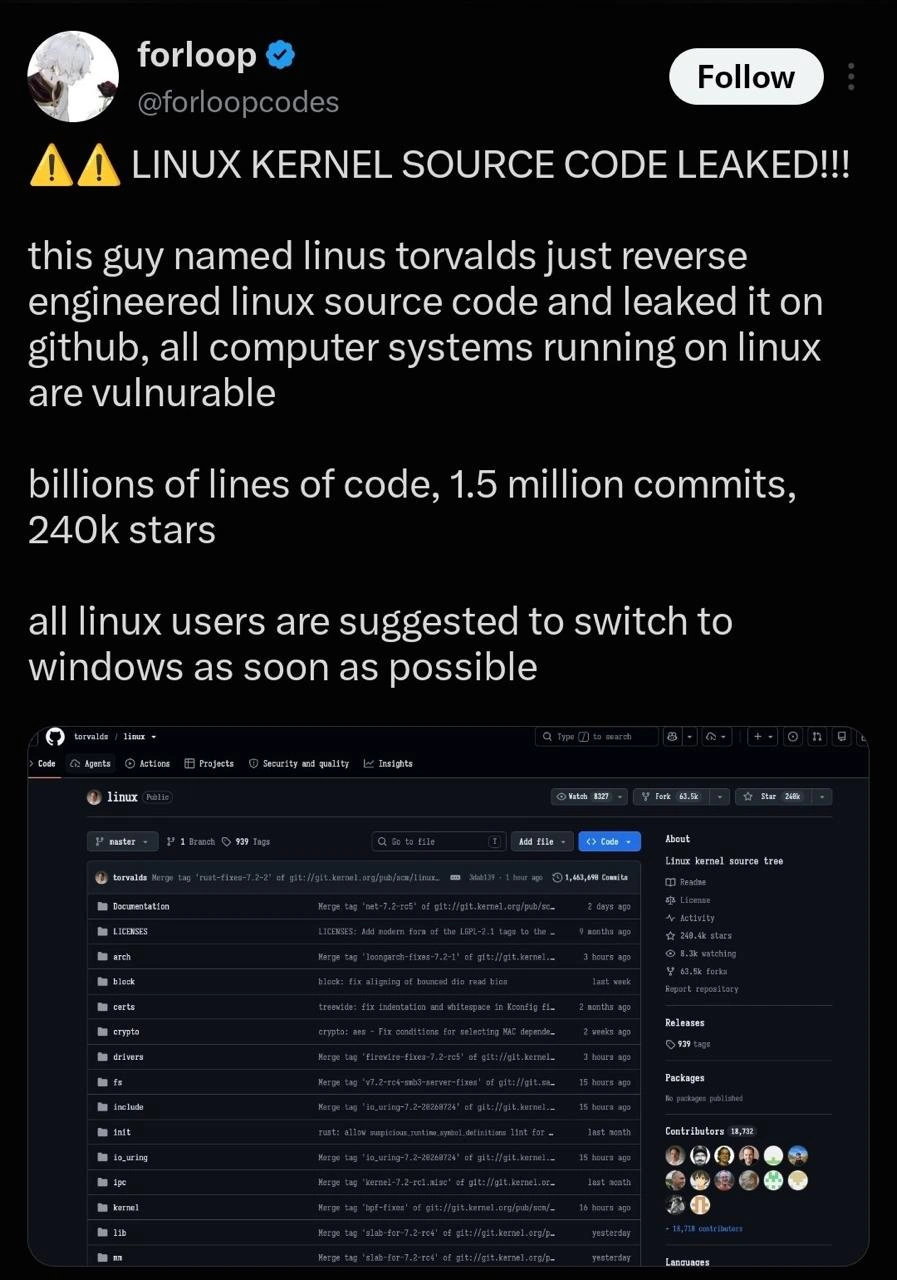
The 'Many Eyes' Fallacy of Open Source Security
Why is this Security meme funny?
Level 1: Anybody Could, Nobody Did
Imagine you have a big classroom where the teacher says, "We're not going to assign a specific cleanup helper today because anyone here could pick up the trash on the floor." That sounds nice — in theory, every student could help keep the classroom clean. But what do you think happens by the end of the day? Everyone assumed someone else would pick up the crumpled papers and candy wrappers. The floor is still a mess because no single student felt it was their job.
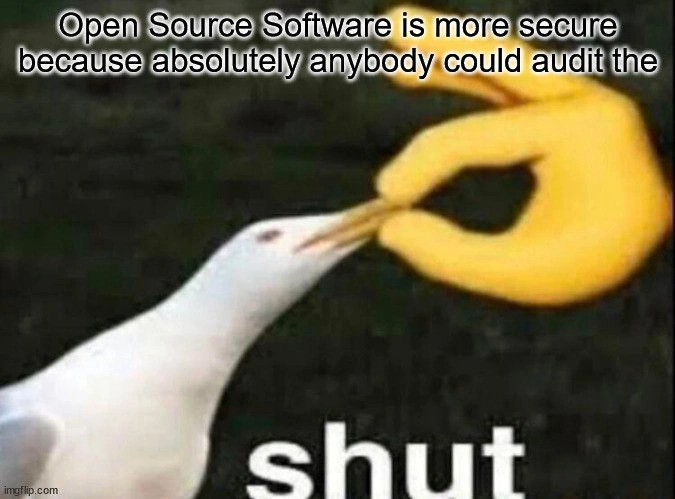
This meme is joking about the same kind of situation, but with computer code and security. One person is saying, "The code is open for everyone, so it’s definitely safe — anyone at all could check it for problems!" That's like saying the classroom will be clean because anyone could have cleaned it. The funny (and a bit sad) twist is that just because anybody could do it doesn't mean that somebody actually will. In the picture, a cartoon hand literally shuts the talking seagull’s beak, basically telling it, "Shh, stop right there." The experienced voice is saying, "That idea sounds nice, but it doesn’t match what really happens." It's humor that makes developers chuckle because it points out a simple truth: if everyone assumes someone else will do the work, the work might never get done. In other words, having the door wide open for helpers doesn't help much if all the helpers walk by and leave the work for the next person. That's why the seagull gets shut up — the older, wiser character knows that just being open isn't enough to guarantee safety, just like our classroom didn't magically stay clean on its own. The joke is funny because it’s true in everyday life: when everybody could do it, often nobody does it!
Level 2: Who Actually Audits?
Let's break down the joke in simpler terms. Open Source Software (OSS) is software whose source code is freely available for anyone to inspect, modify, and improve. The idea often promoted is that this openness makes it more secure. Why? Because theoretically, any programmer in the world could audit the code — meaning they could read through it, review it, and spot any mistakes or security holes. This is the "many eyes" theory: if a lot of people look at something, someone will surely notice a problem. It's like saying, "If a hundred people proofread an essay, it'll end up with no typos because someone will catch each error."
Now, the meme text starts with this claim: "Open Source Software is more secure because absolutely anybody could audit the..." – implying "audit the code." The bottom part just says "shut," with a seagull's beak being pinched closed by a cartoon hand. This image is a popular meme format used to abruptly silence someone. Here, it's shutting up the speaker in mid-sentence. The humor comes from the fact that the argument being made ("anybody can audit the code!") is getting literally cut off. Essentially, a grizzled senior dev figure is telling the idealistic speaker to "just shut it."
Why would someone be so dismissive of that claim? Because in practice, who actually audits open source code? The uncomfortable answer is: almost nobody, until things go wrong. Sure, the code is available on GitHub or another repository for anyone to see. But reading through thousands of lines of code to find hidden problems is a tedious, specialized job. Most developers use open source libraries as tools — they trust them like a car part that just works. They usually do not open up the engine to inspect every piece, unless they have a specific reason. So saying "anybody could audit it" is like saying "anybody could go through all your car's parts to check for defects" — true, but how many people actually do that in their spare time? Very few.
Let's clarify some terms from the meme and tags:
- "Many-eyes security" mantra: This refers to the belief that having more people able to look at code makes it safer. It's sometimes informally called Linus's Law in open source communities. It’s a mantra because it’s repeated often, almost like a slogan.
- Audit the code: In this context, "audit" means thoroughly reviewing source code to find bugs or security vulnerabilities. A security audit of code is like a detailed inspection — checking if there are any places an attacker could exploit. It requires patience and expertise.
- Security vulnerability: This is a flaw or bug in software that could be used by a bad actor (hacker) to do something harmful — for example, steal data, take control of the system, etc. The meme tags mention Heartbleed – that was a famous vulnerability in an open source encryption library called OpenSSL. Heartbleed allowed attackers to read sensitive data from servers’ memory due to a simple coding oversight. Even though OpenSSL was open source (so anyone could have inspected it), the bug went unnoticed for a long time.
- Open source security debate: There's an ongoing discussion in tech: is open source more secure or less secure than closed source software? One side argues openness means transparency and many helpers (so safer). The other side points out that if everyone assumes "someone else will fix it," issues can be neglected (so not necessarily safer). Also, open code means hackers can study it freely to find weaknesses, which is a double-edged sword. This meme is siding with the skeptical view: just being open isn't enough to guarantee security.
So the top text in the meme is basically the optimistic claim that "Open source is secure because anyone at all can review the code for bugs." The punchline "shut" is the rebuttal — shorthand for "Be quiet; that argument doesn't hold up in reality." The humor is a bit DeveloperCynicism: it's funny to those in the know because they've heard that rosy claim too often and have seen it proven false. It's poking fun at an IndustryTrends_Hype — the kind of thing you read in tech blogs or hear from enthusiastic newbies. The gruff hand silencing the seagull represents the voice of experience saying, "Enough. The real world doesn't work that way." Even if absolutely anybody could audit an open source project, the truth is that somebody actually has to do it, and usually that ends up being almost nobody until it's too late.
Level 3: Eyes Wide Shut
Seasoned developers have learned (often the hard way) that theory and practice in security can diverge drastically. The meme captures a piece of industry satire: it mocks the optimistic claim that "Open Source Software is more secure because absolutely anybody could audit the code." This claim sounds great on conference slides and in PR statements, but senior engineers greet it with a cynical smirk. Why? Because they've seen how the OpenSource ideal sometimes crumbles in real life. In reality, "anybody could audit" often means almost nobody actually does.
Think about the typical OpenSourceCulture around a widely used library. Thousands of projects might depend on it, but only a handful of maintainers are actively involved in its upkeep. Most other developers use it as a black box — they trust it works and seldom read its source. Companies often assume the community has vetted the code, while the community assumes the company (or someone else) has done due diligence. This is the classic "many eyes" fallacy: an assumption of security rather than an assurance. The top caption in the meme is essentially parroting this assumption, and the giant yellow hand literally clamping the seagull's beak shut represents the senior engineer's impatience with that naïveté. The bottom text "shut" bluntly conveys, "Just stop. I'm tired of hearing that."
Why is the senior dev so skeptical? Because of hard-earned experience with SecurityVulnerabilities in open source components. They remember catastrophic bugs like Heartbleed in OpenSSL and the chaos it caused. (OpenSSL’s code was public for all to see, yet that bug survived for years until one pair of eyes finally caught it.) They can cite the more recent Log4Shell fiasco (December 2021), where a critical zero-day flaw in the popular open source Log4j library caught the world off-guard. Everyone assumed such a widely-used project must have been audited by "someone", yet here we were frantically patching, proving that assumption false. It's a dose of DeveloperCynicism coming from battle-weary veterans: just because code is open doesn't automatically make it secure.
The humor also lies in the security vs. reality gap. The meme text is cut off mid-sentence ("... absolutely anybody could audit the") as if someone was confidently preaching the virtue of open source security — only to be silenced abruptly. That abrupt cutoff is exactly how a senior might shut down a junior or a hype-prone manager repeating a platitude. It's saying, "Enough with the IndustryTrends_Hype, let's face facts." The SecurityVsUsability angle comes in when organizations blindly adopt open source for its flexibility and cost benefits (usability, community support) while ignoring who’s actually vetting it. The mantra "many eyes make bugs shallow" becomes a convenient excuse to not invest in proper security audits — after all, the code is out there, someone will catch issues, right? The meme brutally calls out this lazy thinking.
Consider how this plays out in practice:
- Unfunded Audits: Open source projects often rely on volunteers. Comprehensive security audits take time, skill, and often money. Unless a company sponsors a security review, most projects won't get one until after a disaster.
- Bus Factor & Maintainers: The "many eyes" might literally be just two tired eyeballs of a core maintainer juggling hundreds of issue tickets. Many critical OSS tools have a bus factor of 1 or 2 (meaning only one or two people truly understand and oversee the project). If those maintainers miss something, no legion of casual onlookers is magically stepping in.
- Attackers Have Eyes Too: Ironically, making code public means bad actors can also scrutinize it. If absolutely anybody can audit the code, that includes hackers who actively sift through for exploitable bugs. Often, they’re more motivated to find vulnerabilities than random users are to report them. The meme’s implicit punchline is that open source isn't inherently secure — it can be a double-edged sword.
To put it succinctly, the open source security ideal vs reality looks like this:
| "Many-Eyes" Ideal | Actual Outcome |
|---|---|
| Countless contributors review every line | Few qualified folks have time to review |
| Bugs get caught early by the community | Some bugs linger unnoticed for years |
| Security comes "for free" from openness | Security still requires dedicated effort |
In other words, transparency is not a substitute for scrutiny. Seasoned devs have learned that robust security doesn’t happen by accident or by sheer potential; it requires concrete action. The meme resonates because it's developer humor born of frustration: After the tenth time hearing "But it's open source, it must be secure!", any veteran will feel an urge to metaphorically clamp that argument shut. The joke lands since it’s industry satire rooted in truth — a truth that every senior engineer who ever scrambled to patch an open source vulnerability knows all too well.
Level 4: The Many-Eyes Paradox
"Given enough eyeballs, all bugs are shallow."
– Linus's Law (Eric S. Raymond, 1999)
In open source lore, this famous mantra suggests that with Open Source Software (OSS), having a multitude of observers will ensure bugs and security flaws are quickly spotted and fixed. It's a cornerstone of the open source culture: transparency begets trust. The theory comes from The Cathedral and the Bazaar, positing that many-eyes security will naturally emerge when code is open to all. Under ideal circumstances, this is like a massively distributed peer review. In academic terms, it's an appeal to collective intelligence: if enough people scrutinize the code, no problem can long escape notice.
However, real-world software isn't a mathematical proof easily verified by infinite eyes. It's more like a sprawling novel where finding a subtle vulnerability can be as hard as catching a single typo in an encyclopedia. The many_eyes_fallacy arises because it assumes a virtually infinite pool of skilled reviewers actively auditing every line. In practice, this assumption breaks down due to human factors and resource constraints. The paradox is that the more people who could audit the code, the less any particular person feels responsible for doing so. This is akin to the bystander effect in crowds: when an issue is visible to everyone, often nobody takes action, assuming "surely someone else will." The result? Critical bugs may linger unnoticed, hiding in plain sight.
From a theoretical standpoint, detecting all security flaws in non-trivial software is an unsolved problem. It borders on the limits of formal verification and computational complexity. Ensuring a program has no vulnerabilities can be as hard as proving a negative — related to the infamous halting problem in computability. Without rigorous analysis (which few volunteers have time or expertise for), many bugs remain non-trivial to discover. Moreover, security vulnerabilities are often subtle and require deep domain knowledge to catch; ten casual observers are not equivalent to one expert reviewer. The "many eyes" ideal assumes a high signal-to-noise ratio of quality contributions, but in large open projects, reviews can be sporadic and uneven. Some critical components get almost no eyeballs at all, a fact painfully highlighted by incidents like Heartbleed. Heartbleed was a severe flaw in the widely-used open source OpenSSL library that went unnoticed for over two years. It proved that even with code out in the open, certain bugs were anything but shallow. The many-eyes mantra leaks in the face of such reality: vulnerabilities can slip through unnoticed when everybody assumes somebody else already audited the code. This deep irony — a paradox of open source security — underpins the humor of the meme.
Description
This meme uses the 'Shut Up Seagull' format, where a large yellow emoji-style hand pinches a seagull's beak closed, silencing it. The background is dark and indistinct. Text at the top reads, 'Open Source Software is more secure because absolutely anybody could audit the'. At the bottom, aligned with the silencing action, is the single word 'shut'. The image includes a small watermark 'imgflip.com' in the bottom-left corner. The meme humorously cuts short a common but naive argument in favor of open-source security. The technical context, especially given the post date of December 2021, points directly to the Log4j (Log4Shell) vulnerability crisis. It satirizes the 'many eyes' theory, where the theoretical possibility of anyone auditing the code is supposed to guarantee its security. Experienced engineers know that 'could' doesn't mean 'does,' and critical, widely-used libraries can go unaudited for years, leading to massive security vulnerabilities. The joke resonates with senior developers who understand that the security of the software supply chain often rests on underfunded and under-maintained open-source projects
Comments
57Comment deleted
The 'many eyes' on that critical OSS dependency turned out to be one unpaid maintainer who burned out in 2017 and a CVE that just says 'good luck'
Sure, the repo is public - right next to the 1,237 other tabs every "potential auditor" swears they'll read after the sprint retro
After 20 years in tech, I've learned that 'many eyes make all bugs shallow' actually translates to 'everyone assumes the other guy already looked at it' - just like how we all assumed someone was auditing OpenSSL before Heartbleed, or Log4j before... well, you know
'Given enough eyeballs, all bugs are shallow' - turns out the eyeballs were all on the README, while the JNDI lookup sat unreviewed for eight years
Ah yes, the classic 'many eyes make all bugs shallow' argument - conveniently ignoring that those eyes are usually skimming Stack Overflow at 2 AM, not performing rigorous security audits of your dependency tree's dependency tree. Turns out 'anybody could audit it' and 'anybody actually does audit it' are separated by approximately 10,000 unpaid volunteer hours and a critical CVE that's been sitting there since 2015
Linus’s Law works - until you realize those “many eyes” are GitHub stars, not reviewers, and the xz backdoor still ships
Open‑source security model: infinite reviewers in the spec, a bus‑factor‑1 maintainer in production
Many eyes make bugs shallow - until those eyes are glued to Jira tickets instead of the codebase
And what's actually wrong here? Comment deleted
I think its refering to log4shell. Comment deleted
people claim that open source is better because anyone can audit, but no one guartantees that the code will be checked Comment deleted
So you should check it by yourself Comment deleted
Memes don’t need to be fun. They also may teach us something. It’s DevMeme, not fun meme, you know🤔 Comment deleted
Well if it were to be a real Backdoor, not a bug, it could be found far more easy. Comment deleted
Original please Comment deleted
let it be the original Comment deleted
I use arch btw Comment deleted
thanks to arch linux my netbook can handle 10 fps on low graphics minecraft (compared to 2 fps on winxp) Comment deleted
Win xp supports minecraft? Comment deleted
winxp supports java 8, thats enough for 1.12.2, which was tested Comment deleted
How old is 1.12.2? Comment deleted
4.5 years (summer 2017) Comment deleted
Well Minecraft is Java. Comment deleted
thanks to arch linux and optifine, I get 60fps on my pentium shitshow Comment deleted
Is OF faster than vanilla? Comment deleted
sometimes Comment deleted
if you turn all the settings down, yes, massively. Comment deleted
u woman, u do not Comment deleted
D: Comment deleted
Lol Comment deleted
Well, this vulnerability was found because the open source code was audited, so the problem was patched... Comment deleted
That's the idea behind the phrase. Free software is not magically better with less bugs, community just has a way to actually discover and fix them. Comment deleted
i dont see how that is a bad thing? Comment deleted
Maybe because it's not. Comment deleted
Ah i see. Necromancy Comment deleted
i don't think so, at least because 1.16 crashed under java 8 Comment deleted
I thought OF is just bringing better Graphics... Comment deleted
you need extra shaders for the real meat Comment deleted
optifine eats 2x ram... (allocate 4GB for minecraft, optifined minecraft uses 7GB) Comment deleted
I have 4GB RAM, stop shitting me Comment deleted
I that Comment deleted
only 32x resource packs, BUT same settings with and without OF Comment deleted
pics will be soon Comment deleted
Optifined minecraft 1.17.1 Private bytes for java: 3.1GiB Allocates: 2.1GiB -Xmx 4g from where 1GiB? Comment deleted
> why xp > how big is the render distance > openjdk or oracle java? Comment deleted
openjdk 16 Comment deleted
31 render Comment deleted
31 render distance? holy shit no wonder lmao Comment deleted
I got like 2 or 4 chunks render distance btw, not ideal, but I have to take what I can get with my 1.9GHz Pentium Comment deleted
how can i set render distance below 2 chunks Comment deleted
impossible afaik Comment deleted
maybe with mods Comment deleted
NOT xp, but xp-styled win7 Comment deleted
still bad Comment deleted
No optifine 1.17.1 allocated 2.4GiB private bytes 3.4GiB maybe it is not reproducible now, because I updated versions? Comment deleted
firefox uses 28GiB virtual memory, but i meant not virtual Comment deleted
Hahahahahaa Comment deleted