Skip to content
DevMeme
3703 of 7435
Put Me Back Online
DevCommunities Post #4042, on Dec 17, 2021 in TG

Put Me Back Online

Why is this DevCommunities meme funny?

Level 1: Famous In One Room

Imagine a kid who is the most important person in one small clubhouse: everyone knows them, asks them questions, and listens when they speak. Then they leave the clubhouse and nobody outside knows who they are. The funny part is that they want to go back immediately, because being tiny-famous in one room still felt like being famous.

Level 2: Tiny Famous

Telegram channels are broadcast-style spaces where admins can post to subscribers. Related groups and communities often have moderators who remove spam, manage behavior, and keep discussion from collapsing into noise. In small technical communities, those roles can become surprisingly visible.

Community management means keeping an online space useful and livable. That includes setting rules, answering repeated questions, calming arguments, approving content, banning obvious bad actors, and deciding what kind of culture the group should have. It sounds simple until the same debate returns every week wearing a new hat.

Micro celebrity means being famous only inside a narrow context. A person might be known by everyone in a Kubernetes meme channel, a local Linux chat, a retro hardware group, or a programming language forum, while being completely anonymous everywhere else. The meme exaggerates the feeling of being removed from that tiny stage.

For newer developers, this explains why community spaces can feel intense. Reputation is not just about code skill. It can come from being helpful, funny, fast with news, strict about rules, or simply always present. That can be positive, but it can also create burnout when someone starts treating notifications like proof they matter.

Level 3: Local Clout Cache

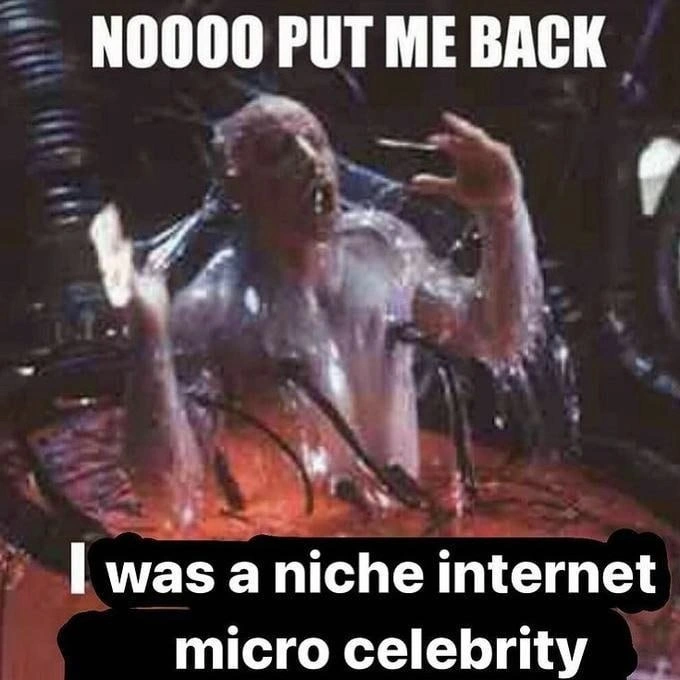
The visible text frames the scene as a panicked extraction from an online identity:

NOOOO PUT ME BACK

I was a niche internet micro celebrity

The original post message adds the target:

All admins and mods of TG Channels be like:

So the joke is not about global fame. It is about the tiny but very real prestige economies inside online communities, especially Telegram channels and other semi-private social platforms. The person being pulled out of the pod is not begging to return to physical comfort. They are begging to return to a place where their username meant something.

This is a sharp DevCommunities meme because technical spaces run on these micro-status systems more than they like to admit. A channel admin, Discord moderator, subreddit maintainer, GitHub project owner, forum regular, or niche newsletter curator may be unknown to the wider world but highly visible inside a small network. They answer questions, enforce norms, forward links, approve posts, delete spam, settle arguments, and become part of the local infrastructure. Then they step outside that context and discover their "celebrity" status has no portable runtime.

The humor depends on the gap between platform-mediated identity and real-world identity. Inside the channel, the admin may be the person who posts first, bans bots, knows every regular, and can trigger a swarm of reactions with one comment. Outside the channel, they are just another person who has to explain why moderating a Telegram group felt like being mayor of a strange little city that mostly runs on screenshots and arguments about fonts.

There is a darker systems lesson hiding here: community roles are work, even when they are unpaid and informal. Moderators absorb conflict, filter abuse, maintain rules, and create the feeling that a space is alive. Platforms benefit from this labor because healthy communities produce attention, retention, and content. The admin gets status, belonging, and sometimes a fragile sense of purpose. That bargain can feel empowering until the person realizes the status is stored entirely inside one platform's social graph. Lose the channel, the account, the audience, or the algorithmic feed, and the identity evaporates like cache without persistence.

The sci-fi pod imagery makes that dependency feel literal. The character appears to be ripped out of a machine world, wet, disoriented, and furious. For a Telegram admin, the pod is the channel dashboard, the unread count, the forwarded posts, the moderation queue, and the little burst of recognition when regulars respond. "Put me back" is funny because it is melodramatic, but anyone who has watched a niche community become their main social feedback loop knows the melodrama is not purely fictional. It is just embarrassing enough to be accurate.

Description

The image shows a sci-fi scene of a person emerging from or being pulled out of a wet, pod-like machine, with cables and dark machinery around them. Large white all-caps text at the top reads, "NOOOO PUT ME BACK." At the bottom, white text over a black redaction-like background reads, "I was a niche internet micro celebrity." The sibling metadata caption says "All admins and mods of TG Channels be like:," turning the image into a joke about Telegram channel administrators and moderators deriving identity or status from small online communities. The technical-culture angle is platform-mediated microfame, community management, and the strange local prestige economies that form around messaging channels and niche internet spaces.

Comments

5
Anonymous ★ Top Pick Niche internet clout is just distributed cache state with no durable backing store.
  1. Anonymous ★ Top Pick

    Niche internet clout is just distributed cache state with no durable backing store.

  2. @feskow 4y

    Average r/196 microcelebrity

  3. @cptnBoku 4y

    "flex" right there ಠಿヮಠ

  4. @eth0fox 4y

    https://t.me/dev_meme/4001 pwease guys I nweed fake internet points 🥺👉🏻👈🏻

    1. dev_meme 4y

      No, it was not for karma, it was requested to increase visibility of the post at the sub for the project to get more visitors

Use J and K for navigation