Skip to content
DevMeme
3285 of 7435
The Illusion of Security: Using Base64 as 'Encryption'
Security Post #3609, on Aug 29, 2021 in TG

The Illusion of Security: Using Base64 as 'Encryption'

Why is this Security meme funny?

Level 1: Snack as a Lock

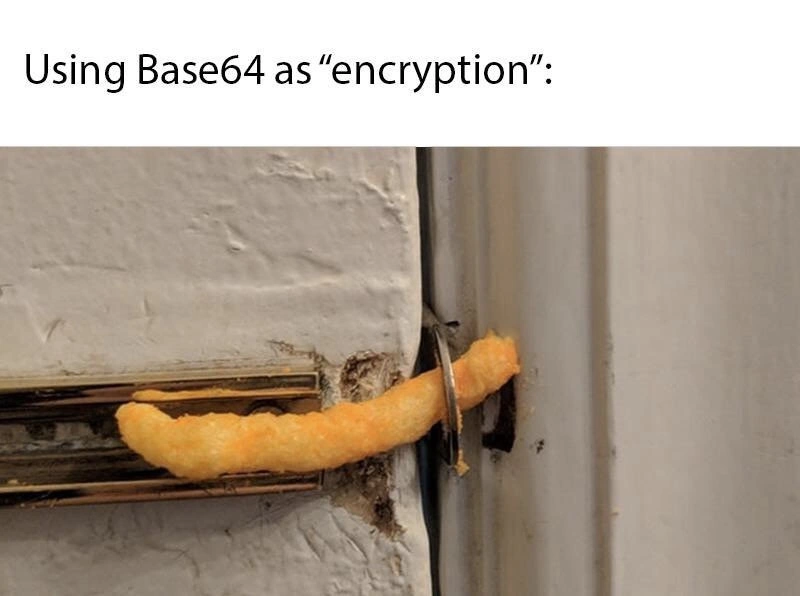
Imagine trying to lock your front door with a cheese puff – yes, the crunchy orange snack – instead of a real lock. Sounds silly, right? If you jam a Cheeto in the door frame, it might keep the door closed for a moment, but anyone could just pull it out (or eat it!) and walk right in. That’s exactly what this meme is showing, and why it’s funny. Using Base64 to hide a message is just like using a cheese puff to secure a door: it looks like you did something to lock it, but in reality it’s not locked at all. The secret message turns into a bunch of mixed-up letters with Base64, but anyone who knows the simple trick can decode it back to the original text in no time. In other words, a Cheeto is a terrible door lock, and Base64 is a terrible way to keep a secret. Even a kid can tell that a door isn’t safe when it’s “locked” with a snack. In the same way, programmers know that data isn’t safe when it’s only been Base64-encoded. The meme makes us laugh because it uses a goofy example everyone can understand to say: just because something is kinda hidden doesn’t mean it’s secure at all.

Level 2: Base64 Is Not Encryption

At this level, let’s break down the basics. Base64 is an encoding scheme, not a form of encryption. That means it takes data and converts it into a different format using a known formula, without hiding it behind a secret key. Specifically, Base64 translates binary data (any file or stream of bytes) into a set of 64 characters: the letters A–Z, a–z, the digits 0–9, and the symbols + and / (with = used for padding at the end). It’s a lot like converting information into a different alphabet so it can travel safely through systems that might only handle text. Anyone who knows the encoding method can reverse it. In fact, Base64 is built into many programming languages and tools precisely because it’s meant to be easily decoded when needed.

On the other hand, encryption is about actually protecting data. When you encrypt something, you use a secret key or password to scramble the information. The result looks like random nonsense, and without the right key, no one can easily turn it back into the original message. For example, if you encrypt the word “Secret” with a real encryption method, you might get something like “q$9Hk\u*1” – completely unreadable. Only someone with the correct secret key can decrypt that back to “Secret.” If they don’t have the key, that scrambled text stays gibberish. That’s the power of real cryptography: it creates a locked box around your data that outsiders can’t open.

Now compare that to Base64. If you encode the word “Secret” in Base64, you get “U2VjcmV0”. That looks a bit odd at first, but anyone can decode “U2VjcmV0” back into “Secret” with almost no effort. No password or special permission needed – it’s just a standard conversion. Here’s a concrete example to illustrate how easily reversible Base64 is:

Original text: "password123"
Base64 encoded: "cGFzc3dvcmQxMjM="
Decoded back:  "password123"

See what happened? We took "password123" and turned it into "cGFzc3dvcmQxMjM=" using Base64. To someone unfamiliar, cGFzc3dvcmQxMjM= looks like a jumble of random characters. But any developer or tool can quickly decode that string and reveal the original text "password123" in an instant. It’s like writing a note in a simple secret code – anyone who knows the code can read it. There’s no true lock here, just a disguise.

This is why we emphasize that Base64 is not encryption. It’s just an obfuscation – a way to hide the plain data slightly, mainly to make it less immediately readable or to fit a certain data format. But it doesn’t secure the data against someone who wants to uncover it. In terms of security, encoding something in Base64 is like hiding a house key under the doormat: the information is slightly out of plain sight, but it’s easily found by anyone who knows where to look. By contrast, proper encryption is like locking that key in a safe that only you can open.

If a developer stores sensitive info (say, passwords or personal data) by just Base64-encoding it, that’s considered a serious security flaw. They haven’t truly protected the data at all; they’ve just made it look different. In programming and security, it’s crucial to understand this difference. Encoding schemes (like Base64, hex, etc.) are meant for data representation and compatibility – making data portable, not hiding it. Encryption methods (like AES, RSA, etc.) are meant for data protection – actually restricting access using secrets. Mixing them up can lead to dangerous mistakes, like thinking your data is locked up when it’s really just wearing a flimsy disguise.

The meme with the Cheeto in the door lock is a lighthearted way to remember this lesson. A cheese puff in a door jamb might make the door look like it’s stuck or locked, but everyone knows that’s not a real lock. In the same way, converting data with Base64 might make it look secret, but it’s not real security. It’s a funny visual reminder that making something look hidden isn’t the same as truly locking it away.

Level 3: Security Theater Snack

Using Base64 as “encryption” has become an inside joke among developers. The meme nails it with that image of a Cheeto stuck in a door lock. Just picture someone proudly saying, “There, I secured it!” while wedging a bright-orange cheese puff to keep the door closed. The absurdity is immediate: anyone can simply pull out (or eat) the Cheeto and open the door. This perfectly parallels the feeling experienced engineers get when they see sensitive data merely Base64-encoded and proclaimed secure. It’s a mix of amusement and horror – amusement at how flimsy the “security” is, and horror that someone thought it would actually work.

In real-world software, this scenario pops up more often than you’d think. I’ve seen code where a developer stores passwords or API keys as Base64 strings, maybe even adding a comment calling it “encrypted.” But Base64 is not encryption – it’s like a secret code that isn’t secret at all. Any colleague, hacker, or even a curious user can decode a Base64 string with trivial effort (there are browser tools and one-liner scripts to do it in seconds). The moment a seasoned dev spots something like UGFzc3dvcmQ= in a config file, they know immediately: that’s just "Password" in disguise. It’s the classic case of security theater: giving the appearance of security without substance. The data looks scrambled to the untrained eye, but there’s no actual lock keeping it safe.

For example, imagine an overconfident junior dev telling their team, “Don’t worry, I encrypted the credentials.” Then they reveal something like QmFzZTY0IGlzIGdyZWF0 in the config. A senior engineer will instantly recognize that as Base64 gibberish. The ensuing conversation tends to go like this:

Junior Dev: “Our secrets are safe – I encoded them with Base64!”
Senior Dev: “Encoding is not the same as encrypting... we can decode that in 2 seconds.”
Junior Dev: “...Oh.” (Facepalm)

Everyone quickly learns that obfuscation is not real protection. Obfuscation just means hiding something in a superficial way – using a trick or simple transformation – whereas true security means there’s a real lock (a cryptographic key) that attackers can’t bypass so easily.

Seasoned engineers laugh (and maybe cry a little inside) because we’ve encountered this mistake plenty of times. It’s a too real scenario. Relying on Base64 to protect secrets is often a sign that the person didn’t fully understand what real encryption entails. It might stop your non-technical colleague from immediately recognizing a password, but it won’t stop any attacker worth their salt. In fact, attackers specifically look for Base64-encoded blobs when scanning code and network traffic, because it’s a big clue something might be hidden – and decoding Base64 is low-hanging fruit. There’s a running joke that the first step in “hacking 101” is to check if the supposed encrypted text is just Base64; nine times out of ten, that’s exactly what it is.

So why does this happen? Sometimes it’s ignorance – not everyone has a background in security, and they might genuinely think any text conversion equals encryption. Other times it’s a quick-and-dirty workaround: implementing proper encryption (with keys, algorithms, key storage, etc.) can be complex and time-consuming, whereas calling a Base64 library function is easy and foolproof (in terms of execution, not security). It’s the path of least resistance, a classic Security vs. Usability trade-off (or really, security vs. convenience). Base64 is available in virtually every programming language (often as a one-liner like encodeBase64(str)), so it’s tempting to say “Hey, at least it’s not plain text!” and call it a day. This is essentially pseudo-security – doing something that gives a false sense of safety without actually solving the problem.

The corporate world has its share of these security flaws masquerading as solutions. I’ve seen a manager breathe easy because the data in a report looked jumbled, not realizing it was just Base64-encoded. A string of random-looking characters can fool people who don’t know better, allowing a checkbox like “data is encrypted” to get ticked without true justification. But that false confidence can lead to nasty surprises later. All it takes is one breach where an attacker laughs and says, “They literally base64’d their passwords,” for the reality to hit home. It’s embarrassing and dangerous – an organization can get burned badly by thinking a Cheeto-level defense was enough.

In the end, the meme’s absurd visual says it all. A cheese puff is obviously a terrible door lock – it crumbles under the slightest pressure. Likewise, Base64 “protection” crumbles as soon as anyone takes a closer look. “Base64 as encryption is as secure as jamming a Cheeto in a lock” isn’t just a joke — it’s a warning born from hard-earned experience. Developers share this meme and laugh because it’s a comical reminder of a serious truth. It reminds us not to confuse a snack-sized security measure with a real defense. Next time someone suggests a quick fix like “let’s just Base64 it,” you’ll probably remember that bright-orange Cheeto and realize it’s time to implement a real lock instead.

Level 4: Zero-Bit Security

Base64 provides exactly 0 bits of cryptographic security. In formal terms, it's not an encryption algorithm at all, merely an encoding scheme. Real cryptography relies on secret keys and computational hardness, but Base64 has no secret key by design. According to Kerckhoffs’s principle (a cornerstone of cryptography from 1883), a secure system should remain secure even if everything about it is known except the secret key. With Base64, there is no secret component—it's a fixed, publicly known transformation. This means anyone who knows the Base64 mapping (which is basically every developer on the planet) can reverse it instantly. In other words, Base64 encoding offers no more secrecy than writing your message in a well-known code language that all your adversaries learned in grade school.

Proper encryption aims to make the output (ciphertext) indistinguishable from random noise without the key. It hides patterns and structure, achieving high entropy so that an attacker can't glean useful information. Base64 does the opposite: it preserves patterns in a predictable way. It works by taking input bytes and encoding them into groups of four characters using a fixed 64-character alphabet. If there's repetition or recognizable structure in the input, that structure often remains evident in the Base64 output (just translated into different symbols). For example, Base64-encoded data still reveals the exact length of the original data (often via those == padding characters). This is a far cry from a true cipher like AES, which produces output that appears random and leaks virtually nothing about the original message unless you have the key.

From a complexity standpoint, breaking a real encryption scheme without the key requires astronomical effort. Decoding Base64, in contrast, requires no effort beyond a simple lookup table. Modern ciphers (say AES-256) effectively have 2^256 possible keys – an unfathomably large number – so without the key you'd be brute-forcing until the heat death of the universe. Base64 has effectively 1 possible “key” (the publicly known encoding scheme), so there's nothing to brute force; decoding is an O(n) operation. In fact, cryptographers joke that Base64 is “its own decryption” – the algorithm to encode is the same complexity as to decode, and both are trivial. It's essentially a substitution cipher with a fixed, well-known alphabet. Historically, simple substitution ciphers (like the ancient Caesar cipher or its cousin ROT13) were defeated long ago because once the mapping is known, the game is over. Base64 falls exactly in that bucket – except it was never even meant to be a cipher to begin with, just a text representation.

It's worth noting that Base64 is extremely useful for what it's designed for: data formatting, not security. Often, encrypted data or binary files are Base64-encoded to safely transmit them over text-only channels (for example, email or JSON). But in those cases, the security comes from the real encryption step, not from the Base64 layer. Base64 is just packaging – like writing an encrypted message in printable characters. The trouble comes when someone mistakes that packaging for a lock. Security through obscurity – doing something obscure like Base64 and hoping no one notices – is a known anti-pattern. The meme is poking fun at exactly that: using a reversible encoding as if it were a protective cipher. It’s a cryptographic facepalm, illustrating that Base64 adds zero actual secrecy.

To put it bluntly, calling Base64 "encryption" is like claiming a Cheeto is a high-tech lock. A seasoned security engineer will chuckle (or cringe) at the idea. Base64's "protection" is so weak that it might as well not exist – it's the digital equivalent of a door that’s closed but not actually locked. In fact, Base64's cryptographic strength is on par with the tensile strength of a cheese puff in that door frame: virtually nonexistent.

Description

This meme provides a powerful visual metaphor for a common security fallacy in software development. The top of the image has the text 'Using Base64 as “encryption”:'. Below this caption is a close-up photograph of a door's slide latch. Instead of a sturdy metal bolt, a single, orange, puffy cheese curl (like a Cheeto) is threaded through the lock mechanism, pretending to secure the door. The image is absurd, as the cheese curl is obviously fragile and could be broken with the slightest force. The technical joke is a direct analogy: Base64 is an encoding scheme designed to represent binary data in text format, not a method of encryption. Like the cheese curl lock, it offers a superficial layer of obfuscation that is trivially reversible. Experienced developers recognize this as a critical anti-pattern, often seen in code written by beginners who misunderstand the fundamental difference between encoding (changing format) and encryption (securing with a key)

Comments

23
Anonymous ★ Top Pick A junior dev told me he 'encrypted' the API keys with Base64. I told him that's like leaving your house key under the doormat, but the doormat is transparent and has 'KEY IS HERE' written on it
  1. Anonymous ★ Top Pick

    A junior dev told me he 'encrypted' the API keys with Base64. I told him that's like leaving your house key under the doormat, but the doormat is transparent and has 'KEY IS HERE' written on it

  2. Anonymous

    Every time someone brags that our “kube-secrets” are safe because they’re Base64-encoded, I picture this Cheeto deadbolt and wonder which will crumble first - the snack or our audit narrative

  3. Anonymous

    The only thing Base64 encrypts is your promotion prospects when the security audit finds it protecting production API keys - at least the pool noodle has the decency to be obviously useless

  4. Anonymous

    Ah yes, the classic 'security through encoding' approach - because nothing says 'protected data' like a transformation that literally has a 'decode' button in every browser's dev console. It's the equivalent of writing your password on a sticky note, but in a different font, and calling it 'encrypted.' At least with actual encryption, an attacker needs computational resources or a key; with Base64, they need... the ability to copy-paste into atob(). I've seen this in production more times than I care to admit, usually accompanied by comments like 'encrypted for security' in code reviews that somehow got approved. The real tragedy is when this passes compliance audits because someone checked the 'data is encoded' box without understanding the difference between encoding and encryption. It's 2024, folks - if your 'encryption' scheme can be defeated by a Stack Overflow snippet from 2009, it's time to have a conversation with your security team

  5. Anonymous

    If your “encryption” can be undone by piping to base64 -d, your key management strategy is basically “buy more Cheetos.”

  6. Anonymous

    Base64 “encryption” is when a codec gets promoted to a control - wrap it as a Kubernetes Secret, admire the trailing ==, and hope the pen tester’s grep only looks for “AES”

  7. Anonymous

    Base64 'encryption': the architectural choice where you trade unbreakable security for the thrill of inevitable decoder rings

  8. @phpzapecanus 4y

    Md5

  9. @sashakity 4y

    YouTube args be like

  10. @sylfn 4y

    using XOR(s, 'Lol' * ceil(s.size()/3)) as an encryption

    1. @SamsonovAnton 4y

      Using full 52-round™ ROT13 as encryption. 😎

  11. @RiedleroD 4y

    using the hashed date of when the user registered as salt for SHA-256 encryption: 💪

    1. dev_meme 4y

      For salt it’s not that bad actually May be you meant for pepper?

      1. @Stepan_Poznyak 4y

        Maybe he meant that time of registration is fully stored on the server and registration date is calculating on frontend? Even if miliseconds is not stored hacker can iterate password over in 1000 times

      2. @RiedleroD 4y

        not sure what pepper is in this context, but I did mean to write a simple, but working solution to password encryption.

    2. @k_scranton 4y

      it seems to be good enough, since the whole point of using salt is to break reverse tables, and they won't store a billion variations for every password

    3. dev_meme 4y

      But sha256 isn’t encryption, that’s hashing

      1. Deleted Account 4y

        But it doesn't matter

      2. @RiedleroD 4y

        yes, sorry. I meant password hashing.

  12. Deleted Account 4y

    Basic http auth: hello, it's me

  13. @lexore 4y

    if (password == "********") { true; }

    1. @sylfn 4y

      in open source code

  14. @ZgGPuo8dZef58K6hxxGVj3Z2 4y

    Is that a fucking cheetos?

Use J and K for navigation