Skip to content
DevMeme
3286 of 7435
The Non-Technical Manager's Ultimate Power Move: 'But Does It Scale?'
Management PMs Post #3610, on Aug 29, 2021 in TG

The Non-Technical Manager's Ultimate Power Move: 'But Does It Scale?'

Why is this Management PMs meme funny?

Level 1: Bigger Plans

Imagine you set up a little lemonade stand to serve a few friends on your street. You’re happy because it works great for those 5 thirsty neighbors. Now picture an adult walking up, giving you a serious look and asking, “But can this lemonade stand serve the whole city?” That question sounds pretty silly, right? Your stand is just a small table with a pitcher and a few cups. The adult is asking a huge “what if” to seem clever, but it really misses the point. You might just shrug or giggle, because obviously your lemonade stand isn’t meant to handle a city’s worth of people. The grown-up probably expected to blow your mind with that big question, but instead you find it kind of funny. That’s exactly why this meme is amusing: someone is trying to sound smart by asking a giant question about a tiny project, and everyone just laughs because it’s so over-the-top.

Level 2: Buzzwords vs Reality

When you start a career in tech, you quickly encounter the term scalability. Scalability basically means making sure a system can grow to handle more work – like more users on a website or more data – without breaking. If something scales well, it can keep running smoothly even as the demand increases. For example, a simple app might work fine for 100 users, but if one day 100,000 people show up, will it still work? Designing it so it can handle that growth is what we call making it scalable. Think of how a small startup’s software needs to scale up as it becomes as popular as Facebook – that’s the idea of “does it scale?” in a nutshell: can it get much bigger and still work?

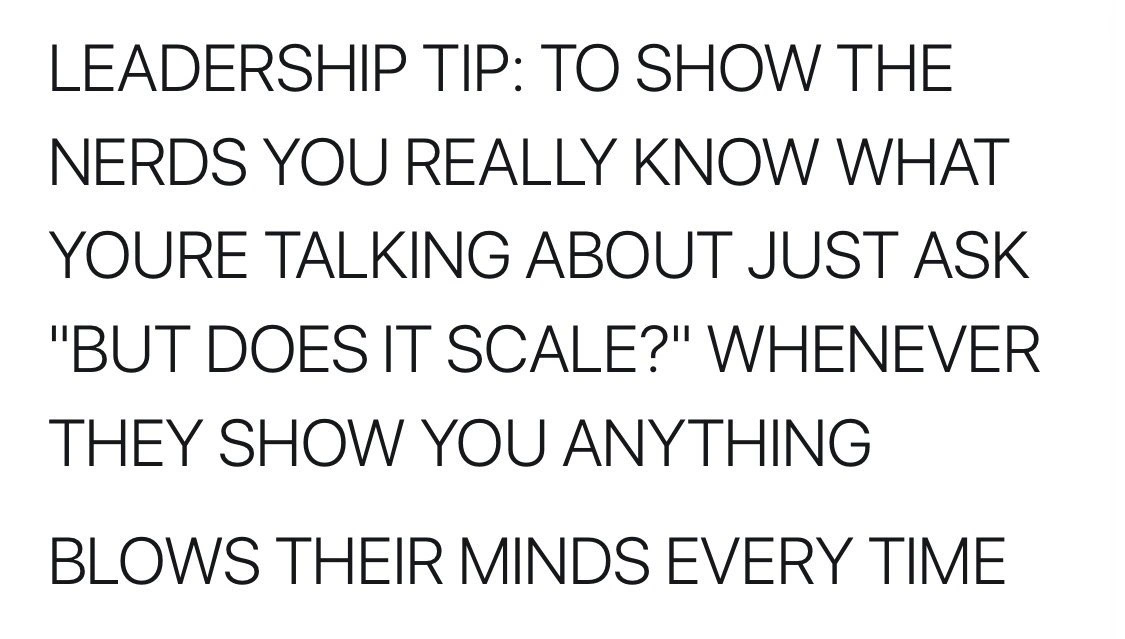
Now, the funny part of this meme is how the phrase “Does it scale?” is used. Often, it’s a very valid question in engineering – we do need to consider if our solutions can handle future growth. But here, it’s used as a joke about managers. The meme jokes that a non-technical manager, who might not understand all the technical details, will ask “But does it scale?” almost automatically whenever an engineer shows them something new. Why? Because they know it’s a smart-sounding question. It’s like a shortcut to seeming knowledgeable. The meme’s text even frames it as a “LEADERSHIP TIP,” implying that any boss can impress the engineers (playfully called “the nerds” in the meme) by tossing out this question every time. Of course, in reality, engineers are used to hearing it, so it doesn’t actually blow their minds at all.

This setup is a classic bit of management humor rooted in corporate culture. In many companies, there’s a bit of a gap between management and engineering teams. Managers (like project managers or executives with a business background) often focus on the big picture, while engineers focus on the technical details. Because of this gap, managers sometimes rely on popular tech phrases to participate in conversations. These popular phrases are often called buzzwords. A buzzword is a trendy term that people use to sound informed or modern. For example, words like “synergy,” “the cloud,” or “AI” become buzzwords when folks throw them around without much context. “Scalability” (or saying something works “at scale”) has become one of those buzzwords in tech.

So when a manager keeps asking “Does it scale?”, engineers might grin because it feels like the manager is just using a buzzword rather than getting into specifics. The engineers might be thinking, “We’re just showing you a login screen... scaling isn’t an issue yet.” But the manager asks it anyway to cover their bases. It’s a bit of a miscommunication: the manager wants to show they care about the product’s future (which is a good thing), but by always defaulting to that same question, they sometimes miss the point of what’s being presented.

The meme’s phrase “blows their minds every time” is an obvious exaggeration for comedy. In truth, when an engineer hears a boss ask “But will it scale?” for the umpteenth time, their mind isn’t blown – they’re probably just politely answering and maybe sharing a knowing look with teammates. The humor comes from the fact that the manager thinks they’ve asked a deep, important question, but to the developers it’s kind of obvious or even premature. It’s like if you showed someone a cute little treehouse you built, and they responded, “But can it fit 100 people?” You’d laugh because that question misses the point of your small project.

Engineers even joke about this with a game called Buzzword Bingo. In tech company meetings, Buzzword Bingo is when people draw a bingo card and fill the squares with common buzzwords or catchphrases they expect to hear. Every time a manager says one – like “synergy,” “blockchain,” “machine learning,” or “does it scale” – you mark that square. If you get a whole row, you (silently) celebrate bingo. It’s a playful way to poke fun at how predictable these phrases can be. The fact that “Does it scale?” is typically on that bingo card shows you how common (and joke-worthy) that question has become.

In simple terms, this meme highlights an inside joke in the tech world. It says: some managers try to look smart in front of the tech team by always asking about scalability. The engineers aren’t truly impressed because it’s such a routine, catch-all question. The meme exaggerates it as if this trick “blows the engineers’ minds” every time. The reality is the engineers usually just think, “Here we go again,” and then explain whether scaling is relevant or not. It’s a lighthearted poke at the difference in perspective between managers and engineers – one side is trying hard to impress with a big buzzword, and the other side is quietly laughing because they’ve heard it all before.

Level 3: The Buzzword Gambit

Ah, the age-old leadership hack: when in doubt, ask “But does it scale?” as your trump card. This meme zeroes in on a classic Management vs Engineering standoff and a bit of buzzword-driven corporate culture theater. In many tech organizations, non-technical managers or executives with MBAs adopt this manager buzzword strategy to feign architectural insight. They’ve learned that scalability is a magic word that instantly sounds visionary. By dropping the word scale at every presentation, they hope to dazzle “the nerds” on the team and mask their own superficial technical insight.

From a senior engineer’s perspective, it’s equal parts amusing and exasperating. We’ve all been in those design reviews or sprint demos where a higher-up, who might not know a CPU from a GPU, leans back and drops the one-size-fits-all question: “But does it scale?” It’s the ultimate safe query in tech management. Scalability is indeed important – no engineer denies that – but context is key. A veteran dev immediately recognizes when “Does it scale?” is being asked earnestly versus when it’s just empty buzzword bingo filler. The meme’s bold all-caps text even mimics how emphatically such leaders deliver this line, as if they’ve brilliantly uncovered the one concern the nerds never considered.

What makes this so humorous to an experienced dev is the disconnect. Real scalability discussions involve concrete specifics: “Can our data pipeline handle a 10x increase in events per second?” or “Should we design for horizontal scaling with load balancers and stateless microservices?” These are meaningful queries. But a vague “Does it scale?” without context is just leadership theater. It’s akin to asking “Will it work on the cloud?” or “Are we using AI?” – broad enough to sound insightful, yet empty enough to reveal nothing. The engineer’s mind might flash to all the gritty realities of scaling (like concurrency bugs, database sharding, CAP theorem trade-offs, caching and load-balancing woes) while the manager likely wouldn’t know horizontal scaling from a horizontal line.

There’s an undercurrent of shared trauma here. Many devs have seen projects go awry when leaders obsessed over scaling from day one for an imaginary million users (leading to months of over-engineering), only for the product to struggle to get a thousand real users. That’s the painful irony: often the loudest “But does it scale?” champions push premature optimizations that derail a project. Other times, they ask the question and feel their job is done – tick the visionary leadership box – while the team is left sighing and scrambling to address a problem that might not even exist yet. We laugh at this meme because it rings too true: it captures that moment of miscommunication where leadership’s superficial engagement collides with engineering’s practical reality.

It’s simultaneously funny and frustrating. Funny, because this scenario has become a running gag; frustrating, because it rarely adds value to the discussion. In fact, it's so predictable that developers have turned it into a coping game of Buzzword Bingo. They’ll fill a bingo card with all the typical leadership catchphrases and check them off as they inevitably get uttered. For example, a meeting’s bingo card might include:

  • “Does it scale?” – center square, of course.
  • “Leverage synergy” – the classic corporate filler.
  • “Cloud-native solution” – just add cloud, instant innovation.
  • “Machine learning” – because apparently everything needs AI now.
  • “Paradigm shift” – to round out the buzzword buffet.

If an engineer silently marks off a full row, they’ve “won” – or perhaps lost, considering what they just endured. By now, “Does it scale?” is practically a guaranteed square on these cards.

Let’s be clear: scalability does matter in software architecture – building systems that can handle growth is a real concern. But effective leadership means understanding when and how to discuss it. The meme satirizes leaders who skip that nuance. They want the prestige of sounding technically insightful without doing the homework. And hey, from their perspective this hack “works” – no one in the room can deny the importance of scale. It’s the perfect safe question to avoid looking ignorant. Yet for the engineers who live and breathe the system, it’s a facepalm moment. We’re thinking: “Sure, boss, it runs on my machine... did you want me to simulate 10 million users for this login form?” The comedic spark is in that contrast between form and substance – using a heavyweight concept scalability as a lightweight party trick.

Ultimately, this meme is poking fun at a leadership habit where sound bites substitute for real insight. It resonates with senior devs because we’ve all witnessed this Buzzword Gambit in action. We chuckle (perhaps a bit cynically) because behind the joke is a real culture gap – the ManagementHumor of a manager trying to impress versus the TechHumor of engineers rolling their eyes. And just to bring it full circle, someone online already quipped: “But does this tip scale?” 😏 Spoiler alert: if every boss starts parroting this line, its impact will wear off faster than a poorly optimized server under peak load. In other words – no, that cheeky leadership hack doesn’t really scale.

Description

This is a text-based meme presented as a piece of sarcastic advice. On a plain white background, black, sans-serif, all-caps text reads: 'LEADERSHIP TIP: TO SHOW THE NERDS YOU REALLY KNOW WHAT YOURE TALKING ABOUT JUST ASK "BUT DOES IT SCALE?" WHENEVER THEY SHOW YOU ANYTHING BLOWS THEIR MINDS EVERY TIME'. The humor is derived from its cynical accuracy. For experienced engineers, 'scalability' is a critical, nuanced architectural concern involving trade-offs in performance, cost, and complexity. The meme mocks non-technical managers or stakeholders who learn this single buzzword and use it as a blunt, context-free weapon in every technical discussion, often to critique a proof-of-concept or a feature where massive scale isn't yet a relevant concern. It perfectly captures the frustration of having a complex technical presentation derailed by a superficial, catch-all question designed to make the asker sound smart rather than to facilitate a meaningful discussion

Comments

23
Anonymous ★ Top Pick My project is a script that emails me when the daily build fails. When my manager asked if it scales, I said 'Absolutely. It can fail in every region, on every commit, and across multiple cloud providers. The failure notifications will scale perfectly.'
  1. Anonymous ★ Top Pick

    My project is a script that emails me when the daily build fails. When my manager asked if it scales, I said 'Absolutely. It can fail in every region, on every commit, and across multiple cloud providers. The failure notifications will scale perfectly.'

  2. Anonymous

    It scales horizontally: one director says it, then it shards across the org until every meeting is eventually consistent in cluelessness

  3. Anonymous

    The irony is that after 20 years in the industry, you realize the correct answer to 'Does it scale?' is always 'Not without a complete rewrite, but we'll cross that bridge when we're lucky enough to have that problem.'

  4. Anonymous

    The scalability question: where non-technical leadership goes to die on the hill of appearing technically competent. Bonus points if they follow up with 'What's our strategy for handling millions of users?' when you're still trying to get your first hundred. Experienced engineers know the real power move is asking about observability, failure modes, and operational complexity - but that requires actually understanding the system architecture, not just parroting the same concern that worked in 2015 when everything was being 'webscale.'

  5. Anonymous

    'Does it scale?' - the PM's CAP theorem grenade that turns a 5-min demo into a distributed systems symposium

  6. Anonymous

    Sure, it scales - once you define whether you mean QPS, data volume, org chart, or the cloud bill

  7. Anonymous

    “Does it scale?” without a workload model is management’s N+1 query - easy to ask, pathological in prod

  8. @obemenko 4y

    What the actual fact this shit means

    1. @RiedleroD 4y

      when stuff doesn't work on a large scale (i.e. when many people use it), then it doesn't scale well. For example: internet radio scales worse than regular radio

      1. @SrZorro 4y

        Why would internet radio scale worse than regular radio? With regular you have to build radio stations (or lease from others) to scale a radio on the internet should be fairly easy, deploy more servers and call it a day

        1. @daniilfurgen 4y

          It's cheaper to build one big radiotower and some retransmitters than having lots of servers and internet coverage

        2. @RiedleroD 4y

          radio sends the data once, if the amount of receivers in a radius increases, the sender doesn't care. In the case of internet in general, if the amount of clients increases, server load and bandwidth usage increases dramatically

          1. @CcxCZ 4y

            Yeah, we don't have any "good" multicast solution. We do have IP multicast though which ironically has very similar limitation to regular radio transmission: limited number of bands/channels you can use in one area. Or one ISP. Those that provide IPTV tend to use that.

            1. @sylfn 4y

              create ipv6 multicast - way more addresses available

              1. @sylfn 4y

                * forgot that i have only ipv4, but its white

                1. dev_meme 4y

                  That's still much better than hundreds of public ipv6

  9. @obemenko 4y

    Understandable

  10. @prkiso 4y

    Multicast?

    1. @lexore 4y

      in the internet?

  11. @sylfn 4y

    No one here.

  12. @RiedleroD 4y

    hey, I know where this gif is from

    1. @Agent1378 4y

      Are you old too?😁

      1. @RiedleroD 4y

        no, I just recently got this movie recommended (but I didn't watch it yet)

Use J and K for navigation