A Punny Joke About Hungarian Currency and Data Types
Why is this Languages meme funny?
Level 1: Whole Coins Only
Imagine you have a piggy bank with only whole coins – no half coins, no smaller change, just whole coins. If something costs 5 coins, you pay 5 coins, not 5 and a half or 5.75 coins. In Hungary, their money (called the forint) works kind of like that: you pay with whole forint coins (or bills) and there are no cents. Now, think of numbers: a whole number is like counting whole coins (we call that an integer), and a number with a decimal point (like 5.5) is like saying “5 and a half” of something (we call that a float in coding). The joke in the picture is saying: in Hungary they use forint (which sounds like “for int,” meaning for whole numbers) and not “forfloat” (which is a made-up word to sound like “for float,” meaning not for fractional numbers). The husky dog is basically making a silly nerd pun. It’s funny because it mixes money and computer talk: “forint, not forfloat” is like saying “they use whole number money, not fractional funny money.” The dog’s big goofy grin in the last picture shows that it knows it made a super corny joke. You might groan, but you can’t help but smile a little, because it’s a playful way to say “Hey, in this country they don’t even need decimals!” It’s a simple pun that makes people who know about coding chuckle, kind of like a secret handshake between money and math.
Level 2: Forint vs Float
Let’s break down why this punny meme is funny, especially if you’re newer to coding. First, the context: Hungary’s currency is called the forint. Unlike dollars or euros that have cents, the forint doesn’t use any smaller coins – you won’t see prices like 3.99 Ft; it’s usually a whole number. Now, in programming, we have different ways to represent numbers. An int (short for integer) is a number with no decimal point – just whole numbers like 1, 42, or 1000. A float (short for floating-point) is a number that can have a fractional part, like 3.14 or 2.5. The meme’s joke is comparing these two ideas: Hungary’s prices are whole numbers (like an int), not numbers with fractions (like a float). The text “forint, not forfloat” is wordplay: “forint” sounds like “for int” (for integer) and they made up “forfloat” to sound like a currency that uses a float. It’s as if the husky is explaining Hungary’s pricing in programming terms: they chose an integer type of money, not a floating-point type of money.
This is a classic bit of coding humor. If you’ve learned about data types, you know how important the int vs float distinction is. For example, consider how 2 divided by 3 might be handled: as an integer you’d get 0 (if you only keep whole numbers), but as a float you’d get 0.666…, which shows floats handle fractions. Floats are super useful, but they come with some quirks. One quirk is that they sometimes produce long decimal results due to how computers store them. A beginner might be surprised that in many languages 0.1 + 0.2 doesn’t exactly equal 0.3 – you might get something like 0.30000000000000004. It’s a tiny difference, but it’s there because floats aren’t perfect with decimals. This meme hints at that problem in a joking way: by saying Hungary pays in “for int,” it implies wouldn’t it be nice if everything was just integers so we avoid those funny float decimals? In real life, Hungary’s money system actually does avoid decimal cents, which is kind of neat from a programmer’s perspective.
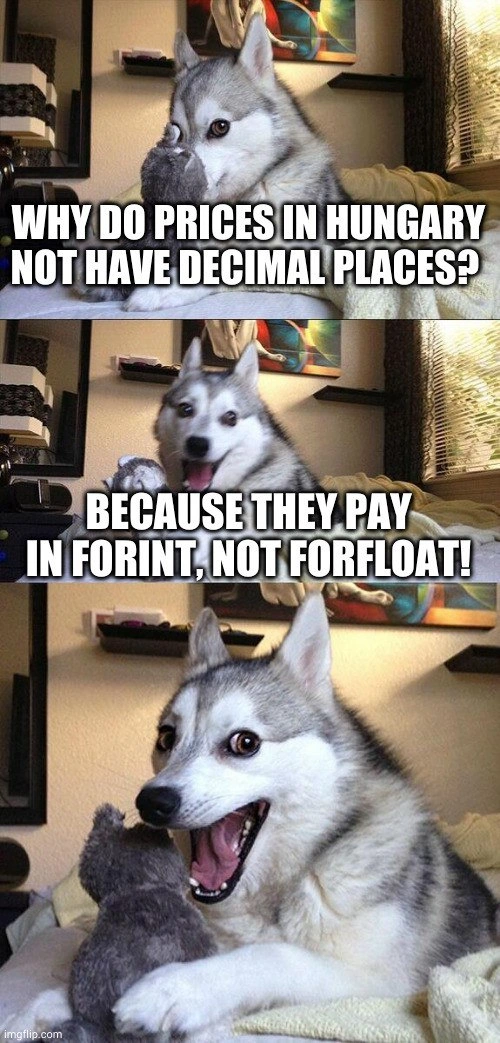
The image itself, known as Bad Pun Husky, is famous in meme culture for corny jokes. It’s always a husky with a goofy grin telling a bad pun that makes you groan and laugh at the same time. In the panels here, the husky first asks a serious-sounding question: “Why do prices in Hungary not have decimal places?” – setting you up to think about economics or currency. The second panel starts the answer: “Because they pay in forint…” – okay, that’s just a fact, right? But then comes the punchline: “…not forfloat!” The husky has this big excited face because it knows it just dropped a decimal_places_joke. The humor comes from the unexpected twist: it turns a normal fact (“they pay in forint”) into a programmer pun (forint vs for float). It’s the kind of joke you only get if you know both the currency fact and the programming terms. For a junior developer or someone learning to code, it’s a fun reminder of what an int and a float are. You might even recall your instructor warning, “be careful using floats for money!” Here, the meme creatively connects that lesson to a real-world example. It’s relatable humor because many of us have had that moment of confusion about floats (“Why is my calculation slightly off?”) and then the realization, “oh, it’s a floating-point rounding thing.” Seeing a silly dog meme about it makes the topic memorable and shows that even nerdy details like data types can be a source of jokes. Plus, who doesn’t love a good(bad) pun? The forint_vs_float gag is one you might even try on your coding friends to see them facepalm and chuckle.
Level 3: Exact Change Only
This meme packs a double whammy of currency trivia and programming humor that makes seasoned developers smirk. In Hungary, prices are typically whole numbers with no decimal places – if something costs 1000 forint, it’s just 1000, not 1000.00. The meme’s punchline riffs on this by saying they pay “in forint, not forfloat,” which sounds like “for int, not for float.” It’s a type pun: int (integer) versus float (floating-point number). In code, an integer is a whole number (no fractional part), whereas a float can have a decimal fraction. The Hungarian Forint conveniently contains the word “int,” hinting it’s an integer-only currency. The bad-pun husky gleefully implies that Hungary’s pricing is literally for ints (whole values) and not for floats (not fractional values). It’s a classic currency_precision_pun delivered as a cringe-worthy dad joke, and the husky’s triumphant grin in the third panel sells the so-bad-it’s-good payoff. Experienced devs recognize this as a playful hat-tip to a CS fundamental: how numeric types handle decimals, or in this case, how they don’t.
On a more technical level, the joke highlights a serious point about floating-point arithmetic that senior engineers know all too well. Floating-point numbers (float or double types in many languages) are stored in binary with limited precision, which means they can’t exactly represent many decimal values. Every developer has seen weird artifacts like 0.1 + 0.2 not quite equaling 0.3 due to tiny binary rounding errors. Storing currency in a float can lead to phantom cents appearing or disappearing because 0.01 (one cent) isn’t represented precisely in binary. In practice, “for int, not for float” is solid advice: financial applications often use integers (like counting cents, or in the forint’s case just counting whole forint units) or specialized decimal types to avoid the floating-point fiascos. An integer can represent money in the smallest unit exactly (100 coins with no fractions is exactly 100), whereas a float might make 100 * 0.01 turn into 0.9999999… and require careful rounding. Seasoned developers have battled these rounding bugs – from misaligned invoice totals to penny-off errors in interest calculations – and learned that using an integer type for currency is usually the safer bet. The LanguageQuirks tag fits here: different programming languages handle numeric precision differently, but nearly all of them will surprise you if you treat binary floats the same as decimal math. For example, in Python or JavaScript:
price_total = 0.1 + 0.2 # adding two floats (in dollars, for example)
print(price_total)
# Output: 0.30000000000000004 (Oops, not exactly 0.3!)
That tiny extra 0.00000000000000004 is the computer struggling with base-2 fractions – a quirk of floatingPointArithmetic that every coder bumps into. By contrast, if we counted in all pennies as an integer, we’d get exactly 30 cents with no surprise decimals. The meme jokingly suggests Hungary preempted this whole issue: no decimals in the currency means no floating-point drama! It’s humor, of course – Hungarian prices aren’t designed for coding, but the coincidence is perfect for developer humor. This decimal_places_joke resonates because it’s too real: we’ve sat in code reviews debating float vs int for money, or chased a bug where a total came out $0.01 off. When the husky asks “Why do prices in Hungary not have decimal places?”, every programmer who’s dealt with currency calculations can practically hear the unspoken answer: because decimals are a pain in code. And then the meme delivers the punch: “Because they pay in forint, not forfloat!” – simultaneously answering the question literally (they use forint currency) and cracking a type-system joke (use an int, not a float). It’s a groaner and a high-five moment in one.
Beyond the wordplay, there’s an undercurrent of best practice here that senior devs appreciate. Historically, the industry learned about float pitfalls the hard way – early financial software using binary floating points ran into rounding errors, so modern guidelines often insist on integer math for money (or using libraries for decimal math). Some languages introduced fixed-point or decimal types (like Python’s Decimal or Java’s BigDecimal) to handle currency precisely. But the simplest route, taken by many systems, is just to use an integer count of the smallest unit – exactly what you’d do for Hungarian forint since there is no smaller unit. It’s as if reality aligned with programming ideals: an integer_pricing system free from fractional pennies. Seasoned engineers find that oddly satisfying. The forint_vs_float pun is a lighthearted reminder that sometimes the real world can be modeled in code without messy fractions – a rare treat! And using the Bad Pun Dog meme format to convey it is the cherry on top. The husky’s progressively goofy expressions mirror how a dev might feel setting up an elaborate joke and then reveling in the punchline. In short, this meme hits on multiple levels: a linguistic pun, a computer science in-joke, and even a hint of software-design wisdom. No wonder it’s relatable humor in coding circles – it takes a mundane fact about Hungarian currency and elevates it into a type-check gag that only folks fluent in programming and world currencies would fully appreciate. It’s the kind of niche joke that makes you both facepalm and laugh, which is basically the definition of great DeveloperHumor.
Description
This meme uses the 'Pun Dog' or 'Bad Joke Husky' format, which features a husky telling a corny joke in three panels. In the first panel, the husky has a thoughtful expression, posing the setup: 'WHY DO PRICES IN HUNGARY NOT HAVE DECIMAL PLACES?'. The second panel shows the husky with a playful, smiling look, delivering the punchline: 'BECAUSE THEY PAY IN FORINT, NOT FORFLOAT!'. The third panel shows the husky with a wide-eyed, goofy grin, representing the laughter after a cheesy joke. The humor is a multilingual pun combining the Hungarian currency, the Forint, with the programming data types 'int' (integer) and 'float' (floating-point number, which can have decimals). Forint sounds like 'for int', creating a clever, if groan-inducing, joke that only developers with some knowledge of both international currency and basic programming concepts would appreciate

Comments
14Comment deleted
I tried to buy a coffee in Budapest with a double, but they said they only accept exact change
Hungary quietly solved monetary precision by choosing a unit that fits in a signed 64-bit int - leaving the rest of us drafting yet another RFC on why 0.1 + 0.2 is “context‐dependent.”
This is why financial systems still use fixed-point arithmetic - not because of Hungary, but because IEEE 754 floating-point can't accurately represent 0.1, and nobody wants to explain to the CFO why their quarterly reports are off by 0.0000000001 cents due to rounding errors in JavaScript
This meme perfectly captures the essence of type system pedantry that every senior engineer has weaponized in code reviews. The joke works on multiple levels: it's a legitimate observation about Hungarian currency (the forint genuinely has no subdivisions in common use), while simultaneously being a groan-inducing pun about primitive data types. It's the kind of joke that makes you simultaneously appreciate the cleverness and question whether you've spent too much time in strongly-typed languages. The real kicker? In production systems handling Hungarian transactions, you'd actually use a decimal type for currency to avoid floating-point precision errors - making this both a pun AND a subtle reminder of why financial calculations should never use floats. The dog's escalating enthusiasm mirrors how we feel delivering these puns in Slack at 2 AM during an incident
Hungary is that rare edge case where the PM’s 'no decimals' story passes QA - store HUF as scaled int/BigDecimal, not double, unless you enjoy auditing phantom cents
Hungary's forint: the rare currency that sidesteps float precision pitfalls - no bank runs from rounding errors
Money is an int with a scaling factor; Hungary just sets scale=0. If your code says price: float, prepare to teach the CFO why 0.1 + 0.2 ≠ 0.3 HUF
Lol thats really good Comment deleted
Is it true Comment deleted
Thats totally the reason. /s Also in Hungary there is no 1 and 2 Forint. So it will be rounded to the next 5Ft Comment deleted
@RiedleroD Comment deleted
? Comment deleted
If inflation continues, they'll pay in FORLONG soon. 😂 Comment deleted
Yes xD Comment deleted