Remote Work: The Public Stance vs. The Private Reality
Why is this RemoteWork meme funny?
Level 1: Work From Home, Feel Alone
Imagine you and your classmates get to stay home from school every day. At first, you’re super excited – no early alarm, you can play video games whenever you want, and you even joke about how silly it would be to actually want to go back to school. You might tease a friend who says, “I miss seeing everyone at school,” by saying, “Ha, why would you miss school? Staying home is way better!” That’s like the developers in this meme bragging about working from home and poking fun at people who miss the office.
But now think about what happens after you’ve been home alone for a long time. You wake up and you don’t see your friends or teachers – there’s no recess to chat or play, no lunch period to sit with buddies. You’re in your room or at the kitchen table all day with just your computer. After a while, you start feeling lonely and sad. You realize you actually miss the routine: walking to class, laughing with your friend about a silly joke, even raising your hand to ask the teacher a question. Without any of that, you feel a bit like Tom the cat in those pictures – gloomy, tired, and pretty depressed. Maybe you start eating junk food or drinking soda after soda because you’re bored or stressed, kind of like Tom with all those bottles around him. You keep telling everyone “I love being home, it’s awesome!” because you don’t want to admit that you might actually miss school. But deep down, you do feel isolated and unhappy.
This meme is exactly about that feeling. On the outside, the developers are acting tough and saying “Work from home is the best, who needs the office!” (just like you bragging about skipping school). On the inside, though, the developers are feeling lonely, burned out, and blue (just like you eventually feeling lonely at home without friends). It’s showing us that sometimes we pretend something is great even if it’s making us sad, because we don’t want to seem weak or different. The funny cartoon pictures help us laugh a little, but the message is simple: too much time alone, even if we thought we wanted it, can make us really unhappy. And that’s why the meme is both funny and true – it reminds us that working (or studying) from home all the time might not be as perfect as it sounds, especially when you start to miss the people and structure you used to have.
Level 2: Remote Reality Check
So, what’s going on here for those newer to the developer life? This meme is contrasting what developers say about working remotely with how they might actually feel inside. Let’s break down the basics and the tech lingo:
Remote work (often abbreviated as WFH for “Work From Home”) means doing your job from your house (or anywhere outside the office) using the internet and a computer. Since 2020, almost every software engineer has tried WFH due to the pandemic. At first, it sounds amazing: no morning commute in traffic, you can wear comfy clothes like sweatpants, and you have more freedom to set your schedule. Many developers genuinely enjoy these perks and have been saying things like “Why would anyone want to go back to the office? Remote life is great!” This public attitude of loving RemoteWork is what the top caption of the meme refers to — developers “making fun of people who want to get back to work in office.” It’s a bit like lighthearted teasing: “Haha, imagine wanting to sit in a cubicle when you could be coding from your couch!”
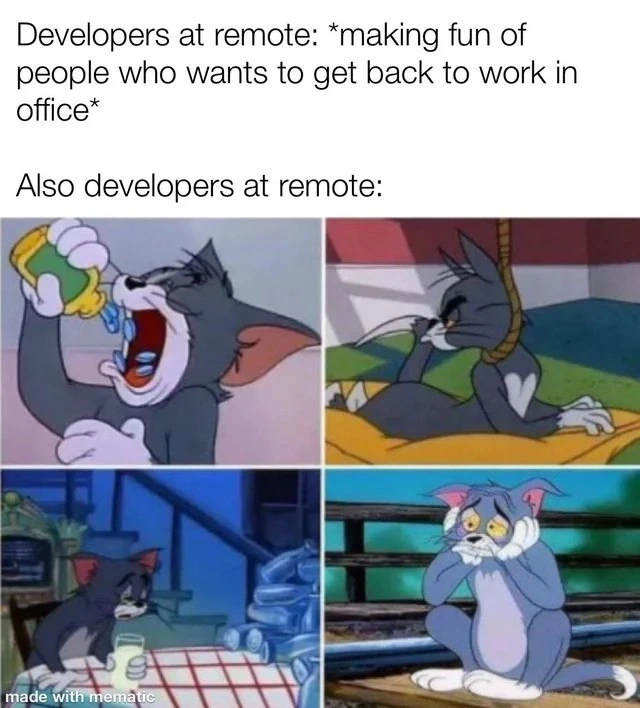
However, the meme then shows the other side: “Also developers at remote:” followed by four pictures of Tom, the cartoon cat from Tom & Jerry, looking absolutely miserable. These images are exaggerated for comedic effect, but they represent the real challenges many developers face with prolonged WorkFromHome stints. Let’s go through the panels one by one and relate them to a developer’s reality:
Tom chugging medicine from a bottle: In this first panel, Tom is shown tipping a bottle back and gulping down what looks like medicine or some potion. For a developer working remotely, this is a metaphor for coping mechanisms. Often, devs joke about surviving work with lots of coffee or even stronger stuff like energy drinks. Some might half-jokingly say, “I’m on my third cup of coffee and it’s not even noon!” The image could also hint at less healthy coping habits – like relying on painkillers for the headache from too many Zoom calls, or needing a swig of cough syrup or alcohol to calm nerves. In essence, it represents a remote dev trying to self-medicate stress or exhaustion. This panel introduces the idea that while they outwardly boast about WFH, privately some developers are struggling and trying to “feel better” with these quick fixes.
Tom lying in bed with a noose above him: This is a surprisingly dark image – Tom is on his back looking defeated, and above him hangs a noose. In a cartoon, such imagery is shocking, but here it’s used to symbolize extreme sadness or depression. For a remote developer, this can relate to feelings of isolation and hopelessness. Imagine working alone in a room for months – it can really impact your MentalHealth. This picture says that some WFH devs feel so low and lonely, it’s like they’re at the end of their rope (figuratively speaking). Of course, it’s shown in a cartoonishly dramatic way – developers aren’t literally setting up nooses – but it emphasizes feelings of despair. In real life, a developer might experience burnout so severe that they have trouble getting out of bed or feel a pit of dread on Monday morning. The meme boldly visualizes that internal pain to make a point: DeveloperAnxiety and depression can hit hard when you’re isolated. (If you’ve heard of the term “WFH blues,” it means the sadness or down feelings from working alone at home too long. That’s what’s depicted here.)
Tom slumped at a table with a tower of empty bottles: In the third panel, Tom looks drained, resting his head in one hand at a kitchen table. In front of him is a huge stack of bottles – since it’s a Tom & Jerry cartoon, those are likely empty milk bottles (Tom loves milk). But visually, it reminds us of someone who might have a pile of beer bottles or energy drink cans after a long night. For a remote developer, this image touches on a couple of things. First, physical exhaustion: see how Tom looks like he hardly has the strength to sit up? Remote developers often work longer hours than they mean to, because there’s no clear “office closing time.” It’s easy to lose track of time when your workstation is at home – you might fix “just one more bug” and suddenly it’s midnight. Those bottles could represent countless cups of coffee or soda consumed to stay awake. Second, it hints at unhealthy habits: maybe the dev hasn’t been eating well (just snacking and drinking sugary drinks) or maybe, feeling lonely, they had a bit too much alcohol one night. In simple terms, this panel shows a developer who is burned out – extremely tired and possibly using substances (even if it’s just lots of caffeine) to cope. It’s the opposite of the cheerful image of a remote worker chilling in pajamas; it’s the hidden side where the remote worker is exhausted and not taking care of themselves.
Tom sitting outside looking sad and exhausted: In the final panel, Tom is outdoors, but he’s not enjoying it. He has a thousand-yard stare, baggy eyes, and a frown. This represents the emotional and mental toll after a long period of remote work stress. The developer here has reached a point of pure frustration and loneliness. Maybe they stepped outside to get some fresh air (since being cooped up indoors all day is a problem when working from home), but it hasn’t improved their mood. This is the meme’s way of concluding: “Look, our poor remote developer is utterly sad now.” It highlights feelings like isolation (missing coworkers and office friends), boredom (every day at home feels the same), and fatigue (tiredness that isn’t just physical but also mental). At this stage, a real-life developer might start questioning, “Do I actually miss the office a bit? At least I used to laugh with teammates or have someone to talk to.” Tom’s sad face is basically the private truth many wouldn’t post on social media: WFH can sometimes make you miserable, even if you don’t admit it publicly.
Overall, these images are showing remote_dev_isolation in a very visual, cartoonish way. The meme’s text and images together create a little story: Developers publicly act like remote work is 100% awesome, but in reality, a lot of them are feeling depressed and burned out. It’s a commentary on workplace humor and the current state of tech work culture.
Now, let’s connect this to real developer life and some terms:
Communication: One big challenge in remote work is communication. In an office, if you have a question or want to discuss something, you can walk over to a teammate’s desk or bump into them and chat. Remotely, you have to use tools like Slack (a chat app for workplaces) or Microsoft Teams, or schedule a Zoom video call. This can be harder, especially for new developers. Tone and context can get lost in text – you can’t see if someone is smiling or hear their voice tone in a short message. This sometimes causes misunderstandings or makes people more hesitant to ask questions (nobody wants to be the one sending ten Slack messages in a row). Also, waiting for replies (asynchronous communication) can slow things down and leave someone feeling stuck and alone. The meme doesn’t show computers or chat apps, but the feelings Tom has could very well come from struggling with these communication hurdles. For instance, imagine Tom (the developer) has a bug he can’t solve; at the office he might swivel his chair and ask a senior dev for help. At home, he might post the question in a chat and then…wait. And if no one answers quickly, he grows frustrated or feels isolated with the problem. That “I’m on my own” feeling can contribute to the anxiety portrayed in the meme.
MentalHealth: The tag MentalHealthInTech is directly relevant here. “Mental health” refers to our emotional well-being – feeling okay, handling stress, not being overwhelmed by anxiety or sadness. In tech jobs, especially during the big shift to remote work, mental health became a huge topic. Working alone can be depressing for many people. Humans are social creatures; even introverted developers often benefit from some face-to-face interaction, a routine, and a change of environment. Without those, it’s easy to feel lonely. Burnout is a term mentioned a lot: it’s when someone feels extreme work-related stress or exhaustion to the point that they become less effective at their job and emotionally drained. Think of it like a battery that’s run down – you lose motivation and energy. All four of Tom’s images basically scream “burnout” in different ways. Developers might joke about being “burned out on remote,” but it’s a real concern. Some companies started to realize their employees were reporting more depression, anxiety, or burnout symptoms after long periods of WFH. The meme is a form of WorkplaceHumor that actually shines light on these mental health issues — by using dark comedy (a cartoon character in grim situations) to say what some developers might be afraid to admit openly.
CorporateCulture: This phrase refers to the personality or vibe of a company – how people interact, what values are encouraged, and what the everyday atmosphere is like. Remote work has a big effect on corporate culture. For example, a company might have had a fun culture with team lunches, Friday afternoon happy hours, ping-pong in the break room, etc. When everyone went remote, those things disappeared or went virtual (ever heard of a “Zoom happy hour”? It’s as awkward as it sounds). New cultural norms emerged: maybe a flurry of Slack emoji reactions became the new way to show appreciation, or virtual game sessions tried to replace in-person chats. Some developers loved escaping what they saw as superficial office culture (no more forced small talk or distracting ping-pong games if you don’t want them). But others started to feel that the company culture became impersonal when remote – it’s harder to feel like a team or a family when you’re just squares on a video call. The meme’s contrast hints at this: devs joking about not needing the office might actually be missing the sense of belonging or community that came with it. In simpler terms, the “culture” of a workplace can suffer when everyone is isolated, and that can make people (like our Tom cat developer) feel less motivated and more down.
Now, why is this meme especially relatable pain and DeveloperHumor? Because it’s basically an inside joke among developers living the remote life. It calls out a little hypocrisy in a funny way: lots of us were bragging “remote life is the best life,” while simultaneously feeling the RemoteLife blues day by day. The use of Tom & Jerry cartoon images adds a layer of nostalgia and comedic exaggeration, which makes a tough topic (like developer anxiety and burnout) easier to laugh at and discuss. In developer communities (Reddit, Twitter, Slack groups), you’ll often see memes like this – they’re a way to vent and bond over shared struggles. It’s much easier to post a meme of Tom looking miserable and get a few “so true…” responses than to openly say “Hey, I’m feeling lonely working from home, anyone else?” The meme format lets people acknowledge the problem with a bit of humor.
In summary, the meme is highlighting the satire_of_wfh_burnout: it satirizes or pokes fun at the overly rosy picture of remote work by showing the cartoon_depression_visual of a developer’s true state. For a newer developer or someone outside tech, the key takeaways are:
- Remote work has pros and cons: Devs often talk up the pros (flexibility, comfort) but may hide the cons (loneliness, burnout).
- It’s okay to feel conflicted: The meme basically says, “We all joked about hating the office, but hey, we secretly struggle with this remote thing.” It’s normal and many are going through it.
- Communication and mental health are challenges in WFH: Not seeing your team in person can make communication harder and isolation can affect your mood. The meme uses extreme cartoon scenes to drive that point home in a comedic way.
- Developers cope with humor: This is a form of DeveloperHumor – using an old cartoon character in a meme to express very modern tech workplace feelings. It’s both funny and a little sad, which is exactly the blend that resonates when something is “funny because it’s true.”
If you’re a junior dev or someone just now experiencing remote work, this meme is basically a tongue-in-cheek heads-up. It says: “Yes, we all joke that working from home is perfect, but don’t be fooled – everyone can have tough days (or months) when they feel like this.” It encourages a bit of empathy and self-awareness beneath the humor. The next time you see developers on social media bragging about remote life, remember Tom’s weary face in this meme – it might tell the real story of what’s going on behind the screen.
Level 3: Burnout Over Broadband
At the highest level, this meme exposes a harsh paradox of RemoteWork culture that seasoned developers recognize all too well. On the surface, many developers loudly champion Work From Home (WFH) as a superior lifestyle (no commute, comfy pajamas, more freedom). They snarkily mock colleagues who admit to missing the office, as if wanting to return on-site is old-fashioned or weak. The top text of the meme captures this bravado:
Developers at remote: making fun of people who wants to get back to work in office
*Also developers at remote:
That setup sets the stage for an ironic punchline. The four images of Tom (the famous cartoon cat from tom_and_jerry) in various states of despair reveal the hidden truth: those same remote-work warriors are quietly suffering from isolation and burnout. The humor lands because it’s satire of WFH burnout that rings true in tech circles – a classic case of “laughing outside, crying inside” that many veteran engineers have witnessed during extended stints of working remotely.
Why is this so relatable, especially by October 2021? By then, a lot of developers had been forced into an extended remote experiment (thanks to the pandemic), and the initial euphoria of skipping daily commutes and working in sweatpants was wearing thin. CorporateCulture narratives had shifted: one camp insisted remote was the glorious future of work, while another camp began voicing concerns about productivity and team cohesion. Many devs on Twitter and Slack proudly planted the flag of RemoteLife – posting photos of multi-monitor home setups and joking about “office lovers” stuck in the past. It was almost a tribal identity among developers to defend remote work as the ultimate perk. But behind that public DeveloperHumor, plenty of those same folks were hitting a wall of DeveloperAnxiety and loneliness after months away from any in-person interaction.
The meme’s images of Tom the cat function as darkly comic metaphors for this relatable pain. Each panel exaggerates a form of remote developer misery:
- Self-medication or quick fixes: In the first image, Tom is gulping some “medicine” straight from the bottle. This cartoonish scene echoes how a stressed dev might chug coffee or energy drinks like medicine, or resort to quick fixes (like popping anxiety pills or painkillers) to get through another isolated day. It symbolizes desperate coping mechanisms for stress and exhaustion.
- Despair and hopelessness: The second panel shows Tom literally lying in bed with a noose hanging overhead. This is a shockingly dark visual for a kids’ cartoon character, used here as an absurdist symbol of extreme burnout or suicidal ideation. It’s saying: “This is how bad it can feel when you’re alone with your work and your thoughts all day.” Seasoned devs know colleagues who’ve hit that kind of rock bottom – hopefully not as comically literal, but the MentalHealth toll of burnout is real. The noose image is an over-the-top way to represent feeling trapped and hopeless, as if remote isolation is squeezing the life out of the developer.
- Physical neglect or substance abuse: In the third panel, Tom slumps at a kitchen table next to a tower of empty bottles. In Tom & Jerry cartoons those are likely milk bottles, but here they unmistakably resemble empties from a heavy drinking binge. This hints at how a remote dev’s routine can degenerate: working late into the night, surrounded by leftover coffee mugs or beer bottles, forgetting self-care. It’s a nod to the unhealthy habits that can form when work and home blur together – perhaps living on junk food, not exercising, or drinking to destress. Experienced developers might chuckle grimly remembering crunch times where their desk looked similarly chaotic.
- Exhaustion and isolation: The fourth image shows Tom sitting outdoors, utterly exhausted and sad, with drooping eyes and a hollow expression. It’s the final stage of burnout: total depletion. No energy left to even pretend anymore. A remote developer might recognize this as that feeling of logging off a ten-hour day of Zoom calls and coding, then realizing they haven’t spoken to a real human being in person all week. Tom’s blank stare says it all – the RemoteWork blues have well and truly set in.
The genius of this meme is how it contrasts public attitude versus private reality for remote developers. This dual nature is something senior engineers often discuss candidly (in private chats or late-night venting sessions). Here’s a breakdown in more concrete terms:
| What Remote Dev Boasts Publicly | What the Remote Dev Actually Feels |
|---|---|
| “I love not having a commute!” | Struggles to unplug, works longer hours at home |
| “Office culture is pointless meetings.” | Misses spontaneous hallway chats & camaraderie |
| “I get to code in pajamas every day 😎.” | Feels slobbish, isolated, and low-energy 😔 |
| “We’re just as productive over Zoom.” | Suffers Zoom fatigue and miscommunications |
(Yes, even the productivity brag has a flipside: remote teams often face Communication hurdles – countless Slack pings, email threads, and video calls to synchronize, which can ironically diminish real productivity.)
For a seasoned developer, none of this is theory – it’s lived experience. They’ve seen how MentalHealthInTech can decline when everyone is remote. Productivity might look fine in Jira or commit logs, but under the hood people are burned out over broadband. The meme uses the famous slapstick cat-and-mouse duo to deliver this message with dark humor: Tom’s cartoon suffering is exaggerated enough to be funny, but it’s painfully relatable to any developer who has gone through long periods of remote isolation. It’s basically the 2021 developer edition of the old saying “Not all that glitters is gold.” Remote work glittered at first (and developers made fun of anyone who didn’t embrace it), but in reality it brought new problems that aren’t as laughable.
On a deeper level, this meme also pokes at CorporateCulture and the tech industry’s sometimes one-sided narratives. Tech companies in 2020-2021 often boasted how well remote was going – higher output, happier employees, less overhead. Many devs enthusiastically echoed that sentiment online. But whispering behind those boasts were very real issues: junior devs who felt adrift with no mentorship, teams that grew increasingly siloed and out-of-sync, and individuals dealing with anxiety or depression in lonely home offices. The satire here is that while we in tech love to portray ourselves as forward-thinking (“Offices are so past century, remote FTW!”), we sometimes collectively ignore the human need for social connection and structure. Even the toughest old-school engineer (the type who loves saying “I hate open office plans” or “I’d live in a cave with Wi-Fi”) can secretly suffer if every day is just them and a screen.
In summary, the highest-level insight is this: Remote work isn’t a silver bullet. This meme resonates with senior devs because it captures the dissonance between what we say about WFH and what we actually feel. It’s a knowing laugh at our own hypocrisy and pain. The humor works precisely because it’s true – as much as developers joke about preferring to be hermits with fast internet, we’re all human and long-term isolation hurts. And acknowledging that truth with a bit of dark cartoon humor is very much in line with how tech folks use DeveloperHumor to cope with real issues. After all, if you didn’t laugh, you might just end up like poor Tom in those pictures – and nobody wants to hang that on their status update.
Description
This is a two-part meme contrasting the public attitude of remote developers with their potential private struggles. The top text reads, 'Developers at remote: *making fun of people who wants to get back to work in office*'. Below this, the text 'Also developers at remote:' introduces a four-panel collage of scenes from the cartoon 'Tom and Jerry'. The images depict the character Tom in various states of extreme despair and self-harm: the top-left shows him swallowing a handful of pills, the top-right shows him with a noose around his neck, the bottom-left shows him looking dejected while drinking alone, and the bottom-right shows him sitting sadly on railroad tracks. The meme uses dark humor to highlight the potential negative mental health impacts of remote work, such as isolation, loneliness, and burnout, which can exist behind the facade of publicly celebrating the remote lifestyle. For senior developers, it's a grimly relatable take on the often-unspoken downsides of the work-from-home culture that is so prevalent in tech
Comments
12Comment deleted
I save two hours on my commute every day, which gives me two extra hours to stare into the abyss of my terminal and wonder if CI/CD now stands for 'Crippling Isolation and Despair'
Remote dev paradox: we brag about shredding the commute, then discover the real monolith was the work-life boundary we deleted in prod
We've successfully replaced water cooler conversations with Slack threads about water cooler conversations, achieving the same social awkwardness but now with read receipts and typing indicators
Remote developers: 'I'll never go back to the office!' *proceeds to work 12-hour days in pajamas, attend back-to-back Zoom calls without breaks, debug production issues at 2 AM from bed, and realize the office boundary between 'work' and 'home' was actually load-bearing infrastructure*
Remote killed commute latency but introduced a stealth memory leak - social isolation - so the human process hits OOM and the only autoscaler is espresso
Remote devs roast RTO until they realize the team is a partitioned cluster: Slack’s eventually consistent, decisions wait for quorum across three time zones, and there’s no circuit breaker for burnout - suddenly the office looks like a low‑latency monolith
WFH devs mock office drones while their own social graph returns connection refused
Nothing changed since office times Comment deleted
being lonely at home or being annoyed at the office... hard choice 😄 Comment deleted
*this post was sponsored by management team Comment deleted
More looks like managers after realising they're obsolete after remote is started. Comment deleted
Well that was me IN office. Comment deleted