The Brutal Reality of Learning Game Development, Two Tutorials In
Why is this Learning meme funny?
Level 1: Biting Off More Than You Can Code
Imagine a kid who dreams of being a famous chef after watching two cooking shows on TV. At first, he’s super excited: he’s telling everyone, “I’m going to open my own restaurant, and I’ll be the best chef ever!” That’s like the first panel of the comic where the person is excited to make video games and become a coding master. Now picture that same kid actually trying to cook his first real meal after those two shows. Let’s say he tries to make a fancy cake. But he quickly discovers cooking is not as easy as it looked on TV – the kitchen gets messy, the cake batter spills, and the cake comes out flat and burnt. After just this one attempt, he feels totally discouraged. He slumps down and says, “Maybe I’ll just deliver pizzas instead...” In other words, he’s thinking about doing a much simpler job related to food because being a master chef suddenly seems too hard.
This is exactly what’s happening in the meme, but with making video games instead of cooking. The person in the comic started with big dreams – becoming a great game designer and coder – but after trying a little, they realized it was going to take a lot more work than they thought. It’s funny and a little sad at the same time. We laugh because the change from huge dreams to giving up is so quick and extreme. But we also understand that feeling. It’s like when you try something new, think it will be easy, and then go “uh-oh, this is really hard.” The comic is showing that moment in a silly way: our hopeful game-maker is already imagining doing a totally different, easy job (delivering food) because coding a game felt overwhelming after just two lessons. In simple terms, the meme is joking that learning something complicated isn’t as easy as it looks, and sometimes when we get frustrated we feel like quitting and doing something easier. It’s a playful way to say, “Don’t worry, everyone feels overwhelmed at first – you’re not alone!” and it makes us smile because we’ve all been in that spot where our big dreams meet real hard work.
Level 2: Tutorial Reality Check
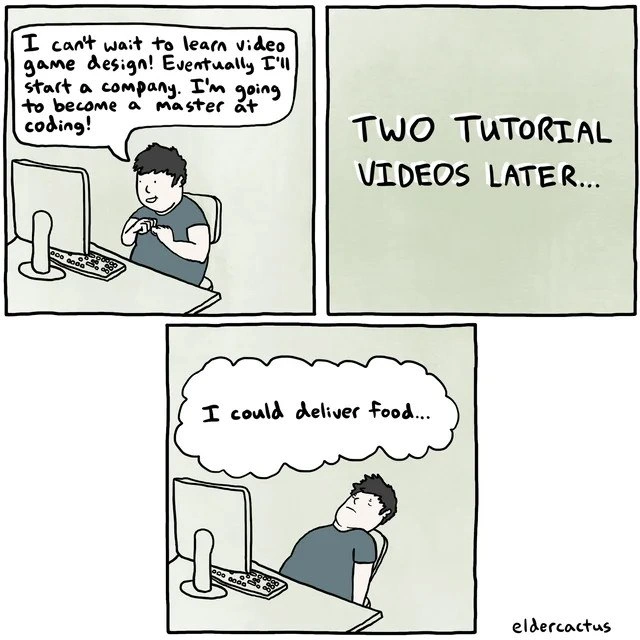
In this comic, a beginner developer starts off full of excitement and big dreams, then quickly hits a wall of reality. In the first panel, the character is practically bouncing in their chair saying things like, “I can’t wait to learn video game design! I’ll start a company. I’m going to become a master at coding!” This captures the huge expectations a lot of newcomers have. They’ve watched maybe one inspiring video or read an article about a solo indie game developer making millions, and now they’re thinking, “That’ll be me soon!” It’s very relatable for many juniors who are just starting out in coding or game development. When you’re new, you often don’t realize how much you don’t know. The phrase “master at coding” after just starting is an overly optimistic goal – becoming a master programmer typically takes years of learning and practice, not just a few tutorials. But at this stage, the beginner truly believes they’re on the fast track to success. This kind of early overconfidence is common and even has a name: the Dunning-Kruger effect. That’s a psychology term (mentioned often in tech humor) which means beginners often overestimate their abilities because they don’t yet know what they don’t know. In simpler terms, when you first learn a little, you feel like “Wow, I’m great at this!” because you haven’t encountered the hard parts yet.
The second panel fast-forwards the story: it simply says “TWO TUTORIAL VIDEOS LATER…” in big text. This indicates that only a short time has passed – literally, the person just watched two tutorial videos on game development – and already things are changing. Let’s clarify what a “tutorial video” means: it’s usually a step-by-step instructional video, often on YouTube or a learning site, that shows you how to do a small project or teaches a specific skill. For example, a game development tutorial might teach how to make a character move and jump in a simple game using a game engine like Unity. These tutorials are designed to be easy to follow. You typically write the exact code the instructor tells you to, and by the end you have a basic little game mechanic working. Tutorials are great for getting your feet wet, but they can also give a false sense of accomplishment. Following steps to make a pre-designed outcome is not the same as building something from scratch on your own – but a newcomer might not realize that yet. So, “two videos later” implies the person probably spent maybe an hour or two following along some beginner content. At first, they might have felt “Cool, I’m already making a game!”. But as soon as the tutorial ended and they tried to do something on their own or looked ahead to what’s next, they likely hit confusion or errors. This transition is where the hype meets the reality.
Now the third panel shows the outcome: the same person is slumped in their chair, looking completely defeated. The thought bubble above them says, “I could deliver food…” in a deflated, resigned way. This is a punchline that contrasts sharply with the first panel’s excitement. After just a small exposure to actual coding, the person’s confidence collapsed. They went from “I’ll start a game company!” to “maybe I’ll just get a simple job” in no time. It’s an exaggerated way to show frustration and a reality check. Instead of dreaming about making video games, now they’re considering a much more straightforward job like delivering food (think of working for a food delivery service such as Uber Eats, DoorDash, or Deliveroo). Delivering food is used here as the opposite of the complex, ambitious goal of game development. It’s a job you can do with no specialized training in coding or game design – basically anyone with a car or bike can start delivering food. So it represents the character thinking, “Forget this hard stuff, I’ll just do something easy to make money.” It’s a bit of dark humor because it suggests the person is ready to give up on their dream very quickly. A lot of developers chuckle at this because the thought “maybe I should just quit and do something simple” crosses our minds when we hit tough challenges (for example, when debugging a really stubborn problem, someone might joke “I’m going to quit programming and become a farmer”). Here, delivering food is that simple alternative.
Let’s break down why learning game development can cause such a swift change in attitude:
Steep Learning Curve: Game development has a lot of moving parts. After a couple of tutorials, a beginner might realize they haven’t even begun to understand things like how graphics rendering works, how to handle user input smoothly, or how to deal with character physics. The term learning curve means how quickly or slowly someone can learn something new. A steep learning curve implies it’s hard to learn at first – you have to climb a lot just to get basic skills. Game dev is known for this because initially there’s so much to absorb (a programming language, an engine interface, maybe some math for movement, etc.) that it feels overwhelming.
Tutorial vs. Real Project: Following a tutorial is like painting by numbers – you’re copying what someone else shows you. But making your own game means starting with a blank canvas. After the tutorials, our beginner probably tried to do something without the step-by-step guide and got stuck. For example, maybe the tutorial showed how to make a player jump, but what if the beginner now wants to add an enemy or a scoring system? Without a tutorial, they suddenly realize they don’t know where to start. That realization can be a rude shock. It’s like training wheels came off and the bike wobbled immediately.
Complex Skills Required: To create a complete video game, you need a mix of programming skill and often other skills too. You might need to know a programming language (for instance, C# if using Unity or C++ for Unreal Engine), understand how to use a game engine (the software that handles a lot of game functionality for you), and even some basic mathematics (like coordinates, angles, maybe some physics for things like gravity or collision detection). A tutorial might not dive deep into these; it might just tell you “type this code to move your character.” But do you know why that code works? Possibly not yet. Here are a few things a real game developer eventually has to learn that might intimidate a newcomer:
- Game Loop & Performance: Games run continuously, checking input and updating frames many times per second. You have to write code that is efficient and doesn’t make the game lag. A beginner who just learned
print("Hello World")hasn’t dealt with something running 60 times a second and managing lots of objects on screen. - Graphics and Physics: Even with a game engine handling graphics, you need to understand concepts like sprites vs. 3D models, maybe even how lighting and rendering work if you go deeper. Physics involves math (gravity, velocity, collisions) – engines help with this, but only if you know how to use their features.
- Debugging: When something goes wrong (and it will), figuring out why is a skill in itself. Tutorials often go smoothly, but when you try to make a change and nothing works, it can be very confusing. Learning to read error messages or fix bugs is something that comes with practice.
(...and there’s so much more: audio, game design principles, saving game state, etc. No wonder our poor beginner felt overwhelmed!)
- Game Loop & Performance: Games run continuously, checking input and updating frames many times per second. You have to write code that is efficient and doesn’t make the game lag. A beginner who just learned
Self-Taught Struggles: The character in the meme is learning via tutorials online, essentially self-taught. Being self-taught can be tough because you don’t have a structured curriculum or a teacher to help when you’re confused. It’s easy to hit a snag and think “I have no idea what to do next.” Many self-taught developers experience this exact scenario: you follow along with curated examples, but when you try to build your own idea, you feel lost. It takes patience and maybe searching forums or documentation to push through – things a newcomer might not know how to do yet.
So, by the time this person finished the second tutorial video, reality set in. The grand plan of becoming a hotshot game developer who founds a company suddenly seems very far away. The text in the thought bubble “I could deliver food…” perfectly captures that sudden collapse in confidence. It’s both a little sad and very funny in an ironic way. It’s sad because you feel a bit bad for the character getting discouraged so fast, but funny because it’s such an extreme 180-degree turn. We laugh because we recognize the feeling. It’s developer humor at its core: taking an experience we’ve all had (feeling lost or giving up early in learning) and exaggerating it just enough to make it comical. The tags like RelatableDeveloperExperience and LearningCurve are on point – anyone who’s tried to learn coding, especially game dev, can relate to that initial roadblock and disappointment. And DeveloperHumor often uses exactly this kind of situation: high hopes smashed by the first encounter with confusing reality, depicted in a lighthearted way.
In essence, this meme is explaining a common beginner’s journey in three quick frames: Excitement -> First effort -> Doubt. It’s a gentle reminder that learning to code (or learning anything complex) is a journey that will have ups and downs. The comic exaggerates by compressing that journey into what seems like a single sitting (“two videos later…”), which makes it funny. But the core message is true: after the initial excitement, everyone hits that point where they go “uh-oh, this is harder than I thought.” The meme just adds the comedic idea of immediately considering a totally different career (food delivery) as a way to show just how deflated the person feels. And for those of us who’ve been through it, we nod and smile because, yeah, been there, felt that!
Level 3: The Valley of Despair
This meme hits on a painfully familiar pattern in learning to code, especially in GameDev. We see a newcomer brimming with confidence: “I’m going to become a master at coding and start a company!” Every experienced developer recognizes this Dunning-Kruger effect moment. In the beginning, when you know almost nothing, you also don’t know how much there is to learn – so everything seems easy. After two tutorial videos, our aspiring indie game mogul crashes from the peak of over-optimism straight into the “oh no, this is actually hard” valley. The humor comes from that rapid plummet in confidence that many of us felt when we first started out. One minute you’re on Mount Hype thinking you’ll build the next Minecraft after a weekend of tutorials; two videos later, you’re slumped in your chair considering delivering takeout instead of delivering code. It’s a classic DeveloperExpectationsVsReality gag that’s both funny and a little too real for anyone who’s been through the learning curve grind.
Beyond the punchline, there’s a kernel of truth about GameDevelopment being a deceptively complex field. Those first tutorials might have shown how to move a character on screen or print “Hello World” in a game engine, giving a false sense that “Hey, I’ve got this!”. But building a full game is an entirely different beast. Seasoned devs know that making a game involves a stack of hidden complexities: rendering pipelines, game loops, physics engines, asset management, input handling, maybe even networking and AI. After a couple of introductory videos, the newbie hasn’t even scratched the surface. The meme exaggerates for comic effect – quitting after two videos – but it resonates because many of us remember that shocking moment when we realized just how deep the rabbit hole goes. The character’s dejected posture in panel 3, staring at the screen, is a scene we’ve all lived: the first time a tutorial stops making sense and the code doesn’t work when you try it yourself. It’s essentially the tutorial_hype_crash in visual form.
This scenario also pokes fun at the overly grand career plans juniors sometimes have. In panel 1, our hero isn’t just learning to code – he’s already fantasizing about starting a company and being an indie_game_dreams success story. This is a satire of that starry-eyed phase where every beginner imagines becoming the next Notch (creator of Minecraft) or the next big indie-game mogul after watching a couple of YouTube coding lessons. Experienced developers grin at this because we’ve either been that person or mentored someone like them. We know that mastering coding takes years of practice, debugging, and actual projects – not just watching tutorials. We also know the tech industry loves to hype “learn X in 24 hours” or “become a rockstar developer fast!”, which feeds these unrealistic expectations. The meme shines light on the unavoidable reality check: even something as fun-sounding as game dev is still hard work and complex problem-solving. When that reality hits, it can be disheartening – thus the thought bubble "I could deliver food...". That line is both a punchline and a dark truth about self_taught_struggles: after struggling with code, even a mindless gig like food delivery suddenly seems attractive by comparison. It’s a comical pivot from grand ambition to gig economy, encapsulating the pivot_to_gig_work many have joked about when code gets overwhelming. (“Maybe I should quit and drive for Uber” is practically a meme in developer circles).
Notice also the relatability factor: delivering food is a super ordinary job compared to the exotic dream of launching a game studio. The contrast makes the joke pop. For veterans, it also invokes memories of their own early career detours or day jobs taken while leveling up coding skills. Perhaps you remember burning out on a side project and thinking, “You know, flipping burgers wouldn’t be so bad...”. This comic cleverly compresses that journey into three panels, and the abrupt jump-cut “TWO TUTORIAL VIDEOS LATER...” is something like an internet meme trope to indicate a short time passing with a big change (think SpongeBob’s "two hours later" cards, but here it’s two YouTube videos later). It exaggerates how quickly the enthusiasm dies, which is funny because it’s almost true: the first shock of complexity does often come quickly. For a senior developer reading this, it’s a nod to a shared experience – we smile because we survived that newbie discouragement. We know that many juniors go through this phase of DeveloperExpectationsVsReality and that feeling of “maybe I’m not cut out for this” is as common as compiler errors. The meme is effectively saying: “Remember that time you thought programming was easy until it wasn’t?” and every coder with a few years under their belt can chuckle and sigh at that thought.
On a deeper level, the comic highlights how learning really works. True skill growth is a rollercoaster: initial excitement, then a dip when you realize the scope of what you don’t know. Psychologically, this dip is often called the “valley of despair” on the road to mastery – and it’s perfectly normal, though it sure doesn’t feel great in the moment. The humor is a gentle form of commiseration. It says, “Yeah, we’ve all been that guy, dreaming big then getting knocked down by reality. It’s okay – keep going (or at least laugh about it)!”. In software circles, we sometimes joke about this with dark humor: “I opened Unity once to make a game… now I have PTSD.” The meme’s final panel essentially captures that sentiment in a clean, funny thought bubble.
In summary, at the senior perspective, this meme is a compact tale of RelatableDeveloperExperience: tutorial_hype_crash, crushed indie_game_dreams, and the humbling learning curve of coding. It’s funny because it’s true – and it reminds us how far we’ve come from those early days when quitting to “deliver food” felt like a tempting escape route from pointer bugs and null reference errors. The next time a junior excitedly proclaims they’ll build the next big game in a week, a seasoned dev might just grin and think of this meme, knowing that a valuable reality check probably awaits just a couple of tutorials later.
Description
A three-panel comic strip by 'eldercactus' that captures the rapid deflation of enthusiasm when learning a complex technical skill. In the first panel, an eager character sits at their computer, proclaiming with excitement, 'I can't wait to learn video game design! Eventually I'll start a company. I'm going to become a master at coding!'. The second panel is a simple transition card that reads, 'TWO TUTORIAL VIDEOS LATER...'. The final panel shows the same character slumped in their chair, looking completely defeated and overwhelmed. A thought bubble above their head contains the resigned thought, 'I could deliver food...'. This comic humorously illustrates the steep learning curve in fields like game development and the common experience of hitting a wall of complexity right after introductory materials. It's a relatable commentary on 'tutorial hell' and the Dunning-Kruger effect, where initial confidence is shattered by the true scope of the discipline, leading to feelings of imposter syndrome and burnout
Comments
7Comment deleted
The first tutorial is 'Hello World.' The second is 'Replicating the physics of a dying star using a custom C++ engine.' There is no third tutorial
Two Unity tutorials in and he’s already eyeing food delivery - turns out orchestrating an eventually-consistent fleet of drivers is still simpler than making floating-point physics deterministic across platforms
This is the same energy as watching a junior discover that their "revolutionary app idea" requires understanding distributed systems, CAP theorem, and why their O(n³) algorithm won't scale past their local demo
Ah yes, the classic 'Hello World' to 'DoorDash World' pipeline - where the only thing you're compiling after two tutorials is a list of restaurants with decent tips. At least food delivery has better error messages than segfaults, and the stack traces are just... stacks of orders
Two tutorials in: Hype meets first entity-component refactor, pivoting to DoorDash faster than a failed YC pitch
Two Unity tutorials in, I pivoted from building a game studio to being the delivery app’s stateless worker - horizontal scaling, no netcode
After two Unity videos, he pivoted from shipping an ECS MMO to a single‑node, human‑in‑the‑loop scheduler that “solves” the vehicle routing problem by biking - finally, a system he can deploy