The Classic Frontend Facade vs. Backend Reality
Why is this Backend meme funny?
Level 1: Hiding the Mess
Imagine you quickly clean your room by shoving all your toys and clothes under the bed and into the closet. From the doorway, the room looks nice and tidy – the floor is clear, the bed is made, and nothing embarrassing is in sight. But if someone actually opens the closet or looks under the bed, they'll find a huge mess hiding there. This meme is funny for the same reason. It shows a person who, in the mirror, looks like they have a great haircut (the part everyone can see), but the back of their head (the part normally hidden) is cut really badly and unevenly. It's like saying: something can look great on the outside even when it's a disaster behind the scenes. We laugh because it's a silly, relatable situation – we all know the feeling of hiding a mess and hoping no one notices!
Level 2: Beauty and the Beast
In software, frontend and backend are like two halves of an application. The frontend is everything a user sees and interacts with – the visuals, buttons, and layouts on a website or app (basically the "beauty" in the story). It's built with things like HTML, CSS, and JavaScript in web development, and its job is to provide a sleek, friendly experience. The backend is all the behind-the-scenes stuff – the server, database, and the logic that makes the app actually work (often the "beast" doing the heavy lifting). This includes handling requests, storing data, and running core functionality, usually written in languages like Python, Java, or Node.js. Users don't see the backend directly; they just feel its results (for example, when an app saves your data or loads new information, that's the backend at work).
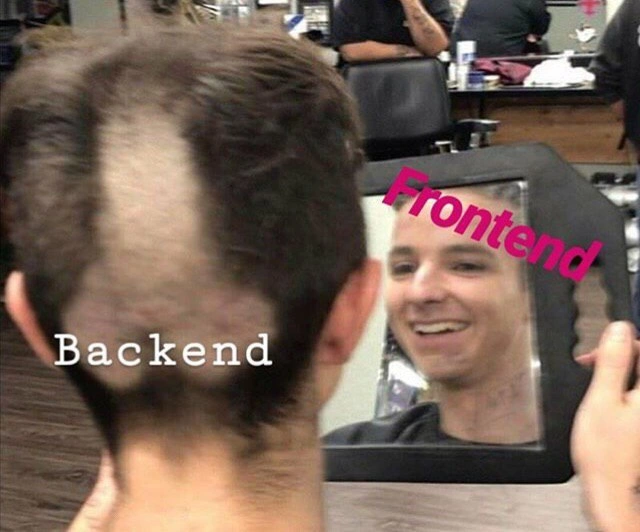
The meme uses a funny haircut metaphor to compare the two. In the image, a man is checking his haircut with a hand mirror. The reflection shows the front of his hair looking tidy and stylish – that's labeled "Frontend" in bright pink. But when you look at the actual back of his head (which people normally wouldn't see without a mirror), it's completely botched: mostly bald with random patches of hair left. That part is labeled "Backend" in plain white text. This visual joke says a software project can have a polished frontend (a nice-looking interface) but a disastrous backend (a chaotic behind-the-scenes codebase). It's highlighting the difference between presentation vs. reality in tech. The "presentation" here is the neat front appearance (the well-designed UI that everyone sees), and the "reality" is the ugly state hidden behind (the sloppy code and system that only developers know about).
This is humorous because it's a common scenario that many developers, even beginners, eventually encounter. Imagine you’re rushing to finish a project for a deadline or a class assignment. You spend most of your time making the visible part look great: perfecting the layout, picking nice colors, making sure the app looks impressive to users or your teacher. Meanwhile, to save time, you might write the simplest, messiest code behind the scenes just to make it work. Maybe you hard-code some values, skip writing comments or tests, or copy-paste code from the internet without fully understanding it. In other words, you create an ugly backend while the frontend looks gorgeous. In software terms, you're accumulating technical debt – taking quick and dirty shortcuts in the code that you'll have to "pay back" by fixing later.
The meme strikes a chord because a lot of us have been there. The product or website might wow people who see it (just like the front reflection shows a handsome haircut), but another developer peeking at the source code would gasp (like seeing the actual botched hairdo in the back). It's a lighthearted reminder not to just paint a pretty façade on the surface while neglecting the foundation underneath. In developer communities, jokes like this are common because they capture that relatable feeling of, "If it looks fine to the user, we sometimes ignore the big mess hidden under the hood." In simple terms: don't judge an app by its interface – it might be held together by code that's as patchy as that bad haircut!
Level 3: Polished UI, Patchy Code
In the trenches of development, we've all seen an app that dazzles on the surface but terrifies under the hood. This meme nails that scenario with a hilarious barbershop metaphor: the guy in the mirror has a neat, stylish front view (captioned Frontend in bright pink) while the back of his head is a botched, patchy shave job (captioned Backend in plain white). It's practically a staple of tech humor to slap a "Frontend" label on the pretty part of something and a "Backend" label on the ugly part – every engineer in the room nods knowingly. Here the haircut metaphor is on-point (or should I say, on-scalp): the polished front is what the world sees, and the messy back is the hidden reality.
As a battle-scarred backend engineer, I can practically smell the technical debt in that patchy undercut. It's a classic Backend vs Frontend gag: the frontend gets all the shiny frameworks, responsive design, and pixel-perfect polish, while the backend is held together by duct tape and prayers. The mirror reflection in the image is basically the user's or manager's perspective – they're all smiles seeing the sleek interface, blissfully unaware that just out of view, the codebase is one bad deploy away from collapse. That bright UI stands in for a polished frontend, and that sad scalp represents the result of server-side neglect.
I wouldn’t be surprised if the backend code here is littered with "fix later" comments and try { ... } catch (e) { /* ignore errors */ } blocks. For example, imagine a snippet like this:
try {
criticalDatabaseSave(data);
} catch (error) {
// TODO: handle properly later; for now just keep the UI from crashing
}
This kind of code basically says "we'll deal with the mess later" – but of course, later never comes. Senior devs recognize this pattern too well. They've shipped products that wowed the client in a demo, only to spend weeks afterward untangling a jungle of spaghetti code and half-baked logic underneath. It's funny and painful at the same time. Many of us have been on-call at 3 AM because something in that neglected backend finally blew up, while the frontend just showed a friendly "Oops, something went wrong" message (nicely styled, naturally) or even nothing at all.
The humor here comes from that dramatic contrast. The UI is glossy and modern – maybe built with the latest hot JavaScript framework, with every gradient and animation just right. Meanwhile, the server code behind it might be a monolithic, fragile beast written in a rush last year and never refactored. It's like seeing a sports car with a beautiful paint job, but when you peek under the hood, the engine is sputtering and held together with zip ties. Seasoned engineers chuckle (perhaps a bit bitterly) because they've lived this exact scenario. It's a tongue-in-cheek reminder that when you only care about the parts users see, you risk ending up with a system that looks great until you "turn it around" and reveal the horror show powering it.
Description
This meme uses a humorous 'reverse mullet' haircut to illustrate a core concept in web development. The image shows the back of a person's head with a wide, messy, shaved strip down the middle, labeled 'Backend'. The person is looking into a handheld mirror, and their reflection shows a perfectly normal and happy-looking front view, which is labeled 'Frontend' in vibrant pink text. The joke lies in the stark contrast: the user-facing frontend is polished, clean, and presentable, while the server-side backend, which the user never sees, can often be a complex, messy, or compromised collection of legacy code, quick fixes, and technical debt. For experienced engineers, this is a deeply relatable commentary on prioritizing external appearances over internal code quality, often due to deadlines or shifting requirements, leading to a 'spaghetti code' reality hidden behind a beautiful user interface
Comments
7Comment deleted
Users admire the pixel-perfect frontend, unaware that the backend is a single 10,000-line PHP script from 2004 that can only be deployed on a Tuesday when the moon is waxing
Frontend: glassmorphic 60 fps React bliss; backend: a 2009 monolith hastily shaved into “microservices” by a Saturday sed one-liner - just pray the stakeholders never ask for a rear-view mirror
The real mirror moment is when you realize that beautiful React frontend is just reflecting your Express API's existential crisis about whether that database query should really return 50,000 records without pagination
Backend developers: spending 80% of their time architecting elegant distributed systems, optimizing database queries, and ensuring data consistency across microservices - only to have stakeholders ask 'but can you make the button more blue?' The frontend gets all the glory in the mirror, while the backend does the heavy lifting in the shadows. At least our 3AM production incidents are invisible to users
Frontend: the receding hairline users screenshot. Backend: the unkillable skull scaling to infinity
Pixel-perfect React up front; the backend’s a SOAP comb-over held together by nightly cronjobs
Pixel perfect in the mirror, but behind it lives a monolith held together by cron jobs, undocumented triggers, and a migration backlog - the haircut your SLOs never see