Backend Developer Costume Kit
Why is this Backend meme funny?
Level 1: Invisible Costume
This is funny because it is like buying a Halloween costume called "person who keeps the house working" and opening the bag to find normal clothes and a wrench. Nothing looks exciting, but if that person stops working, the lights go out, the sink leaks, and everyone suddenly notices.
Level 2: Plain Clothes, Real Systems
A backend developer builds the parts of software that users usually do not see directly. That can include servers, databases, APIs, authentication, payment logic, background jobs, logging, and deployment systems. If an app is a restaurant, the frontend is the menu, tables, lighting, and waiter interaction; the backend is the kitchen, inventory, recipe timing, payment terminal, and plumbing.
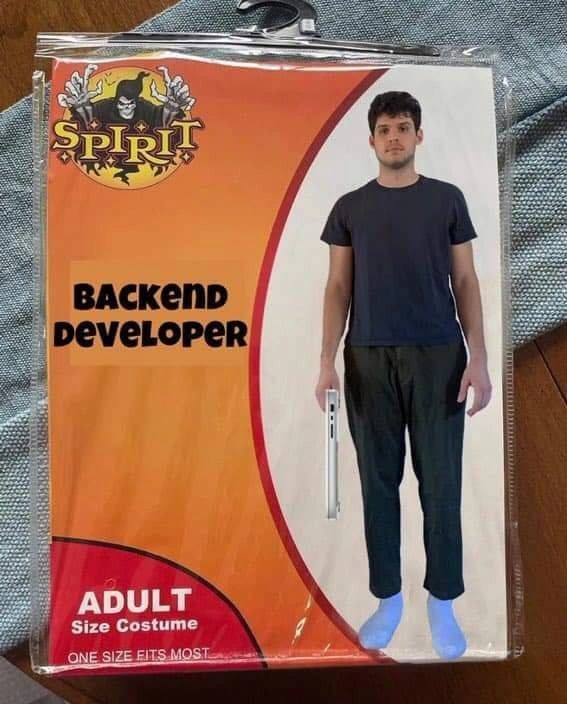
The image turns that invisible job into a fake packaged costume. The big label BACKEND DEVELOPER tells you what the costume is supposed to be. The person on the right looks like an ordinary person at home, not a dramatic character. The object in his hand suggests a laptop or computer equipment, which is the only clear tool clue. The bottom text:
ADULT Size Costume ONE SIZE FITS MOST
makes it feel like a mass-produced Halloween product, which is funny because there is almost nothing to mass-produce. The visual pun is that "dressing as a backend developer" means looking like someone who could disappear into a quiet corner and fix a database connection pool.
For a junior developer, the humor becomes clearer after the first time a small backend change has weird consequences. You rename a field, deploy an API response, or change a validation rule, and suddenly a frontend screen, a mobile client, and a reporting dashboard all have opinions. Backend work can look plain from the outside because the complicated part is not the costume. It is the network of responsibilities hiding behind the screen.
Level 3: Costume as Interface
The joke works because the package promises a recognizable identity and then delivers the least theatrical developer archetype imaginable. The visible text says:
BACKEND DEVELOPER
and the "costume" is just a dark T-shirt, loose pants, blue socks, and a small laptop-like object held at the side. That is the whole Backend punchline: the work is vital, but the public-facing aesthetic is almost aggressively invisible. Frontend developers get pixels, animations, color systems, and the occasional argument about whether a button is 38 or 40 pixels tall. Backend developers get services, queues, database migrations, auth flows, deployment pipelines, and a wardrobe optimized for not being in the screenshot.
The Spirit-style packaging matters because Halloween costumes usually exaggerate a role into readable symbols. A pirate gets a hat. A vampire gets a cape. A backend developer gets ssh, a terminal, and the haunted knowledge that someone is still calling the deprecated endpoint from a mobile app version released three years ago. The parody is not saying backend engineers are boring; it is saying the stereotype has no external costume because most of the identity is operational context: knowing which cron job is safe to kill, which database table has "temporary" columns from 2018, and why the API gateway starts sweating whenever marketing sends an email blast.
The "ONE SIZE FITS MOST" line sharpens the DeveloperStereotypes angle. It turns a complex profession into a generic bag of visual markers: plain clothes, blank expression, machine in hand. That is how tech culture often flattens roles. BackendVsFrontend jokes survive because every team has watched invisible infrastructure become important only when it fails. When the page loads, nobody thanks the cache invalidation strategy. When it does not, suddenly everyone has strong opinions about the backend, including people who learned the word API during the incident.
The deadpan pose also lands because it mirrors the emotional posture of a lot of production work: calm outside, stack traces inside. In real life, backend competence is often measured by absence: no lost payments, no duplicate messages, no surprise 500s, no migration locking a table at noon. That makes for terrible costume design and excellent self-deprecating humor.
Description
The image shows a fake costume package styled like a Spirit Halloween product. The package text includes the `SPIRIT` logo, the label `BACKEND DEVELOPER`, and the bottom text `ADULT Size Costume` plus `ONE SIZE FITS MOST`. On the right side of the package, a plain-looking man stands in a dark T-shirt, loose pants, blue socks, and holds a laptop or thin device, making the costume intentionally mundane. The joke is that the backend developer archetype is so visually indistinct that the costume is just normal clothes and a machine for touching servers nobody sees.
Comments
11Comment deleted
The premium version includes a hoodie, a stale local database dump, and the ability to say `works on my machine` without moving your face.
Is there anything scarier than a programmer holding a screwdriver? Comment deleted
This, for example. (I have highlighted the relevant part just in case you don't get where to look at.) Comment deleted
wow Comment deleted
this board is gonna be screwed but thats ok Comment deleted
😂😂😂😂🤡🤡🤡 Comment deleted
routinely burning plastic? Comment deleted
Oh my god I didn't notice Comment deleted
That's a sysadmin, not a backend dev Comment deleted
Not only is she soldering plastic, she's soldering her finger Comment deleted
It's all about those big blue eyes, isn't it? Nobody gives a damn about those PCB and soldering iron. 😁 Comment deleted