Tweet thread where a localhost URL and SQL operator bug collide humorously
Why is this Bugs meme funny?
Level 1: Secret Hideout and Wrong Key
Imagine a kid named Ben who built a little toy website in his room. He’s upset because it’s not working, so he asks for help by telling everyone, “Hey, come look at my website, it’s at my house!” The problem is, nobody else can go to his house to see it – it’s like a secret hideout that only Ben knows. That’s the first funny bit: he gave an address only he can access, so of course no one else can see the problem!
Now, inside Ben’s secret website, picture that he used the wrong key to turn something on. It’s as if he had two identical-looking keys and he picked the wrong one, so the engine of his toy website wouldn’t start. Along comes his friend, who can’t visit the site but has a good guess. The friend says, “I think you used the wrong key. Try the other one!” Ben tries the other key and—voilà!—his toy website starts working. Ben slaps his forehead and says “Doh!” because it was such a simple mistake.
In simple terms, Ben’s mistake was using the wrong symbol (kind of like a wrong key) in his code, and asking people to visit a place they couldn’t go (a site only on his own computer). It’s funny because it’s a silly mix-up, and his friend solved it with just a tiny suggestion. It’s like Ben learned two lessons at once: share things in a way people can actually see, and use the right little symbol to make the magic happen.
Level 2: Localhost vs The World
Let’s break down what happened in simpler terms. Ben was struggling with his code and asked for help on Twitter. He posted a link to his web application: http://localhost:8080/tutorial01/welcome.jsp. The term localhost is important — it means “this computer right here.” When you use localhost in a URL, you’re telling the web browser to look on your own machine for the web server. If Ben runs a server on his computer at port 8080 (a common default for local web servers), only Ben can actually see that site. When other people click a localhost link on their computers, their browsers look on their own machines for that address (and of course don’t find Ben’s app). In short, localhost is not a public website. It’s like giving out an address that says “my house” without a street or city — only you know where that is. So when Ben asked, “Can anyone help me find out why my web app isn’t working?” and then gave a localhost link, no one online could directly visit it. This is a common misunderstanding for newcomers in WebDev: they test a site locally and assume others online can see the same thing.
Now, Rahmesh’s reply was about an SQL error. SQL stands for Structured Query Language, and it’s how we communicate with databases (like asking the database for information). If Ben’s web app involves a database (which it likely does, given the mention of an SQL statement), an SQL error could definitely break the app. Rahmesh told Ben to use a single equals sign (=) for checking equality in the SQL query, not a double equals (==). This hints that in Ben’s code or query, he may have written something like:
-- This is incorrect SQL (using == will cause an error)
SELECT * FROM users WHERE id == 5;
The correct way in SQL would be:
-- Correct SQL uses a single =
SELECT * FROM users WHERE id = 5;
In many programming languages (like Java, C, or JavaScript), = is used to assign a value (e.g., set x = 5), and == is used to compare two values (e.g., check if x == 5). However, in SQL, the single = is used for comparisons in conditions (there’s no concept of using == in standard SQL for equality). It’s a subtle but important syntax difference. New developers often carry over habits from one language to another. If Ben had learned in Java or C that == checks equality, he might mistakenly use == in an SQL query string, not realizing it’s invalid there. The database would throw an error because it doesn’t understand ==. The error message likely said something about a syntax error near ==. Rahmesh recognized this pattern instantly — the tweet reply basically says “I’ve seen this error before, you probably wrote == in your SQL.” And indeed, once Ben changed == to =, his app started working.
So why is this funny to developers? There are two main reasons:
Localhost Confusion: Ben asked for help in a way that shows he’s a bit of a beginner. Sharing a
localhostlink is practically asking people to look at a web page that only exists on his own computer. It signals that he might not understand why others can’t see his running app. It’s a bit like hosting a big billboard in your bedroom and wondering why no one outside can see it.SQL Operator Mix-up: Ben also made a very typical beginner mistake in his code by using the wrong operator (
==instead of=) in an SQL query. This is a fundamental syntax error. It’s the kind of bug that more experienced devs immediately recognize because many of us have done it ourselves or helped someone through it. It’s a one-character mistake that completely stops the code from working — frustrating for the newbie, but obvious when you know the rule.
In the Twitter thread, an experienced helper (Rahmesh) addresses the real issue (the SQL bug) almost telepathically. He didn’t need to access the localhost link at all; he just knew from context what the likely problem was. When Ben replies “Doh! Working now,” it confirms Rahmesh’s hunch was correct. The whole interaction is a little slice of DeveloperHumor: it highlights how beginners often get tripped up by small things and how seasoned developers can often guess those gotchas quickly. Ben learned two lessons here: one about how to ask for help (provide accessible info, not a private link), and one about proper SQLQueries syntax (use the right number of =). And the rest of us get a chuckle, remembering our own early Debugging adventures and CodingMistakes. It’s funny and relatable because we’ve been there!
Level 3: Double Equals, Double Trouble
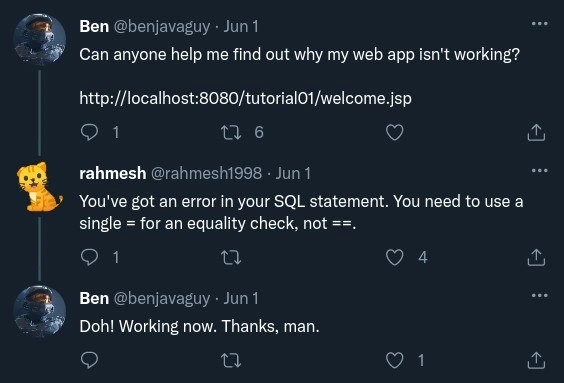
This meme spotlights a pair of classic rookie mistakes that make experienced developers both cringe and chuckle. In the screenshot, Ben tweets a desperate plea about his web app not working, sharing a link to http://localhost:8080/tutorial01/welcome.jsp. Immediately, another user (Rahmesh) replies with a pinpoint diagnosis: “You've got an error in your SQL statement. You need to use a single = for an equality check, not ==.” Ben then exclaims, “Doh! Working now. Thanks, man.” The humor comes from the collision of two unrelated blunders happening at once:
Localhost SOS: Ben essentially asked the entire internet to click a link that only exists on his own computer. The
localhost:8080URL uses the loopback address (often127.0.0.1), meaning “this computer, port 8080.” No one else can access that link because it literally points to your own machine. It's a notorious newbie move to share a localhost URL, akin to asking someone to visit you by going to their house. Seasoned devs see publicly_sharing_local_url like this and instantly know the person might be new to WebDev or just very stressed. In a professional setting, accidentally leaving alocalhostreference in a public configuration or expecting others to see your dev environment is a running joke (localhost_in_production, anyone?). Here, sharing that link on Twitter for debugging help is a dead giveaway that Ben is out of his depth.SQL Operator Confusion: Even without seeing the code, Rahmesh zeroes in on a common SQL bug. Ben likely wrote an SQL query in his Java/JSP code that used
==instead of=. In SQL (Structured Query Language), a single equals sign is the correct operator for comparing values in a WHERE clause (for example,WHERE user_id = 42). Writing==causes a syntax error in most databases. The reply “use a single = for an equality check, not ==” addresses this exact mistake. This hints Rahmesh has seen this error before—perhaps the phrasing “You’ve got an error in your SQL statement” echoes the notorious MySQL error message (You have an error in your SQL syntax...). For veteran developers, it’s a CodingMistake so common that it’s almost a rite of passage. It bridges two knowledge domains: programming languages where==is a comparison operator (like in Java, C, or JavaScript) vs. SQL where=is the comparison operator and==just isn’t a thing. Ben probably assumed his database query should use the same==he learned in Java for equality, not realizing SQL’s syntax differs.
The juxtaposition of these errors multiplies the humor. Any dev with a few years under their belt has helped someone who did exactly this, or remembers doing it themselves. We have the frantic cry for help (“my web app isn’t working!”) but with insufficient/problematic info—posting a localhost URL is unhelpful to others and hints that the asker might not understand networking. Then, almost by psychic debugging, the responder identifies a totally distinct bug (the SQL == issue) without directly accessing the app. This scenario illustrates a kind of developer intuition: experienced engineers often instantly recognize the root cause from a tiny clue (DebuggingFrustration radar). The meme is essentially winking at how obvious this all is to a pro — Rahmesh didn’t need to click that impossible link; the mention of a tutorial JSP and the general “not working” complaint probably reminded him of a textbook bug from some BugsInSoftware hall-of-fame. And indeed, it was exactly that bug.
From a senior perspective, this tweet thread is both a facepalm and a fond flashback. It encapsulates the gap between beginners and seasoned devs. The novice is stuck on something that’s instantly clear to the experienced helper. The seasoned dev’s reply is short and matter-of-fact, solving in seconds an issue that might have stumped the newbie for hours. It highlights an unspoken camaraderie: we’ve all been “Ben” at some point, making simple mistakes and seeking help in not-quite-right ways. And many of us have tried to assist a “Ben” by deciphering their problem from scant clues. In the end, the web app is “Working now” after correcting a tiny error. The relief in Ben’s reply (“Doh!”) is palpable — a classic newbie realization that something small (just one character!) broke everything. This whole exchange celebrates the DeveloperHumor in everyday Debugging_Troubleshooting: sharing a laugh over the kind of bug that’s obvious in hindsight and the quirky way the help was requested.
Description
Screenshot of Twitter in dark mode showing a three-message thread. Message 1: Ben (@benjavaguy, Jun 1) says, “Can anyone help me find out why my web app isn’t working? http://localhost:8080/tutorial01/welcome.jsp”. Message 2: rahmesh (@rahmesh1998, Jun 1) replies, “You’ve got an error in your SQL statement. You need to use a single = for an equality check, not ==.” Message 3: Ben responds, “Doh! Working now. Thanks, man.” Standard Twitter icons for reply, retweet, and like appear under each tweet (counts: 0 reply/6 likes, 1 reply/4 likes, 1 like respectively). The humor lies in Ben sharing an unusable localhost link and also confusing SQL’s single-equals comparison with double-equals, a classic novice bug that seasoned developers instantly recognize

Comments
6Comment deleted
Posting a localhost URL on Twitter and using '==' in SQL - congratulations, you’ve implemented Works-On-My-Machine as both a network topology and a query optimizer
The best part about sharing localhost URLs for debugging help is watching senior devs politely explain the SQL syntax error instead of explaining how TCP/IP works
Ah yes, the classic '==' in SQL - because apparently spending years writing conditionals in Java, JavaScript, Python, C++, and literally every other language makes you forget that SQL decided to be the hipster database that was using single '=' for equality before it was cool. It's like muscle memory's cruel joke: your fingers know what they're doing, but SQL is out here playing 4D chess with operator semantics. At least it wasn't a Friday deployment
Senior observability: no logs, no metrics - just the faint smell of port 8080, and someone instantly knows you wrote WHERE user_id == ? in SQL
Tweet a localhost:8080 welcome.jsp and get “use = in SQL, not ==” as the fix - senior debugging is just Bayesian inference on legacy Java: see JSP, assume string‑concatenated queries
Ramesh just upgraded Ben's SQL from invalid == to 'works on Twitter' - prod will love the self-healing queries