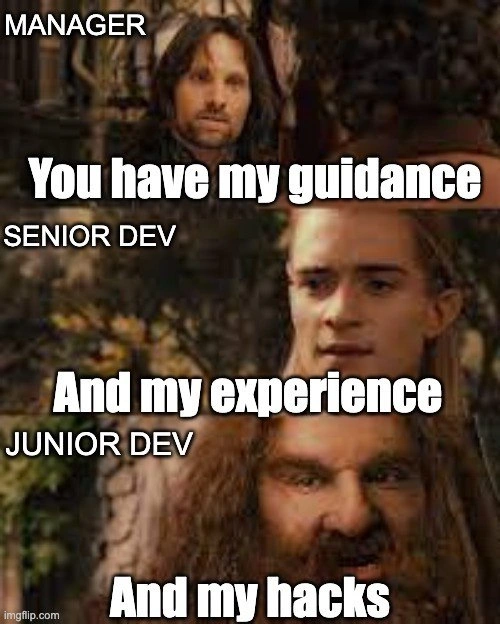
Fellowship formed: manager guidance, senior experience, junior hacks in project kickoff meme
Why is this Management PMs meme funny?
Level 1: Different Ways to Help
Imagine a family cleaning up a messy room together. The parent is like the team leader who says what needs to be done (“Let’s put all the toys away and fold the clothes”). The older child has cleaned up many times before, so they carefully put each toy in its right place and hang up the clothes nicely, using what they’ve learned about how to do it well. Meanwhile, the little child really wants to help too, but they might just shove toys into the closet or under the bed to make the room look clean quickly. Here, the parent is giving directions, the older kid is using their skill and experience to do a thorough job, and the younger kid is helping in their own quick (if messy) way. In the end, the room does get cleaner because everyone helped in their own style. It’s funny because the littlest helper’s method is a bit silly and not how the others would do it, but they’re trying their best! We smile because we know that feeling – sometimes the fastest solution isn’t the perfect one, but it still counts as helping. It shows how each person contributes differently to reach the same goal, and that teamwork isn’t always perfectly polished, but everyone’s effort matters.
Level 2: Guidance, Experience, Hacks
The meme’s text and characters represent three common roles in a software team, each contributing in a different way. It references the famous Fellowship of the Ring scene where heroes volunteer their sword, bow, and axe – but here it’s about a manager, a senior dev, and a junior dev offering what they bring to a new project. To someone early in their career, here’s what each part means:
Manager (Project Manager or Team Lead): This is the person in charge of planning and oversight. When the manager says, “You have my guidance,” it means they’ll provide direction and support. In real life, a manager guides the team by setting goals, making decisions, removing obstacles, and keeping everyone on track. They don’t usually write code themselves; instead, they coordinate the work (like a leader mapping out the journey for the team). Their guidance helps the team know what to do and how to proceed, especially at a project kickoff when the plan is being formed.
Senior Developer: This is an experienced software engineer who has a lot of knowledge from previous projects. When the senior dev says, “And my experience,” it means they’re contributing all the know-how they’ve gained over the years. A senior developer is familiar with good coding practices, software design, and common pitfalls. They often mentor junior devs and make important technical decisions. Their experience is valuable because they can foresee problems and recommend the best approach. In our fellowship analogy, the senior dev is like a skilled elf archer who hits the target with precision – they want to implement features the right way so the project stays reliable and maintainable.
Junior Developer: This is a newcomer or less experienced programmer who is still learning the ropes. When the junior proudly says, “And my hacks,” it’s the funny twist of the meme. In programming, a hack is a quick-and-dirty solution or a makeshift workaround – basically, a way to fix a problem fast, which might not be the cleanest or best long-term solution. (Importantly, this kind of “hack” isn’t about breaking into systems; it’s about improvising in your own code.) So the junior dev offering “my hacks” means they’ll do whatever it takes to help, even if that means writing code that’s a bit messy or unconventional. Juniors often write such quick fixes either because they don’t know all the best practices yet or because they’re eager to show results. It’s like the dwarf in the story offering brute force: the junior’s contribution might be rough, but it can be useful in a pinch to move the project forward.
Together, these three form a kind of “fellowship” on the software team. As a new developer, you might find this meme funny because it’s exaggerated but also pretty relatable. In many workplaces, when a project kicks off, the manager provides the plan and guidance, the senior dev contributes expertise to build things correctly, and the junior dev jumps in with tons of enthusiasm (and maybe a few creative shortcuts to get things working). This meme is a lighthearted take on those team dynamics. The manager’s “guidance” and senior’s “experience” sound serious and professional, while the junior’s “hacks” comes across as cheeky and out-of-place — and that contrast is exactly what makes people laugh. It’s developer humor that rings true to anyone who’s been on a team: we’ve all seen one person leading, another perfecting, and another improvising. The meme reminds us that everyone is trying to help in their own way. Even if the junior’s quick fix isn’t perfect, it still counts as contributing, and it often comes from a place of eagerness to help. That mix of sincerity and silliness — a team combining big plans, big skills, and a little bit of scrappy effort — is why this meme makes engineers smile and nod in recognition.
Level 3: The Fellowship of the Code
In this meme, we witness a playful mashup of The Lord of the Rings and a typical software project kickoff meeting. The iconic moment of the Fellowship forming is reimagined in a dev context: the manager solemnly declares, “You have my guidance,” echoing a leader’s pledge of support; the senior dev adds, “And my experience,” offering hard-earned expertise much like an elf presenting his bow; finally, the junior dev enthusiastically pipes up, “And my hacks,” parodying the dwarf’s famous “And my axe.” This substitution of hacks for axe is more than a pun – it’s a knowing nod to the realities of modern engineering teams.
The humor hits home for seasoned engineers because each role's contribution is spot-on yet steeped in irony. In many teams, managers indeed promise guidance – setting direction, clearing roadblocks, and cheerleading the project’s vision – but they write no actual code (just as Aragorn’s sword symbolizes leadership more than hands-on impact). Senior developers bring deep experience – the wisdom of past projects, knowledge of design patterns, and the foresight to avoid pitfalls – analogous to Legolas’s deadly accurate bow. Then we have the junior developer, brimming with energy, who contributes by writing code in any way possible, sometimes resorting to scrappy quick fix hacks. The junior’s proud offer of “my hacks” is the punchline: it’s an earnest yet comical contribution, akin to Gimli’s rough-and-ready axe-play. It’s funny because hacks, in developer lingo, are clever but ad-hoc solutions – the kind that make seniors cringe and project managers wince, yet often save the day when you’re racing a deadline.
This scene satirizes a classic team dynamic (and a few anti-patterns). We have the well-meaning manager following the playbook of managerial guidance (“I’ll guide the team to success!”), the senior dev symbolizing best practices and mentorship (“I’ll ensure we do it right”), and the junior unknowingly introducing a dose of technical debt (“It’s not pretty, but hey, it works now!”). Many veteran developers have war stories of exactly this setup. Picture a critical sprint planning session: a manager sets an ambitious deadline and assures support, a senior engineer proposes a robust architecture, but as the clock ticks down, the actual implementation falls to a junior who copy-pastes a Stack Overflow snippet at 5 PM. The code isn’t elegant, but miraculously it passes the tests – a hack that gets the team through the demo. Everyone feels a mix of relief and dread: relief that the feature is delivered, and dread because they know that hack might morph into a bug farm down the line.
The shared laughter here comes from that “too real” recognition. Teams often end up relying on junior hacks even when they know better, because real-world pressures intrude on ideal processes. It’s a bit of collective trauma bonding for developers. We chuckle remembering how a clumsy workaround kept things on track, and also recall the late nights spent gingerly untangling that very code later. This meme highlights that trade-off: the manager’s guidance and the senior’s experience set the stage, but it’s the junior’s scrappy fix that actually slices through the immediate problem – much like an axe hacking through a knot when finesse alone won’t do.
Why does this pattern persist? Often, organizational culture and incentive structures practically encourage it. Managers under deadline pressure tend to celebrate quick, visible progress; seniors, while advocating for clean code, know that if they insist on perfection they might derail the schedule; and juniors are eager to prove themselves, even if it means coding first and asking questions later. The result is an unspoken agreement: shipping something that “mostly works” today can trump waiting for the ideal solution tomorrow. Over time this becomes an industry in-joke – everyone knows we should refactor those hacks, but somehow there’s always another feature to build first. It’s the sort of scenario where a team nervously jokes, “We’ll clean it up in version 2.0,” fully aware that version 2.0 might never come.
Ultimately, the meme is a celebration of teamwork wrapped in gentle sarcasm. Just as the original Fellowship succeeded not only through elegant archery or kingly leadership but also thanks to a determined dwarf swinging his axe, real software projects often succeed because of a few well-timed hacks alongside the guidance and expertise. Experienced devs laugh because they’ve seen themselves in all three roles at different times – the idealistic planner, the seasoned expert, and the scrappy problem-solver. The phrase “And my hacks” encapsulates the lighthearted truth that behind every polished app or smooth demo, there might be a hasty fix held together with optimism and duct tape. It’s a humorous reminder that, in the quest to ship software (or to destroy a metaphorical Ring of Deadlines), each member of the fellowship brings something valuable... even if one of those things is a hack.
Description
The meme uses the iconic Fellowship-forming scene from The Lord of the Rings, split into three vertical panels. In the top panel, a character labeled "MANAGER" declares in bold white Impact text, "You have my guidance." The middle panel shows another character labeled "SENIOR DEV" with the caption, "And my experience." The bottom panel features a bearded dwarf labeled "JUNIOR DEV" proclaiming, "And my hacks." The joke contrasts how, in software projects, managers promise direction, seniors bring expertise, and juniors contribute quick-and-dirty solutions, highlighting team dynamics familiar to engineering leaders
Comments
13Comment deleted
Project kickoff summary: manager promises “strategic vision,” senior pledges “battle-tested architecture,” junior drops a 12-line Bash script - six sprints later the vision is pivoted, the architecture is PowerPoint-ware, and that Bash script is proudly running in prod as the “integration layer.”
After 20 years in this industry, I've learned that junior devs' 'hacks' eventually become the legacy systems that senior devs spend their careers refactoring, while managers continue offering 'guidance' that somehow always translates to 'can we make it work by Friday?'
The eternal trinity of software delivery: management provides the roadmap nobody follows, seniors bring the battle scars from production incidents past, and juniors contribute the Stack Overflow solutions that somehow work in prod but nobody dares to touch during refactoring. Together they form an unstoppable force - until the junior's 'hack' becomes tomorrow's legacy code that the next senior has to explain in an architecture review
Manager: "You have my guidance." Senior Dev: "And my experience." Junior Dev: "And my hack" - 18 months later, it's the mission-critical Lambda no one can redeploy
Guidance, experience, and hacks - the canonical stack for a “temporary” spike that ships behind a feature flag, survives three quarters, and graduates to critical legacy
Guidance sets the epic quest, experience charts the safe path - juniors' hacks are the warp-speed shortcuts that summon prod deploys, tech debt be damned
axe = hacks don't mind me Comment deleted
Now it's not funny :c Comment deleted
but has MY AXE! Comment deleted
Repeat it one more time, jokes get funnier this way 😂 Comment deleted
?? im not repeating truly toxic it chat Comment deleted
I think they're trying to tell you that you ruined the joke by explaining it. I personally think it's fine, though a bit redundant. Comment deleted
s/hacks/quirks/g Comment deleted