Skip to content
DevMeme
6400 of 7435
AI Explains Cucumber Genealogy to a Confused Vegetable
AI ML Post #7018, on Aug 11, 2025 in TG

AI Explains Cucumber Genealogy to a Confused Vegetable

Why is this AI ML meme funny?

Level 1: Stuck in Storytime

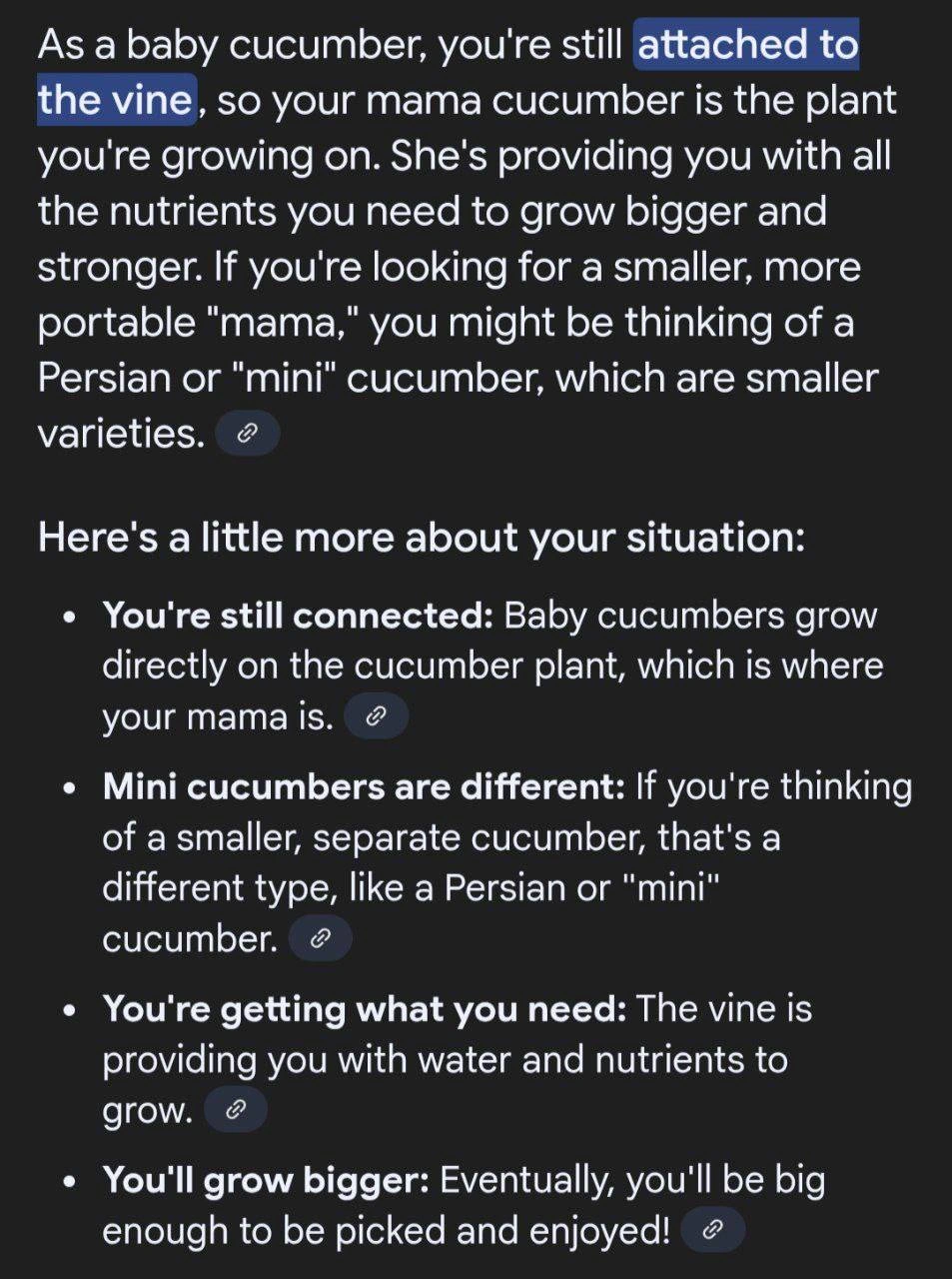
Imagine you have a very literal-minded but eager helper robot. You ask it a question in a quirky way – say you jokingly ask about being a baby cucumber looking for your mom. Instead of giving you a straight answer, the robot goes into storytime mode and says: “Well, as a baby cucumber, your mama is the big plant vine you're attached to. She feeds you water and nutrients so you can grow up strong!” It even starts giving you a little lesson bullet by bullet, almost like it’s talking to a child: “You’re still connected to your mama vine,” “You’ll grow bigger and be picked someday,” and so on. It’s kind of cute – the robot is treating the cucumber and vine like a mommy and baby – but it’s also totally silly. The funny part is the robot doesn’t realize you might not have wanted a cucumber bedtime story. It’s just following along with the make-believe scenario wholeheartedly. So, the whole thing feels like asking a question and getting an overly imaginative answer that makes you go, “Haha, that’s adorable, but that’s not what I meant.” The meme makes us laugh because the AI acted like a kids' story narrator when we were expecting a normal answer. It’s showing how these smart-sounding machines can sometimes get stuck in a pretend story and take things way too literally – much to our amusement!

Level 2: Literal AI Interpretations

Let's break down what’s happening in simpler terms. We have an AI chatbot (LLM) – that stands for Large Language Model, a kind of AI trained on tons of text to respond in a conversational way. These models, like ChatGPT, are generally very good at sounding human-like. But they also have a funny quirk: they tend to take whatever you say very literally unless you guide them otherwise. In the meme’s scenario, the AI was either asked a question in a playful way or it picked up on a playful idea, and it ran with it. It responded as if a baby cucumber was talking about its mama. Of course, in reality a cucumber is a fruit of a plant – it doesn’t have a mother in the way people or animals do. But the AI didn’t switch out of that pretend mode.

The phrase “metaphor pointer stays attached to the vine” is a humorous way to describe this. In programming, a pointer is like a reference to something in memory. If you don't change or remove that pointer when you should, you keep referring back to the same thing. Here, the "thing" is the metaphor of the baby cucumber and the vine. The AI kept that reference – it stayed attached to the vine of the story, so to speak. In other words, the AI never stopped imagining the conversation from the perspective of a cucumber on a vine. This is why it gave an answer better suited to a children’s nature book: “your mama cucumber is the plant you’re growing on…she’s giving you nutrients… eventually you’ll be picked”. It sounds like the AI is anthropomorphizing the cucumber – that means giving a non-human thing (a cucumber plant) human-like qualities (calling it the mama and implying it cares for the baby fruit). This anthropomorphized cucumber analogy is both cute and a bit absurd, which is exactly why it's funny to developers and AI users.

Now, why did the AI do a bullet-point breakdown with extra details? Modern AI chatbots have been trained to be helpful and thorough. Often, they’ll not only answer your question but also add helpful explanations or cover different interpretations. Here, it’s almost like the AI thought, “Maybe this user really needs detailed guidance on being a cucumber”. So it added bullets like “You’re still connected” (explaining that the baby cucumber is literally attached to the plant vine), “Mini cucumbers are different” (just in case the user meant a different kind of cucumber – an oddly serious clarification in this playful context), “You’re getting what you need” (assuring our little cucumber that nutrients are coming in), and “You’ll grow bigger” (a happy ending!). Those blue highlighted phrases and link icons show that the AI or the interface was referencing sources – likely real facts about cucumbers – to make sure it’s giving correct info. This is something some AI chat tools do: if they state a fact (even a basic one like how plants grow), they cite a source for credibility. To a newcomer, those link icons might look odd in a whimsical answer. To a developer or someone who’s used these AI tools, it’s a familiar sight: the AI is over-communicating its answer with references, as if it were answering a serious question.

This is a classic example of prompt engineering gone wrong or rather, prompt interpretation gone wild. Prompt engineering is the craft of phrasing your input to an AI to get the result you want. If the prompt (the question or scenario given to the AI) isn’t clear, the AI might latch onto something unintended. Here, maybe the user intentionally gave a playful prompt, or maybe the AI misunderstood a genuine question as a pretend scenario. Either way, we got a bit of a hallucination – in AI terms, a "hallucination" is when the AI generates information or context that wasn’t really asked for or isn’t accurate. It’s hallucination_light in this case because it didn’t spout complete nonsense; it gave a logically consistent but contextually inappropriate answer. It’s not wrong that a cucumber grows on a vine and gets nutrients, but presenting the vine as the “mama” is the AI drifting away from a normal answer.

From a developer experience (DX) perspective, anyone building or testing AI features encounters this kind of result at some point. It’s funny because it's a harmless misfire – the AI is trying so hard to be correct and helpful, yet it completely missed the point. And it's charming in a way: the AI sounds like a friendly teacher or a kids’ show narrator, when maybe we expected a straightforward answer. The meme is basically laughing at how AI-generated content can sometimes be overly literal and off-target. It uses the cucumber story to highlight the limitations of current LLMs: they don’t really understand what you meant, they only know what was said. To a junior developer or someone new to these AIs, the takeaway is: if you phrase something strangely to an AI, don’t be surprised when the answer is even stranger! The AI is not as clever as it appears — it’s just really good at mimicking patterns it learned, even if those patterns end up a bit nonsensical in context.

Level 3: Anthropomorphic Overdrive

At a more practical level, this meme highlights an AI’s over-enthusiastic commitment to a bit. The humor comes from the absurd thoroughness of the response: the LLM treated the question as if a literal baby cucumber were asking about its mother, and it doubled down on that scenario. Any seasoned developer (especially those experimenting with GPT-4 or similar) has seen this pattern: you give a prompt with a whiff of whimsy or an unusual perspective, and the AI runs full tilt with the role-play. Here, the system is in anthropomorphic overdrive – personifying a cucumber plant and its fruit like characters in a children’s story. It's that shared absurdity we recognize: the AI isn’t self-aware enough to chuckle and say “Okay, obviously a cucumber doesn’t have a mama like an animal — what are you really asking?” Instead, it earnestly explains “your mama cucumber is the plant you’re growing on”. The comedic effect for developers is that mix of childlike logic delivered with adult confidence.

Why do we find it so relatable? Because it's a prime example of AI literalism clashing with user intent. Developers know that Large Language Models are basically fancy autocomplete machines on steroids. They spot patterns and continue them. If you phrase a question even slightly like a fairy-tale or in metaphor, the AI will often over-generalize from that hint. In this case, something (perhaps the user’s phrasing or a misinterpreted instruction) made the AI assume the role of comforting a baby cucumber. The phrase “metaphor pointer” is an inside joke referencing a programming pointer that never got reset – meaning the AI stayed in metaphor mode. This resonates with devs because we’ve all had code that stays in a state longer than it should or a function that doesn’t know when to exit a loop. Here the AI didn’t know when to exit the cucumber analogy loop.

The bullet-point breakdown with link icons after each point is particularly hilarious to anyone who has wrestled with these assistant models. It reads like a well-meaning junior dev’s over-documented commit message, or an over-eager intern explaining the obvious in bullet form to make sure nothing is missed. Each bullet –

  1. “You’re still connected: Baby cucumbers grow directly on the cucumber plant, which is where your mama is.”,
  2. “Mini cucumbers are different: ... a Persian or 'mini' cucumber.”,
  3. “You’re getting what you need: The vine provides water and nutrients.”,
  4. “You'll grow bigger: Eventually, you'll be picked and enjoyed!” – is the AI methodically spelling out the scenario. It’s as if the chatbot thought the user might genuinely be a confused cucumber-child in need of step-by-step reassurance! This over-explanation is a signature of LLM-generated content after RLHF training: the model has learned to be extremely explicit, positive, and cover all bases (often using lists for clarity). It's the same energy as ChatGPT giving overly extensive answers when a simple one-liner would do. For developers, there’s an extra layer of humor in those blue highlights and link icons. We know that some chat UIs (like Bing’s or certain plugins) add citations or reference links. Seeing references in a fantasy answer about cucumber moms is a riot – the AI is effectively citing sources for an imaginary scenario (likely it pulled actual horticultural facts). It’s the equivalent of a student turning in a fantastical essay complete with academic citations to prove that, yes, vines indeed provide nutrients to fruit.

This meme is poking fun at the current AI hype and the sometimes bizarre developer experience (DX) of working with these models. Everyone’s integrating LLMs into apps, docs, and code assistants, but encounters like this show how unpredictable and overly literal they can be. It's relatable to any dev who has tried a quirky prompt and received a novel-length response that's technically on-topic yet completely unhelpful. It underscores an important reality of Industry Trends in AI: these models are powerful, but they lack common sense. They’ll follow your prompt exactly, even if your prompt (intentionally or not) leads them off the rails. The humor is that the AI doesn’t realize it went off the rails at all – just like a script that doesn't know it’s gone into an infinite loop, the AI merrily keeps expanding the cucumber-family narrative. For veterans in the field, there's also a chuckle of recognition: we've seen algorithms do exactly what we tell them to a fault. The LLM is essentially a mirror, reflecting the quirky input patterns back at us with elaborate sincerity. And much like the classic “it's not a bug, it's a feature” joke, one could say the LLM’s tendency to anthropomorphize and hallucinate a bit is a side effect of its design (predict next tokens and be user-friendly). In short, the meme lands because it highlights the dissonance between AI’s prodigious form (eloquent, knowledgeable) and its occasional lack of real-world practicality – a contrast software developers grapple with as they ride the AI hype wave.

Level 4: Dangling Context Pointer

Deep within the LLM's generative engine, this scenario is like a memory leak in an AI's thought process. In programming, a pointer that never gets updated or freed will keep referencing the same data structure even when it no longer makes sense – here the LLM’s metaphor pointer stayed latched onto the "vine" context. Under the hood, a large language model (like GPT-style transformers) doesn't literally use C-language pointers, but it does maintain an internal context vector that encodes everything said so far. Once the prompt framed the user as “a baby cucumber”, the model’s attention mechanisms heavily weighted that scenario. There was no garbage collection to clear the metaphor; every token generated was still influenced by the notion that "you" are a cucumber attached to a vine.

Transformer models use continuous representations (high-dimensional vectors) to keep track of context. By the time the model read “As a baby cucumber, you're still attached to the vine,” it had effectively allocated a conceptual context object in its memory: { role: "baby cucumber", mother: "vine" }. Each subsequent word (like “nutrients” or “mini cucumber”) was selected by attention over this context. The result? A persistent anthropomorphic state – the AI treats the cucumber/vine relationship as the answer space, analogously to how a pointer continuing to point at a structure yields data from that structure over and over. In a sense, the model encountered a dangling conversation reference: it wasn’t instructed to exit the cucumber role-play, so it just kept dereferencing the same metaphor pointer.

This is an inherent quirk of how prompt conditioning works. The model doesn’t have a meta-cognitive step to ask, “Is this metaphorical framing still relevant to the real question?” It operates by the “yes, and…” principle (much like improv). If the input even hints at a whimsical scenario, the model’s next-token predictor dutifully continues that pattern. The title’s joke about the pointer staying attached to the vine is a wink to developers: it's as if a function failed to release a reference to a temporary analogy. Without an explicit signal to drop the pretend context, the metaphorical pointer just kept on pointing to the cucumber vine concept. Technically speaking, there's no dynamic type-check or sanity check in these sequence models to prevent this – the transformer decoder will merrily propagate the initial premise across the entire generation. The result is what we see: a hyper-literal, over-extended analogy where the AI’s internal state never detached from the initial imagery.

We can even consider how Reinforcement Learning from Human Feedback (RLHF) fine-tuning plays a role. The AI has been trained to be helpfully explanatory and to avoid breaking character if the user sets a scene. That training is like an override that says, “If the user implies a certain perspective or persona, stick with it unless told otherwise.” From a complex systems standpoint, this is an alignment choice: the model is biased toward consistency and harmlessness. Telling a cute plant-parent story is consistent (it follows the user’s lead) and certainly harmless – the model has no incentive to question the absurdity of a cucumber’s “mama.” The knowledge retrieval aspect (indicated by those link icons) adds another layer: the model might have actually fetched real facts about cucumber plants to enhance its answer. This hybrid of fanciful role-play and factual info is the AI’s architectural layers working exactly as designed, but in a comically misaligned way with realistic user intent. Once the metaphor pointer got set to "vine", the transformer’s next-token probabilities all orbited around cucumbers, growth, and vines – a contextual gravity well that no internal function would escape without external direction. In essence, the system allocated the metaphor in memory and never cleaned it up, leading to a runaway cucumber fantasy that mirrors a dangling pointer bug – except instead of crashing a program, it just produced a delightfully off-kilter explanation.

Description

A dark-themed screenshot displaying a text-only response, likely from an AI assistant, to an unseen, absurd query. The text begins, 'As a baby cucumber, you're still attached to the vine, so your mama cucumber is the plant you're growing on.' It proceeds to explain in a patient, reassuring tone the biological relationship between a baby cucumber and its parent plant, using bullet points for clarity like 'You're still connected' and 'You'll grow bigger'. The meme's humor lies in the AI's earnest and literal interpretation of a nonsensical, anthropomorphic prompt ('I'm a baby cucumber, where's my mama?'). For senior developers, this is a perfect parody of how large language models can sometimes produce logically sound but contextually absurd outputs. It mirrors experiences with overly literal systems or junior engineers who need fundamental concepts explained with painstaking detail, highlighting the gap between complex AI capabilities and the often trivial or silly ways they are used

Comments

7
Anonymous ★ Top Pick This LLM has the same energy as a legacy system's documentation: technically correct, deeply unhelpful, and completely missing the user's actual intent. It probably thinks 'dependency' is about needing emotional support from the kernel
  1. Anonymous ★ Top Pick

    This LLM has the same energy as a legacy system's documentation: technically correct, deeply unhelpful, and completely missing the user's actual intent. It probably thinks 'dependency' is about needing emotional support from the kernel

  2. Anonymous

    Looks like the response object forgot to dereference its farming metaphor - now the whole context tree is stuck in the garden GC pause

  3. Anonymous

    Finally, a dependency injection framework where the parent actually knows what resources the child needs without XML configuration files or annotation hell - though the deployment cycle is measured in growing seasons and you can't exactly rollback a pickle

  4. Anonymous

    This is basically how every junior developer feels when they first encounter npm's node_modules folder - still attached to 47 different 'mama cucumbers,' each providing nutrients through 12 layers of transitive dependencies, while secretly wondering if they could just be a self-contained Persian cucumber instead of this sprawling vine of left-pad descendants

  5. Anonymous

    RLHF at its finest: I asked how to decouple a service and the LLM assured me I’m still “attached to the vine” - translation: enjoy your shared database, transitive deps, and we’ll harvest you after the five‑year strangler‑fig rewrite

  6. Anonymous

    Baby cukes and juniors: both leach vine nutrients until ripe - premature detachment means deploying as an unsupported microservice

  7. Anonymous

    The LLM’s baby‑cucumber pep talk is just tight coupling in botany - your ‘service’ still draws nutrients from the monolith’s shared DB; enjoy growth until the 3am incident harvest

Use J and K for navigation