When Atlassian's Outage Becomes a Developer's Holiday
Why is this Agile meme funny?
Level 1: Surprise Day Off
Imagine you're at school and suddenly the power goes out and all the computers stop working. The teacher can’t use the smart board, can’t pull up the lesson plans, and even the lights are off. If this went on for a while, you and your classmates might start whispering, “Do we get to go home early?” You’re joking, but also a little hopeful that you might get an unexpected break from class. That’s exactly the feeling this meme is talking about, but in a software company. The company’s main work apps (the ones everyone uses to organize their tasks and share information) all went offline at the same time. When developers see that everything is down, they jokingly ask, “Is this a day off?” It’s funny because usually a big outage is a bad, stressful event, but here the people affected are turning it into a hopeful joke — maybe they’ll get a surprise day off since no one can do their normal work without those tools. It’s the same playful idea as kids cheering for a snow day: something unexpected stops the usual routine, and everyone secretly rejoices at getting a little holiday.
Level 2: Kanban Blackout
Let’s break down what’s happening in this meme. Atlassian is a company that makes popular workplace tools like Jira and Confluence which many software teams use every day. Jira Software is a tool for tracking work – think of it as a giant to-do list for the whole development team. Teams use Jira to create tickets (tasks or bug reports) and organize them on a board (often a Kanban board) with columns like “To Do,” “In Progress,” and “Done.” Confluence is another Atlassian tool – basically a shared online notebook or wiki where teams write documentation, specs, and meeting notes. Jira Service Desk (now often called Jira Service Management) is used by support and IT teams to track help tickets. Jira Core is a more basic project-tracking version of Jira for general business tasks. In an Agile software team, these tools are part of the daily routine: updating the Kanban board, checking documentation, handling support issues, etc. They’re the central toolchain that keeps everyone coordinated.
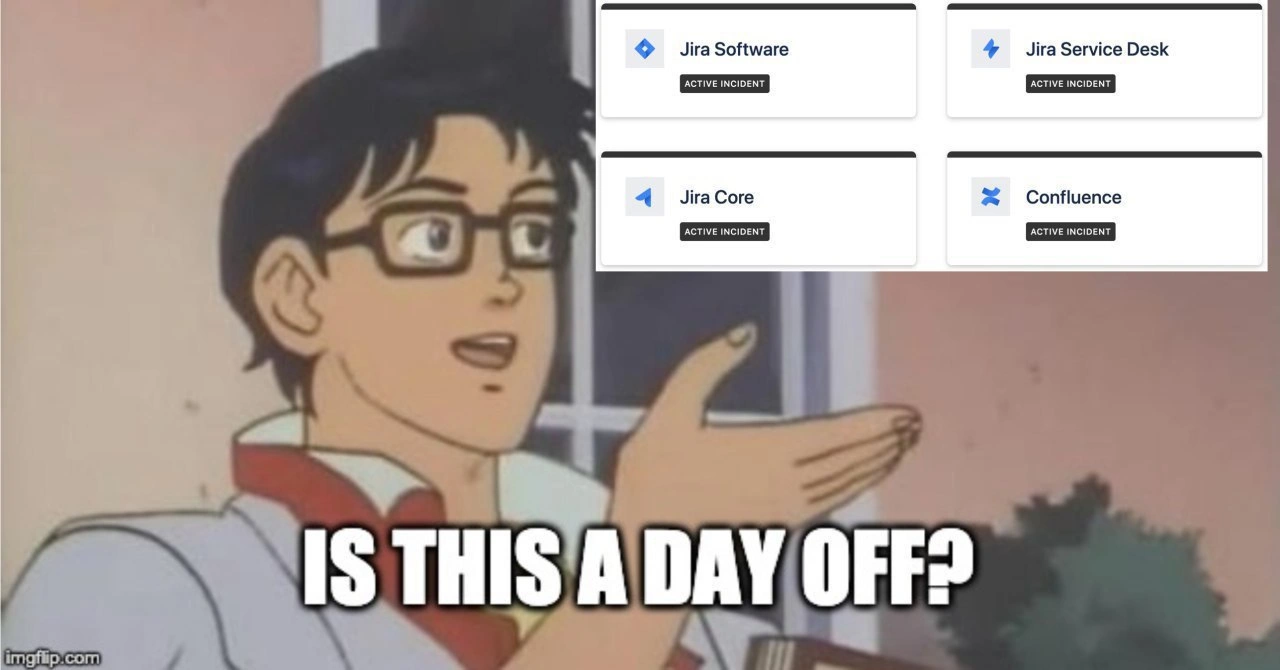
Now, the meme shows a screenshot of Atlassian’s status page with four products – Jira Software, Jira Service Desk, Jira Core, and Confluence – each labeled “ACTIVE INCIDENT.” A status page is a website where companies report problems with their services. “Active Incident” means there’s an ongoing serious problem (an outage) with that product. In other words, all those tools are down at the same time. This is a huge deal: it’s like the entire toolkit a development team relies on suddenly stopped working. No one can create or update Jira tickets, and no one can read or write pages on Confluence. It’s a Kanban blackout — the digital board that tracks every task has gone dark. If you’re a new developer, imagine coming to work and finding that the app you use to see your assignments and report progress just won’t load at all. You’d probably see messages flying around like, “Jira is not loading, is it down for you too?” followed by a collective groan.
In an Agile environment, teams have daily meetings (daily stand-ups) where each person says what they’re working on, often referencing Jira tickets. They also constantly update Jira as work gets done or new work comes in. With Jira offline, those Agile rituals get disrupted. People can’t move cards on the board or log what they did. Similarly, if Confluence is offline, you can’t access important docs or write new notes. It’s as if suddenly all your project plans, to-do lists, and documentation are locked in a closet you can’t open. This leads to ToolingFrustration: the frustration of being blocked by the very tools that usually help you.
Because all these tools went down together, it’s likely a very severe outage on Atlassian’s side. Companies often rank incident severity with numbers (for example, Sev-0 or Sev-1, where a lower number means more severe). A “Sev-0” (Severity 0) incident is an absolute emergency – it means a critical service is completely unavailable for many users. In this case, multiple major services are unavailable at once, so it’s an all-hands emergency for Atlassian’s engineers. They’d have their on-call teams scrambling to fix the issue and update the status page. Meanwhile, in every company affected, managers and developers are realizing they can’t do a lot of their normal work. This directly hits DeveloperProductivity and may even halt progress for the day. Teams measure work done in a sprint (a short, time-boxed period, often two weeks) with something called sprint velocity (how many points or tasks get completed). If you lose a day because your tools are down, that’s essentially a sprint_velocity_zero_day — a day in which no measurable progress can happen.
So, instead of panicking, many developers cope with humor. The meme’s caption, “IS THIS A DAY OFF?”, is a tongue-in-cheek way of saying: “If none of our work tools are working, do we get to chill out?” It’s MeetingHumor too, because if Jira is down, that stand-up meeting might be really short (“No updates today because… well, look!”). Of course, in reality most people won’t just go home; they might catch up on coding tasks that don’t need Jira, or find other productive things to do. But the joke imagines the whole office collectively looking at the blank Jira board and then eyeing the exit or the coffee machine. It’s funny to tech folks because it flips a stressful situation (major DowntimeImpact) into a moment of shared relief: no tickets, no tracking, maybe no meetings… could this be almost like a surprise vacation day? This kind of AgileHumor pokes fun at how reliant we are on our tools, and how when those tools fail, everyone from engineers to project managers is left awkwardly idle, at least for a little while.
Level 3: Sev-0 Snow Day
When every critical Atlassian tool blinks red on the status page, seasoned engineers recognize the Sev-0 apocalypse. All at once, Jira Software, Jira Service Desk, Jira Core, and Confluence are in ACTIVE INCIDENT status — a full-stack failure of our project toolchain. To a battle-scarred dev, this looks oddly like a corporate snow day. The entire Agile engine just threw a piston: no updating tickets, no editing requirements pages, no new bug reports. It’s the ultimate dependency_on_toolchain nightmare (or secretly, a dream) for anyone doing ProjectManagement in tech.
The humor here comes from a darkly familiar place. An outage this massive should be pure OnCall_ProductionIssues adrenaline — pagers blaring, managers in panic. But if you’re not the poor soul on Atlassian’s ops team, a status_page_red across all your work apps feels like an enforced pause. The Kanban board is frozen in time; sprint tasks can’t move, and your stand-up meeting agenda just evaporated. AgileHumor kicks in as everyone on the team shares the same mischievous thought: “All our Agile ritual tools are down… is this an unexpected holiday?” It’s an incident_management_irony that veteran devs laugh about because we’ve seen how a Downtime can paradoxically boost morale. When Jira is unreachable, nobody can assign you new tickets or nag you for updates — the daily torrent of JiraTickets stops cold. This meme nails that shared experience: the moment of guilty hope that a catastrophic outage might grant a brief, blissful respite from meetings and metrics.
Of course, the seasoned perspective also notes the absurd fragility behind the joke. We’ve centralized our entire development lifecycle on one vendor’s cloud. One hiccup in Atlassian’s infrastructure and suddenly a thousand Scrum teams hit sprint_velocity_zero_day. Sprint velocity drops to zero, stand-ups turn into coffee breaks, and the DeveloperProductivity graph flatlines. It’s hilarious in a tragic way: the tools built to enhance productivity become a single point of failure. This has happened in real life — imagine a mid-week morning where every agile team from New York to Sydney stares at the same atlassian_outage status, collectively thinking, “Maybe we really are getting a day off.” The meme’s punchline, “IS THIS A DAY OFF?”, perfectly captures that mix of surprise and snark. It’s a coping mechanism for the folks who’ve been through one too many late-night crises: when faced with a multi-product meltdown you can’t fix, you might as well enjoy the DowntimeImpact and crack a grin at the absurdity. After all, if work comes to a standstill, even the most cynical developer can’t help but joke that Atlassian just accidentally approved everyone’s paid time off.
Description
This meme uses the 'Is this a pigeon?' anime format. An anime character with glasses gestures towards an overlaid image and asks, 'IS THIS A DAY OFF?'. The image he's pointing to is a screenshot of a system status page for Atlassian products. It shows four services - Jira Software, Jira Service Desk, Jira Core, and Confluence - and each one has a black label underneath that reads 'ACTIVE INCIDENT'. The joke satirizes the dependency of development teams on Atlassian's suite for project management and documentation. When all these critical tools are down simultaneously, it can bring productivity to a halt, leading to the humorous conclusion that developers have an unexpected, forced day off
Comments
7Comment deleted
An Atlassian-wide outage is the universe's way of enforcing a mandatory 'No-Story-Points Tuesday'. Productivity is zero, but morale is at an all-time high
Who knew the most efficient way to hit negative sprint velocity was a single-point-of-failure called jira.atlassian.net?
The only time our engineering org achieves 100% alignment is when Atlassian goes down and we all simultaneously realize we've built our entire development process around a single vendor's uptime SLA
When your entire Atlassian stack goes down simultaneously, you realize you've architected a perfect single point of failure for your team's productivity. The irony? You can't even create a Jira ticket to track the incident, document the postmortem in Confluence, or update the service desk about the outage. It's the enterprise software equivalent of 'the system that tracks our problems has become the problem' - a beautiful demonstration of why distributed systems engineers are paranoid about cascading failures and why your disaster recovery plan should probably include 'what if our disaster recovery documentation platform is the disaster?'
Day off in tech: Opening JIRA to 'just check' and closing it three epics later
With PR merges gated on Jira links and change approvals living in Confluence, Atlassian 500s are the only outage that auto‑triggers a company‑wide, SOX‑compliant change freeze
When Jira and Confluence all show ACTIVE INCIDENT, you’ve enabled a company-wide feature flag - workflow=false - because in enterprise land, without a ticket the work literally doesn’t exist