The Unspoken Exception to Transferable Programming Skills
Why is this LowLevelProgramming meme funny?
Level 1: Bikes vs Rockets
Imagine your teacher says, "If you can ride a bike, you can learn to drive anything in just a week!" You feel confident… until they put you in the cockpit of a rocket ship and say, "Go ahead, take off!" 🚀 Suddenly, you're surrounded by controls and dials you've never seen before. Driving that rocket isn’t like riding a bike at all – it's a whole different challenge. Your smile turns nervous as you press your face against the window, realizing this is much harder than you thought. That’s the joke of the meme: the teacher made it sound easy to learn any new programming language, but assembly language is like that rocket ship – so strange and complex that it leaves you wide-eyed, thinking, "Uh oh, this is not what I expected!"
Level 2: A Different Beast
Let’s break down why assembly is such a different beast compared to other programming languages, especially from a beginner’s perspective. First, assembly language (often just called "assembler" in casual talk) is a low-level programming language. Low-level means it operates very close to the hardware itself. In assembly, every instruction you write corresponds to a very basic operation the CPU performs. There's no magic under the hood – no automatic memory management, no high-level constructs like for loops or complex data types built in. You have to manually tell the computer every step. It’s like the difference between giving someone a general instruction ("bake a cake") versus handing them a recipe with every tiny step and measurement explicitly listed. Assembly is that recipe with all the gritty details.
Contrast this with a high-level language like Python or JavaScript. Those languages are designed to be easier for humans to read and write. They handle a lot of details for you. If you want to print something to the screen in Python, you just do print("Hello") and behind the scenes tons of things happen automatically to make that work. In assembly, printing to the screen might require calling an operating system service directly, which means you need to know how to place the right values into the right CPU registers and trigger the OS call. It's the difference between driving a car and building the car’s engine before you drive it. High-level languages let you drive; assembly makes you assemble the engine from scratch, then drive.
Now, about that teacher's advice: "learn one language and you can learn any other quickly." This is often true when the languages are similar in level. Knowing one C-style language (like Java or C#) makes it easier to learn another because they share concepts (variables, loops, functions, etc.). The syntax changes a bit, but the way you think about solving problems remains pretty consistent. This meme is pointing out what happens when you try to apply that advice to learning assembly. Assembly isn't just a new syntax to learn; it’s a whole new mindset. You’re going from a world where the language helps you by doing a lot for you, to a world where the language does almost nothing for you by itself.
For instance, consider a super simple task: adding two numbers and printing the result. In a high-level language vs. assembly, it looks like this:
# High-level example (Python)
x = 5
y = 3
z = x + y
print(z) # This will output 8
; Low-level example (x86 assembly)
mov eax, 5 ; load the value 5 into CPU register EAX
mov ebx, 3 ; load the value 3 into CPU register EBX
add eax, ebx ; EAX = EAX + EBX, so now EAX holds 8 (the sum)
; To print this result, you'd need to call an OS function.
; That involves moving 8 (in EAX) to where the OS expects it and invoking an interrupt or call.
In the Python code, x = 5 creates a variable and stores 5 in it without you worrying about how or where it’s stored in memory. Python (through its interpreter) handles that. In the assembly code, mov eax, 5 explicitly puts the number 5 into a specific CPU register named EAX. The programmer (you) must decide to use EAX and know that it’s a 32-bit register, and that this instruction will place the value 5 into that register. Then mov ebx, 3 loads 3 into another register EBX. The add eax, ebx instruction adds the values in those two registers, leaving the sum (8) in EAX. Now, if you actually want to see that 8 displayed, there's no single print instruction. You have to use a system call — essentially ask the operating system to print it — which might mean putting a code for "print" in one register, the number 8 in another, and triggering a special CPU instruction to switch to OS mode. The exact steps vary by system, but the key point is many steps are needed. So, something that took one line in a high-level language can take many lines of assembly and a deep understanding of the computer's inner workings.
Let’s clarify a few key terms and why assembly often feels daunting:
- Assembly Language: This is a programming language that is one tiny step above machine code (the 1s and 0s). It's human-readable to an extent (using short mnemonics like
MOVfor move,ADDfor add), but each instruction is very simple. Each type of CPU has its own assembly language (for example, x86 assembly for Intel/AMD PCs, or ARM assembly for many smartphones). In the meme, the text "Assembler:" is referring to assembly language itself as if it's a person in the room listening to the teacher. (Technically, an assembler is also the name of the tool that converts assembly code into machine code, but here it's used in the casual sense of the code/human mix.) - Low-Level Programming: Programming "close to the hardware." This means you’re dealing with things like memory addresses, CPU registers, and instruction sequences directly. Low-level code doesn’t automatically manage stuff for you. For example, if you need space for a new value, you might have to manually allocate memory or decide which register to sacrifice. In high-level programming, you might just declare a new variable and not care where it lives in RAM — the language runtime or compiler handles it. Low-level gives you maximum control and maximum responsibility. It's powerful but unforgiving. If you make a mistake (say, reference the wrong memory address), there's no safety net; the program might crash immediately or do very weird things.
- Learning Curve: This is a way to talk about how difficult it is to learn something new. A "steep learning curve" means that it’s hard to learn at first — imagine a steep hill you have to climb, you have to put in a lot of effort up front. Assembly is notorious for having a steep learning curve. Initially, everything about it seems unfamiliar: the notation, the way of thinking, even the tools you use to write and debug it. It takes a while (and lots of mistakes) before you start to feel comfortable. By comparison, many people find the learning curve for a language like JavaScript or Ruby to be much gentler — you can write useful programs pretty quickly even if you're not an expert, because the languages are designed to be beginner-friendly.
- Language Complexity: This can mean a few things, but here we're talking about how complex a language is to use effectively. Assembly's "complexity" is high in the sense that you have to manage and keep track of lots of details. The language itself has a fairly small set of instructions (that part isn't necessarily complex), but using them to do real tasks is complex. It’s kind of like having a small toolbox but needing to build a house — you have to be very crafty with those few tools. In contrast, a language like Python has a huge standard library and a lot of built-in features (a big toolbox), so doing tasks is more straightforward (not as much improvisation needed for basic things).
- Language Comparison: The meme is comparing high-level languages to assembly to make a joke. Think of high-level languages as comfortable family cars and assembly as a Formula 1 race car. Sure, they’re both "cars" in concept, but one demands much more skill and nuance to operate. When the teacher says "any other language," most students would think of languages roughly in the same category. This meme throws in assembly, which is in a category of its own, just to humorous effect. It’s highlighting how unfair that comparison is.
- Expectations vs. Reality: This is the core of the joke. The expectation (set by the teacher) is that learning a new language will be quick and easy. The reality (presented by assembly) is that some languages defy that rule. The meme format shows "Teachers: [ideal scenario]" and then "Assembler:" followed by a contrasting image. It's a common meme structure to show expectation vs reality. Here reality is basically assembly language giving you a reality check — "Nope, not so fast!"
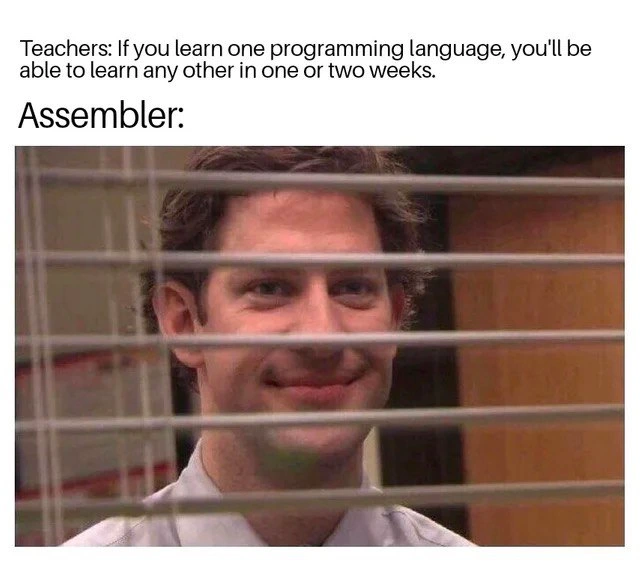
- Jim Halpert Blinds Meme: The image used in the meme is a well-known reaction image. It's from The Office (a popular sitcom), where the character Jim Halpert, played by John Krasinski, often gives a knowing or concerned look to the camera. In this shot, he's peeking through window blinds with a forced smile. In internet culture, that image is used to humorously portray someone who is witnessing something that is about to go wrong or is uneasy about what was said, without openly intervening. Think of it like someone quietly saying "yiiiikes" or "uh oh" with their expression. In the context of this meme, Assembly is personified as Jim. Assembly language is peeking from behind the blinds, hearing the teacher’s bold claim. That face tells us, "I'm quietly watching this situation, and I know it's not going to go as smoothly as you think." You don’t need to be familiar with The Office to get it — the picture alone signals a kind of nervous disbelief, which is exactly how a programmer feels when they realize the 'one-week language learning' rule is about to meet its exception.
For a junior developer or a student encountering this meme, the main point is: assembly language is not just another programming language; it's a throwback to how computers really work at a low level. Learning it is a bit like learning to do everything from scratch. So, the joke is that the teacher's upbeat advice meets its match when faced with assembly. It usually takes more than a week or two to get comfortable with assembly; it might take a month just to write and understand a small program properly. And that’s okay! The meme exaggerates the contrast to get a laugh. It’s funny because most developers remember that, at some point, they too believed they could pick up any new tech quickly — and then something like assembly proved them wrong. The blinds guy with the wary smile is basically saying, "This is not going to be the easy ride you expected," and every programmer who’s struggled with a tough technology can relate to that feeling.
Level 3: Syntactic Sugar Crash
Every seasoned developer chuckles (or shudders) at this meme because it hits on a hard truth: not all programming languages are created equal, especially when one of them is assembly. The well-meaning teacher promise – "If you learn one programming language, you'll be able to learn any other in one or two weeks!" – holds up when you're talking about, say, moving from JavaScript to Python or from C++ to Java. Those languages operate at a similar high level of abstraction; the concepts transfer pretty smoothly. But then you encounter assembly, and it's like slamming into a wall of arcane opcodes and hardware quirks. The meme perfectly captures that collision: high-level hubris meets low-level reality.
In real-world terms, switching between modern languages usually means learning new syntax, libraries, and maybe a different programming paradigm. Your experience with things like loops, functions, and perhaps object-oriented concepts carries over. But assembly throws all of that out the window. There’s no convenient String class, no one-line sort() function, no garbage collector quietly cleaning up memory. It's just you and the bare machine. Seasoned programmers know this shock well. Many of us can remember the first time we opened an assembly debugger or tried to write even a simple routine in x86 assembly. Suddenly, ideas we took for granted (call stacks, local variables, if/while structures) had to be manually implemented with loads, stores, and jumps. It's a bit like knowing how to drive a car and then being handed the controls of a submarine — familiar outcome (movement) but everything about how you do it is different. That’s why the meme’s image — that guy (Jim Halpert from The Office) peering through the blinds with a forced, uneasy smile — is so spot-on. Assembly is basically sitting there behind the scenes, watching the confident proclamation that "any language can be learned in a week" with a look that says, "Oh really? We'll see about that."
The humor here riffs on the learning curve. Typically, once you're fluent in one programming language, your learning curve for picking up a similar language is shallow — you can get productive in days. But assembly’s learning curve isn't just steep; it's a cliff face. After a week with a language like Ruby or Go, you might be writing basic programs. After a week with assembly, you’re often still struggling to do something as simple as print a number to the screen or debug why your loop counter mysteriously isn’t working. There's an industry joke that the only thing you truly learn in one week of assembly is just how much work your compiler has been doing for you all these years. Seasoned devs nod knowingly at that. We’ve all been the eager coder who thought, "I know Java and Python, how hard could assembly be?" — and then spent an entire night wrestling with registers and segmentation faults. The meme nails that feeling. The teacher sets the rosy expectation, and assembly smugly delivers the reality: this will not be as easy as you think.
This resonates as classic developer humor because it's a shared experience of tech folks across generations. The scenario is almost archetypal: a newcomer brimming with confidence gets a reality check from an unforgiving technology. In this case, assembly is the “final boss” of programming languages that humbles even experienced programmers. There's camaraderie (and a bit of PTSD) among developers who have gone through an assembly language course or had to debug low-level code. We laugh at the meme because we remember that bewildered feeling — staring at an assembly listing or error, feeling our brain flip upside-down trying to track what the CPU is actually doing. It’s funny now because we survived it. The meme’s text and image tap into that exact moment of Oh no, what have I gotten into? that many of us have felt.
There's also some truth in the jab at academic or teacher advice. In academia or coding bootcamps, instructors often encourage students by saying, "Don't worry, once you've learned one language, the rest are easy." And generally, that's good advice to keep students motivated. They’re usually referring to high-level languages – the difference between learning JavaScript after Python is mostly syntax and libraries, not a total reinvention of how you think about code. But assembly is the sort of thing that doesn’t fit into that nice promise. Many curricula treat assembly as a separate, specialized subject (like a systems programming or computer architecture class), precisely because it is so different. The meme humorously points out that the blanket statement "you can learn any language quickly" has a giant asterisk next to it. Terms and conditions apply. Void where low-level programming is involved. Seasoned engineers who maybe learned programming in the era of BASIC or Pascal and then met assembly often have a "yeah, they didn't warn me about this one" story. Even those who started with modern languages and later had to peek under the hood find out fast that assembly requires unlearning some comforts.
The image choice — Jim Halpert behind blinds — adds an extra layer for those who recognize it. Jim from The Office is known for breaking the fourth wall and giving the camera an "Are you seeing this nonsense?" face whenever something crazy happens at Dunder Mifflin. In this meme, Assembly is personified as Jim. It's as if assembly heard the teacher's claim and is now peering through the blinds with that half-concerned, half-amused expression. It's the perfect "witnessing a train wreck in progress" look. Even if you don’t know the show, the image conveys a mix of disbelief and smug knowingness. You can almost hear Assembly (Jim) saying, "Heh, okay, let's watch this kid try me out and see what happens." It's a silent, comedic expectation vs. reality commentary in one picture.
In essence, the meme strikes a chord with anyone who has ever ventured outside the comfortable sandbox of high-level languages and into the gritty world of low-level code. It's funny because it's true: after getting proficient in a language like JavaScript or Python, you feel like a coding rockstar — then assembly language comes along like an old-school drill sergeant to remind you that you know nothing about how the computer actually works. That wide-eyed face behind the blinds? That's every programmer the first time they realize that learning a new language isn’t always just about different syntax. Sometimes it means completely rethinking what programming even is. The next time someone casually says, "Oh, you can pick up any language in a week or two," a lot of developers will grin and think, "Sure, how about you try Assembly?" – exactly the punchline this meme delivers.
Level 4: Bare-Metal Reality Check
When you dive into assembly language, you're essentially writing the human-readable form of a computer's binary machine code. In a high-level language like Python or Java, a single line might compile down into dozens of machine instructions. But in assembly, each line you write corresponds almost directly to an actual CPU operation. For example, a simple C statement like sum = a + b; could become a sequence of primitive instructions manipulating CPU registers and memory addresses. You go from thinking in objects and loops to thinking in bytes, addresses, and jumps. It's as if one Python line explodes into a dozen tiny steps you must choreograph by hand.
There's zero syntactic sugar or abstraction in assembly: no friendly for loops or convenient objects. Instead, you get bare-bones operations. Want to increment a number? You explicitly load it into a register with a mov instruction, increment it, then store it back. Want to call a function? You must set up the CPU state (push arguments onto the stack or into registers, call the function address, then clean up) all on your own. It's like manually toggling the switches on the CPU's control panel for each step of your program. In assembly, you implement constructs like loops and conditionals using labels and jumps (essentially GOTO statements), carefully managing the flow of execution yourself. You even manage your own call stack – pushing return addresses and variables as needed. One misplaced jmp or a miscalculated stack pointer, and you've invoked the dreaded realm of undefined behavior or crashes. In short, assembly forces you to confront the bare metal of the machine.
Because assembly deals directly with the computer's instruction set architecture (ISA), it's inherently tied to the hardware. An assembly program written for x86-64 (the common PC architecture) won't run on ARM (which phones use), and vice versa, because the instructions and register names are different. In contrast, a high-level program (say in Python) can run on any architecture that has a suitable interpreter or runtime. So with assembly, part of learning it is learning the particular dialect for your CPU. You end up delving into details like register sizes (32-bit vs 64-bit registers), memory addressing modes (how you reference memory locations, e.g. direct vs indexed addressing), and even how numbers are represented at the bit level (knowing about endianness, two's complement, etc.). These are concepts a high-level language user might never worry about, because the compiler or interpreter handles them behind the scenes. Assembly language brings all those hidden details to the forefront. For instance, adding two numbers in assembly means deciding which registers to use for each operand, possibly handling CPU flags (like the overflow flag) after the addition, and then storing the result explicitly somewhere. It's a far cry from writing c = a + b in a high-level language and moving on.
At this level, you're also exposed to the raw realities of performance and hardware behavior. High-level developers might seldom think about CPU pipelines or cache misses, but an assembly programmer is often keenly aware of them. The way you order instructions can determine whether the processor runs efficiently or stalls. For example, modern CPUs execute multiple instructions in parallel and speculate on branches (the processor guesses which way an if will go). Writing tight assembly might involve ensuring you don't unintentionally disrupt this flow — a naive assembly loop could end up causing pipeline stalls or branch mispredictions that a compiler might have optimized away. Similarly, you might consider the alignment of data in memory to avoid costly cache misses. In other words, writing assembly can demand an understanding of the micro-architecture: how instructions are decoded, executed, and retired inside the CPU. It's a humbling reminder that underneath our sleek high-level code, there's a complex engine ticking away. Assembly drops you into that engine room with a wrench and says, "Here, you fix it." No surprise, then, that assembly has a reputation for being both powerful and painful.
So when a teacher cheerily says, "If you learn one programming language, you'll be able to learn any other in one or two weeks," they're probably not thinking about something like assembly. That advice works for languages that operate at a similar level of abstraction, but assembly is a world unto itself. It demands a fundamentally different mental model. Instead of variables, you think in registers and memory addresses. Instead of simple for loops, you’re calculating jump offsets and loop counters manually. Every tiny oversight (like forgetting to preserve a register value across a function call) can have major consequences. This is why encountering assembly after only knowing high-level languages can feel like hitting a brick wall. The meme highlights that jarring transition — the reality check when you go from a comfortable high-level world to the uncompromising low-level truth of how computers really run. Assembly is the brick wall lurking behind the breezy one-week promise, and many a programmer has pressed their face against it in awe and horror.
Description
A meme based on the 'Jim Halpert peeking through the blinds' format from the TV show 'The Office'. The top text reads, 'Teachers: If you learn one programming language, you'll be able to learn any other in one or two weeks.' Below this, the label 'Assembler:' is shown. The image features Jim Halpert's face smiling smugly as he peers through a set of horizontal window blinds. This meme humorously refutes the common, optimistic advice given to beginner programmers. While skills are often transferable between high-level languages (like Python to Ruby), the joke is that Assembly language (Assembler) is a massive exception. It operates at a much lower level of abstraction, requiring direct manipulation of CPU registers and memory, making it a fundamentally different and more complex skill set that doesn't follow the 'learn one, learn them all' pattern

Comments
8Comment deleted
The transition from Python to Java is a weekend trip. The transition from Python to Assembly is a multi-year deep-space mission where you have to build your own ship out of raw silicon
Assembler watching your two-week ramp-up plan: “Great, I’ll pencil you in with the SysV ABI, the pipeline stall oracle, and the guy who knows why LEA is faster than ADD on Tuesdays.”
The same professor who said "all languages are basically the same" is now three weeks into explaining why we need sixteen different calling conventions and still hasn't covered why the stack grows downward
Two weeks is about right - that's how long it takes to print 'Hello, World' and segfault on the newline
Assembly is where you discover that 'learning any language in two weeks' really meant 'any language that doesn't require you to manually manage every CPU register, understand calling conventions across architectures, and debug by counting clock cycles.' It's the language that reminds you why we invented compilers in the first place - and why systems programmers deserve their premium salaries
Two weeks is what assembly spends choosing AT&T vs Intel, internalizing the SysV ABI, and chasing a 16‑byte stack alignment bug that only segfaults under -O2
Assembly: the one language where 'transferable skills' means finally grokking why we invented compilers
Two weeks to learn any language? Great - now write a memcpy in x86‑64 that preserves callee‑saved regs, honors the SysV ABI, handles unaligned tails, and still beats glibc