Skip to content
DevMeme
342 of 7435
The Programmer's Answer to 'If I Only Had a Brain'
Languages Post #401, on May 29, 2019 in TG

The Programmer's Answer to 'If I Only Had a Brain'

Why is this Languages meme funny?

Level 1: Too Hard on Purpose

Imagine you ask your friend a simple question: “Hey, if you were really smart, what would you do?” Now instead of saying something normal like “solve world hunger” or “build a cool robot,” your friend starts writing in a crazy secret code that looks like complete gibberish. They fill pages with weird arrows and plus signs that no one else can understand. You’d probably look at them and go, “Uh... what are you doing, exactly?” It’s funny (and a bit silly) because you’d expect a super smart person to do something helpful or at least understandable, but instead they’re doing something overcomplicated on purpose. It’s like if someone got a brand new fancy tool set, and they decided to fix a simple toy by disassembling it into a million pieces and putting it back together blindfolded – not because they have to, but just to show they can.

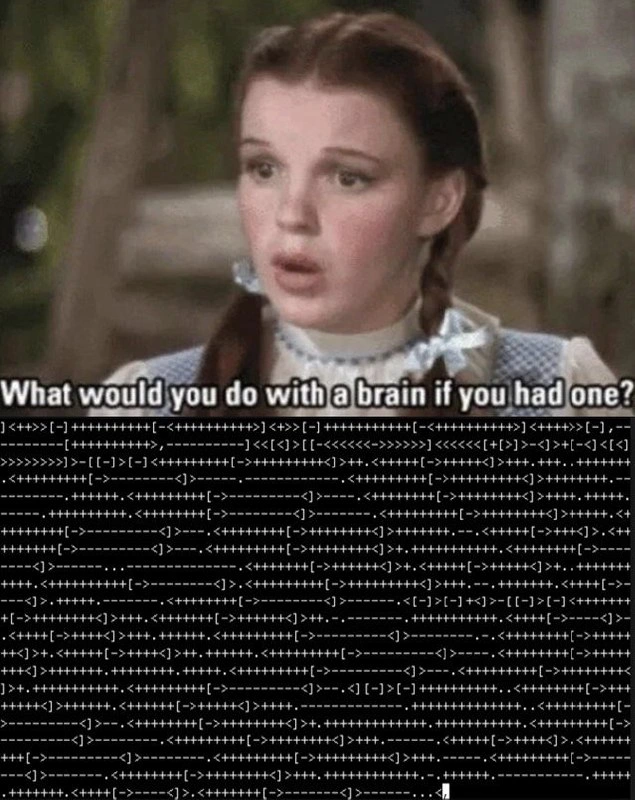
That’s essentially the joke here. The top part shows a character (Dorothy) asking someone who isn’t thought to be very smart, “What would you do if you had some brains?” The bottom part is the “answer,” but the answer is shown as a wall of bizarre code from a programming language aptly named Brainfuck (which is a humorous way to say it will “mess up your brain”). This code is so unfriendly and confusing that it’s famous among programmers as something you tackle only for a crazy challenge. So in everyday terms, the meme is saying: A really smart person might do something so unnecessarily complicated that it blows everyone’s mind (and maybe even their own). It’s poking fun at the idea of using your intelligence to make things harder than they need to be, just for a laugh or a personal challenge. You don’t need any programming knowledge to get the core feeling: it’s funny because the “smart” action looks indistinguishable from nonsense to the rest of us. It’s the humor of someone using a lot of brainpower to do something that, to everyone watching, seems totally over-the-top and pointless – and that contrast is what makes it silly and amusing.

Level 2: Wizard Quote, Weird Code

Let’s break down the meme in simpler terms. The top half shows Dorothy from The Wizard of Oz asking, “What would you do with a brain if you had one?” This is a famous line from the movie, where Dorothy teases the Scarecrow (who doesn’t have a brain) about what he’d actually do if he got some brains. It’s basically a playful way of asking, “If you were smart, how would you use it?” Now, the bottom half of the meme is a block of code – but it’s not in a normal programming language like Python or Java. It’s written entirely in symbols like > < + - [ ] . which looks super weird and incomprehensible at first glance. This is actually code in a language called Brainfuck. Yes, that’s the real name!

Brainfuck is what’s known as an esoteric programming language (often shortened to esolang). Esoteric means unusual or intended for a small audience, and in the context of programming languages, esolangs are typically joke languages or ones created to make a point about language design rather than to build real-world software. Brainfuck, in particular, was created to use only a few characters and still be able to do any computation. It has only 8 commands (just those symbols you see), and despite its goofy name, it’s a sort of legendary little language among programmers. Why legendary? Because it’s incredibly hard to read or write – doing anything useful in Brainfuck requires writing a long sequence of those symbols. It’s like a puzzle or a challenge rather than a practical coding tool.

In the meme, Dorothy’s question is answered by implying: “If I had a brain, I’d write code in Brainfuck.” This is funny because Brainfuck code is a brain bender. It’s famously said to “melt your brain” or “drive you crazy” if you try to seriously program in it. Writing Brainfuck is an extreme way to use one’s brainpower – it’s doing things the hard way on purpose. The code snippet shown is essentially gibberish to anyone who isn’t familiar with Brainfuck. To give an idea of how impractical it is, here’s a quick comparison:

# Brainfuck code to print "A":
+++++++++++++++++++++++++++++++++++++++++++++++++++++++++++++++++.
# (65 plus signs then a dot outputs the letter 'A' in ASCII)

# Equivalent Python code to print "A":
print("A")

In the Brainfuck version, +++++++++++++++++++++++++++++++++++++++++++++++++++++++++++++++++. has 65 + characters followed by a .. Each + adds 1 to an internal counter (starting from 0). After 65 pluses, that counter’s value is 65, which corresponds to the capital letter "A" in ASCII (the system computers use to map numbers to characters). The . then prints out the character for that number. So that insanely long string of plus signs just prints one letter "A"! In Python (a normal high-level language), you can do the same thing with a simple print("A") – one short, readable command. This contrast shows just how ridiculous and unapproachable Brainfuck code is.

Now, imagine someone actually choosing to work with a language like Brainfuck. It’s not something you’d do for building an app or a website; it’s something you do as a quirky challenge or to show off a bit of geeky bravado. It’s the coding equivalent of solving a Rubik’s cube blindfolded – technically possible, very impressive to a niche group, but not exactly useful for day-to-day needs. That’s why the meme is categorized under coding humor and developer humor: it’s a joke that only programmers might fully appreciate. The language quirks here are the entire joke – Brainfuck’s quirky, minimalist syntax is so extreme that it becomes a form of entertainment for some programmers (and a form of torture for others!). Some developers joke about “hurting their brain” for fun by trying out esoteric languages or weird programming puzzles. We sometimes call it “syntactic masochism” — masochism meaning taking pleasure in pain — because you’re voluntarily struggling with painful syntax.

And let’s not miss the wholesome vs. nerdy contrast: Dorothy from a classic family movie is essentially being answered with borderline ASCII art code. The bottom panel’s dense arrows and pluses look kind of like a decorative pattern or some secret code. In fact, any characters in Brainfuck code that are not one of the 8 commands are ignored, so people often format Brainfuck code with spaces or line breaks (or even hidden messages) to make it slightly more readable. But to the uninitiated, it just looks like someone held down random symbol keys on a keyboard. The meme leans into that absurdity: the idea of “having a brain” is humorously illustrated by something that appears absolutely nonsensical unless you’re in on the joke. It’s essentially saying: a truly brainy developer might do something so nerdy and convoluted that it confuses everyone else.

So, to recap in plain terms: The meme sets up a question about being smart (Dorothy’s quote) and delivers a punchline that only a programmer would think of — writing in one of the hardest-to-read coding languages ever. It’s a playful jab at how programmers sometimes use their intelligence in quirky, impractical ways. If you’ve ever heard of someone doing a hard task “for the fun of it” or using a tool in a way that’s complete overkill, that’s the vibe here. The meme lives in the category of programmer inside jokes, relying on our knowledge of this bizarre language named Brainfuck and the shared understanding that writing Brainfuck is like doing a marathon with your shoelaces tied together – technically doable, but why would you, except as a stunt?

Level 3: Masochistic Syntax

For seasoned developers, this meme delivers a knowing grin by combining a pop culture reference with an insider programming joke. The top panel shows Dorothy from The Wizard of Oz asking the Scarecrow, “What would you do with a brain if you had one?” – essentially calling out someone’s lack of sense or intelligence. The punchline (in the bottom panel) is that a developer would use that brain to write code in Brainfuck, an esoteric programming language notorious for its unreadable syntax. This is a classic case of developer humor: it pokes fun at how programmers sometimes choose ridiculously complex or impractical tools just for the thrill or bragging rights. In other words, given a powerful brain, a true code masochist would self-inflict pain via syntax and do something over-the-top like shipping Brainfuck code.

Why is this funny to an experienced coder? Because it satirizes a well-known archetype in tech: the programmer who takes pride in using overly complex solutions (often phrased as having a “big brain” or being galaxy-brained). Brainfuck is essentially a joke language used to demonstrate you can program with almost zero conventional constructs – it’s the ultimate esolang reference for doing things the hard way. No sane team writes production software in Brainfuck; maintaining or debugging it would be an impossible nightmare. So, “shipping Brainfuck code” is an absurd scenario that experienced devs recognize as pure satire. It’s exaggerating the idea of a clever coder to the point of absurdity: Look, I’m so 1337 (elite) that I write programs no one, including me, can read! It’s a humorous take on syntax masochism, where a developer intentionally endures a painful coding experience as a kind of geeky challenge. Seasoned engineers have seen this pattern before on a smaller scale – like that one colleague who writes overly cryptic one-liners in Perl or uses five levels of templating in C++ when a simple loop would do. Brainfuck is the extreme caricature of that tendency.

The visual of the bottom panel – an intimidating block of ><+-[] characters – is instantly recognizable to veteran programmers as Brainfuck code. It looks like line noise or an ASCII art arrow maze, and that’s exactly the point: it’s real code that looks like gibberish. The contrast between Dorothy’s wholesome 1930s movie image and the profane-named, headache-inducing language is another layer of contrast that seasoned devs appreciate. It’s combining the innocence of “if you had a brain” with the tongue-in-cheek vulgarity of “Brainfuck” (which literally suggests “messing up your brain”). The meme text even plays on the double meaning: on a surface level, Dorothy questions someone’s intelligence, and the answer is a literal brain-teaser of a language designed to melt brains. There’s irony: having a brain should help you solve problems sensibly, but here it’s used to complicate things to absurd levels.

This resonates in developer culture because of a shared understanding: just because you can do something doesn’t mean you should. Experienced engineers often learn that the hard way. The meme exaggerates this lesson – demonstrating the ultimate “just because I can” stunt (writing Brainfuck) which is as impractical as it gets. In daily software development, we value readability, maintainability, and clarity. Brainfuck embraces the opposite, purely as a stunt or puzzle. Thus, the meme is a wink to all the times developers have seen code that’s needlessly complex or chosen a tool that was total overkill. It’s programmer hyperbole: “Give this person a brain and they’ll write impossible code for fun.” Everyone who’s wrestled with indecipherable legacy code or overly clever hacks can laugh (perhaps a bit darkly) at that idea.

In short, the humor combines language quirks with a classic movie quote. It mocks the idea of showing off intelligence in a counterproductive way. Senior devs chuckle because they either went through a phase of toying with esoteric languages like Brainfuck or have war stories of code that felt just as nonsensical. It’s an inside joke: only people who know what Brainfuck is (and how absurd it would be to use it seriously) will fully appreciate the gag. And those who do know are likely the kind of seasoned geeks who enjoy the absurdity of an esoteric programming language being the answer to Dorothy’s question. It’s a badge of nerd honor to get the reference – a way of saying “my brain is big enough to get this joke, and twisted enough to find it funny.”

Level 4: Turing Tarpit Torture

At the most abstract level, this meme spotlights Brainfuck as a classic example of a Turing tarpit. In theoretical computer science, a Turing tarpit is a system that is Turing-complete (capable of expressing any computation) but in which accomplishing even simple tasks is excruciatingly convoluted. Brainfuck was intentionally designed with only eight single-character commands, making it a minimalist proxy for a Turing machine. Every > or < in that dense code block moves a data pointer on an imaginary tape (just like the tape head of Turing’s original machine model), and each + or - increments or decrements the value at that tape cell. The [ and ] characters define loops (similar to a while loop or jump in assembly, but here it’s literally “loop until cell is zero”), and the . outputs a byte (with , for input, though input isn’t shown in the snippet). This means that any program theoretically can be written in Brainfuck – the language is mathematically complete – but doing so is an exercise in extreme algorithmic contortion.

From a computational theory perspective, Brainfuck’s absurdly unreadable syntax exemplifies the difference between possibility and convenience. It proves the point that as long as a language has fundamental capabilities like memory manipulation and conditional looping, it can compute anything – but reading or writing such code is another story. The meme’s wall of >++<-- patterns visually resembles static or some cryptic ASCII art, underlining how information-dense and pattern-driven the code is. Each tiny symbol carries significant meaning to a computer, yet to a human, it’s virtually indecipherable noise without careful manual simulation. In fact, tracing Brainfuck code often means mentally tracking a memory array and a pointer index with every plus, minus, and bracket – a tedious process that only a masochistic theoretician (or a very bored engineer) would attempt for fun. The humor here runs deep: it’s pointing out that having a “big brain” (i.e., a lot of knowledge or intelligence) might lead a programmer not to elegant solutions, but to ridiculously complex esoteric ones. It’s a nod to the academic playthings of computer science – like writing a Brainfuck interpreter as a rite of passage – where the brain is indeed engaged, but arguably overkill is the goal.

Historically, Brainfuck was created in 1993 by Urban Müller with the goal of implementing a Turing-complete language in as few bytes as possible. The original compiler was just several hundred bytes long, a testament to its minimalism. This design shows an interesting quirk of computing theory: by stripping down syntax to the bare bone operations, you maximize the effort needed from the programmer to do anything non-trivial. It’s almost a parody of low-level programming – akin to writing raw machine code with a quirky symbolic twist. The top panel’s famous quote is turned into an academic irony: if you had a brain, you’d use a Turing-complete but human-hostile language. Ultimately, at this level the meme highlights the intellectual absurdity of Brainfuck: it exists at the intersection of computer science theory and nerd humor, where the power of universality meets the pain of unreadability. It’s a reminder that just because something is theoretically possible (like shipping code in Brainfuck), the practical insanity of doing so is what makes it funny.

Description

A two-part meme featuring a still image of the character Dorothy from the movie 'The Wizard of Oz' in the top panel. She has a concerned expression and the subtitle below her reads, 'What would you do with a brain if you had one?'. The bottom panel provides the punchline: a large, dense block of white text on a black background, which is source code written in the esoteric programming language Brainfuck. The code consists entirely of the characters '+', '-', '[', ']', '<', '>', ',', and '.'. The joke lies in the juxtaposition of the innocent question with the notoriously complex and unreadable programming language. It humorously suggests that a programmer's idea of using their brain is to create something so deliberately convoluted and minimalist that it's nearly incomprehensible, reflecting a niche aspect of developer culture that celebrates technical cleverness, sometimes at the expense of practicality

Comments

6
Anonymous ★ Top Pick Of course I'd write Brainfuck. How else am I supposed to secure my job? No one can fire you if they can't figure out what your code does
  1. Anonymous ★ Top Pick

    Of course I'd write Brainfuck. How else am I supposed to secure my job? No one can fire you if they can't figure out what your code does

  2. Anonymous

    If I actually had a brain, I’d port our 20-year-old COBOL billing engine to Brainfuck - just to see SonarQube try to calculate cognitive complexity with a single byte of RAM

  3. Anonymous

    The same developer who wrote this also maintains our authentication service and wonders why incident response takes 6 hours just to find where the token validation happens

  4. Anonymous

    Legacy monoliths to new hires: cognitive complexity exceeds available neurons

  5. Anonymous

    Brainfuck proves Turing completeness is the easy part - our lint rules are just “count brackets,” and observability is moving the pointer left until morale improves

  6. Anonymous

    Rebranded as a “minimal DSL for hot paths,” Brainfuck hit our latency SLOs and our bus factor dropped to zero - secured by sheer incomprehensibility

Use J and K for navigation