Skip to content
DevMeme
340 of 7435
Geopolitical Internet Problems, Solved by a VPN
Networking Post #399, on May 28, 2019 in TG

Geopolitical Internet Problems, Solved by a VPN

Why is this Networking meme funny?

Level 1: Disguised as Another Kid

Imagine you’re a kid on a playground where your school has a rule: kids from your class aren’t allowed to play on the new slide (maybe your class was too rowdy). But the kids from the class next door are allowed on the slide. So what do you do? You borrow a sweater from a friend in the other class and mix in with them. Now, to the teacher watching, you look like you’re part of that other class, and you get to go down the slide with everyone else. 😎

In this meme, the “slide” is certain content on the internet that got blocked by one group’s rules (like a country saying “no you can’t see this”). Using a VPN is like putting on a disguise that makes your internet connection look like it’s coming from somewhere else (somewhere without those rules). The joke is that no matter what local rule the EU or UK tries – whether it’s a new ban or filter – people can just pretend to be in a place where that rule doesn’t exist. It’s funny because it shows how silly those rules look when a simple trick lets you ignore them. It’s like saying, “If my country’s internet has a bedtime, I’ll just pretend I’m in a country where it’s still daytime!” Everyone ends up “living in America” online, because that’s the pretend place with no such bedtime for the internet. The meme makes us laugh at how easy it is to dodge the rules, just by wearing a digital costume.

Level 2: Location Spoofing 101

Let’s break down what’s happening in simpler terms. A VPN (Virtual Private Network) is basically a service that lets you connect to the internet through another server (often in a different country) as if you were on that server’s network. It’s like an invisibility cloak for your internet connection. When you use a VPN, your computer creates a secure, encrypted link to a VPN server somewhere else in the world. All your internet traffic goes through that link to the server first, and then out to the websites you’re visiting. Because the connection is encrypted (scrambled using math so others can’t read it), your Internet Service Provider or any government monitors can’t easily see what sites or data you’re accessing – they only see that you’re connected to a VPN server. This is a big win for OnlinePrivacy and DataPrivacy, since it keeps your browsing private.

Now, here’s the key part: when your traffic leaves that VPN server to go to the website you want to reach, it carries the VPN server’s IP address. An IP address is like your device’s mailing address on the internet – and it often gives away your location (at least the country or city). Websites and services use that IP address to figure out where you are. For example, if your IP address is identified as a UK address, a UK-only rule like the porn ban would kick in, or an EU address might trigger Article 13 filtering on an EU-specific site. But if you use a VPN server in the United States, the websites will see a US IP address and assume you’re in the US. So any rules or blocks meant for UK or EU users simply don’t activate because, from the website’s perspective, you’re an American visitor. This trick is often called geo-spoofing – you’re spoofing (faking) your geographic location.

Let’s apply that to the two examples in the meme: Article 13 and the UK porn ban. Article 13 was a proposed EU law (in 2019) that would make websites responsible for blocking copyrighted content from being uploaded by users in Europe – people feared it might kill memes or a lot of user-generated content because filters can be overzealous. If a European user goes on, say, a video site after Article 13, the site might block or filter some content just for European IPs to comply with the law. But if that user runs a VPN through America, suddenly the site sees a US IP and wouldn’t apply the EU-specific filter to them. Similarly, the UK’s porn ban was going to force UK internet users to prove they’re adult (like through an age verification system) before accessing adult content, and ISPs would block sites that didn’t comply. However, using a VPN, a person in the UK could appear to be browsing from the US, where there’s no such ban – so they’d get straight through with no popup or block, because the site doesn’t realize they should be checking age for that user. ContentFiltering based on location fails if you can effectively change your location.

For a junior developer or someone new to this, think of it this way: Networking wise, your IP address is your home address on the internet. A VPN acts like a forwarding address in another country. If the government or a service says “People from your home address can’t access this”, you just send your request from the forwarding address instead, and the response comes back through that forwarding address to you. The filtering system is fooled because it only checks the forwarding address (which is allowed), not realizing who is actually behind it. It’s a lot like having a friend abroad send you something that your local post office would normally block. As far as the system knows, it’s dealing with the friend, not you. This is super common in the world of Security and privacy tools. People use VPNs not only for region-blocked content but also to secure their connection on public Wi-Fi or to stop their ISP from snooping. In this meme, VPNs are portrayed as heroes swooping in to “rescue” users from impractical internet laws by effectively teleporting those users’ internet presence to a freer jurisdiction. The text “We’re all living in America” is basically saying: if America doesn’t have those rules, fine, we’ll all just pretend to be in America online. It’s a tongue-in-cheek solution, but it works technically!

Level 3: Border Control vs. Packets

This meme hits home for seasoned developers and IT folks because it highlights an ongoing tug-of-war between regulation and technology. The top lines call out two heavy-handed policies: EU’s Article 13 (the infamous copyright “upload filter” rule many feared would ban memes and force platforms to automatically censor content) and the UK’s porn ban (a law requiring age verification on adult sites for UK users, with ISPs ordered to block sites that didn’t comply). These are classic examples of location-based restrictions – rules that only apply to people accessing content from a certain region. And what’s the age-old tech response to such regional locks? Spoof the region! So the meme’s punchline is the one-word response from VPNs: “We’re all living in America.”

In other words, VPN providers (and their users) are cheekily saying, “Just pretend to be in the US and you can ignore these laws.” It’s funny because it’s true – anyone who’s dealt with ContentFiltering or geo-blocking knows how trivial it often is to bypass. There’s a shared IT folklore here: when some government or service tries to impose a wall, geeks respond with a tunnel. We’ve seen it time and again. Remember when certain YouTube videos said “Not available in your country”? A VPN was the go-to fix. Or when a new streaming service only launched in one country? People would geo-spoof their location to join the fun. This meme takes that familiar scenario to the policy level: entire laws can be side-stepped by routing traffic through a different country. It’s a wink to the tech community’s common practice – a facepalm at how legislators often underestimate the ease of regulatory circumvention on the internet.

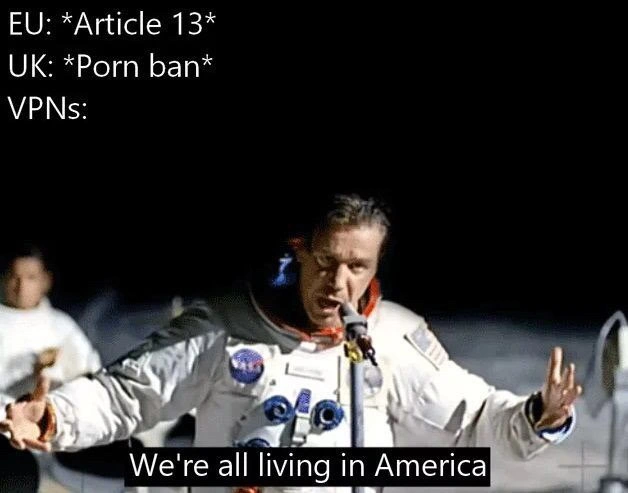
The astronaut visual is actually Till Lindemann, lead singer of Rammstein, from their “Amerika” music video – a satirical song about global Americanization. The meme repurposes the lyric “We’re all living in America” to joke that, thanks to VPNs, the internet will just act like one big America when Europe or the UK start locking things down. It’s a clever multi-layer reference: a German band mocking American cultural dominance is now used to mock EU/UK laws being nullified by American internet gateways. Security professionals and developers chuckle because it underscores a point about DataPrivacy and control: users will route around inconvenience. The humor also carries a twinge of “I told you so” for network engineers – they know that IP-based location restrictions are brittle. If you impose rules only on local IPs, the Networking folks will simply borrow a non-local IP. It’s almost an inside joke about how naive it is to believe the internet can be neatly partitioned by country.

On a serious note, the meme resonates with the frustration in the tech community around these laws. Article 13’s automated filters were seen as out of touch with how content sharing works (and prone to overblocking), and the UK’s plan was criticized for being technically impractical and privacy-invasive. The quick fix of “use a VPN” became a rallying cry. In real-world terms, many UK users really did plan to subscribe to VPN services to get around the porn ban, and EU netizens joked that they’d have to tunnel out to save their memes from Article 13’s filters. The meme distills that collective experience: rather than comply with clunky rules, the internet crowd clicks a button and poof – “Hello from Texas!” Legislators end up playing whack-a-mole; the moment they close one loophole, techies find another. It’s the classic battle of Security/Privacy engineering versus policy: encryption and proxies empower users to evade control, for better or worse. And let’s be honest, every engineer who’s ever run into a dumb firewall rule or an overzealous filter has felt the satisfaction of bypassing it. This image captures that feeling: arms outstretched, triumphant, “Nice try, EU/UK, but we’re effectively all Americans online now.” It’s a high-five to the power of tech to route around obstacles, delivered with a smirk.

Level 4: Tunneling Through Red Tape

At the lowest network level, the internet doesn’t recognize national borders – packets route based on IP addresses, not passports. A VPN (Virtual Private Network) exploits this by creating an encrypted tunnel over the public internet, effectively masking your IP address. Under the hood, protocols like OpenVPN or IPsec perform a handshake (often using cryptography like Diffie–Hellman key exchange and AES-256 encryption) to set up a secure channel. All your data is encapsulated – think of putting a letter inside an envelope – so that intermediate routers and firewalls only see the sealed envelope addressed to the VPN server. Inside that tunnel, your actual web requests travel hidden from prying eyes.

By exiting through a VPN server in the U.S., you inherit that server’s IP address, which belongs to an American IP range. Internet geolocation databases (maintained by looking up which country owns a given IP block via organizations like ARIN or RIPE) will now flag your traffic as coming from the USA. To any content filter doing an IP check, you suddenly look like a Yankee astronaut. This is geo-spoofing at the packet level – a technical sleight-of-hand. The EU’s Article 13 filters or the UK’s site bans typically rely on identifying users by location (like checking if an IP is from within EU/UK). But with a VPN’s cryptographic cloak, local network filters can’t inspect your packets (they’re encrypted), and the content provider sees a U.S. IP, so it serves content as if you’re stateside. Essentially, the VPN sets up a jurisdictional loophole in networking terms: your traffic “teleports” out of the regulated zone before emerging into the open internet.

This leverage of core internet design is almost poetic. We see a clash between technical architecture and legal boundaries: the internet was built to be resilient and route around failure (or blocks). In fact, security guru John Gilmore famously said, “The Net interprets censorship as damage and routes around it.” Here, that’s literally true – the VPN tunnel is routing around political barriers. It’s a cat-and-mouse game at the protocol level: authorities could attempt deep packet inspection to detect and block VPN traffic, but modern VPNs counter with obfuscation, camouflaging as ordinary TLS web traffic (443 HTTPS). States put up geo-fences; engineers respond with better tunnels. The meme’s absurdity (“We’re all living in America”) arises from this fundamental Networking reality: given the open design of the internet and strong encryption, trying to enforce location-based restrictions is like drawing borders on water – the data just flows around them.

Description

A meme featuring a still image from the music video for the song 'Amerika' by the German band Rammstein. In the image, a man in a white astronaut suit is passionately singing into a microphone on a stage. The upper part of the image contains white text on a black background. It lists recent internet regulations: 'EU: *Article 13*', 'UK: *Porn ban*'. Below these, it says 'VPNs:'. The bottom of the image has a subtitle from the music video: 'We're all living in America'. The meme humorously presents VPNs as the universal solution to regional internet restrictions. It references the EU's controversial Article 13 copyright directive and the UK's proposed age-verification for adult content. The punchline implies that by using a VPN to route traffic through American servers, users can bypass these regulations, effectively making their digital location 'America', where these specific laws don't apply

Comments

8
Anonymous ★ Top Pick Politicians pass laws to build digital walls. Engineers spend five minutes configuring a VPN and routing their traffic to a server in Virginia. It's not civil disobedience; it's just better network topology
  1. Anonymous ★ Top Pick

    Politicians pass laws to build digital walls. Engineers spend five minutes configuring a VPN and routing their traffic to a server in Virginia. It's not civil disobedience; it's just better network topology

  2. Anonymous

    We enabled GeoIP blocking for Article 13 at 02:00; by 02:05 Grafana showed 98% of Europe had “relocated” to us-east-1 - nothing like a $5 VPN to break both borders and our compliance dashboard

  3. Anonymous

    The same VPN endpoint handling your company's "critical infrastructure access" is also routing half of Europe's Netflix traffic through a data center in Delaware that still runs on a Pentium 4

  4. Anonymous

    Regulators draw borders at layer 8; WireGuard erases them at layer 3 - and suddenly the whole continent's traffic has a Virginia zip code

  5. Anonymous

    VPNs: the ultimate implementation of 'works on my machine' at a geopolitical scale. When your production environment is subject to Article 13 but your localhost is conveniently tunneled through a jurisdiction with better SLAs on freedom of information, you've essentially achieved regulatory load balancing. It's like running your entire digital life in a Docker container that just happens to be orchestrated from a data center where the compliance requirements align better with your use cases

  6. Anonymous

    Geo‑blocking is the DRM of networking: point the default route at a US exit and your ‘regulation’ downgrades to a UI string

  7. Anonymous

    VPNs: the CAP theorem triumph of internet freedom - partition-tolerant availability over censored consistency

  8. Anonymous

    Regulators ship geo-bans; we wire features to MaxMind; VPNs flip everyone to us-east-1 and suddenly all our compliance tests go green

Use J and K for navigation