Big O Notation vs. Silicon Reality
Why is this Performance meme funny?
Level 1: Shortcut vs Highway
Imagine you and a friend are racing on bikes to get home. đ Your friend yells, âNo! You canât take the highway, that route is longer! You have to take the shortest side streets because thatâs the best way!â According to the map, the side streets are a shorter distance (just like a linked list is supposed to be the quickest for adding new items). So your friend is absolutely sure that the shorter path will be faster. Now, you ignore him and take the big highway anyway. The highway is a bit longer in miles, but you can pedal super fast without any stop signs or red lights. đŚ Meanwhile, your friend who took the short cut has to slow down for dozens of intersections and traffic lights on those small streets. Even though he had fewer miles to cover, he keeps stopping and waiting. You, on the other hand, zoom along continuously at high speed. In the end, you arrive home first. When your friend finally shows up, out of breath, you just shrug and say with a grin, âhaha bike go brrrrâ (thatâs a silly way of saying your bike just kept going fast the whole way). The joke is that a path that looked longer (not âoptimalâ on paper) turned out to be faster because you could go smoothly the whole time. In the same way, sometimes in coding, an approach thatâs theoretically not the best can run faster in reality because the computer can speed through it without hitting any âred lights.â đ´đ¨
Level 2: Contiguous is King
Letâs break down whatâs happening in simpler terms, and why itâs funny to developers. The meme is contrasting two data structures â linked lists and arrays â and their performance. These are basic DataStructures you learn about in any intro to ComputerScienceFundamentals class, and you often analyze them with Big O notation to compare efficiency. Big O notation is just a fancy way to describe how an algorithmâs running time grows as the input size grows. For example, âO(1)â (pronounced âoh-oneâ) means it takes constant time â it doesnât really matter if you have 10 elements or 10,000, itâs roughly the same amount of work. âO(n)â (oh-n) means linear time â if you double the number of elements, it roughly doubles the work. In textbooks, inserting a new element into a linked list is said to be O(1) (very fast, constant work) because you just rearrange a couple of pointers, whereas inserting into an array can be O(n) (slower, proportional to the number of elements) because you might have to shift many elements to make a gap for the new one. The angry guy on the left is basically parroting this textbook wisdom: âLinked list good, array bad for insertion!â đ AlgorithmComplexityAnalysis taught him that arrays are âslowerâ for inserts, and heâs treating that as an inviolable rule.
But hereâs the catch: those Big O analyses make assumptions that arenât always true on real computers. Specifically, they assume that the cost of accessing memory is the same everywhere and every time. In reality, modern CPUs have a hierarchy of memory with caches that make some accesses (to nearby memory) much faster than others. An array keeps its elements in one big continuous block of memory. If you want to go through an array or even move part of it, youâre mostly dealing with one chunk of memory that the CPU can handle efficiently. When the CPU reads one element of an array, it will grab a whole bundle of nearby elements into the CPUCache (a super-fast small memory inside the CPU). So the next time you need the next element, boom â itâs already in the cache, ready to be used without slow memory access. This is called good cache locality or spatial locality. Itâs like having all your tools right next to you when youâre working on something; you reach for the next one and itâs just there.
A linked list, on the other hand, is made of nodes that can be scattered all over the place in memory. Each node holds your data and a pointer (an address) to the next node. So the nodes arenât necessarily next to each other â they could be anywhere. Itâs like a treasure hunt where each clue (pointer) tells you where the next piece is. If youâre traversing a linked list or inserting into it, the CPU might have to fetch each node from a different location in RAM. That often means each time you go to the next node, the CPU has to pull in a new cache line from main memory (which is much slower than cache). Thatâs a cache miss: the data wasnât in the fast cache, so the CPU had to reach out to the slower RAM for it, causing a delay. Those delays add up! So even if youâre doing fewer steps in theory (just pointer manipulation for an insert), each step is kind of expensive if it causes a memory stall.
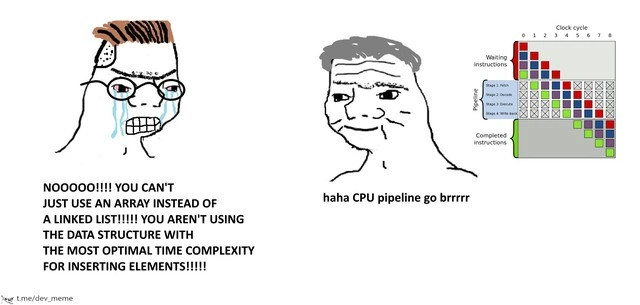
Now, letâs talk about the CPU pipeline and why the meme says âpipeline go brrrr.â Modern processors are like an assembly line working on multiple instructions at once. An instruction (like âadd these numbersâ or âmove this dataâ) goes through several stages (fetch, decode, execute, etc.). Instead of doing one at a time start-to-finish, CPUs pipeline them so that while one instruction is being executed, another is being decoded, and yet another is being fetched. In an ideal scenario, the CPU keeps this pipeline full and thereâs always an instruction at every stage â this maximizes throughput (lots of work gets done each clock cycle). But if the CPU has to wait for data (like a cache miss waiting on main memory), the pipeline can stall â some stages sit idle (those are the little gray "X" marks in the diagram, showing cycles where nothing useful happened). The diagram in the meme shows a timeline of clock cycles 0 to 8 with colored blocks for active work and gaps for waiting â itâs demonstrating how a smooth pipeline (few gaps) is desirable.
When you use an array in a predictable way, the CPUâs branch predictor and memory prefetcher are your friends. The prefetcher guesses the access pattern (e.g. youâre stepping through an array) and will start loading the next parts of the array into cache before you even explicitly ask for them. Itâs like someone running ahead and laying out all the dominoes for you. So by the time your code needs element [i+1], it might already be sitting in cache (prefetched), avoiding a stall. The phrase "go brrrr" is meme-speak for something running fast without interruption â here it means the CPU pipeline is running continuously, churning through those array operations without waiting around. You gave it a nice contiguous chunk of work, and itâs gulping it down efficiently.
Conversely, with a linked list, the next itemâs location is not predictable (itâs whatever address is stored in the pointer). The CPU canât as easily prefetch far ahead because who knows where the next node will be? If each pointer leads to a surprise location, the CPU often ends up waiting for memory for each node. Think of a linked list like having to look up each new bookâs location in a library index as you go, versus an array which is like reading a book chapter â you just turn to the next page. The arrayâs contiguous nature is the clear winner for real hardware. This is why in the meme, the calm character confidently uses an array despite the theoretical cost, and just says the equivalent of âthe CPU will handle it, trust me.â
To illustrate, consider a simple C++ example of inserting numbers at the start of a list vs a vector (array dynamic list):
#include <list>
#include <vector>
std::list<int> linkedList;
std::vector<int> arrayList;
// Insert 100000 elements at the front of each
for(int i = 0; i < 100000; ++i) {
linkedList.push_front(i); // Linked list: O(1) per insert (in theory)
arrayList.insert(arrayList.begin(), i); // Array: O(n) per insert (shifting elements)
}
In terms of Big O, linkedList.push_front(i) is supposed to be more efficient than arrayList.insert(..) at the front. But what happens under the hood? The linked list is allocating a new node each time and linking itâlots of pointers and potential cache misses. The vector (std::vector is basically a dynamic array) might have to shuffle elements on each insert, which is many more operations per insert. However, those operations are super optimized: behind the scenes it might use memmove to move blocks of memory (which uses CPU instructions that move data in bulk very fast). All those elements were already contiguous in memory, so moving them is cache-friendly. In real benchmarks, the array insertion can often still be quite fast. In fact, unless N is huge, you might barely notice a delay, whereas the linked list could be lagging from all the pointer chasing and memory allocations.
The punchline that developers laugh at is that the second guyâs simple approach (âjust use an arrayâ) often outperforms what the first guy thinks is the âproperâ approach. Itâs a classic PerformanceTradeoffs lesson: you have to consider how things actually run on hardware, not just the abstract operations count. Theoretical_vs_practical differences like this show up a lot. Thatâs why experienced devs often test and measure different approaches â sometimes the supposedly inferior $O(n^2)$ method beats the fancy $O(n \log n)$ method on real data sizes due to better cache usage or lower constant overhead. Here, contiguous memory (arrays) are king when it comes to raw speed on modern CPUs, while pointer-heavy structures can become costly. The meme format (the two-panel comic with Wojak characters) is a popular way in dev circles to depict one viewpoint vs another. The left side yelling âNOOOOO!â is a trope for someone being overly dramatic about rules or best practices, and the right side with âhaha ... go brrrrâ is the chill, pragmatic response. The reason itâs funny is that we all know at least a scenario or a person who matches each side â and we know the right side has a point that isnât obvious from the textbooks alone.
Level 3: Big O Blindspot
For seasoned developers, this meme hits on a classic blind spot in how we think about efficiency. Itâs poking fun at the junior (or academically-inclined) mindset that worships theoretical BigONotation without considering performance in practice. The screaming character on the left â depicted as an outraged Wojak (often used in memes to represent an overly purist or gatekeeping personality) â is basically every developer whoâs fresh out of an algorithms class yelling, âBut... but... linked lists have better insertion complexity! This is blasphemy!â đŻď¸. Many of us have been that person early in our careers, or have had heated code review discussions with that person. The meme exaggerates this with the all-caps âNOOOOO!!! YOU CANâT JUST...â format, imitating the dramatic, memetic Soyjak tantrum. Heâs fixated on the formal metric (O(1) vs O(n)) as if it were an absolute law.
The right panelâs relaxed Wojak (sometimes dubbed the âHahaâ Wojak or Chadâ in meme culture) represents the experienced, pragmatic engineer. Heâs smiling with a simple retort: âhaha CPU pipeline go brrrrâ. This one line is both a meme catchphrase and a punchline that encapsulates real-world wisdom: actual hardware behavior can trump abstract complexity. Itâs the equivalent of saying, âI donât care what the book says, I know this runs faster on my machine.â The humor comes from the stark contrast: a wall of angry text and exclamation points on the left, versus a chill one-liner on the right. Itâs mocking how overly theoretical arguments sound verbose and whiny (âYou arenât using the most optimal data structure!!!â) whereas the practical rebuttal is almost zen in its brevity. The âgo brrrrâ phrase is internet-slang implying something (here, the CPU pipeline) is just chugging along efficiently. Itâs intentionally low-tech phrasing to juxtapose against the left sideâs high-minded rant.
This resonates with developers because it reflects real PerformanceTradeoffs weâve seen. For example, a senior C++ programmer might recall replacing a std::list (linked list) with a std::vector (dynamic array) and observing a 5-10x speed boost in a hot code path. On paper, that seems odd â std::list::insert is constant time if you already have an iterator, while std::vector::insert at the beginning or middle is linear time, potentially copying lots of elements. But time and again, benchmarks and PerformanceOptimization work in industry show that arrays_vs_linked_lists usually favor arrays for performance, unless the data size is enormous or patterns are highly unusual. The memeâs scenario is too real: imagine a junior dev insisting a particular feature is slow because someone âused the wrong data structure,â and an old-timer chuckling because they know the code is actually fine (or the bottleneck lies elsewhere entirely, often in I/O or something non-algorithmic). Or conversely, a team struggling with latency finds that a supposedly suboptimal approach runs faster due to better cache usage â itâs a surprise only if you havenât been burned by caches before.
The âbig-O theory meets real-world CPUâ theme also carries an implicit lesson about theoretical_vs_practical knowledge. In school, you learn to count algorithm steps and assume more steps = slower. In the field, you learn to measure with profilers and see counterintuitive results. Many in the developer community share war stories of being bitten by this. For instance, Java programmers know that java.util.ArrayList (array-based) often outperforms java.util.LinkedList for almost every operation, even inserts, because of JVM optimizations and CPU cache effects. Similarly, Python doesnât even have a built-in linked list for general use; the default list is an array under the hood and is usually what you want for performance. A senior developer reading the meme might grin because they recall their own âAha!â moment: maybe the first time they ran a microbenchmark and saw a supposedly $O(n)$ method beat an $O(1)$ method due to those pesky constant factors. The Performance category of this meme is practically a rite-of-passage in software engineering â you donât truly grok performance until youâve confronted the fact that CPUCache behavior can make or break your optimizations.
Even the small pipeline diagram on the right is a nod for the tech-savvy. Itâs labeled "Clock cycle" and shows colored blocks for âWaiting instructionsâ vs âCompleted instructionsâ across cycles 0â8. This is a visual hint at how a CPU pipeline functions, and it underscores the reason the right side is winning. A senior audience knows that a full pipeline (lots of colored âCompletedâ blocks with minimal âWaitingâ) means the processor is being fed instructions fast enough to stay busy. The array approach yields nice, contiguous work that fills the pipeline, whereas a pointer-heavy linked list might cause bubbles (stalling cycles where the pipeline has to wait). Seeing that diagram, an experienced dev might chuckle extra hard: itâs like the meme is saying âsee, the pipeline is nicely busy (brrrr), thatâs why our âinferiorâ O(n) method is zooming past the theoretically optimal one.â Itâs a crafty little detail that turns a silly image into a teachable moment.
In summary, this meme speaks to the theoretical_vs_practical divide that seasoned devs know well. It satirizes the folk who protest based on purity (âYou canât just do that! It breaks the rules!â) and celebrates the folks who quietly get the job done faster by leveraging real-world knowledge. The tags like PerformanceOptimization and PerformanceTradeoffs are essentially what the calm Wojak is smiling about. He knows that engineering is about trade-offs and measuring actual results, not just citing big-O from a textbook. The humor lands because weâve all seen that overzealous concern for the âoptimalâ data structure yield ironically worse outcomes. Itâs a gentle poke at our younger selves or that one colleague who still argues that way â reminding us that sometimes, doing what works beats doing what the theory says is best. After all, as the saying (apt for this meme) goes: âIn theory, theory and practice are the same. In practice... theyâre not.â đ
Level 4: Cache vs Complexity
At the deepest technical level, this meme highlights a clash between algorithm theory and computer architecture. In theory (using Big O notation from ComputerScienceFundamentals), inserting into a linked list is $O(1)$ â constant time, since you just adjust a couple of pointers â while inserting into an array is $O(n)$, requiring shifting elements. AlgorithmComplexityAnalysis assumes a simplified model of the computer (often called the RAM model) where each basic operation (like memory access) costs the same. Under that model, a linked list seems more efficient for inserts. But real-world performance on modern hardware involves hidden costs and optimizations that Big O doesnât capture. This meme humorously exposes that gap: the angry character is stuck in the theoretical $O(1)$ vs $O(n)$ mindset, while the chill character knows the CPUâs cache locality and pipeline efficiency can completely change the game.
CPUCache hierarchies and memory locality are the key. An array stores elements contiguously in memory, meaning theyâre laid out back-to-back. A modern CPU fetches memory in chunks called cache lines (typically 64 bytes at a time). So when you access one element of an array, the hardware automatically pulls in its neighbors into the cache. This is exploiting spatial locality â if your code accesses element $i$, itâs likely to also touch $i+1$, so the CPU cleverly loads a bunch of them in one go. As a result, iterating or even shifting elements in an array can be blazingly fast because most accesses hit in the fast L1/L2 caches (on the order of nanoseconds). In contrast, elements of a linked list are scattered across memory (each node allocated separately, linked by pointers). Traversing or modifying a linked list often incurs a cache miss every time you jump to a new node, paying a hefty latency cost (100+ nanoseconds each, many CPU cycles waiting). The theoretical $O(1)$ insert for a linked list hides these memory costs. You do adjust a pointer in O(1) time, but first you had to navigate to the insertion point or allocate a new node from heap â operations that are not cache-friendly. Essentially, the linked list trades fewer steps for a huge penalty on each step due to poor cache locality.
Another hardware factor at play is the CPU pipeline and out-of-order execution. Modern processors are deeply pipelined and can execute multiple instructions in parallel or out of order, as long as there are no direct dependencies. They also have branch predictors and prefetchers that try to guess what data youâll need next and load it ahead of time. Contiguous array operations (like copying a block of memory during insertion, or iterating sequentially) are perfect for these mechanisms: the CPU can pipeline the load/store operations, and the hardware prefetcher will eagerly pull in the next cache lines because it detects a streaming access pattern. The memeâs tiny diagram titled "Clock cycle" with colored blocks is a visualization of pipeline stages across cycles â green/blue/red boxes showing instructions in progress and gray boxes for stall cycles. An array operation can often keep that pipeline full (instructions go brrrr, one after another) because the processor knows what to expect next. Conversely, pointer-heavy code like a linked list introduces unpredictable memory access patterns: the CPU often has to stall waiting for each pointer to be resolved from memory (those gray Xâs in the pipeline diagram â pipeline bubbles when data isnât ready). The phrase "haha CPU pipeline go brrrr" is a tongue-in-cheek way to say âthe pipeline is humming along efficientlyâ. Itâs mimicking the sound of a rapid-fire machine â in this case, a CPU executing instructions at full tilt without pauses.
From a computer architecture perspective, this is about PerformanceOptimization beyond Big O â considering constant factors and the memory subsystem. Big O is invaluable for understanding scalability, but it abstracts away the reality that, say, an $O(n)$ operation where each step stays in L1 cache can beat an $O(1)$ operation that triggers slow memory accesses. For example, copying 1000 integers in a contiguous block might be faster than chasing a single pointer to a new node, because the block copy can use vectorized SIMD instructions and incur maybe a couple of cache misses total, whereas that one pointer dereference might be a cold miss taking hundreds of cycles. This is why experienced engineers joke that the memory hierarchy has effectively become the new âcomplexityâ to optimize. We design algorithms and data structures to be cache-aware. Whole classes of data structures (like B-trees or cache-oblivious algorithms) were developed to bridge the gap between theoretical efficiency and PerformanceTradeoffs in real machines. The meme captures this deep engineering truth in a humorous nutshell: the textbook optimal solution isnât always the actual optimal when you account for the gritty details of hardware. In short, theoretical_vs_practical friction is on full display â and the calm Wojak is vindicated by those physics and silicon realities.
Description
A 'Haha X go brrrr' Wojak meme contrasting theoretical computer science purity with practical hardware performance. On the left, a crying, angry Wojak character yells, 'NOOOOO!!!! YOU CAN'T JUST USE AN ARRAY INSTEAD OF A LINKED LIST!!!!! YOU AREN'T USING THE DATA STRUCTURE WITH THE MOST OPTIMAL TIME COMPLEXITY FOR INSERTING ELEMENTS!!!!!'. On the right, a calm, knowing Boomer-faced Wojak replies, 'haha CPU pipeline go brrrrr'. Next to him is a diagram of a 4-stage CPU instruction pipeline, illustrating how modern processors execute instructions concurrently. The joke is a classic senior vs. junior developer debate. The junior developer is fixated on the theoretical Big O complexity (O(1) insertion for linked lists). The senior engineer understands that the contiguous memory layout of an array is incredibly cache-friendly, leading to fewer cache misses and allowing the CPU's pipeline and prefetcher to work at maximum efficiency, which often makes arrays significantly faster in practice, despite a theoretically worse O(n) insertion time. A watermark for 't.me/dev_meme' is visible in the bottom left

Comments
7Comment deleted
The best algorithm is one that fits in the L1 cache. Everything else is just a negotiation with latency
Textbook: linked-list insert is O(1). Production: every pointer chase blows a cache line, the pipeline stalls, and that âconstantâ becomes the lead time for procurement to approve more cores
Twenty years of explaining Big O notation in interviews, only to spend my days optimizing for cache lines because that O(1) linked list insertion is meaningless when your prefetcher is crying in the corner
This perfectly captures the moment when a senior engineer realizes that their CS degree's emphasis on O(1) linked list insertions conveniently omitted the part where traversing pointers obliterates your L1 cache, stalls the pipeline, and makes the CPU's branch predictor cry. Meanwhile, that 'inefficient' O(n) array shift is happily prefetched, vectorized, and completes before the linked list even finishes its second cache miss. Modern hardware doesn't care about your asymptotic complexity when n < 10000 and your data fits in cache - it cares about whether your memory access patterns let it go brrrrr
Linked list: O(1) insert, O(infinity) cache misses. Array: shifts brrrr, ships first
That O(1) linked-list insert becomes O(300 cycles) when every pointer chase misses L1 - arrays let the prefetcher and pipeline go brrrrr
BigâO says âlinked list for O(1) insertsâ; the perf counter says âarray,â because pointerâchasing starves the pipeline while the prefetcher makes contiguous memory go brrrr