The Ultimate Satisfaction of Working Assembly Code
Why is this LowLevelProgramming meme funny?
Level 1: Eureka Moment
Imagine you’ve been trying to solve a super hard puzzle for a really long time. It’s one of those puzzles where if even one piece is in the wrong spot, the whole picture looks wrong. You’ve been frustrated for days, moving pieces around, almost giving up a few times. Then finally, you find the correct piece and put it in the right place – and ta-da! The puzzle is complete and beautiful. You’d feel sooo happy and relieved, right? You might jump up and down or let out a big cheer because all that hard work finally paid off.
That’s exactly the feeling this meme is talking about, but with writing computer code. The person was working on a very tricky program written in a language that’s pretty hard to get right (assembly language – it’s like the ultra-puzzle of programming). They kept having problems and it wasn’t working, which made them really upset and tired. After struggling for a long time, they finally fixed the last little error and the program ran perfectly. In that moment, they felt a huge wave of joy and relief, kind of like how you feel after beating a really tough level in a video game or finishing that impossible puzzle.
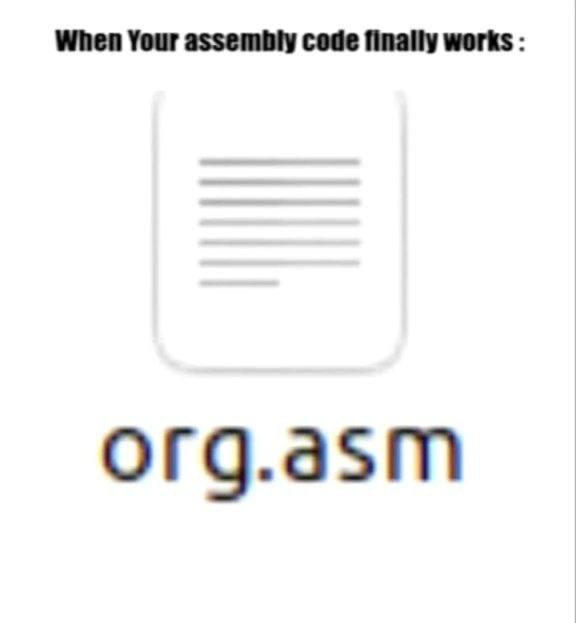
The picture in the meme shows a file named “org.asm.” That’s a nerdy play on words. It sounds like a funny word grown-ups use when they’re extremely happy (you might have heard the word “orgasm” in a very different context!). By naming the file in this way, the meme is basically making a joke that the happiness from the program working is that huge. It’s an exaggeration that makes us laugh because, of course, fixing code isn’t actually as earth-shattering as, say, winning the lottery – but to a programmer who’s been tearing their hair out for days, it feels incredibly good.
So, the big idea is: after an enormous amount of frustration, the sweet feeling of success is like pure bliss. It’s funny and heartwarming because anyone who’s worked hard on something difficult (it could be coding, a school project, a tough math problem, anything really) knows how amazing it feels when everything finally clicks. This meme just uses a little cheeky humor to say “That feeling is the best in the world!”
Level 2: Segment Slip-ups
Let’s break down what’s going on here in simpler terms. Assembly language is a type of low-level programming language. “Low-level” means you’re working very close to the hardware, directly with the CPU’s instructions and memory addresses. In AssemblyLanguageX86, for example, you write things like MOV AX, 5 to put the number 5 into the AX register of the CPU. It’s powerful, but also very easy to mess up because the language assumes you (the programmer) know exactly what you’re doing with memory and addresses. There’s no friendly error message if you accidentally point to the wrong place in memory – your program will just misbehave or crash. This leads to a lot of debugging frustration when you’re new to it (and even when you’re experienced!).
One concept assembly programmers deal with is the idea of segments and offsets. In older computing (like original IBM PCs), memory was divided into segments – think of them like separate sections or rooms in a library. Each segment had an “offset” which is like a specific shelf position in that room. You needed to know both the room (segment) and the shelf position (offset) to find a book (the data/instruction). Now, an assembler (the tool that turns your .asm code into machine code) needs to know where to “place” your code in this library of memory. That’s where the ORG directive comes in. ORG (short for “origin”) is a special line you put at the top of your assembly code to say, “Start assembling my code as if it will be loaded at this specific memory address.” It’s not an instruction that the CPU runs – it’s a note to the assembler itself.
Why does this matter? Imagine you write an assembly program that prints "Hello". In DOS, small programs of type .COM must be loaded at a certain location in memory (right after a 256-byte header that DOS uses). So the code should start at memory address 0x100 (which is 256 in decimal). You would write ORG 0x100 at the top of your code for a COM program. If you don’t do that, the assembler will assume your code starts at 0 by default. Then all the addresses (offsets) it calculates for your data and instructions will be wrong by 256 bytes! That’s what we mean by “misaligned segment offsets” – everything is shifted from where it should be. It’s like having all the chapters of a book start on the wrong page numbers – the content is there, but when you go to the page that the table of contents says Chapter 3 is on, you find the wrong text. Chaos ensues.
Let’s look at a tiny example to make it concrete. Here’s a snippet of x86 assembly for DOS that prints a message and then exits:
; A simple DOS .COM program example (16-bit real mode)
org 0x100 ; set origin to 0x100, where COM programs are loaded in memory
mov dx, msg ; DX register gets the address of the message string
mov ah, 0x09 ; AH = 9, DOS interrupt for printing a string
int 0x21 ; call DOS interrupt 21h to print the string
int 0x20 ; exit program (DOS interrupt 20h)
msg db "Hello, world!$", 0
In this code, msg is the text we want to print. Because we used org 0x100, the assembler knows that msg will actually be located at memory address 0x0100 + (whatever the offset is up to that point). So when we do mov dx, msg, behind the scenes it puts the correct memory address of the string into DX. The DOS interrupt (int 0x21 with AH=9) then prints the string at that address, and everything works nicely.
Now, imagine if we forgot the org 0x100 line. The assembler would think the code starts at 0. It would then assign the address for msg as 0x0000 + offset, which would be 0x000E or something (just an example). So mov dx, msg would load DX with 0x000E, pointing to memory at address 0x000E. But in reality, DOS loads our program at 0x0100, not 0x0000! So the string "Hello, world!" isn’t actually at 0x000E; something else is. When the print interrupt runs, it’ll try to print whatever is at the wrong address. Best case, it’s gibberish; worst case, the program crashes trying to read where it shouldn’t. Boom – segmentation fault or some funky behavior. And the error isn’t obvious – the code looks perfectly fine, it assembled and ran, but it doesn’t do the right thing. This kind of bug can drive a developer insane because there’s no clear message saying “hey, you forgot to set the origin.” You have to realize it yourself by knowing how the system works.
So days of misaligned segment offsets is a humorous exaggeration of a very real struggle: spending multiple days debugging something that turned out to be caused by a small oversight in how you set up your assembly code. When you finally add that ORG 0x100 or correct whatever alignment issue it was, all the pieces fall into place and the program finally works as expected. The relief is huge! It’s like finding that one puzzle piece that was missing under the table – suddenly the picture is complete.
Now about the text “org.asm” shown in the meme: this is meant to look like a filename (perhaps the assembly source file) called “org.asm”. Files ending in .asm are assembly language source files. The joke is that “org.asm” when read aloud sounds like “orgasm.” 🙊 That’s a deliberate pun. They’re comparing the happiness of getting your assembly program working to the intense pleasure of, well, an orgasm. It’s cheeky and a bit silly, but in context it’s poking fun at just how good it feels to finally conquer a nasty bug. Wordplay puns like this are common in developer humor. It’s a way to make a dry technical scenario (fixing a bug involving the ORG directive) instantly funny and relatable by linking it to a very human experience of joy.
In summary, at this level: assembly programming is hard, a tiny mistake with things like segment origins can break everything, and fixing it brings immense joy. The meme uses a funny file name org.asm to symbolically shout “YES!!” in a humorously exaggerated way. If you’ve ever spent all night debugging and then saw your program finally run at 5 AM, you know the mix of relief, pride, and exhausted happiness that comes with that. This meme just translates that feeling into a one-liner picture joke. 😊
Level 3: The ORGasm Directive
For seasoned developers, the scenario depicted is painfully relatable and darkly funny. “When your assembly code finally works” sets the stage: imagine a grizzled programmer hunched over a terminal at 3 AM, having battled mysterious crashes and segfaults for days. The culprit? Misaligned memory due to a missing ORG directive or a wrong segment base. This is the kind of bug that haunts low-level developers’ nightmares. You think everything is coded correctly, but the program keeps blowing up because somewhere, the code’s assumed address doesn’t match reality. After countless assembler error messages, debugger sessions stepping through raw machine code, and maybe a few sacrificed sanity points cups of coffee, the programmer finally finds the one fix that resolves the chaos. They add the correct ORG directive or align that section just right, rebuild, and… it runs flawlessly.
The meme captures that triumphant moment with a cheeky bit of wordplay: an assembly source file named org.asm. Say that out loud and you get “orgasm.” 😅 This is pure DeveloperHumor – combining a dry technical term with a risqué pun to exaggerate the feeling of relief. The bold caption on the image explicitly sets up the joke: this is what it feels like when your assembly finally runs without errors. By using the file name org.asm, the meme creators exploit the coincidence that ORG (a common assembly directive) + .asm (the file extension for assembly code) concatenates into a word that means extreme pleasure. It’s suggesting that getting assembly code to work is basically a blissful experience on par with… well, you get it.
Why do experienced devs smirk at this? Because it’s so true. Low-level debugging is notoriously frustrating. There are no safety nets: a single incorrect memory address can cause complete mayhem, and the error messages (if you get any at all) are cryptic. Many of us have been in that position where a bug made us question reality – “It has to be right, why is it faulting?!” – only to discover a one-line fix that was missing. In high-level development, you rarely get such a concentrated dose of both despair and joy in quick succession. But in assembly language, especially when dealing with things like manual segment management or writing an OS bootloader, you absolutely do. The meme’s punchline nails this emotional rollercoaster.
The phrase “that glorious climax after days of misaligned segment offsets” in the title/text is simultaneously hyperbolic and accurate. It acknowledges the debugging frustration (‘days’ of banging your head on misaligned addresses) and the almost ridiculous ecstasy when you finally solve it (the “glorious climax”). Seasoned programmers often joke that fixing a brutal bug can feel better than… well, a lot of things. Here, they just went ahead and compared it to one of the greatest feelings ever, an orgasm, for comedic effect. It’s tongue-in-cheek and a bit irreverent, which is exactly why it resonates – this is a joke you’d share with your dev team after an all-nighter spent fixing a production crash or wrestling with some finicky LowLevelProgramming problem.
There’s also an element of camaraderie: only those who’ve fought similar dragons will truly appreciate the joke. If you show org.asm to a non-programmer, they’ll likely just be confused (or blush). But show it to a programmer who’s done some assembly or embedded work, and you might get a knowing laugh and possibly a story: “Oh man, I remember spending a week debugging an ISR hand-off in assembly because I forgot to align the stack – when it finally worked, I practically fell out of my chair in joy.” The humor thrives on that shared battle-scars dynamic. It’s an inside joke among engineers which says, “We suffer through these insanely picky bugs, but wow, when it all aligns (literally), it’s heaven.”
From an industry perspective, the meme also pokes fun at how something so low-level and “unsexy” as segment origins can lead to an almost euphoric payoff. We talk about high-flying tech trends and fancy frameworks, but sometimes the biggest victory of your week is just getting a few hundred lines of assembler to not crash. It highlights a truth in software development: the harder the problem and longer the grind, the sweeter the success. And assembly programming, being close to the metal, often provides both the hardest problems and the sweetest successes. So the next time someone’s bragging about their code working, and they have that glassy-eyed, blissful look, check if they’ve been doing assembly – you might just mumble “org-dot-asm” and give them a congratulatory smirk. They earned that ORGasm. 😁
Level 4: Alignment Alchemy
At the deepest technical level, this meme nods to the arcane world of x86 assembly and its segmented memory model. In low-level programming on older systems (like 16-bit DOS or BIOS), memory addressing isn’t flat – it’s composed of segments and offsets. An assembler’s ORG directive (short for “origin”) tells the program at what memory address to assume the code will be loaded. For example, classic DOS .COM programs start at offset 0x100 (256 bytes in) because the first 256 bytes of the segment are reserved for the Program Segment Prefix. So you’ll often see an assembly file begin with something like: ORG 0x100. If this origin is mis-specified by even a few bytes, every memory reference in the program shifts out of alignment.
In real-mode x86, a physical address is computed as:
$$ \text{PhysicalAddress} = \text{SegmentBase} \times 16 + \text{Offset} $$
Misalign the segment base or offset, and the computed address points to the wrong location entirely. This is the heart of misaligned segment offsets: your code and data aren’t where the code thinks they are. The result? Possibly reading gibberish data, jumping to the wrong instructions, or outright crashing with a segmentation fault. These issues are notoriously hard to debug because nothing in high-level logic appears wrong – it’s the underlying address arithmetic that’s off. The meme’s phrase “days of misaligned segment offsets” isn’t an exaggeration: tracking down a bug caused by a missing or incorrect ORG can literally take days of painstaking examination of machine code and memory dumps. Only a deep understanding of assembly language and system architecture can untangle such a problem. It’s the kind of problem where you’re calculating byte offsets by hand, carefully aligning code to 16-byte boundaries, and consulting ancient Intel manuals to figure out why the linker or loader isn’t happy.
When you finally discover the fix – say, realizing you needed ORG 0x7C00 for your boot sector because that’s where the BIOS loads it, or that your data segment needed a different starting address – it feels like you’ve performed some dark memory alignment magic. In a sense, you have; you’ve appeased the exacting requirements of the machine. This is the alchemy of alignment: turning painful trial-and-error into the gold of a working program by manipulating addresses just so. The meme encapsulates that almost mystical success. Only those initiated in the rites of low-level programming (like AssemblyLanguageX86 wizards) fully appreciate why one line (ORG ...) or a tiny address tweak can stand between absolute failure and glorious success. The humor, at this level, comes from recognizing the absurdly complex underpinnings behind a single punny filename – org.asm – and nodding to the esoteric knowledge required to get an assembler and linker to cooperate. It’s a celebration of conquering the machine on its own terms, squeezing out a victory from the teeth of the hardware by understanding those obscure rules of segments and offsets. In short: when you align everything perfectly after a marathon of debugging, it’s pure sorcery – and it feels amazing.
Description
A simple, minimalist meme on a white background. At the top, there is a caption in black text that reads, 'When Your assembly code finally works:'. Below the text is a generic, slightly blurred icon of a document file. Underneath the icon, the filename is displayed in a pixelated font: 'org.asm'. The humor is a wordplay, as the filename 'org.asm' sounds identical to 'orgasm'. The meme equates the immense feeling of relief, triumph, and satisfaction from successfully making notoriously difficult low-level assembly code function correctly to the peak of human pleasure. This is deeply relatable to experienced engineers who have grappled with the tedious, error-prone, and highly abstract nature of assembly language programming
Comments
10Comment deleted
The two best feelings in programming: deleting code and finally getting assembly to run. Both are a huge release
After wrestling with linker scripts and off-by-512-byte ORG offsets, that moment the binary finally boots feels… well… positively org.asm-ic
After 20 years in the industry, I've learned that the only thing harder than writing assembly code is explaining to your PM why refactoring that 'working' assembly module from 1987 will take six sprints and might summon Cthulhu from the interrupt vector table
After three days of debugging why your assembly routine was corrupting the stack, you finally realize you forgot to preserve EBP in the function prologue. When it finally works, the dopamine hit rivals discovering your O(n²) algorithm can actually be O(n) - except this time you earned it one register at a time, and the satisfaction is... well, let's just say the filename is very aptly chosen
Senior dev joy is when nasm -f bin, ORG 0x7C00, and QEMU all align on the first run - finally, an org.asm without fighting a linker script
'org.asm': the rare directive that aligns your origin perfectly, delivering buffer-overflow-level bliss
That moment when the origin directive, SYSV ABI, and 16-byte stack alignment finally agree with the linker - now it’s legitimately an org.asm
Looks originally organized Comment deleted
When admin stopped posting AI slop Comment deleted
The manager may not have understood the assignment, but the IT department definitely did. Comment deleted