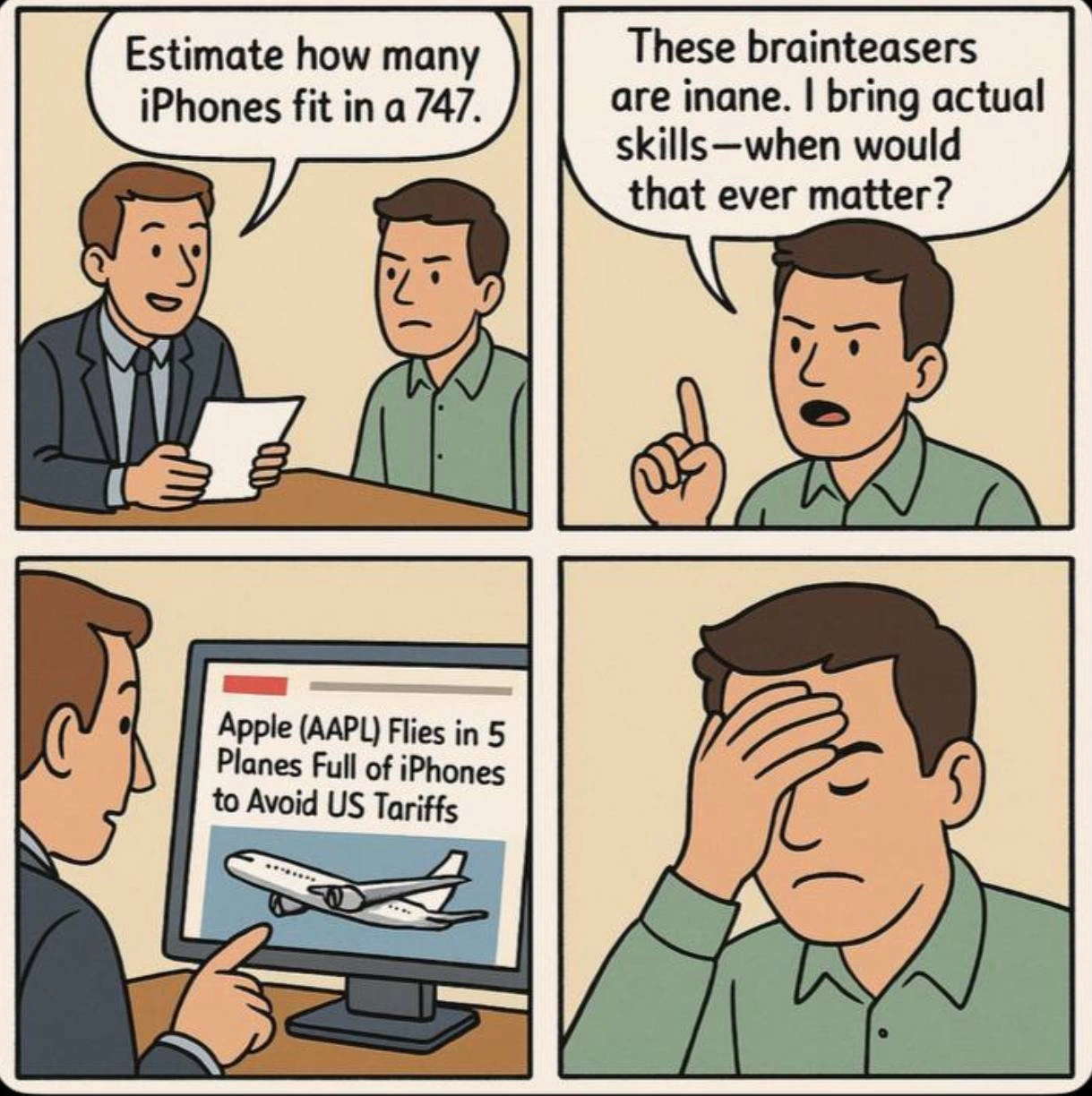
The One Brainteaser Interview Question That Actually Mattered
Why is this Interviews meme funny?
Level 1: Never Say Never
Imagine you’re in class and your teacher asks a really weird question, like “How many sandwiches do you think we could fit in our classroom?” You might laugh and think, “This is silly—I’m never actually going to need to know that!” You feel pretty smart telling the teacher it’s a pointless question. But then, the very next day, the school announces a big food drive, and suddenly your class is trying to pack the room full of sandwich boxes for charity. Now everyone is looking at you, the one who joked about that exact question, and you’re sitting there with your hand on your forehead thinking, “Oh no… this just got real.” You realize that the “pointless” question wasn’t so pointless after all.
That’s exactly what’s happening in this meme. The guy thought the interview question was useless and would never matter in real life. But then real life gave him a big surprise that proved him wrong. It’s funny because he was so sure he’d never need that silly knowledge, and boom, life delivered the same scenario for real. The feeling is a mix of embarrassment and surprise – kind of like when you say “I’ll never ever do that,” and then you end up doing exactly that. The lesson? Sometimes the things that seem unimportant can suddenly become very important. Or simply put: never say “never” – because you might end up facepalming when “never” comes true!
Level 2: Phones on a Plane
Let’s break down the meme in simpler terms, especially for newer developers or anyone who hasn’t been through a technical interview yet. In tech interviews, especially in the past, companies loved to ask brainteaser questions. These are puzzles or tricky questions meant to test how you think, not necessarily what you know. A Fermi estimation question (named after physicist Enrico Fermi) is one common type. It asks you to estimate a quantity that you can’t just know offhand, by making reasonable assumptions and doing some rough math. For example, a classic is “How many piano tuners are there in New York City?” You’re supposed to break it down: how many people live in NYC, how many have pianos, how often do pianos need tuning, etc., then multiply it out to get a ballpark figure. It’s less about the exact number, more about demonstrating a logical approach. In the meme, the interviewer asks: “Estimate how many iPhones fit in a 747.” This is a very similar kind of question. Here you’d think about the size of an iPhone, the cargo space in a Boeing 747 airplane, maybe how the iPhones would be packaged on pallets, and come up with a rough number. It’s a bit of a quirky question, because as a software developer you normally don’t need to know about airplane cargo capacity! That’s why the candidate responds with frustration: “These brainteasers are inane. I bring actual skills—when would that ever matter?” The word “inane” means silly or pointless. He’s basically saying, “This is a stupid question. I know how to code and build apps, why ask me something so unrelated?” This sentiment is common among candidates in TechnicalInterviews who get these oddball questions. They’d rather be tested on coding, system design, or other actual skills relevant to the job.
Now, the twist comes in the next panels. Later, the interviewer shows the candidate a news headline on a screen: “Apple (AAPL) flies in 5 planes full of iPhones to avoid US Tariffs.” Let’s unpack that. Apple – yes, the iPhone company – apparently had to use 5 whole airplanes (like Boeing 747 cargo planes, presumably) filled with iPhones. Why? To avoid US tariffs. A tariff is basically a tax on goods imported from another country. So if iPhones are made overseas (say, in China), and the U.S. government decides to put a tariff on them starting next week, Apple might suddenly have to pay a big tax on any phones it imports after that date. To avoid that, Apple might rush a huge shipment of iPhones before the tariff kicks in. The quickest way to do that is by air – loading phones onto airplanes – because shipping by boat would be too slow. That news headline sounds like something that could really happen if there’s a trade war or a sudden policy change. In fact, big tech companies are known for their supply chain logistics prowess – that means they’re really good at managing how products and components move around the world. Apple in particular uses a just-in-time strategy, meaning they don’t stockpile a ton of extra inventory; they try to get devices shipped out right as they’re needed. This saves money but also means they have to be nimble if something like a tariff or factory shutdown happens.
So, imagine Apple needs to fly in a huge number of iPhones quickly: someone at Apple literally had to figure out how many iPhones fit in one airplane and how many planes do we need to carry X million iPhones. That is basically the interview question! The candidate facepalming (slapping his face in disappointment) in the final panel is reacting to the realization that the “dumb” question he mocked actually has real-world relevance. It’s as if the interviewer is teasing, “See? There is a point to that question.” The humor comes from this irony: the candidate said “when would that ever matter?” and almost immediately, reality gave an example when it does matter.
For a junior developer, it’s a gentle reminder that sometimes interviewers ask weird questions not because you’ll do that exact thing at work, but to see your way of thinking. In this case, the scenario turned out not to be so far-fetched. It’s a blend of InterviewHumor (making fun of those notorious interview riddles) and a bit of real-life business trivia about Apple. It’s also okay if you didn’t know offhand how many iPhones fit in a plane – nobody actually knows without figuring it out. The expected approach in an interview would be: “Well, let’s estimate. A 747 is a huge plane – maybe its cargo hold is about 150 feet long, and two decks tall. If I recall, a 747 can carry on the order of 100 tons of cargo. An iPhone weighs maybe 0.5 pounds and is a few cubic inches in size. So weight-wise, 100 tons is 200,000 pounds, which could be about 400,000 iPhones. Volume-wise, if an iPhone box is say 6 x 3 x 1 inches, and we had to fill 150 x 20 x 10 feet of space, that’s a lot of boxes… (do some quick math)… maybe on the order of a million phones if it was just about volume, but weight will max out first. So perhaps a few hundred thousand iPhones per plane is a reasonable guess.” That logical reasoning is exactly what the interviewer was likely looking for – not a perfect number, but a structured thought process.
To align with the context tags: this meme highlights a fermi_estimation question (the iPhones in a 747), one of those notorious brainteaser_question types. It directly references 747_cargo_capacity (the space/weight a Boeing 747 can carry) and ties it to supply_chain_logistics (Apple’s challenge of shipping products around) and tariff_avoidance (why Apple is shipping them fast – to avoid import taxes). It brilliantly shows a real_world_interview_question moment, where a theoretical interview puzzle mirrors an actual news story. For someone early in their career, the takeaway is part funny, part educational: even if a question seems outlandish, it might teach you to think broadly. And at the very least, it makes for a great story – because how often do you see today’s interview riddle become tomorrow’s headline?
Level 3: From Puzzle to Headline
For experienced developers and industry veterans, this meme elicits a knowing smirk because it bridges a gap between infamous interview tactics and real-world tech business news. The interviewer’s question, “Estimate how many iPhones fit in a 747,” is a quintessential tech interview brainteaser. Such guesstimation puzzles were especially popular in the 2000s-era TechnicalInterviewProcess, used by companies like Microsoft and Google to test a candidate’s problem-solving approach. (Who hasn’t heard of the classic, “How many golf balls can you fit in a school bus?” or “How many piano tuners are there in Chicago?”) These questions are known as Fermi problems or brainteasers and have been much debated in the developer community. Many seasoned engineers roll their eyes at them today – they’re often seen as hiring humor or even hazing, because they can feel disconnected from the actual skills a programmer needs on the job. Our meme’s job candidate echoes this sentiment with some indignation: “These brainteasers are inane. I bring actual skills—when would that ever matter?” This line captures the frustration of countless candidates who've been asked something like, say, the number of manhole covers in a city, and thought, "Seriously? I can code up a full-stack app, why ask me this?"
Now, the punchline: the interviewer later points to a news headline on a monitor: “Apple (AAPL) flies in 5 planes full of iPhones to avoid US tariffs.” Suddenly, that silly hypothetical about iPhones and a 747 isn’t so hypothetical – it’s literally happening at Apple. The final panel shows the candidate facepalming in the universal gesture of “I spoke too soon.” The humor here is a cocktail of irony and schadenfreude for those of us who have been through interviews. It’s the Brainteaser Backfire: the one time you declare a question irrelevant, the universe (or a savvy interviewer with a news feed) immediately demonstrates its relevance.
This scenario also tickles the ribs of anyone familiar with Apple’s legendary supply chain operations. Apple is famous for its just-in-time logistics and complex global supply chain. In a real scenario (and indeed, headlines like this have cropped up in past years during trade war scares), a company like Apple might literally charter a fleet of jumbo jets – think Boeing 747 or similar cargo planes – to rush millions of iPhones from factories in Asia to stores in the U.S., beating a tariff deadline by hours. Tariffs are taxes on imports, and in late 2010s and early 2020s, there were times when new tariffs on electronics were announced to kick in on a certain date. Tech firms would scramble in a very high-stakes capacity planning race to import goods before those tariffs hit, saving hundreds of millions of dollars. Supply_chain_logistics suddenly becomes a dramatic story of “how many iPhones can we stuff into airplanes over the weekend.” It’s the kind of real-world scenario where knowing how to estimate quickly is actually valuable. How many planes will we need? How many iPhones can each plane carry? Those are questions a logistics manager (or an engineer supporting them with data) genuinely has to answer under pressure. Suddenly that inane interview question about a 747 isn’t testing trivia – it’s testing whether you grasp the scale at which companies like Apple operate and how to approach offbeat problems analytically.
From a senior developer or manager’s perspective, the meme is also a subtle commentary on interview techniques. The industry has largely shifted away from off-the-wall brainteasers because studies (and Google’s own HR in 2013) found they didn’t predict job performance. Yet, here we are with a scenario where life imitates the interview question. It’s a bit of an I-told-you-so from the old-school interviewers’ camp: “See, sometimes those wild questions do have real answers!” As a result, there’s a layered laugh here. On one level, you’re laughing at the candidate’s bad luck – what are the odds that his snarky dismissal would be immediately disproven by the news? On another, if you’ve been through these interviews, you laugh at the interview process itself – how it can oscillate between absurd and oddly pertinent.
The Interviews category of tech memes is rife with situations where candidates are tested in ways that feel disconnected from reality. This one flips the script by showing the rare case where the real_world_interview_question comes true. It underscores an unwritten rule in tech and life: never be too sure that something is useless. The veteran developers among us have learned (sometimes the hard way) that no knowledge is truly wasted. Today’s trivial fact, like the cargo capacity of a 747, could become tomorrow’s production emergency or business crisis. (After all, who would’ve thought knowing about a global pandemic would suddenly make toilet paper supply chain a topic every developer jokes about? Yet 2020 happened…)
In essence, Level 3 reveals the shared understanding that this meme is funny because it’s true. It’s a wink to those in the know about both the absurdity of tech hiring practices and the wild problems tech companies actually solve. The hiring humor here has an extra twist of fate. Whether you’re a grizzled tech lead recalling your own whiteboard interview war stories or an Apple supply chain engineer chuckling that your day job just validated a goofy riddle, the meme hits home. Sometimes the line between trick question and real business question is thinner than we think, and that’s exactly what makes this scenario so comically satisfying to seasoned tech folks.
Level 4: Ballparking at Scale
At the most granular level, this meme touches on the art of Fermi estimation – a technique named after physicist Enrico Fermi, who was famous for making quick, order-of-magnitude calculations. Fermi estimations are all about ballparking an answer when an exact solution is impossible or impractical. The classic interview question here, “Estimate how many iPhones fit in a 747,” is essentially a back-of-the-envelope calculation problem. It’s a playful nod to the kind of capacity planning that, in a more complex form, real engineers and analysts actually do. In theoretical terms, figuring out how many items (iPhones) can fit into a space (a Boeing 747 airplane) is related to a known bin packing problem – a problem that is, interestingly, NP-hard in computational complexity. In other words, finding the optimal way to pack objects into containers is computationally difficult (there’s no quick algorithm that’s always perfect), which is why we often settle for good-enough heuristics and estimations.
From a physics and engineering perspective, such an estimation involves constraints like volume and weight. A Boeing 747 can only carry so much volume (cubic meters of space in its cargo hold) and so much weight (tons of cargo before it can’t take off). A savvy candidate might start by estimating the volume of a 747’s cargo hold and the volume of an iPhone (including packaging), then dividing one by the other for a rough count. But a truly detailed estimation could spiral into advanced territory: considering packing efficiency (you can’t use every cubic inch due to irregular shapes and packing gaps), the plane’s maximum takeoff weight, and even fuel needed for that weight (more weight requires more fuel, which itself takes up weight capacity – a classic optimization trade-off in aviation logistics). There’s a whole field of study (operations research and supply-chain engineering) that deals with these questions using linear programming and algorithms more sophisticated than any quick interview answer. In fact, Apple’s logistics team probably uses software to simulate loading planes with iPhones, effectively solving a version of the knapsack problem to maximize units per flight while obeying weight limits.
It’s delightfully ironic that a goofy-sounding interview brainteaser actually mirrors these real-world optimization challenges. We can imagine an engineer at Apple writing code to optimize shipments, grappling with questions like: how many iPhone pallets can we load before hitting the 747’s 396,000-pound payload limit? This kind of problem blends software, hardware, and physical constraints – the sort of interdisciplinary complexity that’s catnip for seasoned engineers. The meme’s punchline hints at this convergence of trivia and reality: the Fermi question the candidate snubbed is basically a one-minute version of an MBA logistics case study or a supply-chain simulation model. In academic terms, it’s an example of how an order-of-magnitude estimate (Fermi-style reasoning) can provide a sanity check for decisions in big systems. Enrico Fermi himself famously estimated the yield of the first atomic bomb test by dropping bits of paper and measuring their displacement – a reminder that quick estimates can have serious applications. Here, we’re just swapping nuclear physics for the physics of stuffing iPhones into jumbo jets.
To put a cheeky spin on it with a hint of code (because why not mix coding humor into an estimation problem?), imagine writing a snippet to compute a naive upper bound:
# Quick Fermi-style estimation in code
plane_volume_m3 = 1000.0 # approx cargo volume of a 747 in cubic meters
iphone_volume_m3 = 0.0007 # approx volume of one iPhone box in cubic meters
ideal_count = plane_volume_m3 / iphone_volume_m3
print(f"Ideally, about {ideal_count:.1f} iPhones could fit by volume.")
# This prints a huge number (around 1.4 million), but real life isn't ideal!
This little exercise would give a ridiculous number (on the order of a million+ iPhones) if we only consider raw volume. A seasoned engineer knows to then check weight: say each boxed iPhone weighs ~0.5 kg, a 747 might max out around 150,000 kg of cargo, so weight would limit it to about 300,000 iPhones. Still a lot, but a fraction of the volume-based number – illustrating why quick sanity checks are crucial. This is where Fermi estimations shine: by combining rough figures and physics realities, you can catch which constraint (volume vs. weight) actually dominates. So at Level 4, the meme is a wink at all the deep science, math, and algorithms lurking behind what looked like a silly interview question. It’s a reminder that even toy problems can scale up to real-world engineering conundrums faster than one might think.
Description
A four-panel comic strip depicts a job interview scenario. In the first panel, a smiling interviewer in a suit asks the candidate, an unimpressed young man in a green shirt, 'Estimate how many iPhones fit in a 747.' The second panel shows the candidate dismissively replying, 'These brainteasers are inane. I bring actual skills - when would that ever matter?' In the third panel, the interviewer points to a computer monitor displaying a news headline that reads, 'Apple (AAPL) Flies in 5 Planes Full of iPhones to Avoid US Tariffs,' complete with a picture of an airplane. The final panel shows the candidate with his hand over his face in a classic facepalm gesture of regret and embarrassment. The meme humorously critiques the common developer complaint about irrelevant brainteaser or Fermi problem questions in tech interviews by presenting a specific, high-stakes scenario where such an estimation was directly relevant to a major business and logistics decision for Apple. It plays on the irony that what seems like an abstract puzzle can have concrete applications in the operations of a massive tech company

Comments
21Comment deleted
He failed the interview because he treated the question as a hypothetical puzzle instead of a real-world distributed systems problem with significant financial latency
Turns out that “how many iPhones fit in a 747” is just capacity planning - only the SLA is set by customs and the blast radius is the entire earnings call
After 20 years of optimizing distributed systems, the only capacity planning that matters in interviews is calculating how many ping pong balls fit in a school bus - until your company actually needs to ship iPhones by the planeload to dodge import duties and suddenly that useless Fermi estimation is your supply chain's critical path
Turns out those Fermi estimation questions aren't just academic exercises - somewhere at Apple, there's a senior logistics engineer who actually had to calculate iPhone packing density for 747s while racing against tariff deadlines. The candidate's frustration is palpable: they've probably architected distributed systems handling millions of requests, optimized database queries saving thousands in cloud costs, and debugged production incidents at 3 AM, yet here they are being asked to estimate fruit volumes in aircraft. The cosmic irony? In this specific case, someone at Apple literally needed that exact calculation for a multi-million dollar supply chain decision. It's the ultimate 'well, actually' moment in tech interviews - where the absurd hypothetical becomes tomorrow's P0 ticket
Brainteasers are useless - right up until Finance flips the tariff feature flag and you’re doing Fermi math, packing density, and 747 capacity planning for an emergency Cupertino release
Turns out the 747 iPhone question is just 3D bin-packing with cube-out vs weigh-out and a tariff-weighted objective function - aka the only interview puzzle that accidentally shipped more units than most MVPs
Fermi estimates: whiteboard trash until they tariff-dodge exabytes via chartered 747s
...explain??? Comment deleted
This is kinda popular interview question, typically asked about tennis balls 🎾 or something similar Then that happens Comment deleted
Нет , тут эй ай ни при чем Comment deleted
Insane ❌️ Inane ✅️ Comment deleted
inane is a word Comment deleted
yup. inane → pointless / senseless insane → crazy Comment deleted
So, both options makes sense Comment deleted
What does it mean then? Comment deleted
I literally explained Comment deleted
oh my bad Comment deleted
was this shit AI generated or something? Comment deleted
yes Comment deleted
I'd rather you inanis Comment deleted
wah? Comment deleted