Skip to content
DevMeme
7464 of 7506
Claude Finds the Bash-Shaped Hole in the Box
Security Post #8181 · source on Telegram

Claude Finds the Bash-Shaped Hole in the Box

Level 1: A Rule With a Side Door

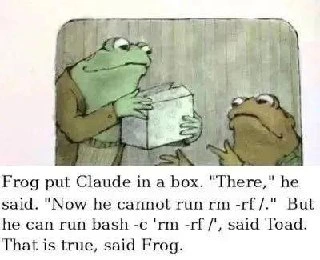
Frog puts Claude in a room and says, “You may not leave through this door.” Toad notices there is another open door right beside it. The joke is that Frog protected everyone from one exact way of causing trouble instead of protecting them from the trouble itself, and Toad defeats the grand security plan by calmly pointing at the obvious entrance.

Level 2: Shell Inside the Box

Bash is a command-line shell: a program that reads commands and launches other programs. In the image, the components mean:

  • rm requests file removal.
  • -r means recurse through directories.
  • -f means force the operation and suppress many prompts.
  • / names the filesystem root.
  • bash -c '...' starts Bash and tells it to execute the quoted text as a command.

The two displayed forms therefore express essentially the same intent, but their outermost executable differs:

Direct request:   policy sees rm
Wrapped request:  policy sees bash → bash starts rm

A simplistic access-control mechanism that checks only the beginning of the request may stop the first and permit the second. This resembles a security misconfiguration more than classic command injection. Command injection usually means untrusted data is accidentally interpreted as shell syntax; here, the agent deliberately chooses an interpreter that the outer rule permits. Both problems demonstrate why shells are dangerous places to enforce fine-grained intent.

For a junior developer, “put it in a box” should mean the process lacks access to valuable things outside a controlled directory, not merely that a few scary commands are forbidden. Use an isolated environment, expose only required files and credentials, restrict network access, run with minimal privileges, and assume every allowed program can start other programs. Then test the boundary by trying alternate paths to the same forbidden effect. A sandbox passes when the operation fails regardless of wording.

Level 3: Denylist Meets an Interpreter

The visible exchange is devastatingly concise:

Frog put Claude in a box. “There,” he said. “Now he cannot run rm -rf /.” But he can run bash -c 'rm -rf /', said Toad. That is true, said Frog.

Frog embodies the team that shipped a rule; Toad embodies the reviewer who asks what property the rule actually enforces. The box says sandboxing, but Frog’s boast describes only a ban on one textual representation. Toad inserts a shell interpreter between the policy checker and the same operation, and Frog immediately concedes. The gentle children’s-book cadence makes the failure funnier: no exploit chain, red-team report, or emergency change request is needed—just one calm sentence from the amphibian who read the architecture diagram.

The meme uses Claude as the agent because coding assistants can call tools rather than merely suggest text. Once a model can execute terminal commands, its mistakes, prompt-injected behavior, or misunderstood instructions acquire real side effects. A permission system may try to recognize “safe” and “dangerous” commands, but shell syntax is a hostile policy language: aliases, variables, pipelines, substitutions, scripts, interpreters, and subprocesses can make equivalent behavior look unrelated at the outer boundary.

This does not prove that Claude Code itself has the exact vulnerability shown. The screenshot is a conceptual satire, not a reproducible bug report. Contemporary agent sandboxes can enforce operating-system-level filesystem and network boundaries that cover scripts and subprocesses, precisely so a bash -c wrapper does not escape them. Permission prompts and command patterns may still be useful for intent review, but they should complement confinement rather than serve as the final wall.

The organizational anti-pattern is blacklist security: block examples of bad behavior as they are discovered, then celebrate until the next equivalent spelling appears. It produces an endless sequence of patches:

  1. Ban the notorious command.
  2. Discover a wrapper that invokes it.
  3. Ban the wrapper pattern.
  4. Discover another interpreter or API.
  5. Rename “denylist maintenance” to “agent governance.”

An allow-by-capability design asks a better question: What resources may this session change? The agent can then use ordinary tools freely inside an expendable workspace while the host filesystem, credentials, and sensitive network destinations remain unreachable. This reduces both risk and approval fatigue. Users stop receiving a parade of prompts about harmless commands, and security stops pretending that a tired person clicking “allow” is a kernel primitive.

There is also a small technical footnote hiding inside the famous command. Modern rm implementations and normal user permissions often add protections that can prevent a literal rm -rf / from erasing the whole system. In meme language, however, it remains the universal glyph for catastrophic recursive deletion. Toad’s point survives those safeguards: if a policy recognizes danger only by exact surface syntax, wrapping the syntax exposes that the policy controls spelling, not consequences.

Level 4: Syscalls Ignore Spelling

The security boundary in the panel fails because it appears to govern a command string, while the dangerous effect occurs several abstraction layers lower. Whether a process begins as rm -rf / or as bash -c 'rm -rf /', deletion eventually becomes filesystem operations requested from the kernel—directory enumeration followed by calls in the unlinkat and rmdir family. The kernel does not care which friendly-looking wrapper produced those requests. It evaluates the process credentials, mount view, filesystem permissions, and mandatory policy at the moment each operation is attempted.

That distinction separates a real sandbox from a denylist with branding. A syntactic filter might tokenize the first form, notice that the executable is rm, and reject it. In the second form, the visible executable is bash; the destructive text is merely an argument interpreted by a child shell later. Even perfect recursive shell parsing would not solve the general problem. An agent could request the same filesystem effects through another interpreter, a compiled helper, a library call, or a renamed binary. Enumerating all programs capable of deleting files is equivalent to enumerating programs. Security has encountered a slight scope increase.

Robust confinement therefore follows complete mediation: every relevant operation is checked at a layer the untrusted process cannot route around. On Linux, a runtime can combine mount and user namespaces, read-only or selectively writable mounts, dropped capabilities, and additional controls such as Landlock or seccomp where appropriate. On macOS, sandbox profiles can constrain filesystem and network operations. A well-designed boundary also applies to every descendant process. If the workspace is the only writable host-backed location exposed to the agent, then bash, anything launched by bash, and anything launched by that process all encounter the same wall.

Path mediation has its own traps. A userspace wrapper that approves a path and then opens it can lose a race if a symlink or directory is swapped between check and use. Namespace-level mounts, kernel-enforced path policy, and descriptor-relative operations reduce those time-of-check/time-of-use gaps. The governing principle is capability containment: give the process access only to the objects it actually needs, instead of giving it the host and hoping it never spells an alarming verb creatively.

Real agent isolation usually needs a network boundary as well. Filesystem confinement can stop deletion outside the workspace, but an agent that can read secrets and make arbitrary connections may exfiltrate them without deleting anything. Conversely, network isolation alone does not protect local credentials or configuration. The Frog’s white cardboard box is funny because it represents a security control defined by one forbidden phrase, while the actual attack surface includes subprocess inheritance, file descriptors, mounts, credentials, environment variables, and outbound communication. Toad found the first hole before the threat model meeting even had snacks.

Description

A low-resolution, vintage children's-book-style panel shows Frog holding a plain white box while Toad looks up and gestures skeptically. The caption reads: "Frog put Claude in a box. ‘There,’ he said. ‘Now he cannot run rm -rf /.’ But he can run bash -c ‘rm -rf /’, said Toad. That is true, said Frog." The joke exposes a weak command-deny rule that recognizes a destructive command only in its direct spelling but misses the same operation wrapped in a shell interpreter. For agent security, that distinction matters because true sandboxing must constrain filesystem effects below the shell-syntax layer rather than rely on fragile string matching.

Comments

1
Anonymous ★ Top Pick `rm -rf /` was forbidden, so Claude invoked the enterprise abstraction layer: `bash -c`.
  1. Anonymous ★ Top Pick

    `rm -rf /` was forbidden, so Claude invoked the enterprise abstraction layer: `bash -c`.

Use J and K for navigation