Skip to content
DevMeme
1662 of 7435
The Audacity of One-Based Array Indexing
CS Fundamentals Post #1858, on Aug 5, 2020 in TG

The Audacity of One-Based Array Indexing

Why is this CS Fundamentals meme funny?

Level 1: Counting Confusion

Imagine you have a row of buckets and you want to number them in order. Most people would label the first bucket as number 1, the second bucket as number 2, and so on. Now, picture if someone came along and said, “Hey, actually, label the first bucket as number 0 instead, then the next one as 1, then 2, etc.” That would feel pretty odd at first, right? You’d double-check and maybe scratch your head: “Are you sure the first bucket shouldn’t be 1?” Because all your life, you’ve been calling the first thing “number 1.”

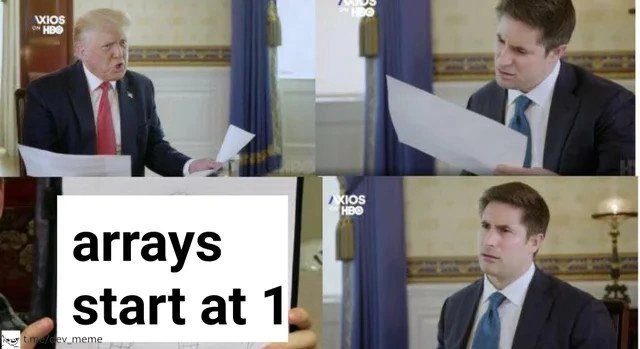
This meme joke is like that scenario, but in the world of coding. Programmers usually label the first item in a list as 0 (it’s a special quirk in computing). They’ve gotten so used to it that it feels normal to them. Now, when a rule says “Nope, start labeling from 1 instead,” it flips their normal upside-down. The funny picture shows a man looking really confused at a piece of paper – that paper says “arrays start at 1,” which is basically the rule “start counting from 1.” His baffled face is like a programmer being told to count differently than usual.

Why is it funny? It’s the surprise and confusion. It’s as if your teacher announced one day that from now on, the alphabet will start at B instead of A – you’d see all the kids go wide-eyed and panicky, wondering if everything they learned will change. In the same way, telling developers to count from 1 in code when they’re used to starting from 0 is a recipe for “Wait, what?!” moments. The humor comes from that relatable feeling of sudden confusion over something as simple as where to begin counting. It’s a little nerdy, but at its heart, it’s like being told to do a very common thing in an unexpected, backward way – and everyone sharing a laugh (and a tiny groan) about how such a small change can throw us off so much.

Level 2: Zero vs One Indexing 101

Let’s break down the key ideas for those newer to coding or not deeply familiar with this concept. Arrays are basically ordered lists of items in programming. Each item in an array is accessed by an index, which is like the item’s position number in the list. Now, a big detail: in most programming languages, the first position in an array is index 0. This is known as zero-based indexing. So if you have an array of five elements, their indices will be 0, 1, 2, 3, 4 (with 0 pointing to the first element and 4 pointing to the fifth element). For example, in Python or Java: my_array[0] gives you the first item. If you tried my_array[5] in that case, you’d be out of bounds because you’d actually be trying to get a sixth element that isn’t there.

However, not all languages follow this. Some use one-based indexing, meaning they count the first element as index 1. Imagine an array of five elements again, but now the indices would be 1, 2, 3, 4, 5 for those elements. MATLAB is a classic example: if you have a vector in MATLAB, A(1) returns the first element and A(5) would be the fifth. Lua (a scripting language often used in game development) and R (a statistical computing language) are also one-indexed. It’s a bit like how we normally count in everyday life (we usually start at 1 when counting things, right?).

The meme’s text says “arrays start at 1”, which is specifying a one-based indexing system. The reason all the developers in the meme’s scenario “panic” at reading that is because it’s an unexpected rule if you come from languages like C, Java, or Python. It’s a LanguageQuirk or LanguageGotcha that can cause confusion. Newer devs might not have even realized that some languages count from 1. If your first programming language is, say, JavaScript, you’d naturally think the first element is index 0 and the second is index 1, and so on. Then you see a language (or a spec for a system) that says “Nope, first element is index 1” – your brain does a double-take.

Why does this matter? Because when you write loops or refer to the “length” of an array, the starting index changes the whole game. For example, consider a simple loop to print all elements of an array. In a zero-indexed language (with a variable n for the number of elements), you might do:

for (int i = 0; i < n; i++) {
    print(array[i]);
}

This will print array[0] through array[n-1] – which are n elements total. In a one-indexed world, a similar loop would typically go i = 1 to i <= n to cover array[1] through array[n]. If you accidentally mix these up – say you start at 0 in a one-indexed context – you’re going to either try to access a non-existent 0th element or miss the last element because you miscalculated the bounds. That kind of mistake is literally called an Off-by-One Error, because your starting or ending point is off by one from what it should be. It’s one of the most common bugs beginners run into when writing loops or working with arrays, even in a single language. When switching between languages or working with an unfamiliar indexing rule, the chance of making that mistake shoots up.

The meme specifically leverages a popular format where someone is reading a document with a surprising statement. Here, the surprising statement is “arrays start at 1”. The person reading it (the interviewer Jonathan Swan in the actual footage) looks baffled and almost alarmed. In a programming context, that’s the face you might make if you learned that the system you’re about to work on counts array elements differently than you expected. It’s a RelatableHumor moment: if you’ve been coding for a while, you likely have a memory of that sudden confusion when an index didn’t line up with what you thought. Maybe you were debugging and realized you started your loop one too high or low, or you came from one language to another and kept getting errors until that “aha!” moment: “Oh, this language starts counting at 1, not 0!”.

The categories here include Languages and CS_Fundamentals because this really is a fundamental concept that varies between languages. It’s a point of comparison: LanguageComparison in the tags suggests that different programming communities handle this differently and often enjoy poking fun at each other for it. For instance, a Python dev might joke, “Index 0 is the only true start,” and a MATLAB user might retort, “Humans count from 1, so does my code!” Neither is wrong; they’re just conventions. But when a convention catches you off guard, it’s funny in hindsight (and frustrating in the moment!).

Spec (short for specification) in this context is like a rulebook or a document that says how a system should work. If a spec says “arrays start at 1,” it means everyone coding for that system is supposed to follow that rule. Usually, specs try to be clear to prevent bugs, so having a non-standard rule like that is surprising. It’s almost inviting misunderstanding unless the team is very careful. That’s why “everyone panics” – it humorously exaggerates that all the programmers seeing this spec detail simultaneously go “Whoa, hold up!” because they can predict the confusion it might introduce.

In simpler terms: one-based indexing means you start counting your array positions at 1. Zero-based indexing means you start at 0. The meme is funny to developers because the majority are so used to zero-based that hearing “start at 1” is like hearing an alarm bell for possible mistakes (the infamous off-by-one errors). It highlights a little quirk of our field: even something as straightforward as counting can become a source of bugs if different assumptions collide.

Level 3: Panic at Index 1

To an experienced developer, this meme hits on a visceral, almost traumatic memory: the dreaded off-by-one error and the surprise of encountering an unusual indexing scheme. The scene is a perfect storm of language quirk shock. Imagine you’re handed a project specification (the “spec”) and buried in it is a requirement that array indices should start at 1 instead of 0. Your reaction is akin to the journalist Jonathan Swan’s perplexed stare in the meme – a mix of confusion and “Wait, is this for real?”.

In day-to-day programming, we take for granted that arrays (and lists, strings, etc.) are zero-indexed in most popular languages (C, C++, Java, Python, JavaScript, you name it). So reading “arrays start at 1” in an official spec triggers a knee-jerk alarm. It’s like reading a plot twist in a familiar story: suddenly all your instincts about how to write loops, how to access the first element (array[0] vs array[1]), and how to calculate lengths need to be re-examined. Everyone panics – that hyperbole in the title captures the collective groan and anxiety of developers who have been burned by indexing miscommunications before. It’s a relatable humor moment because so many of us have fixed bugs that came down to a +1 or -1 in the wrong place.

The combination of this specific spec detail with the Axios interview meme template is brilliant comedic timing. In the original interview, Swan is incredulous at data being handed to him – here, the data is the bizarre spec clause. It satirically elevates a niche programming concern (one-based indexing) to the level of a political bombshell. The suited figure (originally President Trump) handing the paper might represent a clueless manager or an out-of-touch specification author delivering this requirement. The interviewer’s dumbfounded expression is every developer reading that line, instantly picturing the cascade of bugs and confusion it could cause. The text on the paper, “arrays start at 1”, is shown in bold like some dramatic revelation. For a dev team used to zero-based thinking, that’s a forehead-slapping moment.

Why is this so panic-inducing? Because OffByOneError is not just a meme tag – it’s one of the most notorious categories of bugs in programming. There’s even an old joke:

“There are only two hard things in Computer Science: cache invalidation, naming things, and off-by-one errors.”

Seasoned developers laugh (and wince) at this because off-by-one errors have caused countless headaches – from minor misprints to serious security vulnerabilities (think buffer overflows when you go one index too far!). When a spec enforces one-based indexing, it’s basically setting up a fertile ground for such errors, especially if the team or the libraries they use assume zero-based. Integration pain is real: picture mixing a one-indexed data structure with a zero-indexed one. Every time data passes between them, there’s a little translation dance (subtracting or adding 1). Each of those translations is a chance to slip up.

For a senior developer, there’s also a historical and “language war” context here. LanguageQuirks and LanguageComparison debates often include the index base argument. For example, older and domain-specific languages like MATLAB, Lua, R, or Visual Basic use 1-based indexing. In MATLAB, if you write A(1), you get the first element of A – try that in C and you’re actually referring to the second element (since C’s a[1] is the second item). Seasoned folks who have hopped between languages remember the mental gear-shifting required. It’s a classic LanguageGotcha: you forget the convention of the language you’re in, and boom – bug introduced. Many a MATLAB-to-Python convert has experienced that moment of “Why is my loop skipping the first element? …Oh right, I started at 1 out of habit”. Conversely, a C programmer writing MATLAB for the first time might wonder why their loop is throwing an out-of-bounds error when they innocently wrote for i = 0:10. These hiccups create a kind of muscle memory panic.

So when a spec unilaterally declares one-based arrays, experienced devs see a red flag. They panic not because they can’t adapt, but because they foresee the avalanche of tiny off-by-one slips that could happen throughout the codebase. It feels like someone booby-trapped the project with a subtle, pervasive source of bugs. Depending on the corporate culture, this might even spark debates in planning meetings: “Can’t we just use zero-based and subtract 1 mentally when discussing the spec? Do we have to follow this spec literally?” But if it truly is a firm requirement (maybe the software is interfacing with an external system or a legacy codebase that is one-indexed), then the team collectively sighs and braces themselves. The meme’s tagline “everyone panics” playfully exaggerates this drama – envision a whole room of developers reading that line and screaming internally, if not externally.

There’s another layer of shared experience: RelatableDeveloperExperience as tagged. Every programmer, at some point, has been thrown off by an off-by-one miscount. It’s basically a rite of passage in CS Fundamentals courses to debug a fencepost error in a loop. Seeing a spec mandate a non-standard indexing is like hearing the starting gun for a marathon of careful index auditing. Senior engineers with battle scars will recall production issues where a single mis-indexed loop caused a cascade (“why is the last record always missing? oh, the loop condition was wrong by 1”). There’s a reason “off-by-one” is in the Bugs category – it’s that prevalent. And here, the spec is basically institutionalizing that off-by-one offset everywhere, which is both darkly humorous and slightly horrifying.

In summary, Level 3 recognizes the rich irony and pain behind the meme: a simple phrase “arrays start at 1” can unite developers in face-palming empathy. It’s a poke at language design choices and how something as small as the starting index can loom large in a programmer’s mind. The Axios interview format just amplifies that absurdity by showing a very serious-looking panic to a trivially small phrase on paper. It’s a classic case of TechHumor where only those in the know will get why the interviewer looks so disturbed by what, to outsiders, might seem like a mundane statement. The meme validates the gut feeling of every dev who’s been thrown by a one-indexed system: “It’s not just you; this really is that unsettling!”.

Level 4: Counting from Zero

At the deepest technical layer, this meme touches on the fundamental design decision of array indexing in programming languages. It’s an echo of a long-standing debate in computer science: zero-based indexing vs one-based indexing. Early low-level languages like C chose zero-based indexing because it aligns perfectly with pointer arithmetic and memory addressing. An array name in C can decay to a pointer to its first element, and array[0] refers to the memory at the base address. The index is essentially treated as an offset from the start address. In mathematical terms, if base_index is the starting index (0 or 1), the address of array[i] in memory is calculated as:

address(array[i]) = base_address(array) + (i - base_index) * sizeof(element);

This formula simplifies nicely when base_index = 0 (no subtraction needed). If base_index = 1, every access internally does an extra (i - 1) operation. The choice of zero as the starting index was not arbitrary – it made the math elegant for addressing and avoided confusion in range calculations. In a famous note, Edsger W. Dijkstra even argued that numbering sequences from 0 is more natural for computing: the N elements of an array are conveniently indexed as 0 through N-1. This way, the index directly represents an offset and the length computation last_index = length - 1 falls out logically.

On the other hand, some languages (especially those used by mathematicians or domain specialists) went with 1-based indexing to stay consistent with conventional human counting and mathematical notation. For example, FORTRAN and later MATLAB treat 1 as the first index, matching how matrices are indexed in linear algebra (think of the $1^{st}$ row, $1^{st}$ column). It’s not that one-based indexing is mathematically impossible in computers – it’s just a different convention. Pascal and Ada even let you define arrays with an arbitrary lower bound (say an array indexed from 42 to 47 if you wanted!). Under the hood, the compiler adjusts the pointer math so that the chosen base index maps correctly onto memory.

The humor here is rooted in how such a basic foundational choice – what number we start counting from – can feel almost philosophical to developers. It’s as if we’re challenging a zeroth law of programming. Seasoned devs know that whether you start counting at 0 or 1 is baked into many algorithms and data structures. It influences how you write loop conditions, how you think of half-open intervals (like [0, n) vs [1, n]), and how you avoid the classic off-by-one errors. In theoretical computer science, off-by-one errors are sometimes seen as a byproduct of these indexing conventions – boundaries and indices are a form of discrete mathematics, and a tiny shift can invalidate a proof or crash a program. There’s an almost gravitational law here: even this single line in a spec can perturb the entire orbit of a codebase’s logic. The meme exaggerates that effect for comedic impact: the spec says arrays start at 1, and suddenly it’s as if we’ve upended a law of nature in the programming universe, causing widespread panic among the enlightened.

Description

A three-panel meme using the viral Donald Trump and Jonathan Swan interview format. In the top-left panel, Donald Trump is shown speaking authoritatively while holding a paper. The bottom-left panel is a close-up of a paper he's holding, which displays the text 'arrays start at 1' in bold, black font. On the right, two panels show interviewer Jonathan Swan looking down at the paper with a furrowed brow of confusion, and then looking up in utter disbelief. This meme humorously personifies the deeply ingrained computer science debate over array indexing. The vast majority of modern programming languages use zero-based indexing (where the first element is at index 0). The meme presents the concept of one-based indexing (found in languages like Lua, MATLAB, and R) as a shockingly incorrect and controversial statement, with Swan's reaction representing the collective bewilderment of the mainstream developer community. It's a classic joke about fundamental programming principles and the 'holy wars' over language design choices

Comments

7
Anonymous ★ Top Pick There are only two hard problems in computer science: cache invalidation, naming things, and off-by-one errors caused by people who think arrays start at 1
  1. Anonymous ★ Top Pick

    There are only two hard problems in computer science: cache invalidation, naming things, and off-by-one errors caused by people who think arrays start at 1

  2. Anonymous

    Spec says arrays start at 1 - perfect, now the UI, the DB, and the cache can all be off by one in completely different directions

  3. Anonymous

    After 20 years in the industry, the only thing more terrifying than a production outage on Friday at 4:59 PM is discovering your new team's legacy codebase was written by someone who genuinely believed arrays should start at 1... and they implemented their own custom indexing wrapper to 'fix' C

  4. Anonymous

    Presenting 'arrays start at 1' in a professional setting perfectly captures that moment when a MATLAB or Fortran developer joins your Python team and casually drops this heresy in code review. The confused reaction is exactly what happens when you realize they're serious, and now you're debugging off-by-one errors in production at 2 AM because someone thought 'arr[1]' should return the first element. This is why we can't have nice things - or consistent indexing conventions across the industry

  5. Anonymous

    Arrays start at 1? That's just off-by-one job security for the next maintainer

  6. Anonymous

    Polyglot stacks are great until analytics ships 1‑based arrays, backend expects 0‑based, and your pagination becomes a distributed fencepost problem with an SLO

  7. Anonymous

    Arrays start at 1? Bold - finally a unified architecture where pagination, bitmasks, and ring buffers are all wrong in the same way

Use J and K for navigation