Skip to content
DevMeme
1663 of 7435
The Team Reviews Your Push
CodeReviews Post #1859, on Aug 5, 2020 in TG

The Team Reviews Your Push

Why is this CodeReviews meme funny?

Level 1: Showing Your Homework

This is like handing your homework to a group of friends and watching them all squint at the same line. You thought it was finished, but now everyone can see the messy parts you hoped would be ignored. It is funny because the person submitting the work feels proud and nervous at the same time, while the team looks like they just found the part that needs explaining.

Level 2: The Review Stare

A code review happens when teammates inspect code before it is merged into the shared project. In Git-based workflows, a developer usually pushes a branch and opens a pull request. Other developers then read the changed files, leave comments, ask questions, request tests, or approve the change.

The meme is funny because the person pushing code looks exposed, while "My Team" looks doubtful. That matches a common early-career feeling: your code worked locally, the tests passed, and then someone notices the one confusing variable name or asks what happens when the input is empty. It can feel personal even when the review is about the code.

This is also why review process matters. Comments like Can we simplify this? or What happens if this request fails? are not attacks; they are how teams catch bugs before users do. The hard part is learning to separate your identity from the diff. Your code can need changes without you being a bad developer. Annoying lesson, useful lesson, usually learned in public.

Level 3: Diff Under Interrogation

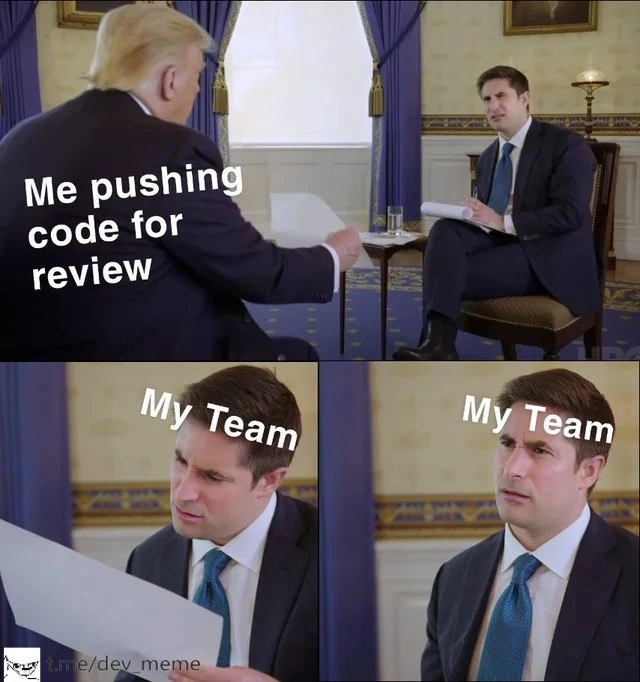
The image labels the person submitting work as:

Me pushing code for review

Then the two lower panels label the skeptical reviewer reaction as:

My Team

That is the whole emotional architecture of a pull request. You write the code in the private optimism of your editor, push it to a branch, open the review, and suddenly every naming choice, skipped edge case, suspicious TODO, and "temporary" abstraction is sitting under fluorescent lights. The team is not even shown speaking; their faces do all the reviewing. Any developer who has watched a senior engineer silently scroll through their diff knows that silence is its own static analysis tool.

The joke is especially sharp because code review is supposed to be a quality process, not a public trial. In healthy teams, review catches defects, spreads system knowledge, improves maintainability, and prevents one person's assumptions from becoming production's problem. In real teams, it also exposes uneven standards, unclear ownership, style-guide archaeology, and the quiet politics of "who is allowed to merge weird code." The meme captures the second layer without needing a single comment thread.

The post message says, Especially at 2:30a.m., which adds the classic production-adjacent flavor. Late-night code is where confidence goes to become a rollback. At 2:30 a.m., the submitter is usually tired enough to believe "small change" means small blast radius, while the reviewers are awake enough to know that no diff is small when it touches auth, billing, caching, migrations, time zones, or the function with a comment last edited by someone who left in 2018.

There is also a version-control subtext. "Pushing code for review" implies a branch, a commit history, and usually a pull request or merge request. The team is not just judging the final patch; they are judging the story told by the diff. Are the commits coherent? Are tests included? Does the code explain the problem being solved, or does it merely prove that someone wrestled the compiler into exhaustion? Good reviewers look for correctness. Great reviewers also ask why the change exists in this shape, because that is where future maintenance pain is born.

Description

A three-panel meme from the same interview setting shows one person labeled "Me pushing code for review" while the interviewer is labeled "My Team" in two skeptical reaction shots. The top panel shows the code submitter gesturing across the room, and the two lower panels show the team reading and then staring back with increasing doubt. The visible text is "Me pushing code for review" and "My Team" repeated on both lower images. The humor is the familiar pull request anxiety of sending a change into peer review and immediately realizing the reviewers can see every shortcut, naming compromise, and missing edge case.

Comments

1
Anonymous ★ Top Pick A good review finds the bug; a great review also finds the variable name you hoped nobody would notice.
  1. Anonymous ★ Top Pick

    A good review finds the bug; a great review also finds the variable name you hoped nobody would notice.

Use J and K for navigation