JSON Statham: Action Hero of Data Formats
Why is this DataFormats meme funny?
Level 1: Action Hero Dress-Up
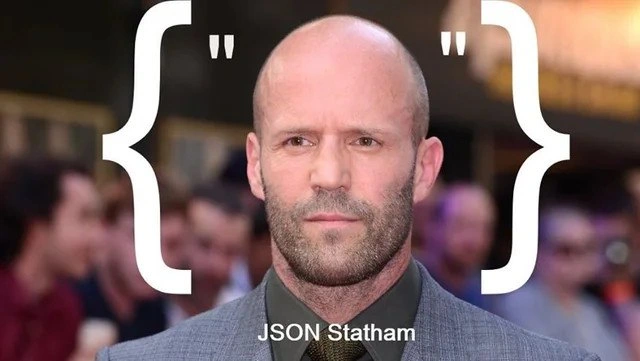
Imagine you have a friend named Jason who loves to dress up in funny costumes. Now, think of a computer thing called JSON (we say it like “JAY-sun”) which is used to organize information and often uses curly bracket symbols { }. This meme jokes that the famous action hero Jason Statham showed up wearing those curly braces as a costume! It’s like someone noticed that JSON sounds just like Jason, and decided to prank us by mixing them together. In the picture, the actor has big curly bracket shapes around his head, almost like armor or a fancy outfit made of code. It looks really silly because you’d never expect a movie star to wear giant punctuation marks! It’s similar to if you had a teacher named Ms. Candy and one day she came to school covered in candy wrappers – her name and her outfit would match in a ridiculous way. Here, the tough movie guy is “dressed” in JSON’s curly braces just because their names sound alike. You don’t need to know much about computers to see the humor: it’s the surprise of an action hero doing a geeky dress-up. The mix of a serious hero with goofy code symbols is so unexpected that it makes people laugh, and that’s why this meme brings a smile to developers’ faces.
Level 2: Brace Yourself for JSON
If you’re a newer developer, you’ve probably run into JSON already. JSON stands for JavaScript Object Notation – it's a lightweight text format for exchanging data. Think of it as a structured way to write down an object (a collection of key-value pairs) so that both humans and machines can read it. In technical terms, JSON is a serialization format: it takes in-memory data (like objects or lists in your code) and packages it into a plain text string that can be easily sent over a network or saved to a file. Later, that string can be de-serialized (read and converted) back into data structures by another program. JSON became incredibly popular for APIs and configurations because it's easy to understand and parse. Its syntax is distinctive and very strict about formatting. We use curly braces { ... } to wrap an object, commas to separate items, and every textual key and value must be in double quotes " (with a colon between each key and its value). For example, a simple JSON object looks like this:
{
"name": "Jason Statham",
"nickname": "JSON Statham"
}
In JSON, the { and } define the beginning and end of an object (think of them like a container holding multiple values), and we put each "key" in quotes followed by its value. In the snippet above, "name" is a key with the value "Jason Statham", and "nickname" is a key with the value "JSON Statham". Notice how both the keys and the string values are wrapped in double quotes. This is exactly why the meme shows big white quotation marks " near the curly braces – to mimic how JSON syntax looks in code. Those symbols in the image immediately scream “JSON!” to anyone who writes it regularly.
Now, the man in the photo is the actor Jason Statham, known for high-octane action movies (The Transporter, The Expendables, Fast & Furious series, etc.). The meme cleverly renames him "JSON Statham" by swapping in the term JSON. It's a wordplay joke, because JSON is pronounced almost the same as Jason. By literally "dressing" him in curly braces and quotes (the characters we see in JSON text), the meme turns him into a human JSON object! The caption "takes no prisoners" refers to Jason Statham's tough-guy persona in films — he’s the type of hero who doesn’t go easy on villains. The nerdy twist is that this phrase also hints at JSON’s behavior: if your JSON text has any little mistake (like a missing comma, an extra bracket, or an unquoted string), the JSON parser will throw an error and refuse to work with it. In other words, JSON doesn’t show mercy to formatting errors. No trailing commas, no mis-typed quotes allowed – it demands everything be just right.
So why is this funny to developers? It’s mixing a coding concept with a pop culture reference in a playful way. Curly braces are very familiar to programmers – we use {} in many languages to group code or data, and in JSON they’re crucial. Seeing those braces used like a costume on an action movie star is delightfully absurd. It’s the kind of inside joke that makes programmers grin: you take something as dry as a data format and give it an action-hero makeover. The wordplay “JSON Statham” is a classic tech pun – the name of a serious format turned into a person’s name. This sort of joke shows that even when we’re deep in code all day, we programmers love to have a laugh. After wrangling APIs and data formats for hours, it’s refreshing to see our everyday tools (like JSON) pop up in a meme, trading its serious job for a bit of fun on the red carpet. It reminds junior devs that the tech community has a sense of humor and that even a serialization format can be a source of entertainment when puns are involved!
Level 3: The Transporter of Data
This meme mashes up a ubiquitous coding tool (JSON) with a Hollywood action icon, producing a layered joke that software veterans will appreciate. For context, JSON (JavaScript Object Notation) is the de facto standard for data interchange in modern applications: web APIs respond with JSON payloads, config files are written in JSON, logs and databases love JSON documents. It's everywhere, transporting data across systems much like Jason Statham's character in "The Transporter" delivered packages with unwavering efficiency. The curly braces { } framing the actor's head are the unmistakable uniform of JSON syntax, instantly recognizable to programmers. By adding the quotes " near those braces, the image outlines what looks like a JSON object hovering on the red carpet. It's as if the format itself showed up to the movie premiere, fully geared in curly braces, ready to kick some serialization butt. In true programmer fashion, the meme anthropomorphizes an abstract tool, turning a mundane format into a literal action hero to make us smile. Developers see this and chuckle because they've spent countless hours staring at these exact braces in code editors—suddenly, those mundane symbols are given a larger-than-life persona.
The pun "JSON Statham" lands perfectly because "JSON" is typically pronounced "Jay-sun" – almost exactly like Jason, the actor’s first name. It's a classic case of a name collision between tech jargon and pop culture. This overlap tickles the programmer's funny bone: a serious, structured data format gets fused with a tough-guy movie star persona. The phrase “takes no prisoners” winks at Statham’s no-nonsense action roles while slyly nodding to JSON’s unforgiving syntax. A JSON parser is notoriously strict – one missing curly brace or an extra trailing comma and JSON ain’t having it. In other words, JSON will outright fail to parse if the data isn't perfectly formatted; it takes no prisoners when it comes to errors. Any developer who has debugged a broken .json file due to a stray comma or an unescaped quote will appreciate that there’s zero tolerance, much like an action hero who shows no mercy to the bad guys. The humor here is born from relatable pain: the strictness of JSON is being likened to the merciless efficiency of an action star eliminating foes.
On another level, the meme playfully acknowledges how JSON has dominated the data format landscape. Back in the day, everyone used XML (with its verbose angle brackets and heavy syntax) or other serialization formats, but JSON came in lean and mean, swiftly overtaking the scene. It's the undisputed action hero of data formats, much like Statham often plays the one-man army who outclasses the competition. The red-carpet setting adds a meta-joke: JSON is being treated like a celebrity at a gala, implying that in the coding world, JSON is a superstar. Seasoned devs remember the years when JSON emerged as a lightweight alternative to XML and SOAP, becoming a blockbuster hit in tech. Seeing JSON figuratively standing over XML's defeated body – in a designer suit, no less – rings true and funny. There’s even a tradition of similar geeky wordplay: if JSON Statham cracks you up, you might also appreciate YAML L. Jackson (a nod to another data format, YAML, paired with actor Samuel L. Jackson). These tongue-in-cheek mashups celebrate our daily tools by comparing them to badass icons. In short, the humor works on multiple layers: syntax symbolism, pronunciation pun, and a bit of tech history. It’s a nerdy trifecta that senior developers can both laugh at and nod along to, because they've lived through the rise of JSON and have a soft spot for curly braces everywhere.
Description
A visual pun meme featuring a headshot of the actor Jason Statham. His face is centrally framed by large, white graphical elements representing JSON (JavaScript Object Notation) syntax. On the left is an opening curly brace '{' followed by a double quote '"', and on the right is a closing double quote '"' followed by a closing curly brace '}'. At the bottom of the image, the text 'JSON Statham' is displayed. The humor is derived from the phonetic similarity between the actor's first name, Jason, and the acronym JSON. It's a classic, simple piece of developer humor that playfully personifies a data format as a well-known action star

Comments
7Comment deleted
Unlike most JSON payloads, this one can parse you. Violently
JSON Statham: the enforcer you send when a rogue microservice spits out a 12 MB payload - he drop-kicks the circular references, chops the trailing commas, and struts off with a 200 OK and p95 under 50 ms
He's got a strict schema: no unnecessary properties, always validates input, and never breaks backward compatibility - which is why he's been in every API response since 2008
When your API response is so robust and well-structured that it could single-handedly take down an entire legacy XML infrastructure while performing death-defying stunts across microservices - no schema validation needed, just pure, unadulterated key-value pair action
JSON Statham never chokes on circular references - he just transports the payload, deeply nested and unbreakable
JSON Statham: transports REST payloads with idempotent retries, drop-kicks trailing commas, but gets replaced by Protobuf the moment someone graphs P99 latency
JSON Statham rejects comments, eliminates trailing commas, and quietly turns your 64-bit IDs into imprecise doubles - then asks why you shipped without a schema