Skip to content
DevMeme
2293 of 7435
Unicode Predicted the 2020s
DataFormats Post #2552, on Jan 5, 2021 in TG

Unicode Predicted the 2020s

Why is this DataFormats meme funny?

Level 1: Scary Calendar Coincidence

This is funny because a computer list gives numbers to symbols, and the numbers 2020, 2021, and 2022 happen to match years. The matching symbols have scary names like dagger and bullet, so it feels like the computer was secretly warning everyone about bad years. It is like opening a dictionary and finding tomorrow's weather hidden beside a random word.

Level 2: Numbers For Characters

Unicode is a standard that assigns numbers to written characters. A code point is one of those numbers, usually written like U+2020. Programs use these code points so text can work across different systems. For example, the symbol has the code point U+2020 and the name DAGGER.

The tweet is funny because the code point numbers match years: 2020, 2021, and 2022. The character names then sound alarming: DAGGER, DOUBLE DAGGER, and BULLET. That makes a normal DataFormats fact look like a warning label for the calendar.

The UTF8 and UTF16 tags relate because those are common ways to encode Unicode text into bytes. They are not the same as Unicode itself, but they are how many systems store or transmit Unicode characters. Most developers meet this world when some string breaks because of a smart quote, emoji, foreign-language name, or invisible character. This meme is the friendlier version: the characters work perfectly, and that is somehow the problem.

Level 3: Prophetic Code Points

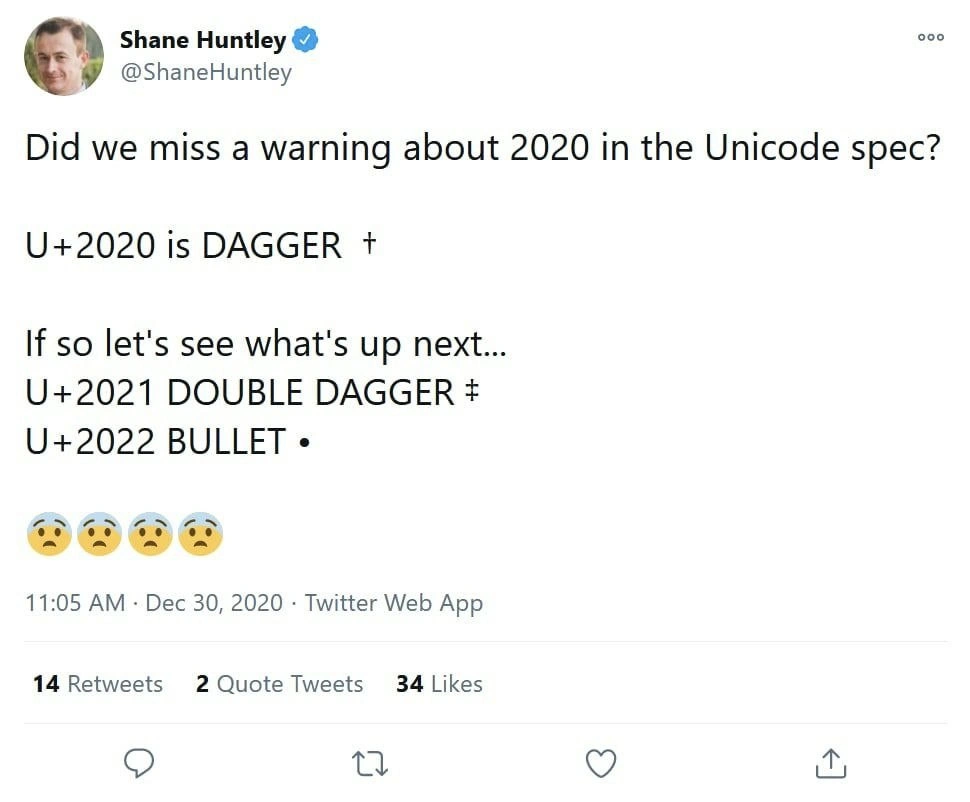
The screenshot shows a tweet asking:

Did we miss a warning about 2020 in the Unicode spec?

U+2020 is DAGGER †

If so let's see what's up next... U+2021 DOUBLE DAGGER ‡ U+2022 BULLET •

The joke treats Unicode as if it accidentally published a roadmap for the early 2020s. U+2020 is not a year; it is a code point, an assigned number in the Unicode character set. But because the number looks like the year 2020 and the character name is DAGGER, the tweet turns a technical lookup into ominous prophecy. Then it escalates: U+2021 is DOUBLE DAGGER, and U+2022 is BULLET. For anyone carrying emotional scar tissue from 2020, that sequence reads less like typography and more like release notes from a hostile universe.

The humor depends on the clean mismatch between CharacterEncoding and human pattern-seeking. Unicode's job is to give characters stable identities so text can be stored and exchanged across languages, platforms, and programs. It does not know or care that 2020 also names a calendar year. Humans absolutely care, especially when the names line up with dark symbolism. That is why the tweet feels like a cursed Easter egg in a specification: technically meaningless, emotionally precise.

There is also a subtle developer joke in the phrase "the Unicode spec." Specs are supposed to be dry, exhaustive, and boring in the most comforting way possible. This meme imagines one as a hidden omen. The dread comes from taking a perfectly normal standards-table entry and reading it with the same paranoia engineers bring to unexplained production logs: "that probably means nothing" is how many incidents begin.

Description

A Twitter screenshot from verified user Shane Huntley reads: "Did we miss a warning about 2020 in the Unicode spec? U+2020 is DAGGER † If so let's see what's up next... U+2021 DOUBLE DAGGER ‡ U+2022 BULLET •" followed by four fearful face emojis. The timestamp line says "11:05 AM · Dec 30, 2020 · Twitter Web App," with engagement counts of "14 Retweets," "2 Quote Tweets," and "34 Likes." The joke treats Unicode code points as ominous year-based prophecies, using real character names for U+2020, U+2021, and U+2022 as dark technical wordplay.

Comments

3
Anonymous ★ Top Pick The Unicode Consortium accidentally shipped the 2020 roadmap as a character table.
  1. Anonymous ★ Top Pick

    The Unicode Consortium accidentally shipped the 2020 roadmap as a character table.

  2. @chestnykh_nastya 5y

    U+2023 is PLAY ‣ типичная кали-юга, короче

  3. @pyproman 5y

    Fun fact: Windows NT 3.1 calendar doesn't allow 2020 (and everything after) as current date.

Use J and K for navigation