The Unholy Offspring of Hadoop and a Bee
Why is this BigData meme funny?
Level 1: The Elephant-Bee Surprise
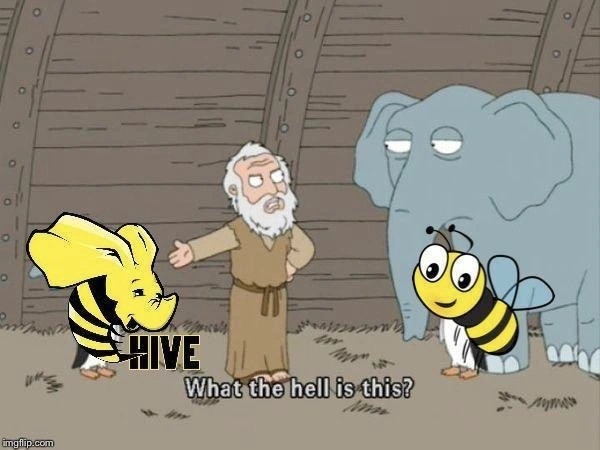
Imagine you’re at a zoo and you see a big elephant and a tiny bee. Now picture seeing a crazy creature that’s like a bee but with an elephant’s head and trunk. You’d probably rub your eyes and say, “Huh? What on earth is that?!” That’s exactly the joke here. In the picture, a man (like Noah from the Ark story) expects to see normal animals, but he’s shocked because one of them is a mix of two animals. This mixed-up animal is representing a technology called Apache Hive in a silly way.
The reason it’s funny is that computer engineers sometimes use animals or cute names as logos for their tools. Hadoop has an elephant logo because it’s all about handling huge things (like an elephant handles big loads). Hive is another tool – its name makes you think of bees and hives (where bees store honey). But Hive runs on top of Hadoop, so its logo is a bee combined with an elephant’s trunk to show it’s part of the “Hadoop family.” When a new developer first sees this logo, they react just like Noah in the cartoon: “What the heck is this supposed to be?!” It’s a mix that you don’t expect to see, just like a child wouldn’t expect to see a bee-elephant creature at the zoo.
In simple terms, this meme is funny because it captures the surprise and confusion of finding something that doesn’t immediately make sense. Even if you don’t know the technologies, you can laugh at the man’s bewildered face. It’s like if you opened a box of toys expecting a toy elephant and a toy bee, but instead you found a toy that’s half elephant and half bee – you’d be pretty confused! Developers feel a bit like that when they discover Hive’s quirky logo for the first time. The mix-up creature makes them pause and say, “Wait, what is this thing?!” And that moment of confusion (and then realization) is what makes the meme relatable and amusing.
Level 2: Meeting the Elephant and the Bee
So, what’s actually happening in this meme? It’s referencing the world of Big Data tools, specifically Apache Hadoop and one of its popular add-ons, Apache Hive. Let’s break it down in simpler terms. Hadoop is an open-source framework that lets you store and process huge amounts of data across many computers. Think of Hadoop as an elephant – it’s big, strong, and can carry a lot (in fact, Hadoop’s logo is a cute yellow elephant). Hadoop has two main parts: HDFS (Hadoop Distributed File System), which is like a big bucket spread out over many machines for storing files, and MapReduce, which is a processing technique that breaks big jobs into smaller pieces so a cluster of computers can work on them in parallel.
Now, on top of this elephant named Hadoop, there are other tools to make it easier to use. Apache Hive is one such tool – it’s often described as a data warehouse on Hadoop or as “SQL-on-Hadoop.” SQL is a language used to query (ask questions of) databases. Hive lets developers use SQL queries to analyze data stored in Hadoop’s file system. Instead of writing complex code to crunch the data, you can write a familiar query like SELECT * FROM sales WHERE region = 'US'; and Hive will handle running the equivalent MapReduce jobs under the hood. You can imagine Hive as the bee part of this equation: it’s named after a beehive, implying organization and structured storage (like bees storing honey in neat cells, Hive stores data in tables and columns).
The funny part is Hive’s official logo. It literally looks like a bee with an elephant’s head/trunk attached. This mash-up logo is shown in the meme as a little creature with “HIVE” written on it. On one side of the cartoon, you see a normal big elephant (that represents Hadoop), and on the other side, a normal bee (just a regular bee, presumably to contrast with the weird Hive logo). In the middle is Noah (from the biblical Noah’s Ark story) looking very confused at this hybrid elephant-bee creature. The caption “What the hell is this?” is basically Noah (or by analogy, a developer) asking about that strange creature.
For a new developer or someone early in their data engineering journey, encountering Hive can indeed be confusing at first. You might be learning about Hadoop (the elephant) – okay, big data storage, got it – and maybe you know what a bee or a hive is (in real life, bees live in a hive and make honey). But suddenly someone shows you Hive’s logo or mentions Hive in the context of Hadoop, and you’re like, “Hive? Bee with an elephant trunk? Wait, what?” The meme humorously captures that exact moment of confusion. It’s highlighting how the Hadoop ecosystem has many components with sometimes quirky names and logos, and how a beginner might react when trying to understand how they all fit together. The elephant stands for Hadoop’s core, the bee stands for the concept of Hive (beehive), and the elephant-bee logo is literally showing Hive as part of the Hadoop family (the elephant’s trunk is a nod to that).
In reality, once you know the pieces:
- Hadoop (elephant) = the base system storing data across a cluster and processing it with MapReduce.
- Hive (elephant-bee hybrid) = a tool on Hadoop that lets you use SQL queries as if you’re dealing with a regular database, but it's actually translating those queries to big-data operations.
- The bee (in the meme) = just a normal bee, possibly there to emphasize how odd the Hive logo looks next to a real elephant and a real bee.
The confusion (“What is this?”) is something every developer goes through when first exploring these big data tools. Soon you learn Hive isn’t a bizarre animal, but actually a powerful software project that makes life easier by providing a familiar query language for big data. And yes, the logos and names are a bit whimsical – that’s kind of an inside joke in tech humor circles. The whole Hadoop family (often jokingly called the “Hadoop zoo”) includes other animals too – for example, there’s Apache Pig (with a pig mascot) which is another Hadoop-based scripting tool. So if you felt like you stepped into a zoo or ark full of tech animals, you’re not wrong! The meme simply exaggerates that feeling in a funny way.
Level 3: Hadoop’s Menagerie of Abstractions
For those of us who’ve wrangled the Hadoop ecosystem, the meme hits home as soon as we see that bizarre yellow-and-black creature labeled HIVE facing the puzzled old man. The humor comes from a very real developer experience: diving into Big Data tools and feeling like you’ve entered a zoo of oddly named projects. Hadoop’s ecosystem has always been a menagerie – you’ve got an elephant as the core (that’s Hadoop’s mascot, symbolizing its capacity to carry huge loads of data), then along comes a “Hive,” which you’d expect to be represented by a bee… but wait, this Hive logo has an elephant’s head and trunk on a bee’s body! What the hell is this? – indeed. That exasperated question is basically a rite of passage in DataEngineering. It captures the moment a developer first encounters Apache Hive and its logo, realizing there’s yet another layer in the already complex Hadoop stack.
The scene (drawn in a Family Guy-style Noah’s Ark gag) is a perfect metaphor: Noah (the developer) has two familiar animals – an elephant (plain Hadoop) and a bee (perhaps representing a generic tiny worker, or even other Hadoop tools like Apache Pig which, yes, is symbolized by a pig). Then Hive strolls in, a mash-up of the two, and Noah’s confused face says it all. Experienced engineers chuckle because we’ve been there: the first time you install a Hadoop distribution and see an Apache Hive icon, you might do a double-take. Is it an elephant? Is it a bee? It’s both – just like Hive is both an integral part of Hadoop’s world and a distinct creature of its own (a SQL engine on a non-SQL platform). The meme humorously encapsulates the proliferation of tools in big data analytics: each with its own cutesy name and mascot, each adding a new abstraction. Hive in particular can confuse newcomers because it sounds like it might just be another data store, but it’s actually a SQL query layer on top of Hadoop. The elephant trunk on the bee hints “Hey, I run on Hadoop!” while the bee part says “I’m about organizing data like a hive.”
Seasoned devs also recall the historical quirk: Hive was created at Facebook to make querying massive logs easier via SQL rather than writing Java MapReduce jobs from scratch. So its very existence was about making the big elephant (Hadoop) more user-friendly by adding some buzz (bees, honeycomb, structured sweetness of SQL). The result was effective – Hive became the de facto data warehouse for Hadoop – but also comically emblematic of how convoluted the ecosystem can look to the uninitiated. We smile because we’ve seen that face: the new hire who opens a Hadoop tutorial and gets hit with a slide of animal logos – elephants, bees, pigs (oh yes, Apache Pig is another thing), maybe a penguin (Apache HCatalog’s logo), a cheetah (Apache Spark’s old logo), and more. It’s Noah’s Ark of tech, and the poor developer’s reaction is, seriously, what is all this?
The meme’s caption, “What the hell is this?”, is exactly the kind of thing you mutter when stumbling upon Hive’s odd branding for the first time. Even after you grasp that Hive lets you write SELECT queries on HDFS data, you might still wonder who thought a bee with an elephant trunk encapsulated that idea! (Inside joke: probably because Hive = beehive, honeycomb cells = structured data, and the elephant trunk shows it’s part of Hadoop’s herd). In practice, once you get past the goofy imagery, you learn that Hive is extremely useful – it spares you from writing low-level code by providing a familiar SQL-like interface, essentially turning the Hadoop elephant into a SQL-speaking workhorse. The senior perspective here is sympathetic laughter: we remember encountering Hadoop’s learning curve – not just the technical concepts like distributed storage or MapReduce jobs, but also the whimsical nomenclature that felt like someone’s inside joke. This meme pokes fun at that WTF moment we all have had, standing in the metaphorical ark as data engineers, looking at a new hybrid creature in our tooling and briefly questioning our career choices, before ultimately embracing the madness of the big data zoo.
Level 4: Chimeric Query Engine
At the upper echelons of big data architecture, Apache Hive represents a fascinating hybrid of paradigms – essentially a chimeric query engine mixing relational algebra with distributed computing. Under the hood, Hive translates high-level SQL queries into low-level MapReduce jobs (and later into even more optimized DAG engines like Tez or Spark). This means that a simple SELECT statement on a Hive table triggers a swarm of parallel tasks across a Hadoop cluster. It's like the Hive bee dispatching hundreds of worker drones (mappers and reducers) over HDFS (Hadoop’s Distributed File System) to gather and process data “honey.” The elephant part of the logo isn’t just for show – it nods to Hive’s deep integration with Hadoop (whose mascot is famously an elephant). In theoretical terms, Hive bridges decades of database theory (declarative SQL, schema, query optimization) with the map-reduce paradigm introduced by Google’s seminal paper – a cross-species marriage of centralized data warehouse concepts and decentralized cluster computing. This marriage isn’t trivial: ensuring data consistency on a file system without transactions, optimizing join orders without traditional indices, and scheduling tasks in a fault-tolerant way all require advanced computer science wizardry. Hive’s metastore (its central schema repository) brings schema-on-read design – the data’s structure is defined logically at query time – contrasting with the schema-on-write approach of classic RDBMS. This allows Hive to tame Hadoop’s file-based chaos with the order of tables and columns. In effect, the “elephant-bee” logo humorously embodies this synergy: the sheer power and scale of an elephant (Hadoop’s brute-force, petabyte-crunching might) combined with the precision and structured productivity of a bee (SQL organizing data into neat honeycomb cells). To a seasoned data engineer, the logo’s absurdity actually makes a sly kind of sense – Hive is an interspecies solution, grafting the SQL-on-Hadoop concept onto a distributed system. It’s a true BigData chimera, born of necessity, enabling analysts to query enormous datasets with familiar SQL semantics, while under the covers a massively parallel computation is executed. The result is both absurd and ingenious, much like an elephant-bee roaming the halls of a data center – improbable in nature, but perfectly adapted to its big-data environment.
Description
This meme uses the 'What the hell is this?' format from a 'Family Guy' cutaway gag featuring Noah's Ark. In the image, a character representing Noah stands between a gray elephant and a cartoon bee. He gestures towards a bizarre hybrid creature that combines the elephant's head and body with a bee's yellow-and-black stripes and wings. The text 'HIVE' is overlaid on this creature, and Noah's dialogue 'What the hell is this?' is at the bottom. The meme humorously depicts the relationship between big data technologies. The elephant is the logo for Apache Hadoop, a foundational data processing framework. Apache Hive is a data warehousing layer built on top of Hadoop, hence it's portrayed as a strange offspring of the two. The joke lands with experienced data engineers who understand that while Hive provides a convenient SQL-like interface, the underlying complexity of running on Hadoop can sometimes feel like a monstrous, unnatural combination
Comments
14Comment deleted
Hive is the original 'serverless' data warehouse: you submit a simple query, and somewhere a server-full of Java processes wonder why they were brought into this world just to suffer
When the PM asks why “just adding SQL” didn’t speed things up, point to the Hive logo - a cheery bee duct-taped to an elephant still lumbering through MapReduce
After 15 years in the industry, I've concluded that Apache Hive is like that senior architect who started as a simple SQL translator but now owns half the data platform - nobody's quite sure what it does anymore, but we're all too afraid to deprecate it because it somehow touches every critical pipeline in production
When your junior dev asks why we're using 'Hive' for data warehousing and you realize they've been setting up actual beehives in the server room because 'distributed systems need workers.' At least they understood the concept of worker nodes, even if the implementation was... sticky
Hive is what happens when leadership wants SQL, but procurement already bought an elephant herd
Hive is what happens when the BI team asks for SQL and infra only has HDFS - half bee, half elephant, all schema‑on‑read, and your SELECT COUNT(*) triggers a YARN safari that blows the SLA
Apache Hive: Hadoop's elephant squeezing into a beehive for 'SQL on Big Data' - because nothing scales like bewildered bees and elephantine latency
Looks high af Comment deleted
i support austrian supremacy Comment deleted
good Comment deleted
i demand franz ferdinand back and his empire also Comment deleted
based Comment deleted
Looks like php was involved Comment deleted
Because Hive is based on Hadoop Comment deleted