Eventual Consistency and the Schrödinger's Cat Paradox
Why is this DistributedSystems meme funny?
Level 1: Kitty Magic Trick
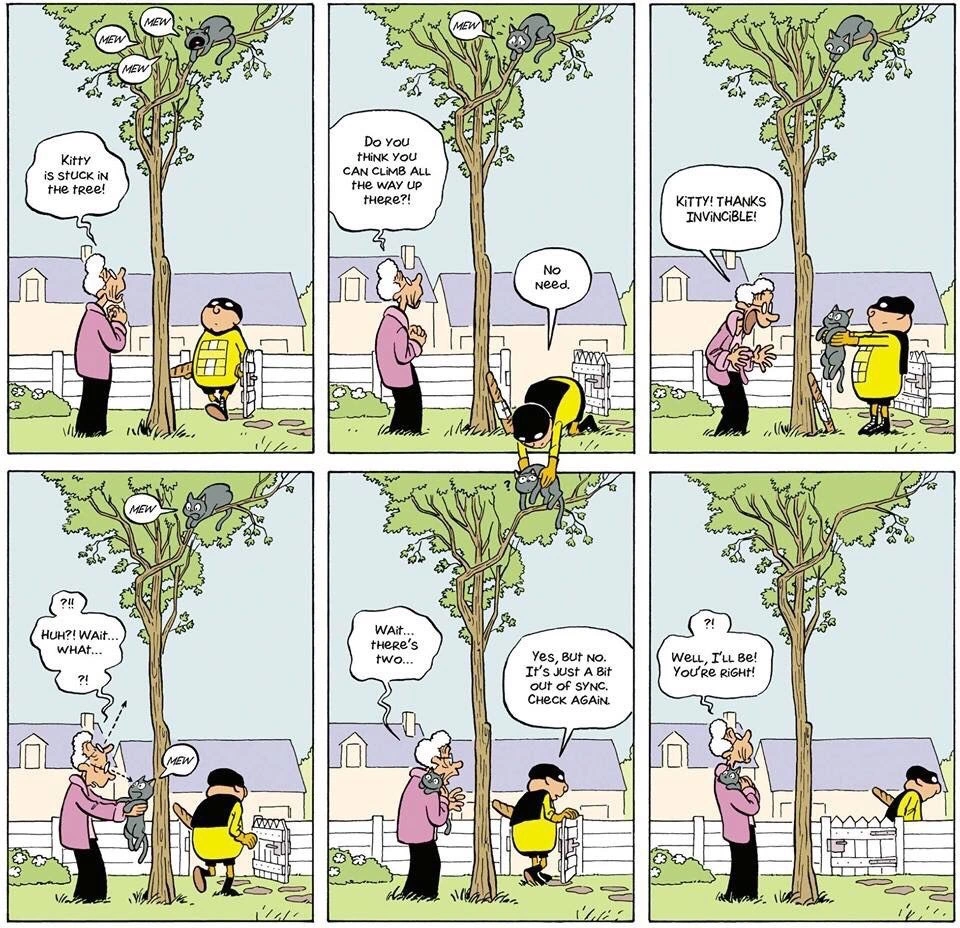
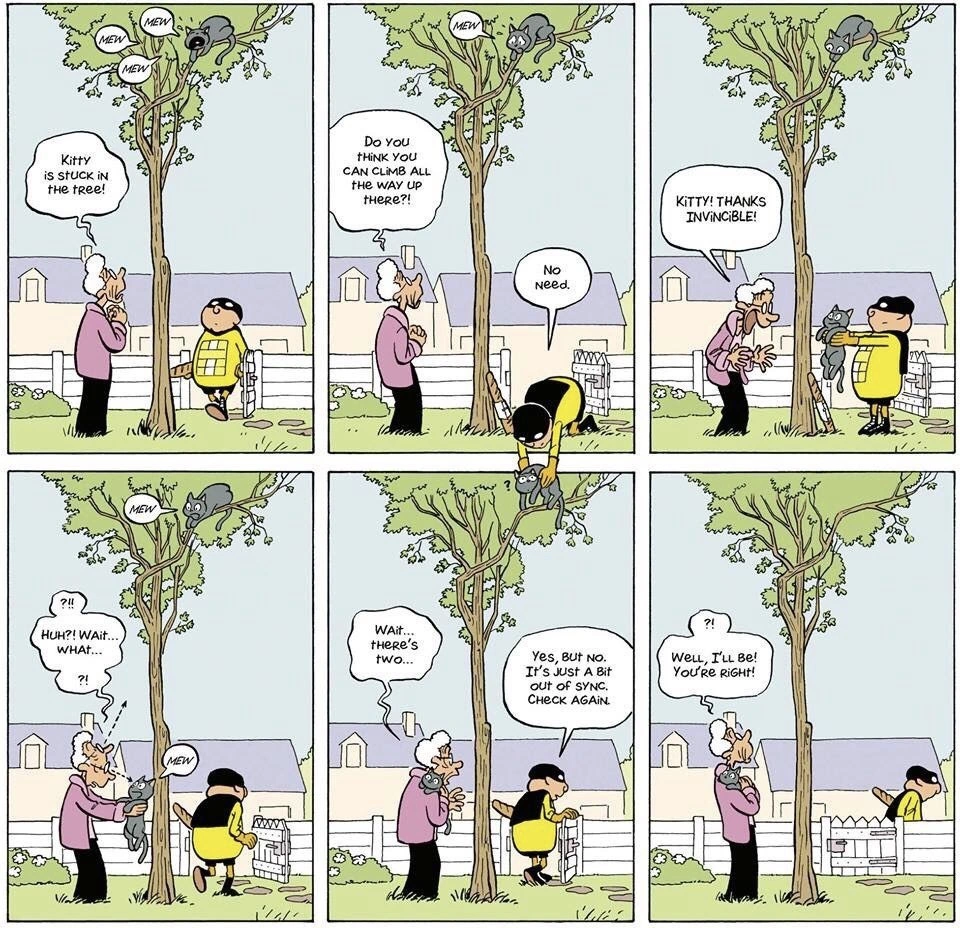
A grandma sees her gray kitty stuck high in a tree and gets very worried. A helpful boy comes by, but instead of climbing the tree, he simply picks up the cat from behind the trunk and hands it to her. Grandma is bewildered – she still hears meowing from up in the branches and thinks she sees another identical cat up there! For a moment, it feels like the cat is in two places at once. It’s like a magic trick: now you see two cats, now you see one. The boy just says, “It’s a bit out of sync, check again.” She waits a second and looks back at the tree – the upper cat has vanished. Ta-da! In reality, there was only ever one kitty; that second “cat” was just the echo of the first one, a lingering image that disappeared once everything caught up. It’s funny because for an instant Grandma truly believed the cat had magically duplicated, until she realized it was just a little delay and everything was normal again.
Level 2: Eventually One Cat
Let’s break down what’s happening in this comic as if it were a computer system. We have a distributed system here – essentially, information (the cat’s whereabouts) is stored in more than one place. Think of one copy as the “main server” (the boy’s perspective with the real cat in hand) and another copy as a “replica server” or cache (the old lady’s view of the cat still up in the tree). Data replication is supposed to keep those copies in sync, but it doesn’t happen instantaneously. The delay in updating the replica is what we call replication lag. In that lag time, the two copies disagree: one says “cat is on the ground,” the other insists “cat is in the tree.” There aren’t truly two cats – it’s the same data, just one copy is late to get the memo!
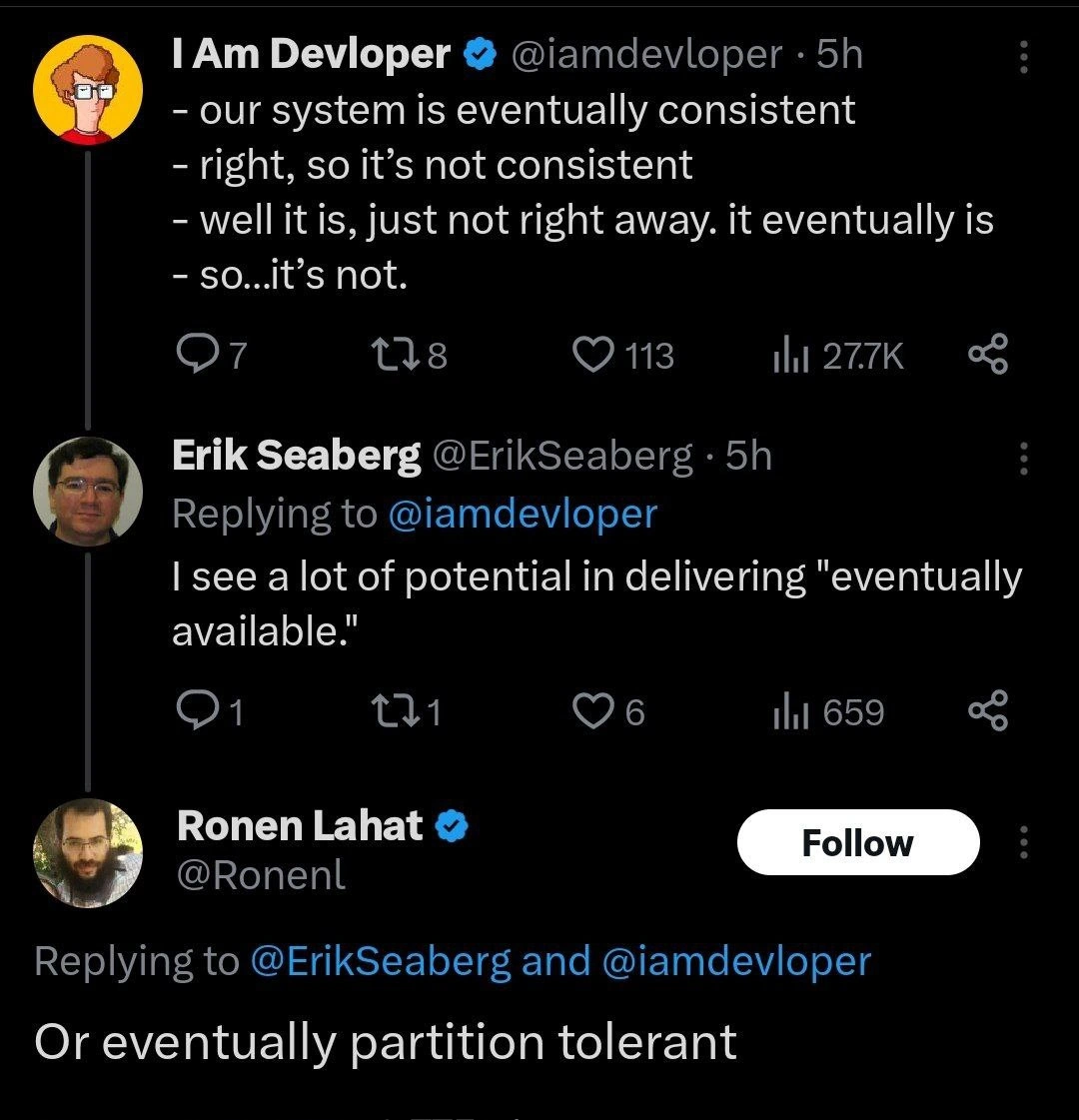
This is a textbook example of eventual consistency. That term means all copies of data will eventually become consistent (i.e. the same), but for a short period they might not match. It’s a type of consistency model used by many databases and caches. The opposite would be strong consistency (or immediate consistency), where as soon as the cat comes down, every observer everywhere would see that change at once. But strong consistency can be slow or impossible if systems are far apart or network connections are unreliable. So instead, many systems choose eventual consistency: they update quickly where they can and let the other copies catch up in a moment. In the comic, after a little time passes (enough for the “data” to sync), the old lady checks again and sees the cat is gone from the tree – now both “servers” finally agree. Consistency achieved!
To visualize this, imagine how a simple distributed database might handle “cat status”:
// Initially, both primary and replica think the cat is in the tree.
let primary = { catLocation: "tree" };
let replica = { catLocation: "tree" };
// Update happens on the primary (cat is moved to ground).
primary.catLocation = "ground"; // The main source now knows kitty is on the ground.
// A read from the replica right now would still see the old value:
console.log(replica.catLocation); // Output: "tree" (stale data, still thinks cat is in the tree)
// Some time passes... the replica receives the update from primary.
replica.catLocation = primary.catLocation; // Now the replica updates its copy to "ground".
// After syncing, the replica reflects the new state:
console.log(replica.catLocation); // Output: "ground" (up-to-date, consistent data)
In human terms: the boy updated the “source of truth” by picking up the cat. Grandma immediately looked at a “backup copy” (her last known info was kitty up a tree) which hadn’t updated yet, so she saw the cat still there. That’s the classic read-after-write delay problem — reading from a different place right after something changes can show old data. But once the update traveled to that other place (the time for the cat’s absence to register), everything matched up again.
We also see a hint of the cache invalidation issue here. A cache is a stored copy of data meant to speed things up. The tree can be seen as a cache that should have been invalidated (cleared or updated) when the cat came down. If the system doesn’t update or invalidate that cache in time, you get that stale view (ghost cat in the tree) sticking around. Eventually the cache expires or refreshes, and poof – the cat-in-tree disappears, as it should. This is why people say cache invalidation is hard: it’s tricky to make sure every cached copy of data knows about changes at the right time.
So, in simpler terms: the comic is teaching us about distributed data consistency. One part of the system had old info, another had new info. Eventual consistency means if you wait a little, the old info gets updated and everyone sees the same reality. The grandma’s “two cats” mix-up was just a temporary glitch because one view was lagging behind. Once the system caught up (the lag cleared), there was only one cat again, just as expected. Pretty neat, right? Instead of a scary computer console, we got a fun cat story to show how data replication works!
Level 3: Out-of-Sync Surprise
Experienced engineers will instantly recognize this two-cats problem as the classic symptom of eventual consistency in action. The meme nails that “??!” feeling when one part of a system shows outdated data. In real-world deployments, this happens all the time: one server (or cache) is showing yesterday’s information while another has the latest. The old lady’s confusion ("Wait… there’s two…?!") is basically a user witnessing stale data due to replication lag. And the boy’s matter-of-fact response – “Yes, but no. It’s just a bit out of sync. Check again.” – is exactly what a seasoned developer might say after deploying an update: “Try refreshing in a moment; the data will catch up.” 😅
This comic strips away the complexity and shows the crux of an eventual consistency system: you perform an update (rescuing the cat) on one node, but another node’s view (the tree) hasn’t caught up yet, creating a brief illusion of duplicate cats. The humor comes from how mundane the fix is: no need for a dramatic tree climb (no heavy synchronization or global lock); just use the data from the up-to-date replica and wait for the other view to sync. It’s a tongue-in-cheek reference to how distributed databases (like Cassandra or Dynamo-style systems) prefer to give an answer right now rather than a perfectly up-to-date answer that might require waiting. The payoff is that awkward moment where two copies of the truth seem to exist. Any senior dev who has dealt with multi-region data or read replicas has likely encountered this: e.g. you update a record in US-East, but a read from Europe a second later still shows the old value. Then, a heartbeat later, Europe “converges” and everything is fine – just like the disappearing cat.
One key insight is how the boy effectively demonstrates a read-your-own-write strategy (sort of an eventual consistency life-hack). He doesn’t bother with the stale tree view at first; he directly grabs the cat that he knows is current. In distributed system terms, he read from a node that had his recent write. This is what many systems do to mask consistency issues: after you post a photo, the app might immediately show it from a local cache or the primary server, even if other servers are still catching up – so you don’t see “two photos” or an empty timeline. The old lady, on the other hand, was like a second client reading from a lagging replica and momentarily saw an extra cat that shouldn’t be there.
The shared pain among developers is real: whether it’s a cache invalidation issue or a delayed database replica, we’ve all had that panicked moment of “data duplicating or vanishing” reported by a user. In fact, the meme’s scenario is essentially a cache invalidation problem in disguise – the hardest part wasn’t rescuing the cat, but updating everyone’s view of it. (No wonder the joke goes that there are two hard things in CS: naming things and cache invalidation… and we somehow ended up with an off-by-one error in that list!) These data consistency hiccups can be subtle and sneaky: a missing invalidation here, a network blip there, and suddenly people are seeing ghost entries that resolve themselves moments later. Senior devs find this comic hilarious because it’s a scenario we know too well: the system says the problem is solved, yet an echo of the problem is still visible. It captures the exact blend of “Huh?! Wait... what?!” confusion followed by “Ohhh, of course – eventual consistency.” that we’ve experienced during on-call rotations or after deploying a new distributed feature.
Crucially, this “two cats” confusion isn’t just a one-off comic gag – it’s daily life in high-scale systems. Modern cloud apps often choose AP-style architectures (Available and Partition-tolerant, per the CAP theorem) which means tolerating a bit of inconsistency. Think of NoSQL databases or globally distributed caches: they replicate data across the world, but they don’t pause everything to make sure every copy is instantly the same everywhere. The benefit is your system stays fast and resilient, even if a network link slows down. The cost? Occasionally, like the lady, someone sees a momentary glitch. Maybe it’s an item that still shows “in stock” on one server after it was sold out on another, or a message that appears unread to you even after your friend replied – until the state catches up. The comic’s charm is how it portrays this with a cat: a benign, funny example of something that can cause serious head-scratching in production. It’s a gentle reminder that “eventually consistent” means things eventually become consistent – and until then, weird little inconsistencies (like phantom cats) are just part of the game. Seasoned devs chuckle because we’ve learned to expect these hiccups and design around them. As long as Kitty eventually comes down from the tree (and he does!), we consider the system working as designed, and we can enjoy a good laugh at how bizarre it looks in the moment.
Level 4: The CAP Purradox
In the lofty realm of distributed systems theory, this comic perfectly illustrates a subtle consequence of the CAP theorem – the trade-off between immediate consistency and availability. Here, the cat in the tree vs. the cat on the ground is a playful metaphor for data replication lag and eventual consistency in a replicated database. The old woman’s view of “Kitty is stuck in the tree!” represents a stale replica of the data: one node in a distributed system that hasn’t yet received the latest update (the cat being rescued). Meanwhile, the boy (dubbed Invincible, fittingly) acts like a client reading from a node that has the up-to-date information – he simply hands her the kitty that’s already on the ground from a fresher data source.
This scenario channels the essence of the CAP theorem (Consistency, Availability, Partition tolerance). In a network partition or delay situation, a system can either block to maintain strong consistency (like making the woman wait until every “replica” of the cat knows it’s down), or it can respond immediately to remain available (giving her a cat right away, even if another branch – literally – still shows the old state). The comic chooses the latter – high availability with eventual consistency. The humorous effect is essentially a consistency model glitch: we momentarily see two copies of the same cat (data) because one view hasn’t caught up. In academic terms, it’s a violation of linearizability for the sake of responsiveness. A linearizable system would ensure that once the cat is down, no observer would ever again see it up in the tree, no matter what. But in an eventually consistent system, observers might temporarily see the old state (“cat is in tree”) until all nodes converge to the new state (“cat is on ground”).
This phenomenon has deep theoretical roots. It’s akin to a real-world visualization of a non-monotonic read anomaly: the old lady reads the cat’s position and gets an out-of-date answer even after the cat was moved. For a brief period, reality (ground-cat) and perception (tree-cat) diverge, similar to how a distributed database without a read-after-write guarantee can return old data right after a write. This is not a bug; it’s a design choice. As Werner Vogels (Amazon’s CTO) famously described eventual consistency: “All replicas will eventually be consistent, given no new updates.” Here “eventually” is the key – after a moment (when replication catches up), the second cat “ghost” vanishes from the tree, and all observers agree there’s just one real cat safe and sound.
From a theoretical perspective, the cartoon is delightfully highlighting how causality and time can play tricks in distributed data. Because there is no global clock, one observer’s “now” can be another observer’s “a moment ago.” The cat’s meow echoing from the tree is like a delayed message in a network – the woman hears MEW from the past state. Only when the distributed state synchronizes does her view match the boy’s view. This eventual agreement is guaranteed by protocols that ensure convergence (like anti-entropy or gossip algorithms in databases: eventually, every replica gossips about the cat being on the ground). Fundamentally, the comic pokes fun at the inevitability of such glitches whenever we opt for eventual consistency over immediate coordination. We get better uptime and performance (the hero solves the problem instantly for the user), at the cost of temporary inconsistency (the double-vision of kitty). In summary, the meme condenses a core truth of distributed computing into a sight gag: under asynchronous replication, you might momentarily have Schrödinger’s cat – simultaneously up a tree and in someone’s arms – until the system sorts things out. It’s a purr-fect example of theory made tangible (and adorable).
Description
A six-panel comic strip illustrating a technical concept using a superhero analogy. An elderly woman asks a superhero named 'Invincible' to rescue her cat from a tree. Instead of climbing, the hero simply picks up a cat from the ground and hands it to her. The woman is initially grateful but then becomes confused when she sees a cat still in the tree, exclaiming, 'WAIT... there's two...'. The hero calmly explains, 'YES, BUT NO. IT'S JUST A BIT OUT OF SYNC. CHECK AGAIN.' In the final panel, the woman looks again, the cat in the tree is gone, and she remarks, 'WELL, I'LL BE! YOU'RE RIGHT!' This meme cleverly visualizes the concept of eventual consistency in distributed systems. The temporary existence of two cats represents a state of temporary inconsistency between nodes or replicas. The issue resolves itself after a short delay ('CHECK AGAIN'), just as data in an eventually consistent system becomes synchronized over time. It's a humorous and accessible explanation of a complex distributed computing topic
Comments
12Comment deleted
That's not a bug, it's a feature of our new quantum superposition caching layer. Just don't observe the cat in both states at once, or you'll collapse the production database
Moved the cat to ground() on the primary, but the read-replica still thinks branchId=42 - give the cluster a heartbeat before you file a Sev 1
Just like production incidents at 3am, sometimes the scariest merge conflicts are just your local branch having trust issues with origin/main - and the solution is always 'have you tried git pull --rebase?'
When your distributed system has a replication lag so bad that you end up with duplicate entities in different states - classic CAP theorem in action. The 'check again' approach is basically eventual consistency with manual polling. At least they didn't try to solve it with a distributed lock or they'd still be waiting for the cat to come down while debugging a deadlock in the consensus algorithm
He didn’t climb; he read from the leader - the tree was a stale follower; wait a tick and the “two cats” incident self-heals
Git status to grandma: ahead by two, but Chris fixup will squash that kitty drama
Nothing beats SLA-friendly heroics like fixing a production “duplicate” by waiting out replication lag and calling it convergence
nolan films be like Comment deleted
Eventually consistent Comment deleted
Kitty is my code old man is my ide and that man is me both my ide don’t know what I am doing Comment deleted
new Promise<Cat>() Comment deleted
nice😂 Comment deleted