Antivirus Meets My Fresh Build
Why is this Security meme funny?
Level 1: Guard Meets Homework
This is like making a toy yourself, picking it up to play with it, and having a very serious security guard stop you and ask what it is. The funny part is that you know it is harmless, but the guard only sees a strange new object.
Level 2: Suspicious By Default
When you compile code, you turn source files into something the computer can run, often an executable file like .exe on Windows. Running that file starts the program.
Antivirus and endpoint protection tools watch programs for signs of danger. They may scan files, check signatures, compare behavior to known malware, and use heuristics, which are rules that guess whether something is suspicious. A false positive happens when a security tool marks safe software as dangerous.
This meme is funny because a developer sees their compiled app as normal work, but antivirus sees an unknown program that suddenly wants to execute. For beginners, this can be confusing: the code is yours, so why is it blocked? The answer is that security tools do not know your intentions. They judge the file by identity, reputation, and behavior, not by the fact that you personally just clicked "build."
Level 3: Heuristics With A Gun
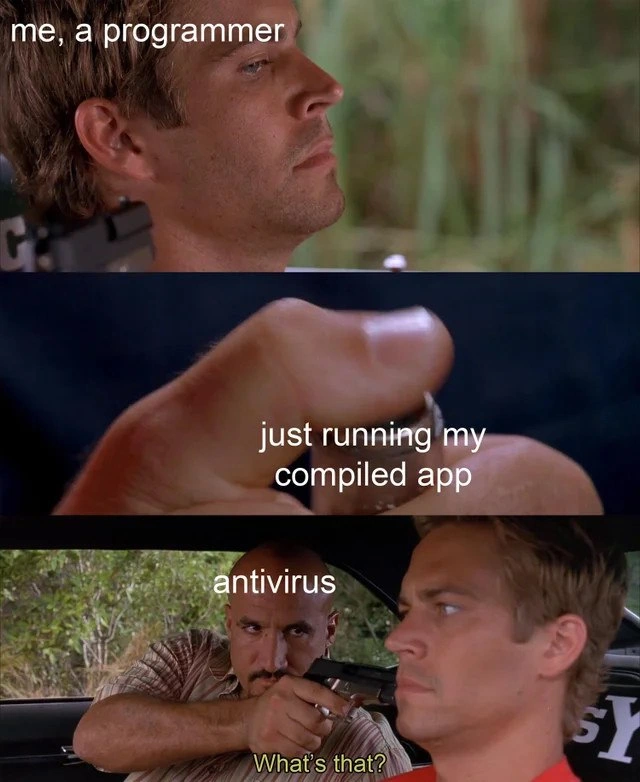
The meme labels the calm driver as me, a programmer, the thumb action as just running my compiled app, and the armed man as antivirus. The subtitle What's that? turns ordinary execution into an interrogation. That is the developer pain: you build a perfectly legitimate executable, run it locally, and endpoint protection reacts like it just caught a stranger crawling through a window.
The senior-level joke is that the antivirus is annoying, but not completely irrational. A freshly compiled app often has exactly the traits that security tools dislike: it is new, rare, unsigned, unknown to reputation systems, and sometimes generated in a build directory full of temporary artifacts. If the program reads files, opens sockets, injects into processes, writes to protected paths, bundles an interpreter, or looks packed in a weird way, it can overlap with real malware behavior. Developers call it "my test build." Endpoint protection calls it "untrusted executable performing suspicious actions." Both sides are describing the same binary from different threat models.
This is where FalsePositive pain enters. Security tooling is optimized to stop bad software before it runs, which means it sometimes blocks good software that merely looks unusual. Local development produces unusual software constantly. Every rebuild creates a slightly different artifact. Debug builds may include symbols, instrumentation, or dynamic loading patterns. Small side projects may have no installer, no certificate, no telemetry reputation, and no broad user base. To an antivirus engine, that is not charming indie energy; it is a list of reasons to squint harder.
CodeSigning is the adult answer, but it is not magic. Signing helps establish publisher identity and tamper evidence, and reputation systems may treat signed software more kindly over time. It does not prove the code is safe, and it can be expensive or awkward for small projects. Corporate endpoint tools can still quarantine internal utilities if policies are strict. The end result is classic DeveloperExperience friction: the programmer is trying to test the thing they just made, while the security layer is trying to protect the machine from exactly that kind of thing.
The image works because it stages security as a surprise ambush. The programmer's action is tiny and innocent: run the compiled app. The response is maximum suspicion. Anyone who has watched their build disappear into quarantine knows the expression on that driver's face.
Description
A three-panel movie meme shows a man labeled "me, a programmer" sitting calmly, then a close-up of his thumb labeled "just running my compiled app". In the final panel, another man labeled "antivirus" points a gun at him from behind while the movie subtitle says "What's that?". The joke is about antivirus software treating a freshly compiled executable as suspicious simply because it is new, unsigned, or matches heuristic malware behavior. For developers, it captures the irritating gap between legitimate local builds and endpoint security systems optimized for paranoia.
Comments
1Comment deleted
Unsigned local binaries have the threat model of malware and the documentation quality of a side project, so the AV is not entirely wrong.