The Anti-Object-Oriented Programming Manifesto
Why is this Languages meme funny?
Level 1: Rocket to Deliver Pizza
Imagine you want to deliver a pizza to your friend who lives on the next street. You could just walk or ride a bike – quick and simple. But instead, you decide to build a giant rocket ship, fuel it up, put the pizza inside, launch the rocket, and then land it at your friend’s house to hand over the pizza. Sounds absurd, right? The pizza would get there, sure, but you used a ton of fuel, spent hours preparing the launch, and risked blowing things up, all for a task that could have been done with a 5-minute walk. By the time you’ve done all that, the pizza’s cold and you’ve wasted a lot of effort and resources. Nobody in their right mind would choose the rocket approach for such a simple errand – it’s complete overkill.
This meme is joking that programmers sometimes do the equivalent of that rocket delivery with their code. In programming, the “simple walk” would be writing a straightforward function to do something. The “giant rocket” is like creating a whole bunch of classes, objects, and layers of complexity to do that same something. Just as using a rocket for a one-block delivery is silly and inefficient, using an overly complex design for a simple job in code is also silly and inefficient. The line “I love when my programs use more resources than they need to – said NOBODY!!!!” drives the point home: no one actually wants to waste computer memory or processing power (just like no one wants to waste rocket fuel to deliver a pizza). It’s a funny, exaggerated way to remind us to keep things simple. Why use a sledgehammer to crack a peanut? Build just what you need, and no more – your program (and everyone who works on it) will be much happier, just like you’d be happier eating a warm pizza that didn’t arrive via outer space.
Level 2: Just Extra Steps
Let’s break down this meme in more straightforward terms. It’s poking fun at Object-Oriented Programming (OOP) for being overly complicated. First off, what is OOP? It’s a programming style where you organize code into classes and objects. A class is like a blueprint – it defines a type of thing (say, a Car class defines what a car can do and what data it holds). An object is an instance of that class (like making a specific car from the blueprint). OOP is all about grouping data with the functions that operate on that data. Instead of just having separate functions and variables floating around, you put them together in these objects. This can make big software projects easier to manage because you can model things in the code similar to how they are in the real world. Java and C++ are classic OOP languages; they encourage you to use classes for almost everything.
Now, the meme is basically saying: “Maybe we went too far with that approach.” The phrase “we were never supposed to go beyond subroutines” is advocating for a simpler time when a subroutine (another word for a function or procedure) was the go-to way to structure code. In plain English, that bullet is like someone saying, “You know, maybe we should’ve stuck to just writing simple functions instead of inventing entire object systems.” It’s a bit dramatic, but it sets the stage: the meme is taking a stance that plain functions and simple data structures might be better than complex webs of objects.
The next point claims “There is nothing in C++ or Java that you can’t do in Lisp.” Lisp is an old programming language (one of the oldest high-level languages, actually) that follows a different paradigm, often used as an example of functional programming. In Lisp, you typically don’t create class hierarchies for everything; you write a lot of functions, and code is very flexible (Lisp is famous for its parentheses and the ability to treat code as data). When the meme says you can do everything in Lisp that you can do in those OOP languages, it’s suggesting that OOP didn’t invent new functionality – any task or program you can make in Java or C++, you could also make in Lisp (or in C, for that matter). It might be done in a different way, but it’s possible. This is essentially saying: “Java and C++ aren’t superior in capability, they’re just different in style – and perhaps unnecessarily complicated in style.” Lisp enthusiasts often point out that Lisp had many advanced features long before other languages (like automatic memory management, dynamic typing, etc.), and it allows you to add on any structure you want (you could imitate OOP in Lisp using its features, for example). So this line is championing Lisp (and by extension, simpler or more flexible coding styles) as having all the power without the verbosity of OOP.
The third bullet drives the point home: “It’s just structures with extra steps and overhead.” Think of a basic structure (or struct) as a grouping of variables – like a record or a simple object with just data and no fancy behavior. The meme is saying an object in OOP is basically that (some data bundled together) but with extra steps (meaning you don’t just update the data directly; you might call methods, go through interfaces, etc.) and with overhead. Overhead in this context means additional resource usage or complexity that isn’t strictly necessary to get the job done. For example, if you have an object-oriented program with lots of small objects interacting, behind the scenes it might be doing more work – allocating memory for each object, looking up which method to call (if using something like dynamic dispatch), etc. – compared to a simple program that uses a couple of arrays or structs and plain functions. The meme bluntly asserts that OOP’s objects are basically the same as simple structures but with these added layers that cost something (either in terms of CPU, memory, or just mental overhead for the programmer). It’s a sweeping generalization, but it resonates because there is a kernel of truth: sometimes you see a super complex class and think, “This is essentially just holding some data and doing one thing… we could simplify this.”
Under those bullets, the meme has a sarcastic quote: “I love when my programs use more resources than they need to – said NOBODY!!!!” This is pretty easy to understand: nobody likes it when an application is using, say, 1 GB of RAM if it could do the same job using 100 MB, or when it’s maxing out the CPU without reason. This jokey quote is implying that overly complex OOP designs can lead to exactly that – programs that are less efficient. It’s like saying, “No sane person actually wants software to be slower or heavier, so why do we write code in ways that make it slower or heavier?” The use of all-caps “NOBODY” and multiple exclamation marks makes it clear it’s meant as a punchline (a bit of obvious hyperbole to get a laugh). If you’re new to these kinds of memes, this format “said nobody ever” is a common way to highlight something undesirable by phrasing it as if someone would say the opposite (but of course, no one genuinely would).
Now, the code snippets and the frantic question marks (??????????) on them are illustrating what the meme sees as OOP absurdity. Let’s go through them:
The first snippet:
private static final class CaseInsensitiveComparator implements Comparator<String>, Serializable– This is a snippet of Java code. For someone new to Java or programming, that line is chock-full of keywords:- private: meaning this class is not visible outside of whatever context it’s defined in (likely it’s an inner class inside another class).
- static: in Java, an inner class can be static, meaning it doesn’t implicitly keep a reference to an instance of the outer class. It’s just a technical detail, but basically it’s a standalone nested class.
- final: this means you cannot create a subclass (child class) from this class. It’s “final” in the inheritance chain.
- class CaseInsensitiveComparator: defining a class named
CaseInsensitiveComparator. As the name implies, it probably compares strings without case sensitivity (i.e., “apple” vs “Apple” it would treat as equal). - implements Comparator: this means the class promises to provide an implementation for the
Comparatorinterface for strings. In Java, an interface is like a contract –Comparator<String>says “I can compare two Strings and tell you which comes first.” So our class will give the code for that. - Serializable: this is another interface, which means objects of this class can be serialized (converted to a stream of bytes). This is often done if you want to save an object to a file or send it over a network. Marking it Serializable is often just to satisfy some frameworks or libraries that might require it (like if this comparator is ever stored or sent somewhere).
So, phew, that’s a lot of stuff just to define one little piece of functionality: comparing strings in a case-insensitive way. The meme’s point here is: “Look how much boilerplate or fluff is involved.” If you compare this to a language like Python, for example, you’d just write a small function
compare_ignore_case(a, b)that returns the comparison result. In Java (especially older Java before modern shortcuts like lambdas), you’d typically make a whole class for it. The red question marks screaming over it in the meme are essentially saying, “Why do we need all this just to ignore letter casing when comparing?!” It’s comedic exaggeration because any Java developer will say, “Well, that’s just how Java is structured” – but deep down, they might chuckle and agree that it’s not the most efficient or straightforward way. To a newcomer, it demonstrates how OOP can lead to writing a lot of ceremonial code (lots of declarations and structure) for a simple task.The second snippet:
public static final abstract class StringBuilderFactory extends String implements Builder, Factory– Now, this one is deliberately paradoxical and likely not real code from any project, but it’s crafted to amplify the absurdity. Let’s unpack it:- public: the class is visible to everyone (standard for a top-level class).
- static: this usually wouldn’t be here for a top-level class (it’s more for inner classes; for a top-level class in Java, you can’t make it static), so this is already odd.
- final and abstract together: In Java,
abstractmeans the class is incomplete – it’s meant to be subclassed and you can’t directly create objects of it.finalmeans the opposite – no other class can subclass it, and it’s complete. Putting both is a contradiction. No real code would compile that way. The meme intentionally put them together to scream “this is nonsense!” - class StringBuilderFactory: the name is amusing because it’s combining patterns. A Builder is a design pattern (often used for constructing complex objects step by step). A Factory is another design pattern (used for creating objects, encapsulating the creation logic). “StringBuilderFactory” sounds like a mash-up of two concepts – maybe a factory that produces string builders? It’s not a standard thing at all; it’s just mashing jargon.
- extends String: Java doesn’t allow extending the
Stringclass (andStringis a final class in Java’s standard library). The meme likely choseStringto extend because it’s patently absurd – why would a “Factory” be a kind of String? It’s mixing unrelated concepts in a nonsensical way. - implements Builder, Factory: So this class implements two interfaces:
BuilderandFactory. These sound like custom interfaces (maybe made-up for the meme) just to illustrate the point that in some code, people have “Builder” and “Factory” roles or interfaces all over. It’s basically stacking patterns on patterns.
All together, this line is overwhelming even for an experienced Java coder, not because it’s complex in a meaningful way, but because it’s contradictory and silly. That’s the point – it’s showcasing how ridiculous things can get if you just keep adding abstractions without thinking. It’s a caricature of enterprise code. The red question marks on this are the meme-maker jumping up and down saying “What on earth is this supposed to mean?!”. The humor is that any one of those keywords or interfaces might be justified in some scenario, but thrown together like this, it’s obviously overdone. It strikes a chord with developers who have seen class names like
PaymentProcessingFactoryBuilderManageror similarly long, convoluted constructs in big systems – names that make you wonder if we complicate things more than necessary.The third snippet is from C++: it’s a template instantiation for spdlog’s queue (something like
template<class SPDLOG_API spdlog::details::mpmc_blocking_queue<...>>). For someone not familiar with C++, this looks like gibberish. In C++, templates are a way to write code that works with any data type (similar to generics in other languages). They get instantiated into specific types by the compiler. The downside is that the resulting type names (especially when you start nesting templates) can become extremely long and messy.spdlogis a real C++ logging library known for being very efficient (partly by using templates and a lot of compile-time machinery). The meme snippet shows something about anmpmc_blocking_queuewithasync_msg– essentially an internal queue used for logging messages asynchronously. The exact content isn’t as important as the visual impression: it’s a wall of text with angle brackets and colons. This is the meme including a real-world example of OOP/generic code that is indeed hard to read. A seasoned C++ dev might cringe in recognition, “Ah yes, template hell.” The red question marks say it all: “How is anyone supposed to parse this easily?” It’s an example of how extremely flexible and abstract code (templates allowing for very generic structures) can sacrifice readability. This isn’t to say spdlog or C++ is bad – it’s extremely powerful – but it underscores the meme’s theme: more abstraction, more complexity, more overhead (if not in the machine, then at least in the programmer’s brain!). To a junior dev, the takeaway is: some codebases (especially in languages like modern C++) have pieces that look almost indecipherable, and that’s often due to layering lots of generic, object-oriented concepts together.On the right side is a tiny snippet of C code (a simple
void setValue(int a, int b) { ... }). This is like the meme’s counterpoint. It’s showing the kind of code the meme advocates for: straightforward, no-frills. In C, you don’t have classes – you just have functions (which can take parameters and maybe return something) and structures for data. ThesetValuefunction in the snippet likely just sets some variables (num1 = a; num2 = b;) and returns one of them (maybereturn num2;). This is simplistic on purpose. It’s almost like an “anti-snippet” to those others. While the other code blocks have a million things going on, this one does one small thing and that’s it. The meme is using it to say, “See this? This is all you often need – a simple function. Compare that to the left side and ask, why do we complicate things?” It’s a little bit idealistic – not every problem can be solved with one tiny function – but as a contrast, it’s effective. It represents the procedural style of programming (like in C or in simple scripting), which relies on direct calls and simple structures rather than elaborate object orchestration. If you’re new to coding, think of it like this: the left side is a complex Swiss watch with many gears (precise but intricate), while the right side is a basic hammer – straightforward and gets the job done for a common task. The meme clearly is saying sometimes you just need the hammer, not the fancy watch.
At the very bottom, we have that quote “idiotic ‘object model’ crap.” – THE GUY WHO MADE LINUX. The “guy” here is Linus Torvalds. For context, Linus created the Linux kernel (the core part of Linux OS) and also invented Git (the version control system). He’s a highly respected programmer, especially in systems programming, and is infamous (or famous) for not mincing words. Linus has ranted on multiple occasions about C++ and overly OOP designs, especially saying they have no place in kernel development where efficiency and simplicity are key. By referencing him, the meme is essentially saying, “Even the experts think we’ve overdone the OOP stuff.” Linus calling something “idiotic ... crap” is very on-brand for him – he’s known to use strong language in technical discussions. For a junior developer, the significance is: even though you might have been taught OOP is the proper way, here’s an example of a top-tier developer who prefers a simpler approach (Linux is written in C, a procedural language). It shows that the industry has varying opinions, and OOP isn’t universally loved. It’s also a bit of an appeal to authority to strengthen the meme’s argument – quoting “the guy who made Linux” is like quoting a star athlete’s opinion on training methods; people pay attention because of who he is.
So, what’s the meme’s overall message in simple terms? It’s saying: We often make our programs way more complicated than they need to be by using too much object-oriented fluff. We could do the same things in simpler ways, using straightforward code, and our programs would probably run faster and use fewer resources. The tone is intentionally exaggerated and humorous. It’s not an academic critique, it’s more of a frustrated joke – the kind of joke you laugh at if you’ve been up late fighting with convoluted code. There’s a bit of “inside baseball” humor here: it assumes the reader knows the annoyance of dealing with over-engineered code. But even if you’re new, you can get the gist: adding more complexity for no real gain is silly, and everyone actually prefers things to be efficient and simple.
For someone starting out in development, it’s worth understanding that this meme is one side of a long debate. OOP was created to handle complexity as programs grew larger; it has real benefits like organizing code, reusing it via inheritance, and so on. But this meme highlights the dark side: if used excessively or inappropriately, OOP can lead to systems that are harder to understand and maintain, not easier. The pendulum in the software world swings back and forth. Right now, there’s a lot of appreciation for simpler, more data-oriented or functional approaches, especially among experienced devs who have seen OOP go wrong. This meme is very much a product of that sentiment. It’s a comedic reminder to “Keep It Simple, Stupid” (KISS principle) – a mantra in software development that simpler solutions are often better.
In summary, ObjectOrientedProgramming is being roasted here. The meme humorously argues that many OOP-heavy codebases are needlessly complex (“extra steps”) and wasteful (“use more resources than they need to”). It contrasts that with older or alternative approaches (like just writing a straightforward function in C or leveraging Lisp’s power) which can achieve the same ends with less fuss. The over-the-top presentation (bold text, all-caps, sarcastic quote, and big question marks) is meant to make you laugh, but also to make you think, “Huh, do we sometimes go overboard with our fancy coding patterns?” It definitely falls under TechHumor or CodingHumor, because it takes something technical (programming paradigms) and makes a joke that only people familiar with coding would fully appreciate. The bottom line for a newcomer is: it’s advocating for not overcomplicating your code. Don’t create ten classes when one function will do. It’s a meme, so it states it in an extreme way (nobody is literally going to stop using OOP entirely because of a meme), but it taps into a real feeling among developers that clarity and simplicity often get lost when people get obsessed with certain “best practices” or patterns. So while you learn about classes and objects, the little voice of this meme is saying, “Remember, all that matters is the result and efficiency – if your design is too convoluted, maybe simplify it.”
And yes, it’s also totally fine to chuckle at the absurd example code and Linus’s brusque quote – that’s shared developer culture. Today they’re dunking on OOP; tomorrow it might be another trend. The important thing is: write code that does the job well, and don’t use a bazooka to kill a mosquito (or as this meme would say, don’t use a whole factory of objects when a simple subroutine would suffice).
Level 3: Class Warfare
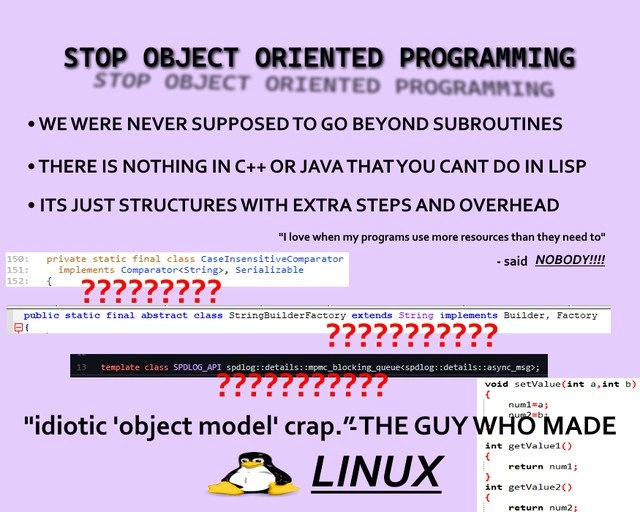
This meme comes across like a protest poster from a grizzled programmer union: “STOP OBJECT ORIENTED PROGRAMMING” blares at the top in bold, black text on a purple backdrop. It’s repeated with a blurry shadow, as if to shout the slogan twice. The whole vibe is very “down with this sort of thing” – it’s a rallying cry against the perceived bloat of OOP. If you’ve spent years in the industry, you recognize this as a tongue-in-cheek call to arms in the long-running LanguageWars. It frames OOP (object-oriented code) as the overbearing villain and harks back to the “good old days” of simple code.
The bullet points underneath read like they’re straight out of an old hacker manifesto. Let’s break them down from a senior dev’s perspective:
“WE WERE NEVER SUPPOSED TO GO BEYOND SUBROUTINES.” This sounds like something a veteran COBOL or C programmer might mutter after seeing a newbie create a 10-class monstrosity to do something that could’ve been a single function. A subroutine is just a fancy word for a function or a procedure – essentially, a named bit of code you can call to perform a task. In the 1970s and 80s, structured programming was king: you had your data structures and you had your subroutines, and that was enough to build anything from a payroll system to a rocket guidance program. This bullet point implies a nostalgia for that simplicity. It’s saying the moment we started introducing objects, classes, inheritance, and all that OOP paraphernalia, we ventured into unnecessary territory. It’s a dramatic overstatement (typical of an anti_oop_rant): of course, sometimes advanced structures help organize huge codebases. But any senior dev reading this has felt the pain of over-architected code and deep down has thought, “why didn’t we just keep this simple?” It resonates with the frustration of maintaining code that has layers upon layers of abstraction for seemingly no gain. Essentially, this line is the meme’s thesis: we didn’t need all these fancy OOP constructs; plain functions were doing just fine.
“THERE IS NOTHING IN C++ OR JAVA THAT YOU CAN’T DO IN LISP.” Cue the battle anthem of the functional programming old guard. This is a direct shot in the LanguageComparison debate, elevating Lisp (the poster-child of FunctionalProgrammingConcepts) to guru status and downplaying mainstream OOP languages like C++ and Java. To a senior developer, this immediately brings to mind all those late-night arguments on forums or Slack about static vs dynamic languages, OOP vs functional, new vs old. Lisp is a sort of legend in these debates – it’s ancient, powerful, and its fans have a bit of a superiority complex about how it had features decades ago that other languages are only catching up on. So this bullet point is essentially saying: “Hey Java/C++ folks, you think your language is so powerful? Lisp could do all that ages ago without the tangled class hierarchies.” Many experienced programmers smirk at this because they recall truths like: Lisp had automatic memory management, dynamic typing, first-class functions, and even object systems (via CLOS) long before these were industry standard. And Lisp has macros that let you mold the language – something Java and C++ can’t do without a preprocessor. So this line taps into that collective memory: it’s the age-old boast that, yes, you can implement object-oriented patterns in Lisp if you want, but you might not need to because Lisp can solve problems in more direct ways. It’s hyperbolic (there are things Java/C++ provide like certain performance characteristics or static type safety that Lisp doesn’t in the same way), but the humor for seasoned devs is in the brassness of the claim. It’s the equivalent of shouting “my grandfather could beat up your fancy new MMA fighter” in a bar – an old timer (Lisp) flexing on the young guns (Java, C++).
“IT’S JUST STRUCTURES WITH EXTRA STEPS AND OVERHEAD.” If you’ve ever ripped open the hood of an object in memory or debugged a program at the assembly level, you know this to be largely true. This bullet boils OOP down to its bare bones: an object is basically a data structure (a bunch of variables bundled together) with “extra” stuff – namely, methods and the metadata to support them. That “extra steps” part? That’s every bit of indirection, every
this->vtable->methodcall, every layer of inheritance you climb or interface you check at runtime. And overhead is the key word – it implies all that extra stuff comes at a cost. Seasoned engineers have often seen how an elegant concept on paper (let’s say, polymorphism: the ability to treat different objects the same way based on a common interface) can introduce real costs in practice (like harder-to-trace execution flow, or CPU cache misses due to pointers jumping around in memory, or simply more lines of code to maintain). This bullet is basically saying, “Look, OOP isn’t magical – it’s just putting lipstick on the pig of plain old data and function calls. And that lipstick ain’t free!” It’s a cynical summary that would get nods (and chuckles) in a room of senior devs who have chased down performance issues or bugs in over-engineered systems. Everyone remembers that one library that required five classes to do something a single well-written function could have achieved. This line calls out that absurdity directly.
Under those bullets, the meme takes a more explicitly jokey tone with: “I love when my programs use more resources than they need to” – said NOBODY!!!! This is pure resource_usage_snark. It’s mocking the idea that anyone would actually enjoy bloat or inefficiency. In reality, every programmer and their manager wants software to run faster and use less memory (unless they’re trying to sell you more cloud servers, ha!). So when OOP designs introduce a lot of bloat, nobody is cheering “yay, our app is eating RAM for breakfast.” The bold “said NOBODY!!!!” in red is classic meme-speak — it’s the punchline format “...said no one ever.” An experienced dev might recall countless times they sarcastically thought, “Oh great, this new update uses twice the CPU – just what we wanted!” (cue eye-roll). This line in the meme captures that exact sarcasm. It’s humorous because it’s obvious: of course no one loves unnecessary resource usage, so why do we keep writing software that does exactly that? It’s the meme-writer giving a sassy side-eye to all the memory-hogging enterprise applications out there.
Now, the code snippets plastered across the image with big red question marks (??????????) are the real visceral hook for anyone who’s been knee-deep in code. Let’s decode each:
Java spaghetti declaration: “private static final class CaseInsensitiveComparator implements Comparator, Serializable” – This line is a poster child for Java-esque verbosity. A senior dev looks at that and instantly remembers the Java standard library or enterprise code where something as trivial as case-insensitive string comparison gets its own class with multiple keywords. Here we have:
private: so it’s hidden inside some other class (maybe an inner class).static: meaning this inner class doesn’t implicitly use an instance of the outer class.final: meaning you can’t subclass this class further – it’s the last in its inheritance line.class CaseInsensitiveComparator: the class name and purpose (comparing strings ignoring case).implements Comparator<String>: it adheres to a comparator interface (Java’s way to allow custom sorting logic).Serializable: it also implements another interface to allow its instances to be serialized (turned into bytes, maybe to send over a network or save to disk).
Whew! That’s a mouthful for what essentially could be one function: “compare two strings alphabetically, case-insensitively”. The meme slaps
??????????over it to scream “WHAT IS ALL THIS?” It resonates with experienced devs who know exactly why all that is there (Java’s design forces you to make a class to pass a comparison function in older versions, you mark it serializable to avoid warnings when using it in certain collections, etc.), but also with those same devs who’ll chuckle and agree it’s overkill. It’s funny because it’s true: Java (before lambdas were introduced) required this ceremony to do something that, in a language like Lisp or Python, you’d do with a simple one-liner function or lambda. The humor also lies in familiarity – many of us have written or seen code exactly like this in real life. It’s almost not exaggerated at all, which is why it’s equal parts painful and funny.Absurd Java class parody: “public static final abstract class StringBuilderFactory extends String implements Builder, Factory”. Now this is the one that likely never compiled anywhere except in the meme-maker’s imagination. It’s a satire of “Enterprise Java” naming and design patterns. Just look at how contradictory it is:
final abstract classis impossible – you can’t be both. It’s like saying “this thing cannot be extended, and also must be extended to be used” – logically ridiculous. ExtendingStringis something Java explicitly forbids (Java’sStringis final to prevent all sorts of mischief). So why put this in the meme? Exactly to elicit a “What the...?” reaction – hence the sea of question marks over it. It’s exaggerating the tendency in some codebases to have overly complex class hierarchies and meaningless abstractions. The name “StringBuilderFactory” itself is gold: it combines two pattern names – Builder and Factory – into one blurb. In the Java world, a Factory class is one that’s meant to create objects (like a Factory pattern), and a Builder is a class meant to incrementally build up a complex object. If you’re outside that world, these terms sound like jargon (and they are). Inside that world, you’ve probably seen classes with names likeSomethingManagerFactoryorWidgetBuilder– they proliferate. By jamming them together and even absurdly extendingString, the meme mocks the tendency to abstract everything. It’s pointing out how enterprise developers sometimes create layers on layers: an object that builds an object that perhaps extends another object... and someone reading the code is left scratching their head. Senior devs laugh (perhaps a bit bitterly) at this because it echoes real experiences: reading code where you have to jump through five different classes to see how a simple piece of data is constructed. It’s an exaggeration, yes, but not without basis – hence it hits close to home.C++ template insanity: The meme also shows a snippet of a C++ template instantiation related to
spdlog(a C++ logging library). It’s something like atemplate<class SPDLOG_API ...>with nested angle brackets and namespace qualifiers. To an experienced C++ developer, this is recognizable: modern C++ templates can produce horrendously long type names and error messages. It’s both a powerful feature (you can generate very efficient, type-safe code) and a notorious source of complexity (ever tried deciphering a 20-line compile error from a failed template instantiation? Not fun). The red question marks here say “Even we C++ pros are bewildered by this.” It highlights that OOP combined with templates/generics can lead to code that looks like alien language. A senior developer sees that and doesn’t even try to parse every token – they just laugh, perhaps recalling the last time they had to wade throughstd::tuple< std::vector< something<std::string>, otherThing<int>... > >and thought “what have we wrought?” The humor is that this is supposed to be a simple log message queue under the hood, yet the type is so complex. It’s mirroring the meme’s message: we added so many layers (threading, generics, patterns) that the end result is hard to comprehend, even though it might just be moving some bytes from A to B. In a way, that snippet is a real-life example of oop_overhead in terms of cognitive overhead – the mental load to understand the code.The lone C snippet (the contrast): On the right side, almost hiding, is a tiny snippet of C code for a
setValuefunction. It’s super simple: looks like it assigns two numbers (num1 = a; num2 = b;) and maybe returns one of them. It’s the polar opposite of the other code blocks – no classes, no fancy syntax, just straight-line instructions. The meme places it there like a little sanity beacon: “Pssst, remember when code was this straightforward?” It’s almost an Easter egg for those who scan past the big flashy stuff and think, “okay, but what’s the alternative?” The alternative shown is a mundane C function. Now, the cynical joke might also be that in the C code shown, the function is declaredvoidbut still does areturn num2– which in reality is either a mistake or tongue-in-cheek to say “look even this simple code isn’t perfect.” But the key point is the visual contrast: 2 lines of simple C on the right vs. the many lines of templated/class stuff on the left. This screams “See how much simpler life could be!” Any developer who’s debugged a problem at the assembly level or written a bit of C for performance reasons feels this. Sometimes you strip away all the abstractions and write a simple loop in C and think, “Ahh, finally I understand exactly what’s happening.” That little C snippet embodies the meme’s suggested solution: procedural code (just do one thing after another, no objects needed) can be refreshingly clear and efficient.
Finally, anchoring the meme at the bottom, we have the Tux Linux penguin icon next to the quote: “idiotic ‘object model’ crap.” – THE GUY WHO MADE LINUX. This is a mic-drop moment: the meme is pulling in Linus Torvalds as a star witness for the prosecution against OOP. Linus, to seasoned devs, is known not just as the creator of Linux, but also as someone with, shall we say, strong opinions on software design. He once famously flamed C++ on a mailing list, basically saying “it’s a horrible language” and that the OO mindset has no place in low-level systems like the kernel. By quoting him, the meme isn’t just being funny – it’s appealing to authority. It’s like saying, “Look, even Linus thinks these fancy object models are garbage. If the dude who built an entire operating system (and Git!) in C with plain structs and functions calls OOP idiotic crap, maybe he has a point!” For veteran developers, this quote is legendary and instantly recognizable. Many will recall the exact context (an email where Linus told someone off for suggesting C++ in kernel development). So it’s a wink and a nod: the meme-maker is aligning with the Linus school of thought. And honestly, in a room of experienced devs, bringing up a Linus quote is sure to get knowing grins because he often says what others only dare to think. It adds a bit of cred – like, “Yeah, I’m ranting, but see, even the Linux guy backs me up.”
Stepping back, what is this meme really about in day-to-day software development? It’s about the pain of over-engineering and the ongoing debate of simplicity vs complexity. Experienced developers have lived through trends: the 90s and early 2000s were a golden age of OOP everything – if your code wasn’t designed with a class hierarchy out of a UML diagram, were you even professional? We saw design patterns (Builder, Factory, Singleton, you name it) practically worshipped as the gospel of good design (thanks, “Gang of Four”). But then time passed, and we all inherited those giant enterprise systems with abstract factories and factory-builders and deep inheritance trees… and they were nightmares to maintain. The pendulum started to swing back. Agile methods and simpler scripting languages (like Python, JavaScript, Ruby – many influenced more by Lisp and functional ideas than by Java’s formality) rose to prominence. Developers realized that maybe we overdid the OOP Kool-Aid. This meme is a product of that realization – it’s the frustrated laugh instead of crying when you open a codebase and see a FactoryFactory or a ManagerManager class. It’s shared trauma, packaged as humor.
Real-world scenarios that this meme mirrors: Think of a time you needed to add a small feature or fix a bug, but to get there you had to wade through an ocean of indirection. Perhaps the functionality was buried in an object that was an instance of a subclass of an abstract factory that implemented an interface that extended another interface… and by the time you find the actual logic, you’re five files deep and swearing under your breath. Or consider performance issues: maybe you’ve seen an app grind because it created millions of tiny objects when a simple array or two would do. Many senior devs have a story like “we rewrote that part in C (or in a straightforward style) and it became 10x faster/used half the memory.” This meme speaks to that architectural overkill.
It also resonates on the level of code quality and maintainability. One might recall the famous quote, “Simple is better than complex, and complex is better than complicated,” from the Zen of Python. Over-engineered OOP tends to drift from complex into complicated territory. A seasoned engineer knows that every abstraction is a double-edged sword: use it to manage complexity, and it can help; overuse it, and you’ve just moved the complexity around or even magnified it. The meme is firmly saying OOP frequently does the latter. The line “structures with extra steps” is basically “complicated for no reason.” And indeed, code that’s complicated without benefit is low quality code. Many of us have participated in refactoring sessions or code reviews where the advice was “do we really need this extra class/layer/indirection?” The best code is often the one with no part left to remove – a principle attributed to Tony Hoare and others. Here, the meme is advocating for removal of whole paradigms if necessary (“stop OOP”). That’s obviously hyperbolic, but that’s what makes it funny. It tickles that part of a dev’s brain that’s been annoyed by pointless abstraction and wants to torch it all and start fresh with something simpler (like Lisp, or C, or just fewer classes).
On the organizational side, a senior dev sees the subtext: We often do big OOP designs because that’s what “serious enterprise development” was sold as for years. There’s inertia and dogma. A junior dev fresh out of college might think everything needs to be an object because they were taught the OOP gospel in school. So they write a Java program where “HelloWorld” is an object with a factory and so on. Management might feel reassured seeing fancy class diagrams – “look how architected our system is!” Meanwhile, the old-timers roll their eyes knowing that all that ceremony isn’t delivering more value, it’s just making the codebase heavier. But once a project is in that state, it’s hard to undo – you can’t just refactor a 50-class framework down to two scripts overnight. It becomes a legacy ball-and-chain. The meme captures the exasperation of being stuck with such a design.
It also slyly touches the functional programming resurgence. In recent years, ideas from Lisp and functional languages got reincorporated into mainstream tech: lambdas in Java, functional style in JavaScript, popularity of Scala, Clojure (a Lisp on the JVM), etc. Why? Partly as a reaction to OOP’s shortcomings in some domains (like concurrency, where immutable functional patterns shine, or simply to enable more concise code). So the meme’s Lisp evangelism isn’t just historical; it’s something we see in industry trends. A senior dev will recognize that the field often swings like a pendulum – centralize vs decentralize, OOP vs functional, etc. Today’s cool paradigm is tomorrow’s butt of jokes. And indeed, OOP, after reigning for decades, is now enough of a punching bag that a meme like this gets traction. It’s like a bit of tech history repeating: back in the ‘90s, OOP was the underdog and procedural was “old spaghetti code.” Now OOP is mainstream establishment, and the more minimalist or functional approaches are the rebels yelling “down with the empire!” This meme sits squarely in that rebel camp, albeit in a sarcastic, comedic way.
For an experienced developer, there’s also a layer of catharsis in this humor. We’ve all had moments of doubting our own code or the tools we use. “Is all this complexity worth it?” It’s almost taboo to say “maybe not” when everyone around you is adding design patterns and abstractions. But then along comes this loud meme that just says it: Stop! It’s too much! It validates those doubts in a funny, over-the-top fashion. Seeing Linus’s quote is like getting permission from the gods of programming to question the status quo. It doesn’t mean we’ll actually stop using OOP (much of the world runs on it, after all), but it’s a pressure release to laugh about its excesses.
In conclusion, this meme is DeveloperHumor with an edge of truth. It’s a form of collective protest through comedy. The reason it lands so well with senior developers is because they’ve been through the full cycle: the OOP zealotry phase and the backlash phase. The imagery of question marks and angry bold text encapsulates the facepalm feeling of dealing with bloated code. And the references (Lisp, Linus’s quote) bring in the rich context of decades of programming practice and debates. ObjectOrientedProgramming isn’t literally “stopped” by a meme, but memes like this keep the conversation going – nudging us to re-evaluate why we do things a certain way. Any graying programmer reading it can almost hear an echo of their own grumblings from late nights at the office: “Why the heck did they do it like this?!” It’s that shared exasperation, turned into a visual joke. In the everlasting language wars, this image fires a shot for the “simpler is better” camp, and judging by the knowing laughs it gets, it hit a bullseye. The battle (or should we say Class Warfare?) between over-engineering and pragmatism rages on, but at least we have memes like this to laugh at ourselves along the way.
Level 4: Turing Tar Pit
At the deepest level, this meme highlights a fundamental truth of CS_Fundamentals: all these languages and paradigms are equivalent in what they can compute – they're all just different skins on the same Turing machine. In theoretical terms, any Turing-complete language can simulate any other. That’s why you hear bold claims like “There is nothing in C++ or Java that you can’t do in Lisp” – it’s literally true in terms of computability. Lisp, one of the oldest high-level languages (dating back to 1958), is rooted in the lambda calculus and is homoiconic (its code is represented as simple data structures like lists). This means Lisp can bend and shape itself through macros; you can implement fancy object systems or new language constructs within Lisp itself. So from a computer science theory perspective, object-oriented languages (Java, C++, etc.) didn’t introduce new capabilities beyond what languages like Lisp or C already had – they introduced new organizational models for those capabilities. Under the hood, all those classes, objects, and interfaces get broken down into something a Lisp or C programmer would recognize: function calls, pointers (references), and data structures.
The meme’s first bullet, “WE WERE NEVER SUPPOSED TO GO BEYOND SUBROUTINES,” channels an old-school programming philosophy. A subroutine (an old term for a function/procedure) is one of the simplest building blocks in programming. Early computer scientists like Dijkstra championed structured programming, which meant building programs out of straightforward units like loops and subroutines and avoiding unnecessary complexity. The bullet implies that the leap from procedural programming to object-oriented programming might have been a wrong turn – that Object-Oriented Programming piled on abstractions we never truly needed. In a theoretical sense, any program can be composed from just functions (subroutines) and plain data structures; objects are conceptually “just structures with extra steps.” An object is essentially a record (struct) of data with an implicit hidden pointer to some code (methods). Those “extra steps” include things like setting up vtables, doing dynamic dispatch, and other behind-the-scenes mechanics that make method calls work. It’s a layered object model on top of the raw machine model. Critics from a theoretical standpoint say: if these layers don’t expand what’s computable, they might just be an unnecessary abstraction tax.
That brings us to overhead. In theory, adding layers of abstraction doesn’t change what you can do, but it often changes how efficiently you can do it. Every additional layer (like an object system) introduces overhead in time or space. For example, C++ uses virtual function tables (vtables) to support polymorphism – each object with virtual methods carries a pointer to a vtable, and calling a method means an extra pointer lookup. This indirection is minor on its own (maybe a few nanoseconds and a few bytes), but multiplied over millions of calls or objects, it’s a tangible cost. Similarly, a language like Java does automatic checks, dynamic type dispatch, and garbage collection – great features, but they consume CPU and memory behind the scenes. The meme’s sarcastic caption “I love when my programs use more resources than they need to” is pointing out that no one actually wants those extra cycles burned or extra bytes allocated for no reason. In theoretical computer science, we often ignore constant factors and focus on big-O complexity, but in practice those constant factors (the overhead per operation) add up. So from a low-level perspective, OOP’s extra indirections and metadata are pure overhead – extra work that doesn’t change the result, only the cost to get it. A seasoned systems programmer might dryly note that the CPU has no concept of “objects” – it only executes instructions and moves data around. All the beautiful class hierarchies in your code are eventually compiled down to primitive operations the CPU understands. In effect, the hardware doesn’t care if your code is neatly object-oriented or a procedural mess; it just sees more instructions either way. If OOP introduces, say, 30% more instructions to do the same job, that’s 30% more time the CPU spends (hence more resource usage for the same outcome).
The meme’s second bullet, “THERE IS NOTHING IN C++ OR JAVA THAT YOU CAN’T DO IN LISP,” can also be read in light of the Church-Turing thesis. It’s a reminder that all these languages are, at core, universal computing systems. But beyond pure theory, it’s touching on language expressiveness. Lisp, with its minimalist syntax and powerful macros, lets a developer implement high-level constructs within the language itself. In fact, many features that Java/C++ baked into the language (like object systems, loops, even concurrency models) could be implemented as libraries or macros in Lisp. This is historically true: the Lisp community had object systems (like CLOS in Common Lisp) as add-ons, not baked into the language core. Lisp advocates often cite that flexibility: you don’t need the language to dictate OOP – you can craft your own patterns as needed. There’s a famous adage known as Greenspun’s Tenth Rule which jokes: “Any sufficiently complicated C or Fortran program contains an ad-hoc, informally-specified, bug-ridden, slow implementation of half of Common Lisp.” In other words, when you push languages like C++/Java to handle higher-level problems, you end up essentially recreating things Lisp could do more directly (often with more complexity and less elegance). The meme echoes that sentiment by implying Java/C++ are reimplementing wheels Lisp already had – and doing so with more verbosity.
Historically, this debate comes from the evolution of programming paradigms. FunctionalProgramming (exemplified by Lisp’s heritage) vs ObjectOrientedProgramming has been a long-running ideological feud in computer science. The meme invokes the voice of one of the debate’s prominent figures: Linus Torvalds. Linus, the creator of Linux (written in pure C), famously despises C++ for systems programming, calling out its “idiotic ‘object model’ crap” (as quoted in the image). He prioritizes control, simplicity, and predictability – values aligned with the procedural approach – over the abstractions that C++ or Java introduce. On the flip side, one of OOP’s visionaries, Alan Kay (who coined the term “object-oriented” and created Smalltalk), intended objects to be small, self-contained little machines communicating by messages – quite different from the deep class hierarchies and excessive patterns that OOP later became in enterprise usage. In academic lore, Kay even criticized languages like C++/Java for missing the point of OOP, showing that even the pioneers were wary of complexity creep. So the meme is firmly siding with the school of thought that thinks OOP’s complexity has run amok, straying from its original goals. It’s essentially saying “we took a wrong turn at Albuquerque” in software design: we had simple, powerful tools (functions, Lisp-y flexibility) and we traded them for verbose classes and frameworks.
In summary, at this high level, the meme humorously illustrates a computer science concept often known as the “Turing tar-pit”: in which everything is theoretically possible, but some paradigms can bog you down in practical complexity. Sure, you can solve any problem with an OOP approach (just as with Lisp or C), but the meme argues it’s like voluntarily stepping into quicksand made of design patterns and class definitions. It’s a protest for simplicity, channeling core CS truths – that more abstraction isn’t always more power – and warning that every extra layer we add is a kind of tax on the system. It’s the voice of a veteran who’s seen fancy architectures fail and is saying, “Enough – let’s get back to basics, because all these classes aren’t giving us new math or magic, they’re just making the journey to the solution more convoluted.” This is the LanguageWars equivalent of stripping a problem down to bare metal logic and asking, “Was all that OO indirection necessary, or did we just do it because we could?” The meme’s answer (with a wink and a scowl) is pretty clear: we over-engineered, and it’s time to remember that elegance in computing often comes from reducing complexity, not adding to it.
Description
A polemical, rant-style meme with a light purple background and bold black text. The main title, repeated for emphasis, is 'STOP OBJECT ORIENTED PROGRAMMING'. It presents a series of bullet points arguing against OOP, stating 'WE WERE NEVER SUPPOSED TO GO BEYOND SUBROUTINES', 'THERE IS NOTHING IN C++ OR JAVA THAT YOU CANT DO IN LISP', and 'ITS JUST STRUCTURES WITH EXTRA STEPS AND OVERHEAD'. The meme includes screenshots of verbose Java and C++ class definitions, such as 'private static final class CaseInsensitiveComparator...' and 'public static final abstract class StringBuilderFactory...', overlaid with large red question marks to signify bewilderment at their complexity. A quote from Linus Torvalds, '"idiotic 'object model' crap."', is featured prominently above the Linux mascot, Tux. The overall visual style is chaotic, resembling a conspiracy theory presentation. This meme is a direct attack on the principles of OOP, championing the simplicity of procedural programming (like C-style structs) and the power of functional languages like LISP. It resonates deeply with senior developers who have experienced the downsides of overly-engineered, 'enterprise-grade' OOP, which can lead to excessive boilerplate, high cognitive overhead, and performance issues, echoing Linus Torvalds' well-known preference for C over C++ for systems programming
Comments
19Comment deleted
Procedural programmer: 'Here's the function that solves the problem.' The enterprise OOP architect: 'An excellent proof of concept, now where is your AbstractProblemSolvingStrategyFactory interface?'
Profiler flagged the 300-line AbstractFinalBuilderFactory as our hottest path, so I replaced it with a struct and a function pointer; latency dropped 40%, and the only thing that broke was the UML diagram
After 20 years, I finally understand why they call it Object-Oriented Programming - it's because every architectural discussion eventually becomes an object-ion to someone else's perfectly working code
This meme perfectly captures the existential dread of opening a 'simple' Java codebase only to find seventeen layers of AbstractSingletonProxyFactoryBean wrappers around what could've been a function and a struct. The real kicker? Linus actually did call C++ 'a horrible language' and refused it in the kernel - turns out when you're managing millions of lines of performance-critical code, 'idiotic object model crap' isn't just a meme, it's a legitimate architectural concern. Meanwhile, the Lisp developers are still smugly pointing out they solved this in 1958 with macros and closures, but nobody invited them to the enterprise party
OOP is fine; it’s when you start subclassing String and stacking FactoryFactories that you’re debugging the org chart, not the code
OOP: Where a C struct gets promoted to a FactoryBuilderAbstractProxySingleton, complete with Spring context startup lag
Every abstract factory you add is another pointer chase between the bug and the stack trace - your cloud bill calls it “abstraction.”
this but unironically Comment deleted
yes Comment deleted
Reject modernity Return back to assembly Comment deleted
lol Comment deleted
Terry Davis did nothing wrong. Comment deleted
Reject assembly Return to code in binary Comment deleted
reject electricity, return to steampunk computing Comment deleted
Reject computing, return to ooga booga Comment deleted
> proceeds to mine a bitcoin in mind Comment deleted
Reject silicon, return to water computers Comment deleted
comments escalated quickly Comment deleted
"Object oriented programs are offered as alternatives to correct ones" Dijkstra Comment deleted