Skip to content
DevMeme
2704 of 7435
Notepad Meets the Terminal Editor Gym
IDEs Editors Post #2988, on Apr 19, 2021 in TG

Notepad Meets the Terminal Editor Gym

Why is this IDEs Editors meme funny?

Level 1: Tiny Button vs Control Room

This is like comparing a toy car that lets you change the sticker color with a giant spaceship control room where every button can be moved, renamed, and taught to help you drive. The funny part is that both are called "text editors," but one offers a small comfort while the other can become a whole personal command center.

Level 2: Editors With Muscles

Microsoft Notepad is a basic text editor on Windows. It is useful for quick notes, plain text files, and small edits. Changing the font affects how the text appears, but it does not turn Notepad into a programming workspace.

GNU/Linux terminal editors are text editors that run inside a command-line terminal. Common examples include vim, nano, and emacs depending on the system and setup. These tools can be customized heavily. Developers can add keyboard shortcuts, change color themes, enable autocomplete, configure indentation, connect language tools, and automate repetitive edits.

Autocomplete means the editor suggests or completes words, commands, variables, or function names while you type. For programming, that can save time and reduce mistakes. Customization means changing the editor's behavior to match how you work, sometimes through configuration files called dotfiles because their names often begin with a dot, like .vimrc.

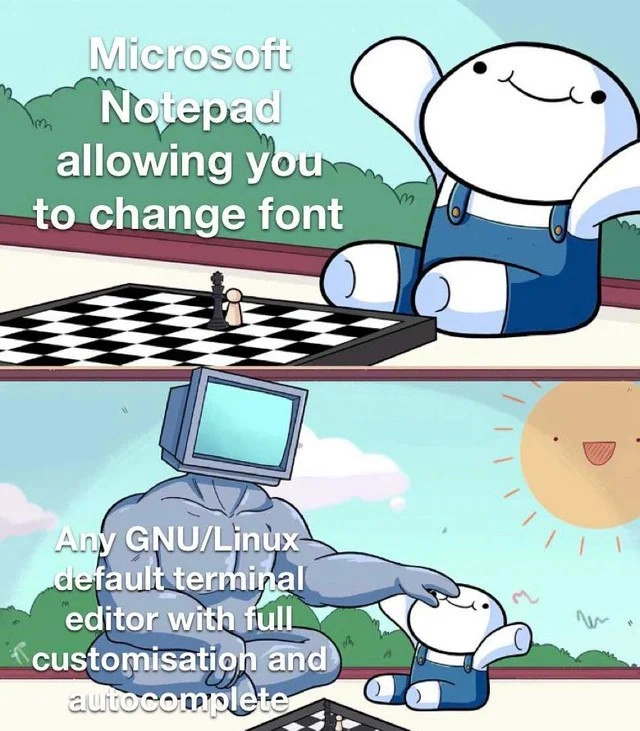
The chessboard visual makes Notepad look like it is playing a tiny, polite game. The lower panel makes the terminal editor look like it has already won the tournament, rebuilt the table, and documented the keyboard shortcuts in a man page. That exaggeration is the humor.

Level 3: Dotfile Dominance

The meme works because it compares two very different ideas of what a text editor is supposed to be. The top panel says:

Microsoft Notepad allowing you to change font

That is a small quality-of-life feature in a deliberately minimal Windows utility. Notepad's job has historically been simple plain-text editing: open a file, type some text, maybe change how it looks on screen, and leave before anyone asks it to become an IDE.

Then the lower panel arrives with:

Any GNU/Linux default terminal editor with full customisation and autocomplete

The gigantic CRT-headed figure is the Unix tooling culture in one image: absurdly strong, faintly intimidating, and absolutely convinced that your text editor should be programmable enough to develop opinions. In the Linux and CLI world, even "default terminal editor" can imply a toolchain of configuration files, plugins, keybindings, language servers, syntax highlighting, completion engines, macros, shell integration, and twenty years of forum posts explaining why your escape key should be remapped.

The joke is not just that Linux editors are more powerful. It is that the baseline expectations are different. Windows Notepad celebrates a visible preference toggle; terminal editors treat the editor as a developer environment. Vim, Emacs, Nano with configuration, or distro-flavored defaults all sit in a culture where ~/.vimrc, init.el, shell aliases, and package managers turn editing text into a lifestyle choice. The post message, "I use arch btw", sharpens that tone: Arch users are stereotyped as proud customizers who treat the operating system as a personal construction project.

There is a real developer experience trade-off under the exaggeration. Minimal tools are approachable because they hide complexity. Highly customizable tools are powerful because they expose it. Senior developers recognize both sides: Notepad will not make you learn modal editing, but it also will not refactor a codebase. A terminal editor can become the fastest thing you own, but first it may require a weekend, three dotfiles, and a small negotiation with your own muscle memory.

Description

A two-panel cartoon shows a small smiling character playing chess against a tiny opponent, with the text "Microsoft Notepad allowing you to change font." In the lower panel, a huge muscular figure with an old CRT monitor for a head crushes or overwhelms the smaller character, with the text "Any GNU/Linux default terminal editor with full customisation and autocomplete." The meme contrasts Notepad's minimal editing features with the power-user culture around Unix/Linux terminal editors, where configuration files, keybindings, plugins, and completion systems can turn a text editor into a personalized development environment. The exaggerated muscle-body visual frames basic GUI convenience as trivial next to terminal-editor customization depth.
Comments

3
Anonymous ★ Top Pick Notepad changed the font; Vim changed the user's personality and shipped autocomplete through a dotfile.
  1. Anonymous ★ Top Pick

    Notepad changed the font; Vim changed the user's personality and shipped autocomplete through a dotfile.

  2. Deleted Account 5y

    Of course... Nano?

  3. @LionElJonson 5y

    omae wa mou shindeiru

Use J and K for navigation