Skip to content
DevMeme
2706 of 7435
Bootstrapped Startup's Honest CTO Job Description
Startup Post #2990, on Apr 19, 2021 in TG

Bootstrapped Startup's Honest CTO Job Description

Why is this Startup meme funny?

Level 1: Work Disguised as Play

Imagine your friend shows you a broken bicycle they found on the sidewalk. The bike’s chain is rusted, the tires are flat, and it doesn’t even roll. There’s a big note on it that says, “Doesn’t work now, but fixing it will be fun!” 😅 Your friend is basically trying to get you to take this busted bike and repair it. They call it “fun,” but you know it’s actually a lot of work to make that bike ridable again. This meme is joking about the same idea. A small company has a big broken project and they’re trying to hire someone by saying “It will be fun to fix!” It’s funny because calling a hard chore “fun” is kind of silly — it’s like if your parents left you a huge messy room to clean and cheerfully said, “Think of it as a fun game!” You would probably roll your eyes, right? Developers see this and laugh because they know fixing someone else’s big mess is not as fun as it sounds. It’s work being disguised as play, and that little note in the picture captures that joke in a very simple way.

Level 2: Beneath the Buzzwords

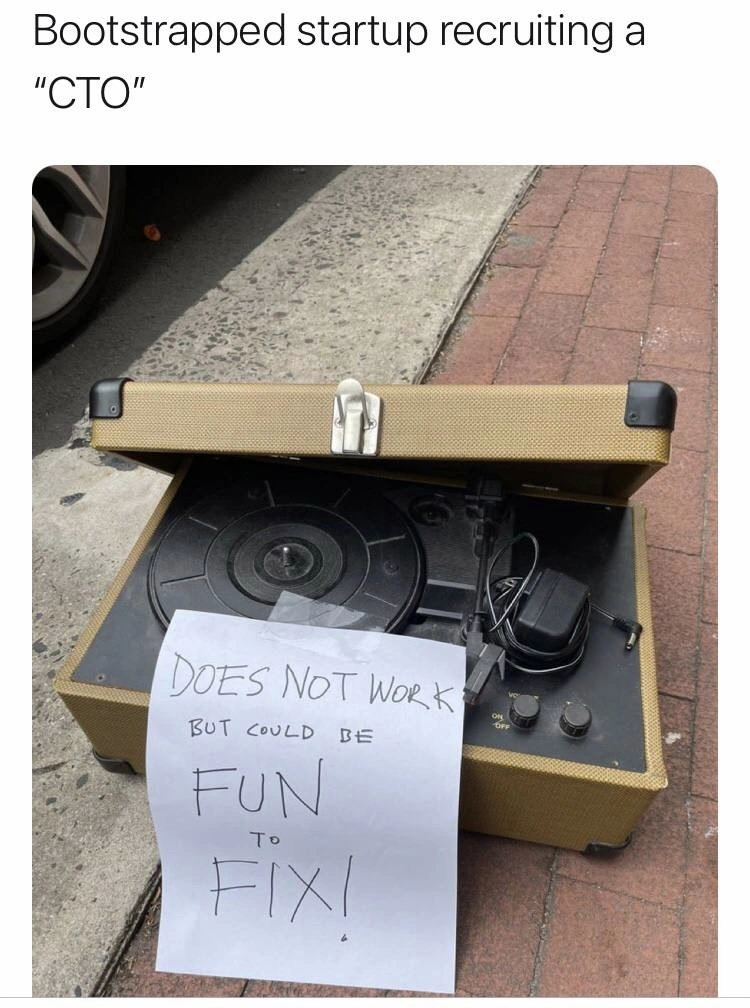
This meme shows a discarded record player with a note saying, “Does not work but could be fun to fix!” The caption frames it as “Bootstrapped startup recruiting a ‘CTO’.” Let’s unpack that. A bootstrapped startup is a new company that is self-funded, meaning it hasn’t raised outside money. They often operate on a shoestring budget, so they can’t afford big salaries or large teams. In this context, recruiting a CTO (Chief Technology Officer) at a bootstrapped startup often means they want one person to handle all the technology because they can’t hire a full team. The quotes around “CTO” in the caption suggest a bit of irony – in a tiny startup, the CTO isn’t a high-flying executive with a tech department, but rather the lone tech lead (even an early_stage_tech_lead) who codes, debugs, sets up servers, and essentially fixes everything. It’s a fancy title for a very demanding, hands-on engineering role.

Now, why compare that to a broken record player on the curb? The image is a metaphor. The broken_record_player_metaphor implies that the startup’s product or codebase is old or broken (like the record player) and has been effectively abandoned in its current state. The sign “Does not work but could be fun to fix!” is like the startup’s pitch to potential hires: “Our system doesn’t work right now, but you’ll have fun fixing it!” It’s poking fun at how companies sometimes advertise a tough, messy job as an exciting challenge. This is common in StartupCulture and tech HiringPractices – they’ll use upbeat language to attract talent, even if the task is actually fixing a big mess. So the fun_to_fix slogan in the meme is highlighting that contrast. It’s as if the startup is saying, “Sure, everything’s on fire, but think of the learning experience!”. This is a form of StartupHumor aimed at developers who have seen job descriptions or recruiter emails that describe a nightmare project as a “great opportunity” or “fun problem to work on.”

Let’s go over some key terms here. TechnicalDebt is an important concept in this meme. In software, technical debt refers to the consequences of quick and dirty solutions done for speed instead of quality. For example, imagine you hurry to build a feature in a week that really needed a month – you might make a mess in the code (no tests, clumsy design) just to get it working. That mess is the “debt” you’ll have to pay back later when it inevitably causes problems. Interest on technical debt comes in the form of slower development, bugs, and the need for refactoring. A bootstrapped startup often accumulates a lot of technical debt because they are in “survival mode,” rushing to get a product out with minimal resources. Over time, this debt grows, and eventually the codebase becomes fragile or even nonfunctional in places. In other words, the software “Does Not Work” as it should. By the time they look for a CTO or tech lead, there might be LegacyCode everywhere – code written ages ago (in tech timeline) with outdated frameworks or bad practices that nobody has had time to fix. We often call such a messy codebase a codebase chaos or a “spaghetti code” situation, meaning the code is tangled and hard to follow.

What does this look like in practice? A chaotic startup codebase might have:

  • Outdated dependencies that haven’t been updated in years (risky and incompatible with new systems).
  • No documentation or comments, so nobody knows how things are supposed to work.
  • Few or zero tests, making it scary to change anything because you’re not sure if you’ll break something else.
  • Hacks and quick fixes piled on top of each other. For example, one function might be 1000 lines long doing everything, or there may be a lot of TODO: comments hinting that parts of the system were never fully finished.
  • Crashes and bugs that are known but were never addressed due to lack of time.

This is what we mean by LegacyCode and technical debt leading to a nonfunctional_system. It’s like a car that’s been driven hard without oil changes – it technically runs until one day it doesn’t. The startup’s product is that clunky car, and now they need a mechanic (the new CTO) to rebuild the engine while the car is still moving. And they’re advertising this as “fun.”

From a Career_HR perspective, calling something “fun to fix” is an attempt to attract optimistic problem-solvers. It appeals to developers who enjoy puzzles and complex tasks. And indeed, some engineers do love the challenge of untangling a big mess (HiringHumor often plays on this idea). But the meme highlights the overly positive spin. In reality, being the solo CTO of a tiny company fixing a broken product can be extremely stressful. There’s likely pressure to get everything working yesterday, minimal guidance (maybe the original developers are gone), and no one to share the on-call burden. The company might be bootstrapped, meaning the compensation could be mostly equity or a tiny salary, justified with “you’ll get to shape the future and have the CTO title.” In StartupLife, having a lofty title like CTO early in your career might sound great, but it often comes with long hours and high responsibility.

The humor in this meme is relatable to many developers because it exaggerates a real scenario. Think of someone leaving a broken appliance on the sidewalk with a note saying “free, might be a fun project.” If you’ve ever picked up such a “free” project, you know it’s not exactly fun — it’s work. Similarly, developers have encountered job listings or interviewers saying things like “We have some legacy systems that need love, but it will be a fun challenge for the right person.” This meme just makes that subtext explicit with the hand-written note. It’s HiringPractices satire. The company is effectively admitting “Our tech doesn’t work,” but tries to frame fixing it as a perk or learning experience. For a junior developer reading this meme analysis: it’s a little cautionary tale. When a job is described in overly rosy terms despite obvious big challenges, remember this meme. “Fun to fix” usually means a lot of hard fixing ahead. It’s not to say such jobs can’t be rewarding, but the meme is a tongue-in-cheek reminder to see through the buzzwords.

In summary, the meme uses a simple visual joke to convey how StartupCulture can downplay huge problems when hiring. The bootstrapped_startup in question has a broken product (the record player that doesn’t play) and is basically saying, “we need someone to make this work again.” The big laugh comes from how familiar that scenario is in tech circles — it’s RelatableHumor. Many of us have heard the line “does not work, but could be fun to fix” in some form, usually in a recruiter’s pitch or a job description. Here it’s literally written out, making the hidden meaning obvious. It’s funny, a bit cringey, and educational for those new to the industry about what codebase chaos really looks like behind shiny startup announcements.

Level 3: Fun-to-Fix Fallacy

At first glance, the meme’s image is practically a CTO recruitment pitch in disguise. A tattered sign on a discarded record player reads: “DOES NOT WORK BUT COULD BE FUN TO FIX!” – which is exactly what a bootstrapped startup might tell a prospective tech lead. In startup culture, calling a broken, nonfunctional system “fun to fix” is the ultimate sugarcoating. It’s a darkly comic twist on HiringPractices in the Startup world: the company has a pile of TechnicalDebt and legacy problems, but they’re spinning it as an exciting opportunity. Seasoned engineers recognize this fun_to_fix slogan as the Fun-to-Fix Fallacy – the idea that wrestling with a codebase chaos of bugs and spaghetti code is some kind of perk. It’s StartupHumor that hits close to home because many of us have seen this play out in real life.

The broken_record_player_metaphor is spot-on. The old portable record player on the sidewalk is a stand-in for a startup’s LegacyCode or janky infrastructure. It’s outdated, possibly held together by duct tape, and clearly nonfunctional – otherwise it wouldn’t be abandoned on the curb. Likewise, early-stage startups often have a hastily-built product held together by quick hacks. Maybe the founders or a now-gone freelancer cobbled together an MVP under crazy deadlines, accumulating massive technical debt. Over time that crufty code turned into a fragile, broken system that barely works (if at all). Now the startup is desperate for someone to resurrect it. They’re effectively doing sidewalk_recruitment: leaving their broken tech out in the open with a cheery note, hoping a Good Samaritan developer will come along, take ownership, and fix it for them. It’s the tech equivalent of putting a busted device on the street with a “free, might be fun to repair” sign. The humor isn’t random – it’s RelatableHumor for anyone who’s been the person who picked up that “free” broken project and later thought, “What did I get myself into?”

Crucially, the meme caption writes “CTO” in quotes, hinting that the title is a bit of a joke. In a tiny bootstrapped_startup, CTO often stands less for Chief Technology Officer and more for Chief of Tearing-Out-your-hair. You’re a one-person army, the early_stage_tech_lead who must do everything from coding and code review to deploying servers and resetting the router when Wi-Fi dies. It’s StartupLife without the glamour: you carry the pager 24/7, you’re debugging production issues at 3 AM, and you’re wading through ugly legacy code every day. The company dangles the prestigious “CTO” title, but really they need a tech janitor to mop up years of neglect. This is a common pattern in StartupCulture: fancy title, abysmal codebase. The job ad might brag “CTO position at an exciting startup” – but if you read between the lines (or in this case, on the crudely taped note), it says “we have a mess and no money, please fix it.”

Why is this funny to experienced developers? Because we’ve translated these HiringHumor taglines before. It’s a cynical in-joke about the disconnect between what startups say and what they actually mean. Let’s decode a few phrases that a bootstrapped company might use when courting a technical leader:

They Say They Really Mean
“Bootstrapped startup, CTO role” We can’t pay much (or at all), but we’ll call you CTO.
“Legacy system, fun challenge” The system is broken and drowning in TechnicalDebt.
“Own the tech vision end-to-end” You’ll be coding everything and fixing everything.
“Flexible equity compensation” No salary now, maybe some stock if we succeed later.
“MVP needs a polish” It barely works; you’ll rewrite core parts from scratch.

In other words, the ctorecruitment_pitch here is full of euphemisms. Career_HR folks might frame the role as “wearing many hats” (translation: you’re the developer, QA, DevOps, and IT support because no one else is around). They’ll say the company is “bootstrapped” (translation: forget a big budget or fancy tools – you MacGyver with free tiers and open-source everything). They might claim “We value developers who love problems”, which sounds great until you realize their problems include an app held together by copy-pasted Stack Overflow snippets. The note “COULD BE FUN TO FIX!” is basically them admitting the record player (codebase) doesn’t even turn on (does not work), but they hope your passion for tinkering outweighs your need for a sane workweek. It’s like they’re recruiting a hobbyist for a job that’s actually critical, hoping you find joy in frustration.

From an engineering perspective, walking into a situation like this is scary. A nonfunctional_system that’s been neglected or built on shaky foundations is not a quick fix; it’s a multi-month (or multi-year) grind of refactoring and firefighting. This is where TechnicalDebt bites hard. The term technical debt refers to the future cost incurred when you speed-run software development by taking shortcuts. A bootstrapped startup often racks up debt intentionally: “We don’t have time to do it right; we’ll fix it later.” Well, later is now, and the debt collectors (bugs, crashes, scaling issues) are at the door. And who is supposed to pay off that debt? The lone new CTO, with interest, and under pressure. Experienced devs know that paying down years of legacy code issues isn’t “fun” — it’s a grueling marathon of debugging confusing logic, updating outdated libraries, writing tests for code that never had any, and untangling architecture that might collapse if you pull the wrong thread. The meme lands because that hand-written note is basically the startup saying to a candidate: “Our entire product is a fixer-upper. We know it’s busted, but wouldn’t it be fun to make it work?” This brand of HiringHumor is funny and painful at the same time.

The RelatableHumor comes from shared experience. Many developers have stories of joining a company (often a small startup) and immediately discovering the onboarding gift is a heap of critical bugs and zero documentation. Or getting lured by a cool title and mission, only to find out the codebase is an archaic monolith on life support. We laugh at the meme because we’ve lived that reality or narrowly avoided it. It highlights a truth about StartupLife: early success can hide a mountain of tech issues that eventually require a hero (or martyr) to fix. The street photo vibe – a broken gadget tossed out with a hopeful note – perfectly captures the mix of optimism and denial. The startup is optimistic someone will save them, and in denial about how unattractive that task really is. As a battle-scarred engineer, you smile at the meme because it says, “We’ve all seen this movie.” It’s a gentle warning wrapped in a joke: if a job posting ever sounds like this note, prepare for a wild ride through legacy-land. “Could be fun to fix” – famous last words in CodebaseChaos.

Description

A meme is presented with a caption at the top that reads, 'Bootstrapped startup recruiting a “CTO”'. Below the text is a photograph of an old, portable turntable in a tan-colored case, sitting on a sidewalk next to a curb. The record player appears dated and is open. Taped to the front of it is a white piece of paper with a handwritten message in black marker: 'DOES NOT WORK BUT COULD BE FUN TO FIX!'. The technical humor lies in the metaphor: the broken record player represents the startup's entire technology stack - a dysfunctional, legacy, or non-existent mess. The job title 'CTO' is in quotes to sardonically highlight that the role is not one of executive leadership but rather a hands-on, under-resourced position for a single developer expected to rebuild everything from scratch. For senior engineers, this is a painfully relatable caricature of certain startup job postings that romanticize fixing a disaster as a 'fun challenge' while offering minimal compensation or support

Comments

7
Anonymous ★ Top Pick The job description promises a 'greenfield project.' The field is a toxic waste dump, but it is technically green
  1. Anonymous ★ Top Pick

    The job description promises a 'greenfield project.' The field is a toxic waste dump, but it is technically green

  2. Anonymous

    Startup recruiter: “Picture this broken turntable as our stack - COBOL core wrapped in Rails 2, duct-taped to a Node script on a lone t2.micro. Doesn’t spin, no tests, last commit reads ‘temp hack’. Should be FUN to fix… for 0.3% equity.”

  3. Anonymous

    "We're pre-revenue but post-PowerPoint, looking for someone passionate about turning our founders' Notion docs into a distributed system that definitely won't need a complete rewrite in six months."

  4. Anonymous

    The classic bootstrapped startup pitch: 'We can't pay market rate, but you'll get 0.5% equity and the privilege of inheriting a monolithic PHP 5.3 codebase with zero tests, no documentation, and a deployment process that involves SSHing into production and running git pull. But hey, it could be FUN to fix!'

  5. Anonymous

    Pros: Vintage ports for legacy integration. Cons: Perpetual downtime, but hey, bootstrapped equity makes the weekend rewiring 'fun'

  6. Anonymous

    CTO at a bootstrapped startup = Chief Turnaround Officer: “does not work but could be fun to fix” - translation: brownfield rewrite in prod, zero tests, paid in title and illiquid optimism

  7. Anonymous

    CTO role decoded: adopt a pre-PMF MVP on a t2.micro with zero tests and keys in Git - comp is 100% equity and the ON/OFF switch maps to founder optimism/production outage

Use J and K for navigation