The Unsettling Anomaly of a Pre-Agile Project Manager
Why is this Agile meme funny?
Level 1: Just Bossing Around
Imagine you’re on a soccer team that usually huddles together to plan the next play. Every day, the team captain and players quickly talk about what the plan is and who will do what — that’s like our daily team meeting to stay organized. They might even write down the plan on a board so everyone can see it. Now picture a new coach comes in and… no team huddle at all. He doesn’t use the playboard or let anyone else talk. He just stays in his chair and points at players one by one, saying “You do this now, then you do that next.” He’s basically just bossing everyone around without any team discussion. The players would find this really strange, right? They’re used to working together and knowing the game plan, but this coach isn’t sharing any plan – he’s just giving orders.
It’s funny (and a bit scary in a silly way) because the coach is acting so different from what everyone expects. Normally, good teamwork means everyone shares ideas and knows what’s happening, but this bossy coach is skipping all that. The team might even joke, “Wow, he’s acting kind of crazy!” because it feels so out of place. In the meme, the project manager is like that coach. He skips the usual team check-ins and planning tools, and just tells people what to do. The developers on the team think this is as wild and unexpected as a coach who won’t even let the team huddle. It makes them laugh because it’s such an odd way to behave, almost like a cartoonishly strict boss. The core of the joke is that someone who ignores all the normal friendly team habits and only gives orders seems so ridiculously bossy that it’s just plain funny to everyone watching.
Level 2: Ceremonies vs Commands
Let’s break down what’s going on here for those newer to these terms. In modern software teams, Agile practices (like Scrum) are all about collaboration, quick feedback loops, and a bit of structure through “rituals” or ceremonies. A Sprint ceremony can refer to meetings such as:
- Daily stand-up: a short daily meeting (often literally with everyone standing in a circle) where each team member quickly says what they did yesterday, what they’ll do today, and if they have any blockers. It keeps everyone in sync.
- Sprint planning: a meeting at the start of a sprint (a sprint is a short, fixed-length work period, typically 1-2 weeks) to choose which tasks or “user stories” to tackle next.
- Sprint review/demo: showing what got done at the end of the sprint.
- Retrospective: after a sprint, the team talks about what went well or badly and how to improve next time.
These Agile ceremonies are meant to replace the old style of project management where a boss might just assign tasks and deadlines in a big plan (that’s often called waterfall methodology – where work flows in one direction from planning to execution with little change or iteration). In Agile, instead of a top-down “boss says do X,” the team is more self-organizing: they pull tasks from a backlog (a to-do list of work, usually managed in a tool like JIRA) and collaborate in frequent meetings to adjust plans.
Now, JIRA is a very popular project tracking tool (basically a big digital board of tickets). Each Jira ticket represents a task or feature, and developers move these tickets through stages (To Do, In Progress, Done, etc.). Teams live and breathe by their JIRA board in many Agile environments; it’s how everyone knows what’s being worked on and who’s doing what. So when the meme says “No JIRA,” it implies this PM isn’t using the usual ticket system at all – meaning tasks might be given out in person, via email, or not formally tracked. For a junior developer, imagine if you had no Trello board or no assignment list in school – you’d just be told verbally what to do next with no written record. It feels disorganized and opaque. That’s why developers in Agile teams expect a JIRA or similar tool to keep everyone aligned.
The mention of “No standing desk” is a cheeky detail. A standing desk is literally a desk that can elevate so you can work while standing up. They’ve become trendy in tech offices for health and are sometimes humorously associated with modern, hip work culture. In context, though, “No standing desk” might also allude to the daily stand-up meeting idea — perhaps this PM isn’t participating in any stand-up (either the furniture or the meeting!). More straightforwardly, it’s painting a picture of a manager who hasn’t adopted any of the typical modern habits. Most project managers or team leads today have at least some Agile habits: maybe using a Kanban board, holding a quick daily meeting, or yes, even having a fancy adjustable desk. The meme lists “No standing desk, No JIRA, No sprint ceremonies” to emphasize that nothing about this person signals the usual Agile process. He’s not literally standing up, he’s not using the standard software, and he’s not conducting the expected meetings.
So what does he do? “He just sat there. Telling us what to work on.” This describes a classic old-school Project Manager approach: the boss figure who decides and assigns tasks to developers directly, without team input or visible planning tools. It’s essentially how things were often done in the pre-Agile days (and sadly, how it still happens in some places). For a junior dev who’s maybe learned about Agile in school or a coding bootcamp, it’s important to understand why this is jarring. Agile promotes empowerment and transparency: you’d normally see what tasks are in the queue, volunteer or be involved in estimation, and know the context of your work within the sprint. But in a command-and-control style, you might just get an order like, “Implement Feature X by next Friday,” with no daily check-ins or shared board to see the overall picture.
Think of waterfall_vs_agile like this: in Waterfall (old method), the project manager might plan everything at the start and then tell each person their tasks (like a big to-do list handed out all at once). There’s usually no frequent course correction; you only find out at the end if things went off track. In Agile (new method), planning is incremental and adaptive; the team meets often to adjust and anyone can raise concerns sooner. Agile ceremonies, JIRA boards, and even habits like daily stand-ups are all tools to avoid disasters and surprises. They let the team manage complexity together rather than one “all-knowing” boss micromanaging. So when those tools and rituals are absent, it feels like flying blind if you’re used to them.
The meme’s joke is essentially calling that old-school PM behavior “psychopathic” in a joking manner. Of course, it’s hyperbole — the project manager isn’t literally a psychopath. But to developers who have grown accustomed to a collaborative Agile workflow, someone ignoring all process can feel as disorienting as dealing with a wild card persona. It’s ProjectManagementHumor borne out of frustration: we’ve filled our work life with ticket numbers, stand-up meetings and sprint goals, so when a manager uses none of that, it’s almost like he’s breaking an unwritten social contract of software teams. The team might half-jokingly label that as crazy behavior because it goes against everything they expect a sane manager to do.
In short, the meme lists the missing AgileCeremonies and tools to highlight how out-of-place this project manager’s style is. If you’re just starting out, know that most tech teams use at least some Agile methodology. So if you walked into a job and the PM really “just sits there telling you what to work on” without any backlog or team discussion, you’d likely feel uneasy (and probably a bit confused about priorities!). The humor here comes from exaggeration and contrast: it’s funny because it’s unusual nowadays. It’s poking fun at the contrast between a heavily Agile culture and a throwback “just do as I say” approach. Understanding that context makes the punchline “Like a psychopath” a playful dunk on this PM’s agile_culture_shock effect on the team.
Level 3: The Ghost of Waterfall Past
This meme hits experienced developers right in the Agile guilt zone. It’s describing a Project Manager who operates like we’re back in 1999: no daily stand-ups, no JIRA board, no sprint rituals—just pure command_and_control_management. For anyone who’s survived the industry’s waterfall_vs_agile transition, this scene is both hilarious and horrifying. The text is formatted like a dead-serious Slack message or terminal output, as if the developer is reporting a paranormal sighting:
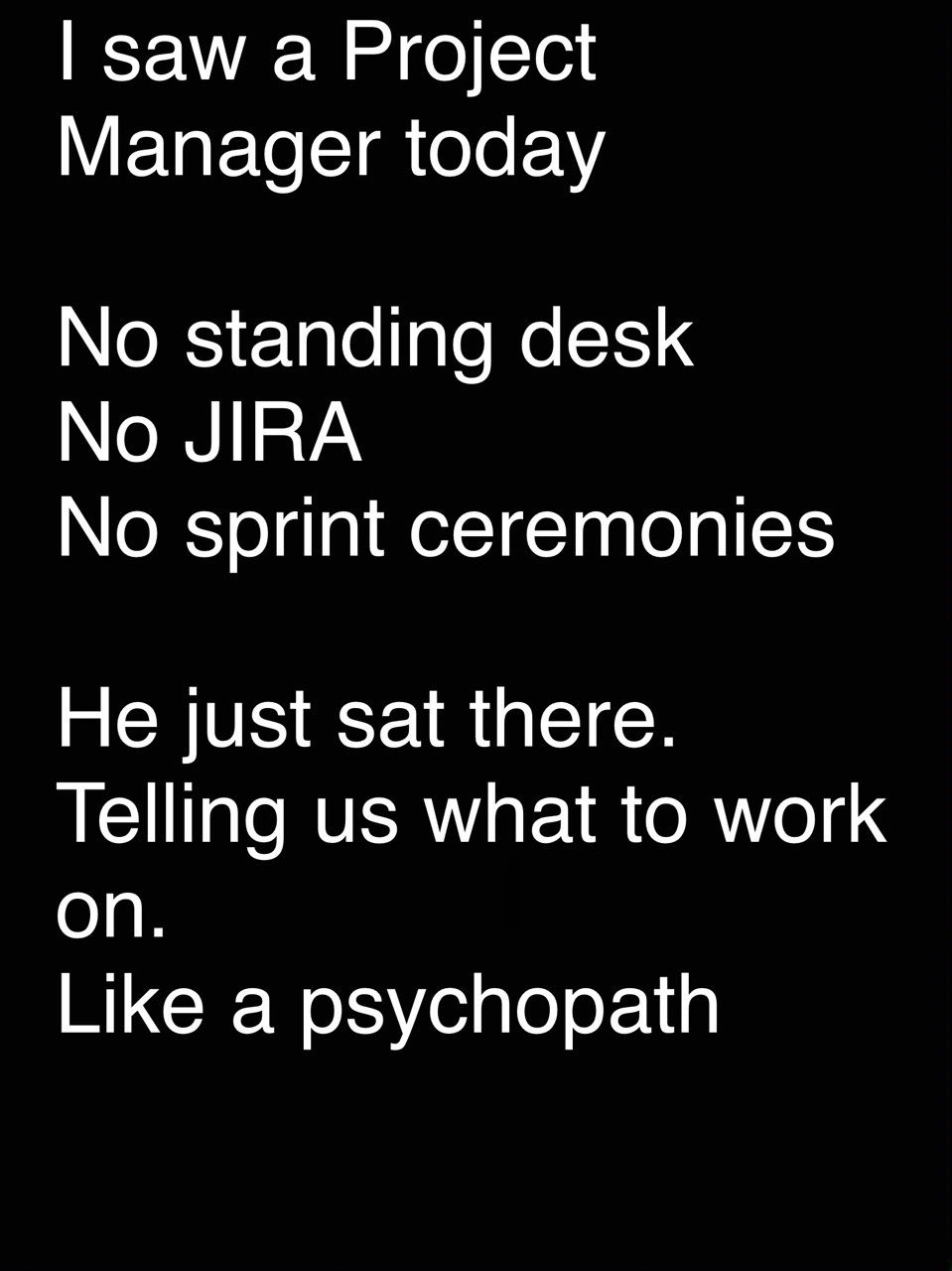
Dev: “I saw a Project Manager today… No standing desk. No JIRA. No sprint ceremonies. He just sat there telling us what to work on. Like a psychopath.”
Why is this so funny to a senior engineer? Because it captures the cultural whiplash of encountering a PM who ignores all the beloved (and sometimes tedious sacred) Agile ceremonies. It’s a satirical throwback to the days of waterfall projects where managers dictated tasks and timelines top-down, often via endless Gantt charts and marathon status meetings. Modern teams have spent years accumulating process debt in the form of Scrum rituals—daily stand-ups, sprint planning, backlog grooming, retrospectives—so suddenly dropping back to “resource allocation by loud voice” feels absurd. It’s as if an old ghost from IT past materialized in your open-plan office, barking orders while you desperately check for a missing JIRA ticket.
The humor also lies in how extreme the PM’s behavior seems by today’s norms. The meme calls him a psychopath tongue-in-cheek, because who else would forsake Jira and stand-ups? Seasoned devs recognize this hyperbole as a jab at outdated management. In a healthy Agile team, a PM (or more often a Scrum Master / Product Owner) facilitates rather than dictates: you track tasks in a JIRA backlog, volunteer for user stories, and huddle every morning for a stand-up meeting (often literally standing, to keep it short). Here, the PM does none of that — he “just sat there. Telling us what to work on.” That one line drips with sarcasm: the PM isn’t even doing the trendy stuff like using a standing desk or hovering over a Kanban board. He’s stationary and old-school, potentially managing from a spreadsheet or his own head. To an Agile-trained team, that’s agile_culture_shock in the flesh.
This scenario satirizes a real AgilePainPoints dilemma: we complain about too many meetings and JIRA tickets, but at least those Scrum rituals keep everyone in the loop. When a manager skips all that, you get flashbacks of chaotic projects where priorities changed on a whim and developers were just code monkeys taking orders. It’s a ManagementHumor warning: be careful what you wish for when you moan about meetings. The cynical veteran in us finds it darkly funny that the very AgileCeremonies we groan about (stand-ups, sprint demos, retrospectives) have become our baseline for sanity. Remove them, and suddenly the workplace feels like a dictatorship. The meme exaggerates this feeling by essentially saying: “He managed projects without the usual rituals… like a psychopath!” — equating the absence of process with a kind of professional sociopathy.
In sum, the meme tickles those with industry context by spotlighting an agile_culture_shock: a PM acting like Scrum never happened. It’s poking fun at both the ScrumHumor of religiously following rituals and the absurdity of abandoning them entirely. Seasoned devs laugh (or groan) because they’ve seen both extremes. They know Agile was meant to fix the very command-and-control behavior this PM exhibits, and seeing it resurface is both nostalgic and nightmarish. It’s funny because it’s true — there are still bosses out there who think stand-ups are optional and Jira is overhead, and encountering one after you’ve embraced Agile feels like spotting Bigfoot in the break room. No JIRA? No stand-up? It’s a sarcastic reminder that “the oldest codebase (or in this case, management style) you haven’t refactored will come back to haunt you.”
Description
A text-based meme presented as white text on a stark black background. The text is broken into short, impactful lines: 'I saw a Project Manager today / No standing desk / No JIRA / No sprint ceremonies / He just sat there. / Telling us what to work on. / Like a psychopath'. The visual simplicity places all the focus on the statement. The humor stems from the dramatic contrast between modern, process-heavy Agile methodologies and a traditional, direct style of management. For developers steeped in the rituals of sprints, stand-ups, retrospectives, and ticket tracking in JIRA, a project manager who simply assigns tasks without this framework is portrayed as shockingly deviant, hence the hyperbolic punchline 'Like a psychopath'. It satirizes how deeply ingrained Agile ceremonies have become in tech culture, making any deviation seem alien and unsettling
Comments
7Comment deleted
An Agile PM's calendar is full of ceremonies to create the illusion of progress. A pre-Agile PM's calendar was empty because they knew progress was an illusion anyway
Apparently the new methodology is RFC-1149: tasks delivered via carrier pigeon - no backlog, just peck order
Remember when we measured productivity by shipping features instead of perfecting our retrospective retrospectives? This PM probably doesn't even know what SAFe 6.0 is
Ah yes, the rare PM who operates in O(1) complexity - no ceremony overhead, no JIRA synchronization latency, just pure, unfiltered task assignment. While the rest of us have been busy optimizing our Agile pipelines with story points, velocity tracking, and retrospective action items, this absolute unit discovered that human communication still compiles without a Scrum framework. It's like finding someone running bare metal in a world of Kubernetes abstractions - technically functional, but it violates every modern architectural principle we hold dear. The real horror isn't the directiveness; it's realizing that decades of process engineering might just be elaborate dependency injection for avoiding actual decisions
Apparently “no JIRA” is just a human‑based scheduler with zero observability, single‑node consensus, and a bus factor of one
PM skips JIRA ceremonies: pure imperative dispatch to dev queue, zero context-switch overhead - blissful O(1) tyranny
A PM without JIRA is a single‑threaded scheduler doing manual memory management - great latency until someone asks for audit logs