Skip to content
DevMeme
687 of 7435
LeetCode's Final Boss: The P vs NP Problem
CS Fundamentals Post #779, on Nov 4, 2019 in TG

LeetCode's Final Boss: The P vs NP Problem

Why is this CS Fundamentals meme funny?

Level 1: Impossible Homework

Imagine you’re in school and you just finished a bunch of really easy homework problems – like, “2+2” and “spell C-A-T.” You feel pretty smart because they were so simple. Then, for the next assignment, the teacher suddenly asks: “Okay, now solve a riddle that nobody in the world knows the answer to.” 😱 It’s as if after drawing stick figures, you’re asked to paint the Mona Lisa from memory. That’s what’s happening in this meme. The person went from super easy tasks straight to a question that’s basically impossible. It’s funny because it’s so unexpected and extreme.

Think of it like successfully riding your bike with training wheels, and then someone says, “Great job! Next, we need you to win the Tour de France.” That huge jump in difficulty is both absurd and comical. The meme makes us laugh because we feel the poor person’s shock. One moment they’re breezing along, and the next moment they hit a brick wall. It reminds us of times when we thought something was going to stay easy, but then it suddenly got really, really hard out of nowhere. In simple terms, it’s funny because nobody would ever seriously expect you to do something that impossible right after doing something easy – and if they did, you’d probably either laugh or cry. Here, we laugh, because thank goodness it’s just a joke!

Level 2: Off the Difficulty Chart

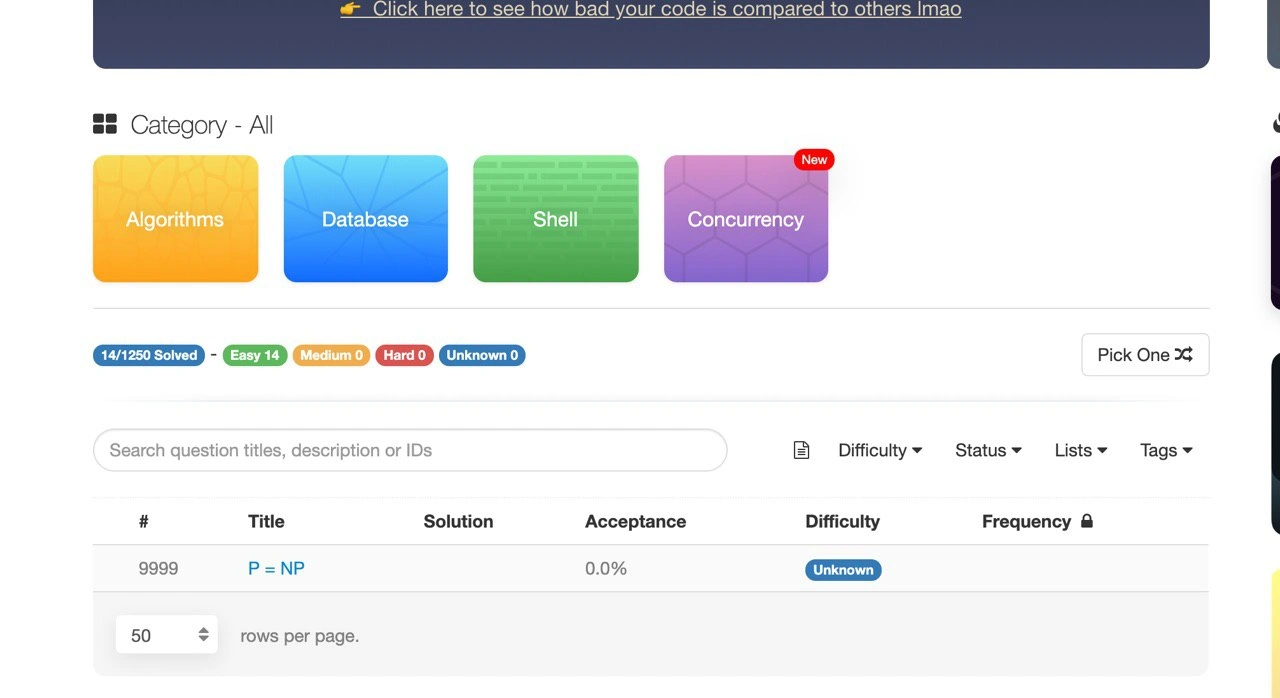
For those newer to programming and coding interview prep, let’s break down what’s happening in this image. It’s mimicking the interface of a site like LeetCode (a popular platform for practicing coding problems). On such platforms, problems are usually categorized by topic (see the orange Algorithms, blue Database, green Shell, and purple Concurrency cards at the top) and by difficulty level (Easy, Medium, Hard). The progress bar that says “14/1250 Solved – Easy 14 Medium 0 Hard 0 Unknown 0” indicates the user has solved 14 out of 1250 total problems on the platform. All 14 solved ones were Easy, and they haven’t solved any Medium or Hard or Unknown difficulty problems yet. This paints a picture of someone just starting out, sticking to the beginner-friendly questions.

Now, normally after you solve a bunch of Easy problems, you might try a Medium problem next. But in the meme, the very next problem that gets queued up for this user is titled “P = NP” with Difficulty: Unknown. This is totally unheard of in real life – “Unknown” difficulty isn’t even a standard category on these sites (they typically only have Easy, Medium, Hard). “Unknown” here basically means “off the charts” — so challenging that they can’t even rate it. The meme is making a joke that this problem is beyond Hard, beyond anything in the normal practice range.

To appreciate why “P = NP” is labeled that way, you need to know a bit about what it means. “P = NP” refers to a very famous open question in computer science. It’s not a typical programming task at all, but rather a theoretical question about whether two classes of problems (P and NP) are actually the same or not. In simpler terms, P problems are ones you can solve quickly (like, your computer can find the answer in a reasonable time as the problem grows), and NP problems are ones where, if someone gives you a candidate answer, you can check it quickly, but finding that answer in the first place might be insanely slow. No one knows if every NP problem is actually secretly solvable quickly (which would mean P and NP are equal), or if some problems are truly hard to solve (P and NP are different). This isn’t just another coding puzzle – it’s basically a million-dollar theoretical puzzle that the best minds in CS have been working on for decades! It’s one of the seven Millennium Problems (really famous unsolved problems in math and CS). So, seeing it listed on a practice site is kind of like opening a beginner’s puzzle book and seeing “Build a working time machine” as the next exercise.

The table in the image shows a row for this problem:

  • #9999 – that’s its problem number (a high number, suggesting it’s way at the end of the list or a special one).
  • Title: P = NP – the name of the problem is literally stating the grand question.
  • Solution: – – this means there’s no solution posted. On many coding challenge sites, a dash or empty solution field indicates that either you haven’t solved it yet or there’s no official solution available. In this case, it implies no known solution exists.
  • Acceptance: 0.0% – this stat shows the percentage of submissions that got accepted. 0.0% means nobody who attempted this problem has succeeded. That figure is intentionally ridiculous here: if even one person had solved P = NP, it would be front-page news worldwide. So of course the acceptance rate is zero!
  • Difficulty: Unknown – as mentioned, problems usually have a difficulty rating (perhaps decided by the site or by user feedback). “Unknown” means it’s not rated – fitting because how do you rate something that might be impossible? It’s beyond the normal Easy-Medium-Hard scale.
  • Frequency: 🔒 – that little lock icon likely means the frequency data is locked or not available. Frequency usually tells how often a problem is encountered (for example, how often it’s been seen in interviews or how popular it is). Locking it might indicate this problem is either brand new, not meant for everyone, or simply not applicable. In this context, it’s another nod to the absurdity: obviously, no company is asking this question to candidates (hence no frequency info, possibly “locked” behind some joke premium tier or just outright not given).

The humor is more apparent now: the user went from solving only very simple tasks straight to an unsolvable, unknown-difficulty problem. It’s the ultimate case of scope jump. Imagine a gradation of challenge like this:

  • Easy: trivial puzzles (e.g. “Reverse a string” or “Find the max of an array”) – straightforward tasks you can solve with basic code.
  • Medium: standard algorithmic challenges (e.g. “Find the shortest path in a grid” or “Implement a sorting algorithm with a twist”) – these require some planning and knowledge of common algorithms or data structures.
  • Hard: really tricky problems (e.g. “Solve a Sudoku solver optimally” or “Implement a balanced search tree from scratch”) – these might involve advanced algorithms, dynamic programming, or creative insights; they can be done, but they’ll push you.
  • Unknown: completely out-of-bounds problems (e.g. “Prove whether P = NP”) – these are not the kind of problems you solve by coding for an hour; they’re open research problems that might not be solvable at all with current knowledge.

By listing “P = NP” under Unknown, the meme highlights just how out there this task is. It gives context to that progression: the user has done the first rung (Easy), hasn’t touched Medium or Hard, and suddenly leaps to something beyond Hard. It’s a bit like a student who has learned how to do basic arithmetic and then is immediately asked to solve a famous unsolved math conjecture – pretty relatable developer experience when you think of times you felt overconfident and then completely out of your depth.

Another aspect to notice: the little red “New” badge on the purple Concurrency card in the interface. This indicates the platform recently added a Concurrency category for problems (likely dealing with multi-threading or parallel processing challenges). For a newcomer, even concurrency problems are typically considered advanced (since they involve thread synchronization, locking, etc.). The presence of that “New” tag shows the site is expanding into tough topics. Yet, humorously, even a brand new concurrency puzzle is a cakewalk compared to “P = NP”. It’s emphasizing that no matter what new categories or hard challenges a platform offers, they’re trivial next to this legendary problem.

The meme’s message in simple terms: “I was doing fine with the easy stuff, and then the platform threw the absolute hardest problem in existence at me. Easy peasy, right? 😅” In fact, the original post caption even jokes: “Easy peasy task so ezzzzzzy” – obviously sarcastic. It’s making fun of the overconfidence one might have after doing a few easy problems and the shock of encountering a task that’s way above anything you’ve prepared for. Even if you’re not familiar with the specifics of P vs NP, you can understand the joke as: the next challenge is basically impossibly difficult, something nobody has solved.

So, for a newcomer: don’t panic, this situation would never happen in reality on a practice site. It’s a hyperbole! The meme is using an extreme example to be funny. It’s a bit of interview humor and a cautionary wink – it says “stay humble, because there’s always a harder problem.” As you learn coding and computer science, you’ll find out that some questions are way harder than they look, and some are still waiting for an answer at all. Here it’s just presented in a silly way: like you finished Level 1 of a game and suddenly the game asks you to beat the final boss who’s impossible to beat. The good news is, in real learning, you’ll climb levels much more gradually… this meme just skips to the end for laughs!

Level 3: The Final Boss Problem

To an experienced developer or anyone who’s ground through coding challenges, the humor here hits instantly. You’ve just breezed through 14 easy practice problems on a platform like LeetCode – probably things like two-sum or reversing a string. You’re feeling good, your learning curve is on the rise, and then BAM! The platform queues up “P = NP” as your next challenge. It’s as if a video game skipped straight from the tutorial to the secret final boss. This stark jump from trivially easy to literally impossible is the core of the joke. It’s poking fun at the sometimes jarring difficulty spikes in interview prep, exaggerated to the extreme. In real life, of course, no interviewer is going to ask you to solve a Clay Institute Millennium Prize problem – that would be beyond ridiculous. But the meme plays on that irrational fear many newbies (and even veterans) have: “What if they ask me something I absolutely can’t solve?” Well, P vs NP is the ultimate un-solvable something. It’s interview humor dialed up to 11.

The look and feel of the screenshot perfectly parodies a LeetCode-style interface (the colored category cards for Algorithms, Database, Shell, Concurrency, etc. are spot-on). Every experienced LeetCoder will smirk at the purple banner up top: “👉 Click here to see how bad your code is compared to others lmao”. That’s a sarcastic twist on the real feature where you can compare your solution’s runtime and memory usage percentile. In reality it’s phrased a bit more delicately (no “lmao” in production UI!), but honestly, that’s exactly how it feels sometimes. You finish a problem feeling accomplished, then click the stats and realize your neat solution is in the 5th percentile for speed – the platform might as well laugh and say “wow, your code is trash compared to everyone else’s 😅.” The meme exaggerates this vibe for comedic effect, capturing that mix of pride and humility every developer knows when hitting that “compare” button.

Now, combine that tongue-in-cheek banner with the list of solved counts just below: 14/1250 Solved – Easy 14, Medium 0, Hard 0, Unknown 0. This tells us the user has only solved 14 problems, all of them Easy, and hasn’t touched any Medium or Hard ones yet. In other words, they’re a beginner who’s been sticking to the low-hanging fruit. Seeing all zeros for medium and hard, a seasoned dev immediately recognizes the comic setup: this person has zero experience with tougher problems. And what does the platform do? It throws them not just a typical “Hard” problem, but something classified as Difficulty: Unknown! It’s like the system said, “You’ve mastered the kiddie pool, time to swim with the sharks.” This is a classic bait-and-switch gag: build up someone’s confidence with simple tasks, then pull the rug out with an insurmountable challenge. Every programmer can relate to a moment when they felt lulled into a comfort zone (“I got this, coding is easy!”) and then encountered a task that absolutely floored them (“I have no idea what I’m doing…”). This meme just scales that feeling to comical heights by using the hardest problem in computer science as the punchline.

Let’s appreciate some details only a seasoned coder might fully enjoy. The problem row shows #9999 as the ID for “P = NP”. A high number like 9999 and the presence of a 🔒 lock icon under “Frequency” hint that this is a special or hidden question (on real platforms, premium or extremely rare questions often have the lock icon and high IDs). The “Frequency” being locked is a sly nod: presumably, the “frequency” of this problem being asked in real interviews is effectively zero (or classified 😉). No company is asking this in interviews – unless you count a PhD defense as an interview! The Acceptance: 0.0% and Solution: – are dripping with sarcasm. A 0.0% acceptance means literally no one has ever gotten their code accepted for this problem. On a normal day, if you see 0% acceptance you’d assume it’s either brand new or fundamentally broken – here it’s because the question itself is unanswerable in code. And “Solution: –” suggests there’s no official solution nor any community solutions, which of course there aren’t, because how could there be? For an experienced dev, each of these UI elements reinforces the absurdity: this isn’t just a hard problem with maybe a handful of solutions – it’s one with zero solutions known.

The senior perspective also catches the deeper industry in-joke: solving P = NP isn’t just harder than the usual “Hard” – it transcends the whole easy/medium/hard scale. The platform labels it “Unknown” because it truly doesn’t fit the usual categories. In day-to-day work, we have difficult bugs or algorithms, but eventually someone figures them out or there’s documentation to consult. P vs NP is emblematic of a problem with no answer key. It’s a humility check: even the best and brightest computer scientists have hit a wall here. So when you see it lined up as the next item in an interview prep list, it’s hilarious. It’s like a college CS fundamentals exam where the last question is, “Oh by the way, invent a new form of calculus. No biggie.” That mismatch is the heart of the humor: the meme takes a relatable developer experience (grinding through practice problems and checking your stats) and smashes it into the realm of unsolved research, creating an absurd scenario that makes tech folks laugh out loud.

To cap it off, let's imagine this as an actual interview scenario (nightmare fuel for any developer, newbie or veteran):

Interviewer: “Great, you solved the first few warm-up questions quickly. For the last question, prove or refute that P = NP. You have 30 minutes. Good luck!”
You: faints 😵

No one in their right mind expects an answer, and that’s exactly the point. The meme is a hyperbolic reminder that no matter how many coding puzzles you’ve crushed, there’s always something out there that will humble you. It’s a mix of interview humor and a wink to the deep theory geeks. Seasoned devs chuckle because they’ve been around long enough to know what P vs NP entails, and they appreciate how ridiculously out-of-place it is on a casual coding platform. In other words, the meme serves up a hearty dose of imposter syndrome comedy: feeling like you’re on top of things one minute, then questioning every life choice the next. We laugh because it’s true – though thankfully, not literally true in any interview or LeetCode contest. It’s a satirical extreme, combining our everyday coding grind with one of computer science’s biggest unsolved mysteries, and that contrast is both funny and a little cathartic for anyone who’s been surprised by a suddenly impossible task.

Level 4: NP-Complete Conundrum

In theoretical computer science, P vs NP is the ultimate unsolved riddle – a millennium problem with a $1,000,000 prize for whoever cracks it. It's all about algorithm complexity analysis and complexity classes. Formally, P is the class of decision problems solvable by an algorithm in polynomial time (think O(nk) for some constant k). NP is the class of problems whose solutions can be verified in polynomial time. The big question "P = NP?" asks: Can every problem that we can verify quickly also be solved quickly?

This meme cheekily lists "P = NP" as if it were just another coding puzzle – but in reality it's the Mount Everest of CS fundamentals. In complexity theory terms, if someone found a polynomial-time algorithm for any NP-Complete problem (the hardest problems in NP, like Boolean SAT or the Travelling Salesman Problem), then P = NP and every problem in NP becomes tractable. That would be earth-shattering: modern cryptography would break (since many encryption schemes rely on certain problems being exponential-time hard), and countless currently intractable tasks (optimizing schedules, protein folding, etc.) would suddenly have efficient solutions. On the other hand, if P ≠ NP (which most experts strongly suspect), it would confirm there are problems that inherently require super-polynomial time – meaning no clever shortcut exists, only brute-force search through exponentially many possibilities.

The meme’s interface shows "Difficulty: Unknown" and "Acceptance: 0.0%" for the P = NP problem, which is hilariously accurate on a theoretical level. The difficulty is literally unknown because nobody on Earth knows whether this problem is solvable in reasonable time or effectively impossible. An Acceptance 0.0% rate jokes that no user’s submission has ever been accepted – of course not, since publishing a valid solution would instantly solve one of the most famous open problems in computer science! It’s a clever nod to the fact that no known algorithm or proof exists to resolve P vs NP, despite decades of research. In academic circles, papers claiming a proof for P=NP or P≠NP pop up occasionally, but none have stood up to scrutiny. So the meme imagines this monumental theoretical challenge casually queued up after a bunch of trivial coding exercises, highlighting the absurd gulf between routine interview coding challenges and deep complexity theory research.

Equally amusing is the notion that a coding platform expects you to submit code for this. Solving P vs NP isn’t like writing a quick sort or a DFS; it would likely involve constructing a rigorous mathematical proof or an entirely new algorithmic paradigm. There’s no simple solution snippet to upload. The very idea of approaching P = NP with a few lines of code underscores the impossibility. It’s like the platform is saying: “Alright, you’ve done those 14 easy puzzles, now just go ahead and revolutionize computer science real quick.” The humor here is rich in irony: LeetCode problems usually test known techniques with neat optimal solutions, but this one is a problem so hard that it’s unknown whether a solution even exists within current computational limits. In summary, Level 4 of this meme is a salute to the profound complexity conundrum of P vs NP, masquerading as a routine programming exercise. It’s absurd, it’s brainy, and it’s what makes this meme comedy gold for those who appreciate Big O notation and the limits of computation.

Description

This image is a screenshot of a user interface for a coding challenge platform, resembling LeetCode or HackerRank. At the top, a sarcastic banner reads, 'Click here to see how bad your code is compared to others lmao'. Below this, several category buttons are visible, including 'Algorithms', 'Database', 'Shell', and 'Concurrency'. A progress summary indicates the user has solved only 14 out of 1250 problems, all of them rated 'Easy'. The main part of the screen is a table of programming problems. One problem, with ID 9999, stands out with the title 'P = NP'. Its acceptance rate is '0.0%' and its difficulty is marked as 'Unknown'. The humor is derived from the immense gap between the user's beginner-level progress and the sheer impossibility of the problem presented. 'P versus NP' is one of the most profound, unsolved problems in computer science, a Millennium Prize Problem worth $1 million. Listing it as just another challenge on the platform, especially for a user who has only tackled easy problems, is deeply ironic and humorous to anyone in the tech field

Comments

7
Anonymous ★ Top Pick I have a polynomial-time solution for P=NP, but it's not practical. The constant factor is the time it takes to convince the Clay Mathematics Institute to actually give you the million dollars
  1. Anonymous ★ Top Pick

    I have a polynomial-time solution for P=NP, but it's not practical. The constant factor is the time it takes to convince the Clay Mathematics Institute to actually give you the million dollars

  2. Anonymous

    Sure boss, I’ll prove P=NP right after lunch - just need to run the linter so it formats the polynomial-time algorithm for me

  3. Anonymous

    The recruiter who rejected me for not solving this in 45 minutes is now asking if I know anyone who can fix their O(n!) recommendation algorithm that's been running since Tuesday

  4. Anonymous

    Finally, a LeetCode problem that accurately reflects my interview performance - 0.0% acceptance rate and 'Unknown' difficulty. Though I suspect the 14 people who marked it as 'Easy' are either time travelers from a post-P=NP world or just clicked the wrong button. At least when I fail this one, I can tell the recruiter I'm in good company with every computer scientist since 1971

  5. Anonymous

    New interview bar: prove P=NP during the warm-up; runtime must be polynomial and HR will still ask about edge cases

  6. Anonymous

    LeetCode #9999: P = NP - acceptance 0.0%; rumor is if you AC it, the platform downgrades every NP‑complete backlog item to Easy and finance wires the Clay bounty

  7. Anonymous

    LeetCode 'Frequency': Sky-high for interviews, mythical in senior roles where real concurrency means herding microservices, not mutexes

Use J and K for navigation