A Developer's Contemplation of Angular 2
Why is this Frameworks meme funny?
Level 1: Running Away
Imagine you get a big fancy building kit as a present, and it comes with a huge book of instructions. You start trying to put the pieces together, but the steps are so confusing and hard that your head hurts. You spend a long time on it and still can’t get it to work right. Now you feel really upset and worn out. You look out your window and see the beach and the ocean waves. Running outside to play in the ocean suddenly sounds way better than struggling with this kit. You even joke to yourself, “Ugh, I just want to throw this thing in the trash or off a pier!”
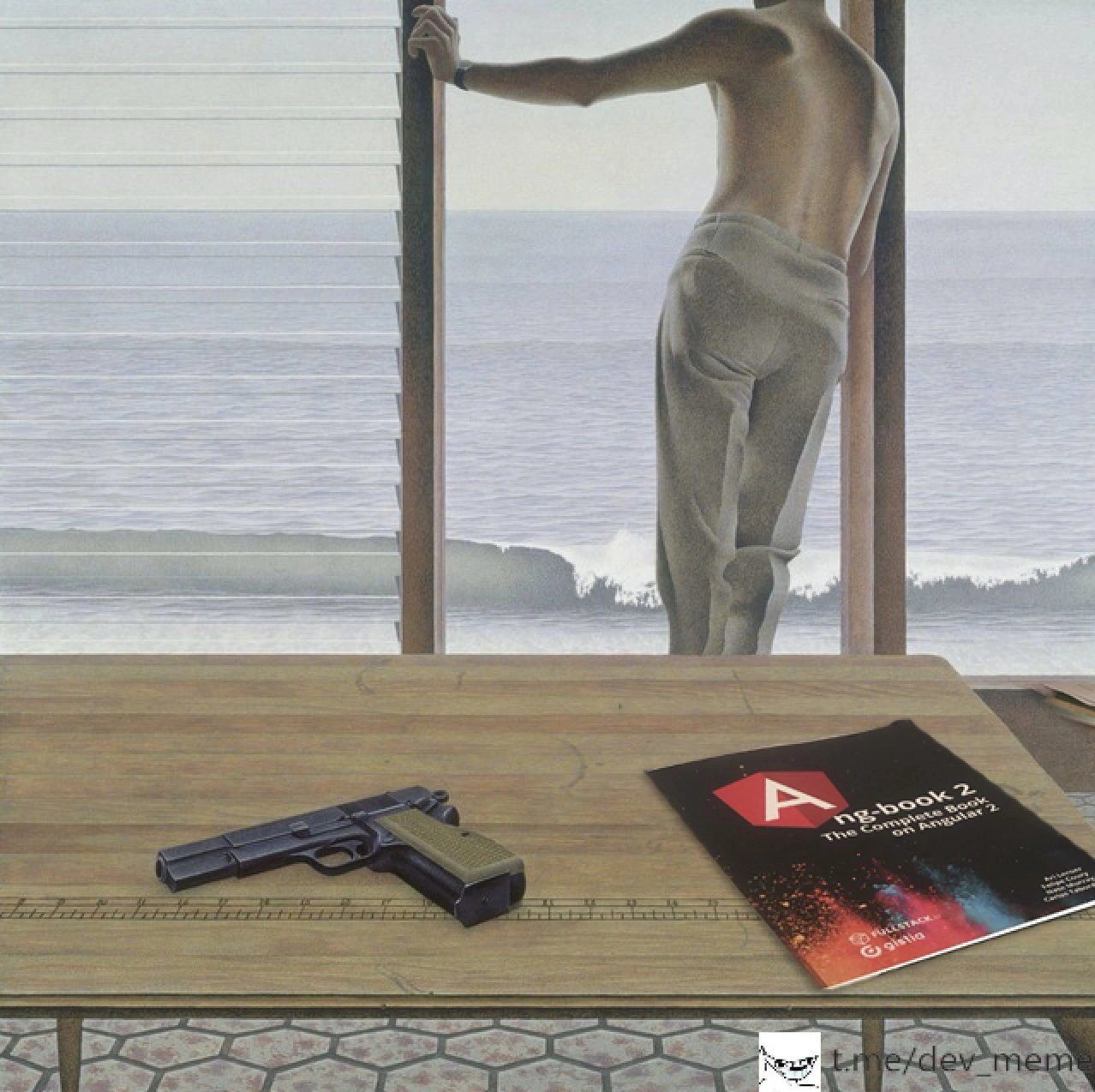
That’s exactly what’s happening in this picture, but with a big programming book instead of a toy. The man tried to learn something very complicated from a thick coding manual. It made him so frustrated that now he’s standing by the open door, staring at the peaceful ocean. He’s thinking about escaping from his hard task, the same way you wanted to escape from that impossible kit. The picture is funny because we’ve all felt like this at some point: when a task is so hard and stressful that anywhere else (even just watching ocean waves) seems like a better place to be.
Level 2: Framework Fatigue
Angular is a popular framework for building the front end of web applications. (A framework is like a set of pre-built tools and rules that helps developers build software faster and in an organized way.) Angular was created by Google and became famous for making dynamic single-page apps possible. However, the jump from AngularJS (Angular 1.x, the original version) to Angular 2 was a huge change. Angular 2 wasn’t just a small update; it completely changed how everything worked. It introduced a new programming language (TypeScript, which is like JavaScript with extra features for safety) and a whole new structure with components and modules. For developers who had spent years mastering the old AngularJS, this felt like having to relearn web development from scratch.
In the meme, the ng-book 2 on the desk is a real book that many developers used (or struggled through) to learn Angular 2. It’s a thick, textbook-like guide because Angular 2 has a lot of concepts – you have to set up an entire project, write components with special syntax (like the @Component decorator), manage data with services, handle routes, and more. Seeing such a hefty manual next to a gun is an exaggerated joke: it’s saying “this framework is so complicated, it might drive someone crazy.” The black pistol lying beside the book is dark humor showing the developer’s extreme frustration. In tech circles, people sometimes joke, “This bug is killing me,” or “I’m gonna shoot my computer,” when they’re very frustrated (not seriously, just out of exasperation). Here, the gun visually represents that kind of joke – implying the guy is at wit’s end dealing with Angular.
Now look at the developer in the background: he’s leaning on the open door and staring out at the ocean. That suggests he’s fantasizing about an escape. It’s like when you have a huge pile of homework and you find yourself gazing out the window, wishing you could just run away to play. In this case, the “window” is literally a door to a beach. The waves are calm and far away, a total contrast to the stress on his desk. The joke is that learning this framework has pushed him to daydream about quitting and going to live a simple life by the sea. The whole scene is a tongue-in-cheek way to show two extreme outcomes of intense stress: on one side, burying yourself in that enormous Angular book (hours and hours of study), or on the other side, dramatically giving up (symbolically represented by the gun or just walking out into the ocean).
This meme highlights a feeling that many programmers know too well, often called framework fatigue. Front-end development changes so quickly that developers get tired of constantly having to learn a new framework or a radically changed version. One year everyone was using AngularJS, then came Angular 2 which was completely different, and then new versions (Angular 4, 5, 6…) kept arriving. And that’s not to mention entirely different frameworks like React or Vue becoming popular around the same time. It’s exhausting to keep up! The humor here comes from recognizing that exhaustion. It’s a form of developer humor that says, “Yes, this stuff can drive us up the wall, so we joke about going off the deep end.” There’s also a bit of a mental health reminder in the joke: if a developer ever truly feels as hopeless as the guy in the picture looks, it’s a sign to step back and take a breather. By turning the struggle into a shared joke, developers remind each other that they’re not alone in feeling overwhelmed – we’ve all been there, and we can laugh at the absurdity of it together.
Level 3: Churn and Burn
This image is a portrait of framework fatigue taken to the extreme. On a wooden desk lies ng-book 2 – The Complete Book on Angular 2, a hefty tome promising to explain Google’s ambitious front-end framework rewrite. Just inches away sits a black pistol — the quintessential "I’m done with this" accessory in dark developer humor. In the background, a burnt-out programmer leans on the door frame, gazing at the rolling grey ocean waves. The scene screams existential crisis by JavaScript. It’s both absurd and alarmingly relatable: Angular’s steep learning curve has driven this coder to literally contemplate the nuclear option (a gun) or an ocean escape (just walking away from it all).
What’s going on here? Angular 2 was not just a version upgrade; it was a complete rewrite of the popular AngularJS framework. Imagine spending years mastering AngularJS (the original Angular 1.x), building apps with controllers and $scope, only to have Google drop a totally new paradigm on you. Angular 2 (later simply called Angular, with versions 2+ onward) threw out the old MVC-ish model in favor of a component-based architecture written in TypeScript. It introduced concepts like @Component decorators, NgModules, pervasive dependency injection, and reactive programming with RxJS. In short, it was a massive cognitive load on developers who thought they already knew front-end. The meme’s ng-book 2 is real – a massive compendium (hundreds of pages thick) – and seeing that brick of a book next to a gun says it all: "Learn this insanely complex framework or else."
Seasoned developers have been through this kind of framework churn before, but Angular’s shift was legendary. Companies had to decide between rewriting entire applications from AngularJS to Angular 2 or risk being stuck on a deprecated tech stack. Many of us spent late nights slogging through code migrations and debugging cryptic template errors, all while questioning our life decisions. The promised benefits of the new Angular (better scalability, structured code, a real CLI, efficient change detection) sounded great on paper. But in practice, getting there required enjoying enduring a gauntlet of new tooling and concepts. You didn’t just drop a <script> tag and call it a day anymore; you had to install Node.js, embrace the Angular CLI (ng new), configure TypeScript transpilation, set up modules and components, and learn about Observables just to display “Hello World.” That’s a lot to take in. No wonder the poor soul in the meme is frozen at the doorway, perhaps thinking it’d be easier to become a fisherman than to finish one more chapter of this tutorial.
The humor here is razor-sharp and cathartic for anyone who’s felt crushed by FrontendDevelopment complexities. The pistol on the table practically shouts the phrase every frustrated dev knows: "Just shoot me now." Of course, it’s not literally advocating violence; it’s a dark, hyperbolic way to depict extreme DeveloperFrustration. Meanwhile, the dev’s thousand-yard stare at the waves – as the tags put it, a wave_of_regret – captures that "what have I gotten myself into?" moment. It’s front_end_despair personified. We’ve all half-jokingly fantasized about escaping to a quiet beach or changing careers when drowning in a new framework. Here those fantasies are laid out plainly: a gun for the ultimate rage-quit, or the open ocean offering a clean getaway from spaghetti code and endless config files. It’s funny in a grim way because it exaggerates a truth: wrestling with a complex framework like Angular can feel utterly defeating at times.
Beneath the melodrama lies a commentary on MentalHealthInTech. Constantly relearning tools and overhauling your knowledge base for the “next big thing” can wear anyone down. Burnout in tech is very real. This meme resonates because it takes that feeling of overwhelming burnout and dresses it up with gallows humor. Even the toughest tech veterans have moments of vulnerability (we just cope by joking about it). After all, when you’re faced with a massive manual and a looming deadline, who hasn’t felt that fleeting urge to toss their laptop walk out the door and never look back? “Churn and Burn” perfectly encapsulates that blend of exasperation and dark laughter, reminding us that behind every shiny new framework are real humans trying not to lose their sanity.
Description
A meme created by photoshopping items onto a realist painting. The original painting shows a person with their back to the viewer, looking out a large window at a calm sea. In the foreground, on a wooden desk, a black handgun with a brown grip lies next to a book titled "ng-book 2 The Complete Book on Angular 2". The red Angular logo is prominent on the book cover. The scene's quiet, contemplative mood is violently contrasted by the presence of the gun and the programming book, creating dark humor. The joke is a commentary on the extreme frustration many developers felt during the transition from AngularJS (version 1) to Angular 2, which was a complete and non-backward-compatible rewrite. For senior developers who experienced this era, the meme is a relatable symbol of the pain, steep learning curve, and breaking changes associated with that specific framework migration
Comments
7Comment deleted
AngularJS to Angular 2 migration was less of a 'refactor' and more of a 'witness protection program' for your codebase. This developer is just contemplating their new identity
I keep the pistol next to the Angular 2 manual as a reminder: even steel has fewer breaking changes than migrating that codebase to v17 with standalone components and the Ivy renderer
When you realize the Angular 2 book is already deprecated but your migration from AngularJS is only 30% complete and management just approved Angular 17 for the new microservice
When the Angular 2 migration guide suggests 'just rewrite everything from scratch' and you realize your entire AngularJS codebase is now legacy code, sometimes the ocean view and existential contemplation seem like the more reasonable career path than explaining to stakeholders why dependency injection now requires understanding decorators, TypeScript generics, and the philosophical implications of Zone.js monkey-patching the entire JavaScript runtime
AngularJS→Angular 2 migration plan: ng new, re‑implement everything with RxJS and NgModules, then explain to the board why a “migration” created a new repo
Angular 2 migration kit: ng-book, an ocean to stare at, and a contingency for retiring AngularJS - ngUpgrade basically means “digest cycle vs zone.js in production until one dies of natural causes.”
ng-book 2: Where dependency injection hierarchies go deeper than your will to @Inject('sanity')