The Bitwise XOR vs. Power Misunderstanding
Why is this CS Fundamentals meme funny?
Level 1: One Symbol, Two Meanings
Imagine two friends who speak the same language, but one word means different things to each of them. One friend excitedly says, “Let’s get some chips!” thinking they’ll get french fries. The other friend hands them a bag of potato chips. Both of them said “chips,” but one meant hot fries and the other meant crunchy snacks. They pause, look at each other confused, and then realize the mix-up and laugh.
This meme is just like that, but with a little ^ symbol. One person thought ^ meant “do a fancy math power” (so the answer would be 5) while the other meant “do a special bit trick” (which would give 4). When they figure out they weren’t talking about the same thing, it’s funny and a bit embarrassing. It’s a simple joke about how the same symbol can mean two different things, and if you don’t realize that, you can end up with very different answers — and some pretty silly faces, just like in the picture.
Level 2: Bitwise Surprise
Let’s break down exactly what’s happening in simpler terms. The symbol ^ in code often does bitwise XOR, which is a fancy way of saying it compares two numbers bit by bit. XOR stands for “eXclusive OR”. It’s an operation that outputs 1 only when exactly one of the input bits is 1 (one or the other, but not both). If both bits are 0 or both are 1, it outputs 0. In truth-table form for one bit:
0 ^ 0 = 00 ^ 1 = 11 ^ 0 = 11 ^ 1 = 0
Now, numbers like 5 and 1 have multiple bits. The number 5 in binary is 101 (which is 5 = 4 + 0 + 1), and 1 in binary is 001. If we XOR them bitwise, we line up the bits:
101 (5 in binary)
^ 001 (1 in binary)
= 100 (4 in binary)
We get 100 in binary which is 4 in decimal. So 5 ^ 1 in a programming language (where ^ means XOR) results in 4. It’s like a little surprise because you might not expect it if you’re thinking in normal math. In regular arithmetic, 5^1 usually denotes an exponent: 5 raised to the power of 1. Exponentiation is a different operation entirely – it means multiplying a number by itself a certain number of times. But raising to the power 1 is simple: you just get the original number back (since 5 to the 1st power = 5).
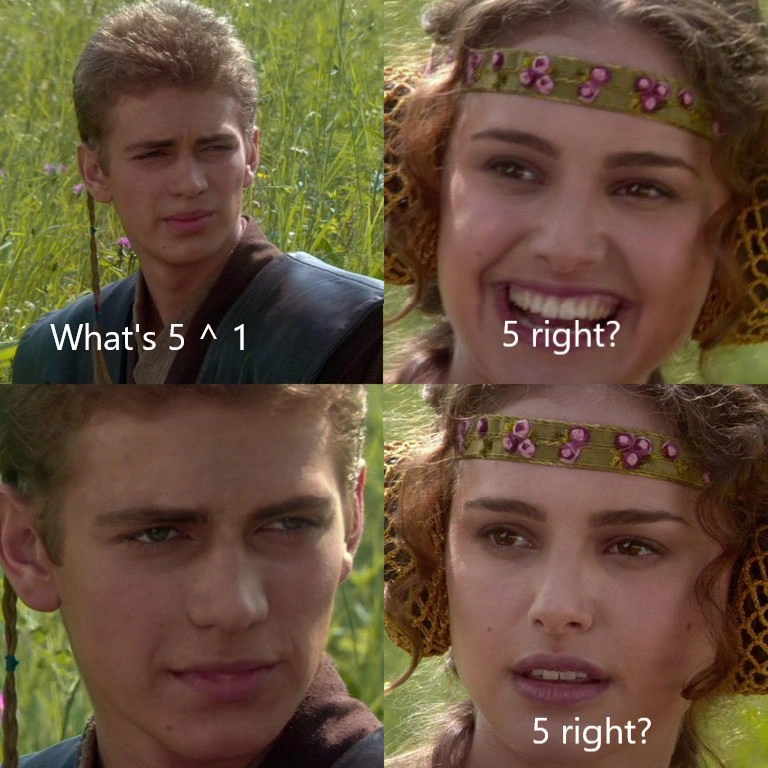
So Padmé sees “5 ^ 1” and thinks of exponentiation (because in math class or a calculator, that’s what ^ often means). She happily answers 5. Anakin, however, meant XOR – a common operation in programming for things like toggling bits or combining flags. He was expecting the answer 4. In the meme, this is why Anakin gives that blank, intense stare in the third panel: he’s processing Padmé’s answer and realizing she misunderstood his question. By the fourth panel, Padmé’s smile fades and she asks "5, right?," now uncertain. The humor is that awkward realization when you and your friend are not talking about the same thing at all.
For many new developers, this confusion is super relatable. If you’re coming from a pure math background, or say you used a tool like Excel or R where you write ^ to do powers, you might assume 5 ^ 1 means 5¹. Lots of beginners have run into bugs or weird outputs because they unknowingly used XOR. It’s one of those CS fundamentals lessons you learn early: always confirm what an operator does in the programming language you’re using. The same symbol can have totally different meanings in different contexts! This is a prime example of a Language Quirk that can cause big misunderstandings.
To see the difference in action, consider Python as an example. In Python, ^ is XOR and ** is exponentiation. Look at this tiny snippet:
print(5 ^ 1) # In Python, ^ does XOR. This will output 4.
print(5 ** 1) # ** does exponentiation (5 to the power of 1). This will output 5.
If you run that code, you’ll get:
4
5
The first line gives 4 because Python is doing bitwise XOR (0101 ^ 0001 = 0100). The second line gives 5 because it’s doing 5^1 as a math power. If Padmé had run into this Python example, she would instantly see her mistake.
The meme’s format (the Anakin–Padmé meadow template from Star Wars) is commonly used to depict one person’s confident assumption and the dawning realization of a mistake. Here, Anakin’s question is genuine from a coder’s perspective, and Padmé’s answer is a reasonable but incorrect response from a non-coder perspective. The comedic tension comes from those silent panels — you can almost hear Anakin thinking, “You did remember I meant XOR… right?”, and Padmé’s nervous “5, right?” as she grasps that she misinterpreted the question. It’s a lighthearted illustration of an operator misunderstanding. And it reminds new developers to double-check: does that symbol do what I think it does?
In short, one tiny caret caused a big confusion. New coders learn that ^ isn’t always the friendly power-up symbol they thought it was. This meme captures that eureka moment (with a bit of secondhand embarrassment 😅). It’s both funny and educational: after seeing it, you won’t likely forget what ^ means in your chosen programming language!
Level 3: Expectations XOR Reality
At first glance, this meme is poking fun at a classic language quirk in programming: the caret symbol ^ means very different things depending on context. In many programming languages (C, Java, Python, JavaScript, etc.), ^ is the bitwise XOR operation (exclusive OR). But in math notation – and some languages or tools like Excel, MATLAB, or R – ^ denotes exponentiation (raising to a power). So when Anakin (the developer in the meme) asks Padmé “What’s 5 ^ 1?”, he’s thinking in code: “what is 5 XOR 1?”. He expects the bitwise result, which is 4. Padmé, however, hears a normal math question: “five to the power of one”, so she confidently answers 5.
This miscommunication sets up the joke. The Star Wars meadow scene template perfectly amplifies it: Anakin’s smug curiosity in the first panel, Padmé’s cheerful answer in the second (“5, right?”), and then the dawning silence in panels 3 and 4 as he stares and she realizes something’s off. It’s a meme format tailor-made for developer humor about misunderstandings. The humor here comes from a shared “gotcha” moment in CS fundamentals – even a single symbol like ^ can secretly do something completely different than what a non-programmer (or a newcomer) would assume. Seasoned developers chuckle because we’ve all been there or seen it happen. It’s the classic expectation vs reality scenario, or in this case Expectation XOR Reality: one symbol, two interpretations.
Why is 5 ^ 1 equal to 4 in code? Under the hood, XOR works on binary bits. The number 5 in binary is 0101, and 1 is 0001. The XOR operation compares each bit: it returns 1 if the bits are different, and 0 if they’re the same. So:
0101 (5 in binary)
^ 0001 (1 in binary)
= 0100 (result in binary, which is 4 in decimal)
Each bit position is processed independently: only the last bit differed (1 ^ 1 would be 0), giving a result of 0100 (4). Meanwhile, 5^1 in the math sense means 51 – and any number to the power of 1 is just itself (5). The difference between 4 and 5 couldn’t be more fundamental. We have a bitwise logical operation on one side and an arithmetic exponent on the other. No wonder Padmé’s answer, while mathematically correct, earns a concerned look from Anakin.
This kind of mix-up is a rite of passage in programming. It highlights how important context is in coding syntax. A veteran developer knows to double-check what each operator really does in a given language. We grin at this meme because it’s a gentle reminder of those early days when something as small as a caret ^ could trip us up. In fact, there are countless Stack Overflow questions from confused beginners asking why 2 ^ 3 didn’t give 8 (since 2³ = 8) but instead returned 1 (because 2 XOR 3 = 1). It’s a syntax humor moment that unites us: the exclusive-or nature of XOR is sneaky if you expect an exponent! And yes, different languages choose different symbols for these operations – for example, Python uses ** for power and ^ exclusively for XOR, whereas older tools or math-focused languages might repurpose ^ for exponentiation. This inconsistency is precisely what makes such memes click with developers across the board.
Beyond the chuckle, there’s a real engineering lesson: always know your operators. Misusing a bitwise operator when you meant to do math (or vice versa) can lead to subtle bugs. In a code review, a senior engineer might even joke, “Don’t go to the dark side of bitwise ops unless you mean it.” 😉 The meme jokingly warns us that even something as innocent-looking as ^ can be an unexpected trap if you’re not careful. Padmé’s face in that last panel – “5, right? ...right?” – is basically every developer’s face when they realize their mental model didn’t match the code’s reality. We laugh because we’ve survived these bitwise vs exponent confusions ourselves and come out wiser on the other side.
Description
This meme uses the four-panel 'Anakin and Padmé' format from Star Wars: Episode II. In the first panel, Anakin asks, 'What's 5 ^ 1'. In the second panel, a smiling Padmé confidently answers, '5 right?'. In the third panel, Anakin gives a silent, knowing stare. In the final panel, Padmé's smile fades into a look of concerned confusion, and she repeats, '5 right?'. The joke hinges on the dual meaning of the caret symbol '^'. In common mathematics, it represents exponentiation (5 to the power of 1 is indeed 5). However, in many programming languages, including C++, Java, and Python, '^' is the bitwise XOR operator. The bitwise XOR of 5 (binary 101) and 1 (binary 001) is 4 (binary 100). This meme humorously captures a classic 'gotcha' moment that distinguishes between general mathematical notation and the specific syntax of programming, a common point of confusion for beginners

Comments
36Comment deleted
That's a classic interview question to filter for people who have actually written code versus people who just say they have
Polyglot microservices are great - Python insists 5 ^ 1 is 4, the legacy VB6 billing service caches 5, and the reconciliation job files a ticket titled “Schrödinger’s caret.”
After 20 years in the industry, you'd think we'd all remember that ^ is XOR, not exponentiation... but then you're debugging production at 3 AM and realize someone's financial calculations are off by exactly the difference between Math.pow() and bitwise operations. At least it's not as bad as that time the junior tried to use ** in IE11
This meme perfectly captures that moment when you realize your junior dev has been using ^ for exponentiation in production code for six months, and now you understand why the encryption module has been returning suspiciously small numbers. The bitwise XOR operator strikes again - because nothing says 'fun debugging session' quite like explaining why 5^1 equals 4, not 5, and watching the existential crisis unfold as they realize their entire mathematical worldview was built on Python's ** operator
“What’s 5 ^ 1?” - the quickest way to know if you’re looking at JavaScript (4), an Excel spec (5), or a regex commit that’s about to page on-call
PMs discovering story points: '5 < 1 day sprint? 5 right!'
Ask 'What’s 5 ^ 1?' in a code review and you’ve mapped the org: data folks say 5 (R/Excel), backend says 4 (C/JS/Python), and a staff engineer files a lint rule banning '^' outside regex so you can ship again
Nope, it's 4 Comment deleted
it depends on operator^ Comment deleted
Hello Goryunov Grigory) Comment deleted
you krnow katakana too Comment deleted
many translators give right answer Comment deleted
Wow, ur avatar looks so familiar. Comment deleted
It's from k-on Comment deleted
Thanks brother. Comment deleted
In some languages operator^ is xor (this is English-only chat, but it is not illegal to talk in other languages while you are providing the translation) Comment deleted
Fuck it, you are programmers, create a bot which will translate russian comments to english if you're so obsessed with it Comment deleted
autotranslate is shit Comment deleted
everyone just puts their russian text into google translate and posts there Comment deleted
i do not, but my native lang is Russian Comment deleted
I'm very proud of you Comment deleted
maybe later Comment deleted
can someone create bot in botfather for that? Comment deleted
🗳 +1 Comment deleted
Me too Comment deleted
token? Comment deleted
I didn't get this - Why don't you create it yourself? Comment deleted
just make a bot called "language police" that will ban or issue a warning for cyrillic 😄 Comment deleted
зачем なぜ why? btw ya mogu iapol'zovat' transleet (i can use translit) Comment deleted
also auto-translate bot will not be able to translate russian translit to english, so thats distinction without a difference Comment deleted
just for fun ofc Comment deleted
Also it can be a power operator. Comment deleted
We won't. Comment deleted
@RiedleroD Comment deleted
thanks Comment deleted
np Comment deleted