Algorithmic trading in under 100 Python lines? O’Reilly headline sparks developer skepticism
Why is this FinTech meme funny?
Level 1: Get Rich Quick
Imagine someone on TV promising, "Follow this one simple trick and you'll become a millionaire overnight!" Sounds fishy, right? This meme is joking about a headline that gives a similar vibe, but in the coding and finance world. The article title basically says, "Hey, you can beat the stock market with just a tiny Python program!"
Why is that funny? Well, it's kind of like someone claiming you can build a full-sized working car with a handful of LEGO pieces. It sounds too good to be true. People who have actually worked on these things (trading or building complex projects) know it's never that easy. If it were, everybody would already be doing it and nobody would have a 9-5 job anymore!
The meme caption jokes, "What could possibly go wrong? I guess now I can leave my 9-5 job and live lavishly." That's like saying, "Oh wow, if it's so easy, I’m gonna quit my job and start this right away!" The humor is that we all know real life doesn’t work like that. Making money in the stock market is hard, and usually requires a lot of knowledge, effort, and yes, more than a few lines of code.
So even if you’re not technical, you get the gist: someone is offering a shortcut to something that normally takes a lot of work. The experienced folks are laughing because they've seen these get-rich-quick promises before and they almost always end in disappointment. It's a gentle way of saying, "Be skeptical of easy recipes for success." If a headline says you can become a Wall Street wizard with minimal effort, there's a good chance reality is a lot more complicated. The joke's on the idea that you could magically skip all the hard parts — if only!
Level 2: Recipe for a Trading Bot
Let’s break down what that O'Reilly headline is talking about in simpler terms. Algorithmic trading means using a computer program (an algorithm) to make trading decisions in the stock market automatically. Instead of a human deciding when to buy or sell stocks, the code decides based on rules the programmer gives it. For example, an algorithmic trading rule might be: “Buy 100 shares of a stock if its price falls by 5% in a day, and sell if it goes up by 5%.” Once these rules are in the program, it can carry them out on its own, faster and often more unemotionally than a human would.
Now, "in less than 100 lines of Python code" suggests they want to show you can write a very short program to do a basic version of this. Why Python? Because Python is a popular language in both finance and data analysis due to its simplicity and powerful libraries. One such library is Pandas, which is great for handling tables of data (like a spreadsheet) inside your code. If you have stock prices for each day, Pandas lets you easily do things like calculate the average price, find the maximum/minimum, etc., with just one or two lines. That’s how they keep the total line count low — they rely on high-level libraries to do a lot of work in the background.
So, what would a basic algorithmic trading script in ~100 lines of Python actually do? Probably something like this:
- Get Some Data: First, you need stock price data. The script might use
pandasalong with an online data source to pull, say, the last year of prices for a particular stock (like Apple or Google). This data would be stored in a Pandas DataFrame, which you can think of as an in-memory Excel sheet with columns like Date, Open, Close, Volume, etc. - Compute an Indicator: Next, the script will calculate a simple indicator or signal from the data. A common example is a moving average — e.g. the average closing price of the last 10 days. Pandas can do this in one line (
data['Close'].rolling(window=10).mean()gives a 10-day moving average). The idea is to smooth out short-term ups and downs and see a trend. - Define a Trading Rule: Using that indicator, the code sets a basic rule for trading. For instance: “If the stock’s current price drops below its 10-day moving average, buy (maybe the stock is cheap now). If the price rises above the 10-day average, sell (maybe the stock is overpriced now).” This is a simplistic strategy, but it's often used as an introductory example. In code, this could be a few
ifstatements or creating a new column in the DataFrame that marks each day as "Buy", "Sell", or "Hold" based on the condition. - Simulate Trades (Backtest): Then the script would simulate following that rule over time. Starting with some pretend money, it "buys" when there's a buy signal and "sells" when there's a sell signal, and it keeps track of the money. This is called back-testing – you're testing your strategy against historical data to see how it would have performed. The code might loop through each day, or use vectorized Pandas operations to calculate the results of these hypothetical trades.
- Output the Results: Finally, the script might print out something simple like "Total profit: $X if you followed this strategy" or plot a graph of the portfolio value over time. This lets you see whether the strategy would have made money or lost money on that past data.
All of the above can indeed be done in around 100 lines, sometimes even less, because libraries like Pandas and NumPy handle a lot of the heavy lifting. For example, Pandas can calculate moving averages and even apply the trading rules across the whole dataset very concisely. The article is likely walking readers through a toy example just like this, to demonstrate the concept of algorithmic trading without getting bogged down in too many details.
Now, why is this funny or eye-roll inducing to experienced developers? Because making a profitable trading bot is not just about writing a short script. The headline makes it sound like "that's it, you're done!" when in fact, those 100 lines are only covering a very simple scenario. It's a bit like a tutorial or recipe that gives you a basic result. A senior engineer knows that turning this into something that works in the real world is a much bigger project.
Imagine a beginner cook following a recipe to bake a basic loaf of bread in 5 steps. They might get bread at the end, which is awesome for learning. But opening a bakery that consistently makes perfect bread every morning requires a lot more skill, practice, equipment, and handling lots of what-if scenarios (what if the oven temperature is off, what if the yeast batch is bad, etc.). In the same way, the O'Reilly article gives you a "recipe" to code a basic trading strategy. It’s a learning exercise. But deploying a real trading system that makes money day in, day out is like running a full bakery – way more involved!
For instance, once you have that prototype working on past data, here are extra steps you'd need before it's truly usable with real money:
- Live Data Feed: Instead of a static CSV file or a one-time download of data, you'd need continuous updates of stock prices as they change throughout the day. That means connecting to a live API or feed. Writing code to handle streaming data (and doing it reliably) is more complex. What if the connection drops? What if the data comes in faster than your code can handle? Those are new challenges beyond the initial 100 lines.
- Placing Real Trades: The example just simulates trades on historical data. To trade for real, your program must talk to a brokerage's system. This involves using the broker's API, handling authentication (keys, secrets), and formatting orders exactly as expected. And when you send an order, you have to handle the response — maybe the trade doesn’t go through, or only part of it executes. So you need code for those possibilities.
- Handling Money and Risk: The simple script might assume unlimited money and just focus on price patterns. Real accounts have limited cash, and you never want to risk it all on one bet. So you'd add rules like "only use 10% of my cash on any single trade" or "stop trading for the day if losses exceed 5%." These are risk management rules. They protect you from going bankrupt due to one unlucky streak. Implementing them means more code and careful tracking of your balance and positions.
- Monitoring & Logging: In a tutorial script, if something errors out, you can just read the error in your console. But if you're running a bot 24/7, you want it to log what it's doing (all the buys and sells, important events) and maybe even alert you if something goes wrong (like send an email or text if it crashes or if it loses a certain amount). That way, you aren’t blind to its actions. Setting up logging, alerts, dashboards, etc., all adds more complexity.
- Adapting to Change: Markets can behave very differently in different times. A strategy might work in a calm market and fail in a volatile one. Professionals will continuously refine their algorithms, add more conditions, or switch strategies when the environment changes. The initial 100 lines won't do that by itself — it would be something you have to update as you learn more.
From a newcomer’s perspective, the takeaway is: the headline isn't a lie, but it's only true within a limited scope. You really can write a simple trading bot in Python with minimal code, and it'll run through historical data and show you something. That’s an exciting and worthy project! The caution is that this simple bot is not a cash machine. If you actually put it in the real market, it's likely to run into lots of problems (and could lose money).
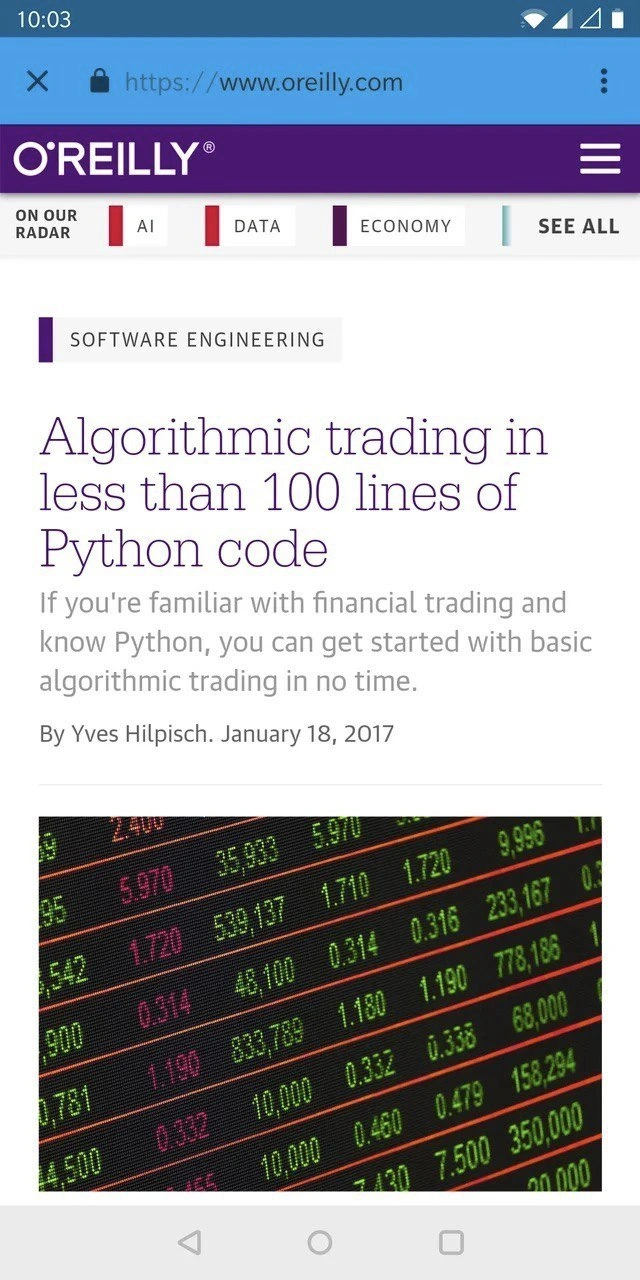
The meme is basically experienced developers chuckling and saying, "If only it were that easy!" They know that behind any successful trading algorithm, there's a ton of work. The O'Reilly article lives in the Software Engineering section for a reason: building these systems is an engineering task, not just a quick script you write and forget. The stock ticker image in the meme (with green and red numbers) represents the chaos of real markets – prices jumping up and down. It's a reminder that when you get into real trading, you're playing in a complex, fast-paced environment, not a controlled classroom example.
In short, for a junior or learner: It's totally fine to be intrigued by "algorithmic trading in 100 lines of Python" – it's a fun project to learn Python and a bit of finance. Just remember it's the first step on a much longer journey. The meme is a light-hearted warning not to get carried away by the hype. Making a few lines of code is easy; making money with them consistently is hard. The folks laughing at this have probably learned that the hard way (some might have tried similar things when they were new!). It’s all about tempering expectations: cool project, yes; instant millionaire, probably no. 😉
Level 3: 100 Lines vs Wall Street
The meme shows a screenshot of an O'Reilly article titled “Algorithmic trading in less than 100 lines of Python code.” Seasoned developers in FinTech and DataScience see that and immediately smirk (or groan). Why? Because anyone who's dealt with real trading systems knows that boasting about line count is a red flag. It's the same vibe as "Build Facebook in a weekend" or "Learn AI in 24 hours" – experienced folks recognize these headlines as extreme oversimplifications.
Here, the humor comes from the clash between the article’s promise and the complex reality of trading on the stock market. The meme’s caption drips with sarcasm:
“What could possibly go wrong? I guess now I can leave my 9-5 job and live lavishly.”
This quip imagines a naive reader actually believing they'll quit their day job and get rich overnight with a tiny Python script. Another commenter jokes, "How to get broke trying to break an economy - millennial style." In plainer terms, they're saying this is a surefire way to lose money while thinking you're about to outsmart Wall Street. It’s dark humor: those of us with experience chuckle because we know that reality will smack down such overconfidence pretty hard.
Let's unpack why the "under 100 lines" claim triggers instant skepticism. In practice, a working trading bot involves far more than a few dozen lines of code. Consider the gap between a toy example and a real trading system:
| O'Reilly's 100‑Line Demo | Real‑World Trading System |
|---|---|
Uses a few lines of Python (with pandas) to load some historical price data and maybe do a simple calculation (like a moving average). |
Has a full market data feed service pulling live prices tick-by-tick, handling network connections, data delays, and cleaning bad data. |
| Hardcoded to one stock or a static dataset for illustration. | Handles dozens or hundreds of symbols across different markets simultaneously, each potentially with its own thread or process. |
| Assumes you can buy or sell at the exact prices in the dataset (no delays, no transaction costs). | Deals with real trade execution via a broker API: encountering bid/ask spreads, order processing delays, and partial fills (when you only get some of the shares you wanted). |
| Omits trading fees, taxes, or cash limits (play-money assumptions). | Accounts for commissions, fees, taxes, and available capital. A strategy that looked profitable in theory might turn negative once you subtract real-world costs. |
| No explicit risk management – if the code says "buy," it buys, full stop. | Implements rigorous risk controls: e.g. position sizing (don’t bet all your funds on one trade), stop-loss orders (automatically sell to limit losses), and circuit breakers to stop the bot if losses exceed a threshold. |
| Probably just prints results or makes a simple plot. | Includes a back-testing framework to simulate the strategy on years of data, plus monitoring dashboards and alerts during live trading. If the algorithm goes off the rails (say, loses too much too fast), it notifies humans or shuts itself down. |
(In short, the left side is a neat little script; the right side is an entire software engineering project with many moving parts.)
Reading the article's subtext, it says "you can get started with basic algorithmic trading in no time." The key phrase is "get started." O'Reilly is likely offering a gentle introduction: a basic strategy example to spark your interest. And that’s fine — everyone has to start somewhere. The meme is just pointing out that getting started is a far cry from getting rich.
What could possibly go wrong? Seasoned devs can list plenty, tongue-in-cheek:
- Ghost signals: A simplistic algorithm will often see patterns in pure noise. It might start trading every time some random wiggle looks like a signal, racking up trades (and fees) for no real reason. End result: lots of action, no profit.
- Data hiccups: Real market data is messy. A small glitch (say, one bad price point or a missed update) could throw off a naive script. Without safeguards, your bot might make a nonsensical trade or crash. (Ever see a program choke on a
NaNvalue? Now imagine that during a trading day... not fun.) - Overfitting the past: That <100-line strategy probably was tuned to perform well on historical data (because the author picked an example where it works). But markets change. A strategy that thrived last year might tank next year. There's a saying in finance: "Past performance is not indicative of future results." An experienced dev knows a short script likely doesn't adapt to new scenarios.
- No kill switch: Without proper risk management, the bot could keep doubling down on a bad trade or refuse to cut losses. Real trading systems have checks like "if we lose X amount, stop trading!" A short demo script probably doesn’t. Imagine it keeps buying a falling stock because "the rules said so" — it can blow up your account.
- Tech troubles: What if your internet goes out, or the trading exchange’s server hiccups? A professional system will reconnect, or have redundancies. The 100-line wonder? It might just freeze or exit. Even a small downtime or bug can cost a lot. (There’s a war story about Knight Capital Group: a bug in their trading software cost them $460 million in 45 minutes. And that system had way more than 100 lines, so imagine what could happen with a super simplistic bot.)
For veteran engineers, this meme hits home because it’s so common to see complex problems oversimplified. We’ve all watched bright-eyed newcomers get excited by a quick Python script that prints some promising results. There's a mix of amusement and sympathy when we think about what comes next for them (the inevitable bugs, losses, and "oh no, why did it do that?!" moments). The meme isn’t mocking learning or beginners — it’s really poking fun at the hype that makes it seem too easy.
Wall Street and the stock market have chewed up and spat out many over-simplified trading bots. The shared joke is: if it were truly as easy as writing 100 lines of code, wouldn't we all have done it by now? The reality is, those 100 lines are just the first tiny step. The headline is an eye-catcher for an educational article, but anyone with industry experience knows that a reliable, profitable trading system demands a lot more work (and code, and testing, and headaches). The meme captures that collective head-shake and grin that experienced developers have when they see yet another "magic bullet" promise. We wish it were that easy... but we know better.
Level 4: No Free Lunch in Trading
At the theoretical extreme, the idea of beating financial markets with under 100 lines of simple code rubs against fundamental principles of both finance and computer science. In quantitative_finance, entire teams of PhDs and veteran engineers build trading platforms composed of millions of lines of code, rigorous back-testing frameworks, and complex risk controls. The notion that a lone Python script could replicate that sophistication is, to put it kindly, highly optimistic.
First, consider the Efficient Market Hypothesis (EMH). This principle suggests that if a simple algorithm could reliably generate profit from publicly available data, the opportunity would vanish quickly as others catch on — essentially, no free lunch in a well-functioning market. In quant terms, any alpha (edge) you discover with a trivial strategy gets arbitraged away until it's no better than flipping a coin.
Then there's the computer science perspective: the No Free Lunch theorem (from optimization theory) reminds us that no single strategy works best across all problems or market regimes. A 100-line toy strategy might shine on one historical dataset but flounder when conditions change; it's a classic case of overfitting. Markets are messy and dynamic — often modeled as stochastic processes with a hefty dose of randomness (some even say chaos). Capturing meaningful signals from noisy price data often requires sophisticated statistical models or machine learning. Those are built on deep math: hidden Markov models, neural networks, reinforcement learning agents. Not exactly the kind of logic you'll squeeze into a few dozen lines of code.
Risk modeling adds another layer of complexity. Market returns exhibit fat-tail distributions (the infamous black swan events where rare, extreme moves happen more often than a bell curve predicts). Writing a robust trading algorithm means accounting for those tail risks. Quants use Monte Carlo simulations (running thousands of random what-if scenarios) to estimate potential losses, or solve partial differential equations like the Black–Scholes model for option pricing. Implementing these from scratch would balloon well beyond 100 lines (or rely on libraries which themselves are thousands of lines of optimized C/Fortran).
On the systems side, an algorithmic trading bot isn't just math — it's an exercise in real-time distributed computing. Your code must ingest live stock_market_data streams, make split-second decisions, and execute trades often in milliseconds. This raises theoretical challenges in concurrency and reliability:
- Latency: In high-frequency trading, even network propagation delays become critical. Firms literally pay for faster fiber optic routes to gain microseconds. A Python script running on your laptop, with its interpreter overhead, is orders of magnitude too slow to compete in that arena.
- Concurrency: Markets don't wait for your code to finish a loop. Handling multiple price feeds and orders at once veers into multi-threading and asynchronous programming. Python’s GIL (Global Interpreter Lock) isn't exactly your best friend here, so truly competitive systems often delegate heavy lifting to compiled modules or use languages like C++ for the hot paths.
In short, the meme-worthy promise of a sub-100-line trading system glosses over the irreducible complexity at the heart of algorithmic trading. It's akin to claiming a few lines of code could solve an NP-hard optimization overnight or print free money. Seasoned engineers know that for every sleek demo script, there's a mountain of complexity lurking beneath. If such a miracle program truly existed, AlgorithmicTrading would be a piece of cake and we'd all be sipping margaritas on our private islands by now.
Description
Mobile screenshot of an O’Reilly website article. The purple - white header shows the URL bar, O’REILLY logo, hamburger menu, and top-nav pills labeled “AI,” “DATA,” “ECONOMY,” and “SEE ALL.” A gray tag reads “SOFTWARE ENGINEERING.” The bold headline in large purple text states “Algorithmic trading in less than 100 lines of Python code.” Sub-text says, “If you're familiar with financial trading and know Python, you can get started with basic algorithmic trading in no time.” Author line: “By Yves Hilpisch. January 18, 2017.” Below is a photo of a stock-ticker display with green, red, and magenta price rows on a black background. Technically, the image riffs on the perennial promise of building a full-blown trading bot with minimal code; seasoned engineers will spot the inevitable complexity behind market data feeds, back-testing frameworks, and risk controls that cannot be captured in a few dozen Python lines
Comments
10Comment deleted
The first 90 lines place the trade; the next 3 million handle slippage, FIX sessions, risk limits, compliance logs, and the phone call to Legal explaining why “except: pass” isn’t a hedging strategy
Ah yes, the classic 'less than 100 lines' promise - the same marketing that got us 'build a blog in 5 minutes with Rails' and 'deploy to production with one click.' Meanwhile, the actual production trading system has 50,000 lines of risk management, compliance checks, and edge case handling that nobody mentions in the tutorial
Ah yes, algorithmic trading in 100 lines of Python - because what could possibly go wrong when you compress decades of quantitative finance expertise, risk management frameworks, regulatory compliance, market microstructure understanding, and production-grade fault tolerance into a weekend tutorial? I'm sure those 100 lines account for slippage, transaction costs, liquidity constraints, fat-finger prevention, circuit breakers, and the inevitable 3 AM margin call when your 'basic' algorithm discovers why professionals use the other 99,900 lines
Algorithmic trading in under 100 lines; the other 250,000 are adapters, backtests, slippage models, risk kill-switches, clock sync, observability - and the part that keeps compliance from paging you at 2 a.m
“Algo trading in <100 lines of Python” - sure, as long as the other 99,900 lines are market data plumbing, FIX, latency, risk/slippage controls, compliance, observability… and the postmortem
Backtest billionaire in 100 lines; live trading pauper in one bad tick
How To Lose Money To Jews: A Python Guide Comment deleted
Jesus dude Comment deleted
Nice Comment deleted
Using 9999999999 lines of C-lib's code Comment deleted