Skip to content
DevMeme
3178 of 7435
DIY air-conditioner meme shows manager's build-vs-buy obsession in software projects
Management PMs Post #3499, on Aug 3, 2021 in TG

DIY air-conditioner meme shows manager's build-vs-buy obsession in software projects

Why is this Management PMs meme funny?

Level 1: Tape Can’t Fix Everything

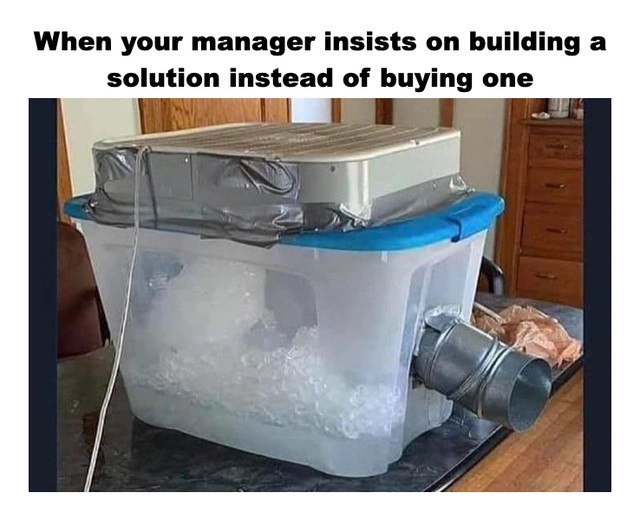
Imagine it’s a super hot day, and instead of buying a real air conditioner or a fan, your dad decides to make one at home. He takes a big plastic box, fills it with ice from the freezer, and sticks a small fan on top. He then uses a bunch of sticky tape (like duct tape) to hold it all together and attaches a tube on the side to blow the cold air out. For a few minutes, cold air comes out and it feels a little better – yay! But pretty soon the ice starts to melt. Now there’s just water sloshing in the box, the air isn’t cold anymore, and the floor is getting wet from leaks because, well, it’s just a plastic box with holes and tape. You’re sitting there thinking, “Wouldn’t it have been easier to just get a normal air conditioner from the store?”

This scenario is exactly what the meme is joking about. It’s funny because the solution is so silly and homemade. The boss (or dad, in our story) was trying to save money or be clever by building something himself, but the result is a wobbly mess that doesn’t work well. It’s like using a band-aid to fix a big hole in a boat – it might kinda-sorta hold for a moment, but everyone can see it’s not a real fix. We laugh because the homemade air conditioner is such an over-the-top example of a “cheap fix” that ends up being more trouble than it’s worth. In simple terms: sometimes when you try to avoid doing something the proper way (like buying the right tool), you end up with a goofy contraption that creates new problems. The meme reminds us of that in a humorous, easy-to-see way. It’s pointing out that you can’t solve everything with tape and ice – sometimes, you just need the real deal!

Level 2: Build vs Buy Dilemma

At its core, this meme is highlighting the build vs. buy decision in software projects, using a silly homemade air conditioner as an example. The image shows a clear plastic storage bin filled with ice, with a small AC unit jammed on top and tons of gray duct tape sealing the gaps. There’s even a round metal duct (the kind used in house HVAC systems) stuck crudely into a hole in the side of the bin, presumably to blow out cold air. The caption says: “When your manager insists on building a solution instead of buying one.” This is a common scenario in tech and business: should we build something ourselves from scratch, or buy (or otherwise adopt) an existing solution?

In the picture, the “problem” is cooling a room. The normal approach would be buying an actual air conditioner or proper cooling device. But the manager in the meme represents someone who says, “No, let’s build our own cooling system!” So the team (or whoever) literally builds a makeshift AC out of a bucket of ice, a small second-hand cooling unit, and duct tape. It’s extremely DIY (Do-It-Yourself), and frankly, it looks janky (slang for low-quality or unreliable). We immediately sense that this contraption is not very robust compared to a real AC. This visual gag translates to software engineering: a manager decides the team should write their own software solution in-house instead of using a ready-made product. The phrase “insists on building a solution instead of buying one” could apply to many things in tech: reimplementing a logging library, creating an internal version of Slack, making a custom analytics dashboard, etc. It’s a Management_PMs trope that management sometimes pushes for a homegrown solution, perhaps to save money or because they trust their team’s abilities (or just their own ideas) more than external options.

Let’s define some terms here:

  • Build vs Buy Decision: This is a choice companies often face – do we build the software/tool ourselves or do we buy something existing (or use an open-source project, or pay for a SaaS)? “Build” means using internal developer time to create a custom solution. “Buy” can mean literally purchasing software, or just adopting a free open-source library (which still saves you the effort of writing it all). Each approach has pros and cons. Build gives more control and custom tailoring, but takes more time and means you’re responsible for maintenance. Buy is quicker to get started and usually you benefit from vendor support or community support, but it might cost money or be less custom-fit to your exact needs.

  • Technical Debt: This meme is also about technical debt. Technical debt is a metaphor in software engineering – if you take a shortcut or quick-and-dirty approach now, you’ll “repay” the debt later with interest, meaning it will cause extra work down the road. For example, skipping writing tests or making a hacky fix might solve an immediate problem, but it creates fragility; you’ll spend more time fixing bugs or refactoring later than you saved upfront. In the meme, the hasty DIY air conditioner is a shortcut – it does provide some cooling right away, but it’s going to require a lot of extra work (regularly adding ice, cleaning water, fixing tape) to keep it running. That extra work is like the “interest” on the initial shortcut.

  • Duct tape solution: This is a common phrase for a makeshift fix. Just as duct tape can temporarily fix almost anything in real life (at least for a short time), a “duct tape solution” in coding means a quick fix or an improvised solution that isn’t very elegant or long-term. It implies the solution is not solid – it’s patchwork. In the image, they literally used duct tape to seal things, which is why it’s so perfect. Engineers might say “the system is held together with duct tape and prayers” meaning it’s very fragile.

  • Not Invented Here (NIH): You might hear this term in engineering circles. NIH syndrome is when a company or team tends to reject using solutions that are “not invented here,” i.e., made by someone else. For instance, if there’s a great library available to do something, but the team lead says “We shouldn’t use it, we can implement our own,” that could be NIH. It can come from a belief that “our needs are so special that only we can do it right” or sometimes from not-invented-here pride (“we want to own all the technology we use”). The downside is you end up spending time building things that already exist, often with worse results because you’re reinventing the wheel under pressure. In the meme’s scenario, an NIH mindset would be ignoring the existence of perfectly good air conditioners on the market and instead concocting this weird homemade cooler.

Now, why would a manager insist on building instead of buying? Common reasons include:

  • Cost Savings (or so they think): Managers often have budgets to worry about. Purchasing software or hardware can be expensive, while using existing staff to create something might appear cheaper. In the air conditioner case, maybe the manager didn’t want to spend money on a new AC unit, thinking the team could assemble one cheaply. In a software case, a manager might balk at a yearly license fee for a product or think paying for a third-party service is too much, and say “we’ll develop our own for free.” They might not account for the hidden cost of developer hours and ongoing support. Remember, developers’ time isn’t free – they are being paid salaries – but that cost is a bit hidden in the engineering budget and sometimes managers act as if using existing staff has no additional cost.

  • Control and Custom Requirements: Sometimes the available off-the-shelf solutions don’t meet 100% of the requirements. A manager could argue that “if we build it ourselves, we can tailor it exactly to our needs.” This is a valid point in some cases. However, custom-building everything can lead to overengineering small differences, and you lose out on all the robustness and features of a mature product. In the meme, maybe the manager thought a normal AC wasn’t exactly right for the situation (perhaps too large or not the right shape) and so they improvised one to fit their idea. In software, an example might be “This project management tool doesn’t match our workflow, let’s code our own tool from scratch!” – which can be risky unless that’s your company’s main domain of expertise.

  • Timeline Misjudgment: There’s often a misconception that “how hard can it be?” to build something. Non-engineers or inexperienced managers might vastly underestimate the effort required to build a fully functional, reliable system. They might think a developer can whip up an equivalent to a well-established product in a short time, since initial prototypes can sometimes be made quickly. But making something production-grade involves handling many edge cases, performance issues, security, etc., which take a lot of time. In the homemade AC example, one might think “AC is just cold air, we can do that easily!” Only after building do they realize real air conditioners have a lot of engineering behind them (coolant cycles, proper insulation, thermostats, etc.). Similarly in software, what starts as a weekend prototype can turn into months of work once you realize all the features you actually need for it to work well.

The consequences of choosing to build when you should have bought are exactly what the meme shows in a comical way. The DIY air conditioner technically works, but it’s clearly not optimal:

  • It’s fragile – you can see it might fall apart or leak at any moment. This mirrors how a self-built software might be fragile (easily crashes or breaks under unusual conditions).
  • It requires manual effort – someone has to continuously replenish the ice. In an analogous software scenario, the homemade tool might require a lot of hand-holding by developers (manually fixing data, re-running scripts, etc.) whereas a commercial solution might automate that or have support provided.
  • It’s likely inefficient – a real AC is designed for cooling; this thing probably wastes a lot of ice and electricity for minimal cooling. In software, a quick custom solution might be much less efficient or scalable than a professionally designed product. For example, an in-house logging system might slow down applications or not scale well, whereas a dedicated third-party logger would be optimized for performance.

For a junior developer or someone early in their career, the lesson here is to be aware of the “reinventing the wheel” trap. Reinventing the wheel means you create something from scratch that already exists. It’s not always bad – sometimes you do need a custom solution – but you should be cautious and realistic about it. If you find yourself or your team saying, “Let’s code our own version of [database/cache/payment system/etc],” make sure to weigh the decision carefully. Ask questions like: Is this our core business or expertise? Do we have time to maintain this long-term? What are we gaining by building it ourselves? Often, using an existing solution (whether by buying, licensing, or using open source) can save a lot of headaches. There’s also the famous saying in programming: “Don’t reinvent the wheel, unless you plan on learning more about wheels.” The idea is that reinventing can be a good learning exercise, but in a production environment with deadlines and customers, it’s usually better to stand on the shoulders of giants and use the wheels already available.

The humor in the meme also serves as a gentle warning. Pretty much every developer can share a story of a project where the team built something internally that, in hindsight, they should have just bought or used off-the-shelf. Maybe it was an in-house CMS (content management system) that became a nightmare to support, or a custom analytics pipeline that consumed endless dev hours. These stories become EngineeringHumor later (we laugh so we don’t cry). You, as a newer dev, might not have experienced this yet, but keep an eye out. Even on a small scale, you might face it: like deciding whether to use a well-known library or write your own utility functions. The meme’s extreme visual helps you remember – sure, you can tape together your own solution, but be aware of what you’re getting into. A homemade fix might feel clever at first (“Look, it’s working!”), but a proven solution might save you a lot of trouble overall.

In summary, the second level explanation of the meme is: a manager chose a homemade, taped-together approach rather than a reliable store-bought solution, and it highlights the silliness and risk of doing so in engineering projects. The picture with the ice-box air conditioner makes the point that while the custom-built route can be done, it often results in a subpar, maintenance-heavy outcome. The meme is funny to those in tech because we immediately relate it to software projects where this exact thing happens – and it usually ends up just as messy as melting ice water all over the floor.


Level 3: Duct Tape Architecture

When engineering meets budget constraints and managerial ego, you get solutions like this duct_tape_solution monstrosity. The meme’s homemade air conditioner is a perfect metaphor for a manager’s build vs buy obsession gone awry. Instead of purchasing a well-built system, someone in charge insisted on a manager_driven_diy approach – and the result is a janky_hardware_prototype held together (quite literally) by duct tape. Experienced developers see this and immediately think of all those times leadership said, “We can save money by coding it ourselves!” only to end up with a fragile quick_and_dirty_fix. It’s the classic BuildVsBuyDecision dilemma taken to absurdity: the manager sees a “cost-effective” custom solution, while the engineering team sees a pile of technical debt about to spring a leak.

In real software projects, this scenario is alarmingly common. A manager might refuse to license a proven third-party product or cloud service, declaring “Our team will build our own version for free!” The top caption “When your manager insists on building a solution instead of buying one” perfectly captures that ManagementHumor. We laugh (perhaps darkly) because we’ve lived it. The homemade AC unit – a plastic bin of ice with a repurposed cooler and duct tape – mirrors those in-house systems thrown together from spare parts and optimism. This is architecture_tradeoff_meme material: trade a small upfront cost (buying a real air conditioner) for a large ongoing cost (maintaining a bad DIY system). The manager likely patted themselves on the back for BudgetConstraints heroics, but everyone else knows this saving is an illusion. The true cost gets paid in endless maintenance, emergency fixes, and misery when the contraption fails on the hottest day.

Let’s break down why this is humorous and painfully accurate from a senior dev perspective. Consider the differences between buying a solution vs. building it in-house:

Buy a Proper Solution Build a DIY Solution
Design Professionally engineered, well-tested product Cobbled together with duct tape and hope
Reliability Known reliability, comes with support/warranty Unpredictable bugs, no external support (you're on your own)
Cost Upfront purchase/licensing cost “Free” initially, but incurs massive technical debt over time
Team Effort Frees developers to focus on core product work Consumes dev time for reinventing wheels and endless maintenance

As the table shows, the DIY route often turns into a classic TechnicalDebt trap. Technical debt is the accumulation of compromises and quick_and_dirty_fix implementations that must be “paid back” later with refactoring and bug fixes (much like interest on a loan). In our meme, the bin AC works for now, but someone will be stuck constantly refilling ice and dealing with puddles. Likewise, a hastily built software tool might function at first, but it demands continuous patches and babysitting. The duct tape sealing that hacky_cooling_system is a dead giveaway: in software, we use “duct tape” as slang for any provisional, shaky fix. Seasoned devs joke about “duct-tape coding” when a codebase is full of kludges just to keep things running. Here it’s literally duct tape – an amusingly on-the-nose symbol for a system that’s one jostle away from falling apart.

Why do such situations arise? Often due to Not Invented Here (NIH) syndrome and misguided confidence. NIH syndrome is an engineering anti-pattern where teams avoid using existing solutions simply because they weren’t built internally. A manager deep in NIH territory might say, “Sure, that vendor sells an air conditioner/library, but we can do it better in-house!” There’s a bit of pride and control-freak nature involved. They imagine the team as ingenious MacGyver-like problem solvers who can whip up anything cheaply. In reality, building a robust system is almost always harder than it appears at first glance. For example, a manager might think, “Why pay for a database backup tool? We can write some scripts ourselves.” A month later, those scripts have evolved into a convoluted, buggy internal tool that technically backs up data… until it silently fails on a weekend. By Monday, the team is in crisis mode, and that “free” solution has cost countless engineering hours.

The homemade air conditioner highlights the absurdity of this manager_driven_diy logic. Just as balancing a heavy AC unit on a flimsy plastic lid is asking for trouble, deploying a half-baked in-house system to production is courting disaster. It’s funny because it’s true: the CorporateHumor hits home when we recall our own “ice-box tech” experiences. Perhaps the build vs buy fiasco was an attempt to avoid a license fee, or because “we have developers sitting idle, let’s use them!” Some organizations treat developer time as if it’s free, ignoring that those developers could be building the company’s actual product instead of reinventing commoditized tools. The manager in the meme likely boasted about saving money on an AC, much like ones who brag about saving subscription costs – but the TechnicalDebt interest will come due. The dev team ends up on call for a system that any sane person would have just paid for.

There’s a rich irony here: the manager’s solution is itself a problem. The contraption looks ridiculously fragile; one bump and that heat-exchanger could tumble off. Similarly, many homegrown software solutions are one minor update away from crashing. I’ve seen internal tools so precarious that only one person knew how to keep them going – the equivalent of having one guy who knows which corner to kick on the duct-tape AC to make it start. And guess what happens when that person leaves the company or is on vacation? Cue the midnight emergencies. Indeed, the sight of loose ice in the bin makes me chuckle darkly: it’s like a temporary fix that’s literally melting away. In software terms, that’s a system with resources that deplete constantly (like memory leaks or cron jobs that need manual restarting).

The meme strikes a chord because it exaggerates a very real phenomenon. DesignPatterns_Architecture textbooks encourage using well-known solutions (don’t reinvent the wheel, reuse components, etc.), but reality in many companies is far from ideal. Under pressure, teams build duct_tape_solution prototypes that somehow become permanent. They might call it a “minimum viable product” (MVP) to justify its shaky state, intending to replace it later – but later never comes. The quick hack quietly becomes a mission-critical system. This is akin to initially using a plastic ice bucket AC “just for this weekend” and then still using the same rig 3 years later every summer, adding more tape each time something cracks. Senior developers have a mix of laughter and PTSD seeing this image, because we’ve maintained those tape-ridden systems. We know that temporary solutions often outlive their intended lifespan.

Crucially, the humor has an edge of caution: architecture trade-offs made in haste can haunt you. It highlights the technical debt hangover waiting down the line. Sure, maybe you got that feature working by coding it all from scratch under a tight deadline, but now you own that code – bugs and all – forever. The manager got their “solution” and possibly accolades for ingenuity or cost-saving this quarter, but six months later, the dev team is swamped fixing issues with the DIY system. It’s like the manager built a Franken-product and said “Ship it!”, and now the team has to play Dr. Frankenstein’s assistant, keeping the monster alive. One can imagine an exasperated engineer thinking, “We could’ve been releasing new features, but nope, here I am spending my day shoveling ice cubes into our production server cooling rig.” The EngineeringHumor here is that engineers often end up doing maddening manual work to support a contrived system, all because someone upstairs was penny-wise and pound-foolish.

In summary, this meme uses a hilariously pathetic homemade air conditioner to symbolize the TechDebt and frustration that come from a manager’s insistence on building everything themselves instead of buying or using reliable solutions. It’s a nod to every over-engineered internal tool, every “we have AC at home” situation, and every developer who’s had to patch a leaking ship that could have been avoided by simply acquiring a solid boat in the first place. It’s funny to seasoned devs because it’s so relatable – we’ve all seen the plastic tub of ice in one form or another in our careers, and it never ends well.


Description

The meme shows a photo of a makeshift air conditioner assembled from a clear plastic storage bin packed with loose ice. A blue snap-on lid has a small window-unit heat-exchanger balanced on top and sealed in place with several layers of silver duct tape, while a short length of round HVAC duct sticks out of a roughly cut hole on the bin’s side. Bold black caption text above the image reads: "When your manager insists on building a solution instead of buying one". Visually, the contraption looks fragile and cobbled together, mirroring the improvised, low-budget tools engineering teams sometimes ship. Technically, the joke references the build-vs-buy dilemma, highlighting how managerial cost pressures can drive home-grown solutions that accrue technical debt and maintenance headaches

Comments

11
Anonymous ★ Top Pick Build > Buy sounds great until Finance notices the TCO now includes a principal engineer on a 24/7 “refill the ice” pager rotation
  1. Anonymous ★ Top Pick

    Build > Buy sounds great until Finance notices the TCO now includes a principal engineer on a 24/7 “refill the ice” pager rotation

  2. Anonymous

    After 15 years in tech, I've learned that every 'simple custom solution' starts as a plastic container with duct tape and ends as a distributed microservices architecture requiring a dedicated SRE team, three Kubernetes clusters, and a $2M annual AWS bill - all to replace what Salesforce does for $50/month

  3. Anonymous

    This is the physical manifestation of every 'we'll just build our own auth system' decision - sure, it technically works, but you're one duct tape failure away from a P0 incident, and the total cost of ownership makes that enterprise SaaS license look like a bargain. At least when this thing leaks, you only flood your kitchen, not your production database

  4. Anonymous

    Build vs buy: we skipped the license fee, and now our SLA is measured in bags of ice, our TCO is duct tape, and the only vendor support is whoever’s on-call at Costco

  5. Anonymous

    Classic build‑vs‑buy: we avoided vendor lock‑in and achieved ice lock‑in - the SLA is whatever the melt rate allows

  6. Anonymous

    Build vs. buy: Managers save on licenses, we spend years maintaining the peanut-powered monolith that outages weekly

  7. @RiedleroD 4y

    haha, like when you have to build your own JSON parser wait

    1. @azizhakberdiev 4y

      Rather it is when you use different libraries only because each of them has one function you need

  8. @Rumbatutumba 4y

    motorized bong, nice

    1. @RiedleroD 4y

      you know them diesel bongs

  9. @kitbot256 4y

    But now they have acquired some new expertise and their CV looks way better!

Use J and K for navigation