Skip to content
DevMeme
4041 of 7435
The Evolutionary Path to Over-Engineering
DesignPatterns Architecture Post #4404, on May 31, 2022 in TG

The Evolutionary Path to Over-Engineering

Why is this DesignPatterns Architecture meme funny?

Level 1: When Looking Breaks It

Imagine you have a cool magic trick that works perfectly when you practice alone in your room. You throw a ball in the air and catch it behind your back every single time – amazing! But the moment your friends come and watch you try it, thud! – the ball drops to the ground on the first try. You get frustrated and shout, “It only fails because you’re all watching me!” Of course, your friends watching isn’t really causing you to mess up the trick, but it feels like that because every time they observe, things go wrong.

This meme is just like that, but for coding. The programmer thinks they have the perfect plan to solve a problem (like knowing exactly how to do the magic trick). But when the computer checks their work (the tests watching the code run), everything falls apart. The funny part is the programmer (through the cartoon Professor) is jokingly blaming the act of checking for the failure: “No fair, it broke because you looked at it!” It’s a silly way to express feeling upset and puzzled. We all know usually things don’t break just because someone looked, but when you’re unlucky it sure can seem that way. The meme makes us laugh because we’ve all had moments where something only goes wrong when someone is paying attention, and we half-jokingly blame the “looking” as the reason – even though deep down we know we just need to practice (or, in the coder’s case, debug the code) a bit more to get it right.

Level 2: Algorithm vs Implementation

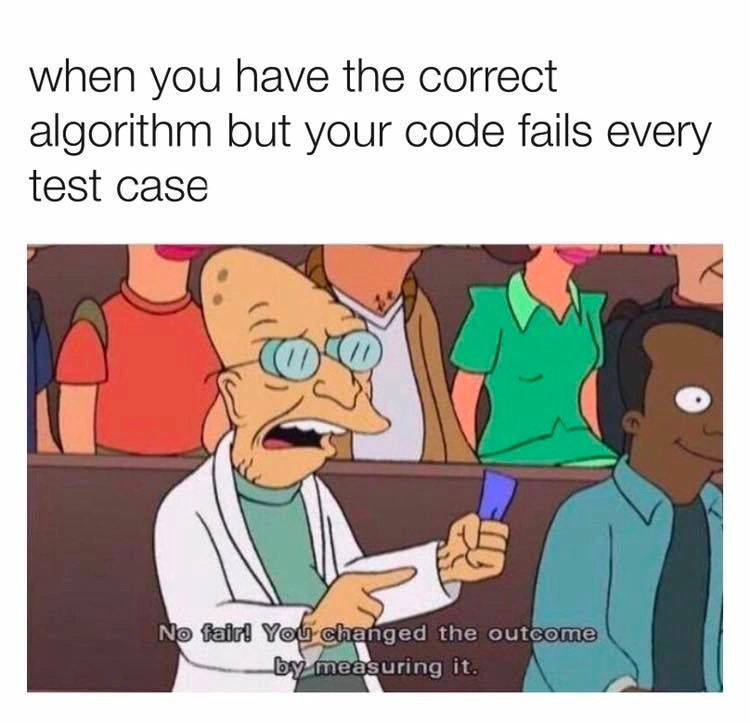
Let’s break down what’s going on in simpler terms. The top caption says: “when you have the correct algorithm but your code fails every test case.” An algorithm is basically a step-by-step solution to a problem – the logic or recipe you plan out. So having the “correct algorithm” means in theory, the plan for solving the problem is right. However, the implementation (the actual code you wrote from that plan) isn’t working as expected, since it “fails every test case.” Test cases (specifically unit tests) are automated checks that feed your code input and compare the output against the expected result. If your code fails all the tests, it means there’s a serious disconnect between what you intended and what you actually coded.

Now, the image below the caption is from Futurama, a sci-fi cartoon popular with many programmers. It shows Professor Hubert Farnsworth, an eccentric old scientist character, in a courtroom scene. He’s pointing angrily and holding a card, with a subtitle of him yelling: “No fair! You changed the outcome by measuring it.” This line is a reference to the scientific idea of the observer effect. In plain terms, the observer effect is when simply checking or measuring something changes what you’re trying to observe. It’s a concept from physics – for example, if you try to measure the air pressure in a tire, a little air might leak out when you attach the gauge, so the very act of measuring changed the pressure slightly. Professor Farnsworth is accusing someone of doing exactly that: altering the experiment’s result just by observing.

So how does this relate to coding? The meme is comparing that idea to a programmer’s situation where the act of testing the code seems to be affecting the code’s behavior. It’s a tongue-in-cheek way to express frustration when your code is acting illogically. There’s even a programming slang term for this kind of situation: a Heisenbug. A Heisenbug is a pun named after physicist Werner Heisenberg, because of his uncertainty principle. In software, a Heisenbug is a bug that goes away or changes when you try to hunt it down. For example, say your program crashes every time you run it normally. But the moment you run it with a debugger or add some print statements to see what’s going on, it stops crashing. Infuriating, right? It’s like the bug knows you’re watching, so it hides. That’s why we connect it to the observer effect – it feels like observing the program (by testing or debugging it) “magically” makes the bug disappear or the outcome different.

In our meme’s scenario, the developer truly believes their solution is correct (and maybe the core idea is correct), yet the unit tests all come back red (failing). Unit tests are small targeted tests for pieces of your code. If they’re all failing, something is fundamentally wrong in how the code is written or how it’s being used. It could be a trivial mistake in code or something tricky like the test environment being different from what the developer expected. Often newbies (and, honestly, all of us) run into situations where the code should work, but doesn’t – maybe because of an overlooked detail. It’s easy to then feel exasperated and half-jokingly blame the tests: “These tests must be broken, my logic is flawless!” This is exactly what Farnsworth’s dramatic accusation represents in a humorous way.

Let’s connect some of the tags and context:

  • AlgorithmHumor: The joke starts with the idea that having the perfect algorithm isn’t enough if your implementation is wrong. It’s poking fun at the gap between concept and reality. You might have learned the ideal solution (say, an optimal sorting algorithm), but if you code it incorrectly (maybe you swapped two indices wrongly), it fails tests. Oops!
  • DebuggingFrustration and BugsInSoftware: Debugging is finding out why your code isn’t working. It can be frustrating, especially with elusive bugs. The meme captures that frustration – the developer is so frustrated they’re essentially accusing the testing process of causing the problem. Of course, in reality, the tests just revealed the problem; they didn’t create it. But when you’re debugging for hours, it sure might feel like the universe is playing tricks on you.
  • UnitTesting and TestingHumor: In good software practice, we write unit tests to catch mistakes. Here, all the unit tests failing is the nightmare scenario – nothing works and you don’t know why. The humor comes from the absurd reaction: rather than calmly fixing the code, the developer (via Farnsworth) yells a physics joke. It’s a way to lighten the mood about an otherwise stressful part of coding.
  • Heisenbug (we described this, the hide-and-seek bug) and observer_effect: These tags point to the core reference. The observer effect in programming is not a literal scientific law, but we use it metaphorically. The meme exaggerates a developer's claim that “My code only fails because the tests are looking at it!” Obviously, tests don’t change the code’s logic – they just report the output. But sometimes running code in a different setting (like on a Continuous Integration server, or with extra logging) does lead to different behavior. That’s often due to things like timing, randomness, or uninitialized variables – not because the test inherently changed it, but because the conditions of observation were different. Still, it can feel like the act of observing was the cause.
  • flaky_tests and ci_pipeline_failures: A CI pipeline (Continuous Integration pipeline) is an automated process that builds and tests code on a server every time you push changes. A flaky test is a test that sometimes passes and sometimes fails, even when nothing in the code changed. This could be due to, say, a test depending on the current time or an external service that isn’t consistent. Developers get very annoyed with flaky tests. Imagine you run tests locally – all green. Then on the CI server one test fails. You rerun the pipeline and now it passes. That inconsistency is exactly what makes you think “Did my act of testing affect it somehow?” The meme resonates with that: it’s like Farnsworth yelling at the CI server, accusing it of messing with the results just by running the tests.

Finally, note the futurama_reference: Using a frame of Professor Farnsworth is a nod to a show many techies love for its science humor. Farnsworth often makes science jokes (or wild claims) in Futurama. So seeing him shout about changing outcomes by measuring is instantly recognizable and extra funny to those who know the show. Even if you don’t know him, you can tell he’s a scientist-looking character losing his cool, which perfectly sells the image of a programmer losing patience with baffling test failures.

In short, this meme’s content is saying: “I swear I did everything right, but reality (or these tests) is telling me I’m wrong… gah, maybe the very act of testing is screwing it up!” It’s a jokey way to convey the exasperation when code fails despite our confidence in our solution. And along the way it slips in a bit of nerdy quantum mechanics humor – because why not? It’s the kind of joke you start to appreciate as you dive deeper into debugging and realize sometimes truth is stranger than fiction in software.

Level 3: The Heisenbug Hypothesis

For seasoned developers, this image hits on a painfully familiar scenario: “My logic is sound; it should work! So why are all the tests failing?” The meme pairs that feeling with Professor Farnsworth’s over-the-top accusation that measuring caused the failure. It’s a perfect storm of software humor. We have a theoretically correct solution (the algorithm works in principle) but in practice our code fails every unit test. In disbelief and frustration, we start wondering if the tests themselves are somehow to blame – much like Farnsworth accusing the observer of altering reality. This is senior-dev sarcasm at its finest: of course the tests aren’t really quantum jinxing our code… except, well, sometimes it feels that way!

What’s being satirized here is the classic disconnect between theory and practice. As any experienced programmer knows, having a correct algorithm on paper doesn’t guarantee a correct implementation in code. Maybe there’s an off-by-one error, a forgotten null check, or a mis-handled edge case causing those red test failures. But emotionally, it’s so tempting to blame something else – “It works in my head, so the failing tests must be wrong!” Farnsworth’s dramatic pointing embodies that irrational moment of blaming the messenger (the tests) rather than the message (the bug in our code).

The meme also nods to the slippery nature of certain bugs in software that we dread encountering. The tags scream Heisenbug for a reason. Seasoned devs swap war stories of bugs that only appear in production or only when the debugger isn’t attached. For example, you might have a multi-threaded program that occasionally crashes or miscalculates, but whenever you try to debug it, it behaves perfectly. It’s absolutely infuriating. Imagine a shared counter without proper locking: in a normal fast run it sometimes returns the wrong total due to a race condition, but if you slow things down with logging or a breakpointer, the threads interleave differently and the count miraculously comes out correct. The bug seems to hide whenever you shine a light on it. This is the quintessential debugging frustration the meme highlights. We laugh (perhaps a bit bitterly) because we’ve all shouted some equivalent of Farnsworth’s line at our screens at 3 AM: “No fair! It only breaks when I’m not looking!”

In real-world scenarios, this can happen with flaky tests in a CI pipeline. You push your code, you’re confident in that elegant algorithm, but the continuous integration server flags a failure. You rerun the tests – they pass. Run them again – now one of them fails on a different assertion. It’s maddening. These flaky tests might be caused by subtle timing issues, uninitialized variables, or environment differences (maybe the CI runs on a slightly different OS, or the database container wasn’t ready). It feels like the act of running the test suite itself influences the outcome. A common inside joke: “Works on my machine! The CI must be cursed.” That’s Farnsworth in a nutshell here, blaming observation itself.

Let’s consider a quick concrete example that senior devs will recognize. Say we have a simple shared counter in a multithreaded program:

import threading

counter = 0

def increment():
    global counter
    for i in range(1000):
        counter += 1  # not thread-safe!

# Launch two threads that increment simultaneously
threads = [threading.Thread(target=increment) for _ in range(2)]
for t in threads: t.start()
for t in threads: t.join()

print("Counter value:", counter)

In theory, with two threads adding 1000 each, counter should end at 2000. But without proper locking, a race condition may occur: the threads interfere and counter might end up a bit less than 2000. Now here’s the kicker – if you insert a harmless log inside the loop (like print(i) every 100 iterations), the extra delay can make the race condition far less likely to misfire, and you might consistently get 2000. The bug “disappears” when observed via logging. This is a mini Heisenbug. To a frustrated developer, it really does feel like observing the system changed its behavior.

From a senior perspective, the humor also lies in how dramatically Farnsworth (a beloved nerdy character from Futurama) encapsulates that gut reaction. He’s effectively putting the unit tests or the CI pipeline on trial, as if they tampered with the code’s outcome. It’s an absurd reversal of blame – tests are supposed to be impartial judges, but here the developer (through Farnsworth’s voice) accuses the judge of foul play! Every experienced programmer recognizes this tongue-in-cheek scenario: we’ve all had moments of doubting our tools or feeling like the universe is unfair when a seemingly correct solution just won’t pass the tests.

There’s also a bit of meta-humor in invoking quantum mechanics and a Futurama character in a coding context. Devs love sneaking in scientific references; terms like Heisenbug and jokes about Schrödinger’s cat (where a bug is both alive and dead until observed) are part of our cultural lexicon. It’s a way to cope with the insanity of debugging by joking, “Maybe it’s quantum mechanics messing with my code.” The meme is basically a screenshot of a shared inside joke: tests failing for no visible reason? Let’s half-jokingly blame quantum physics!

In summary, at the senior engineer level this meme is painfully funny because it exaggerates a real phenomenon. It’s Testing Humor meets Algorithm Humor with a dash of sci-fi geekery. We see the correct algorithm versus wrong output dilemma, the specter of a bug that defies normal logic, and the developer’s theatrical frustration captured by Farnsworth’s outrage. The humor works on multiple levels: it’s referencing a specific kind of bug (Heisenbug), it’s highlighting human nature to deflect blame when we’re baffled, and it’s using a cartoon professor to dramatisize what every developer has felt internally. If you’ve ever sat in front of red failing tests utterly perplexed, this meme is a way of saying “I feel your pain” – with a big knowing laugh.

Level 4: Schrödinger’s Test Case

At the most theoretical level, this meme riffs on the observer effect – a concept from quantum physics – as it manifests in software. In physics, measuring a system can disturb it: shine a light to measure an electron’s position and you inevitably nudge it, altering its path. In the world of code, we see an analogous paradox with Heisenbugs. A Heisenbug (named after Werner Heisenberg of uncertainty principle fame) is a bug that seems to vanish or change behavior when you try to observe or debug it. This is the ghostly phenomenon Professor Farnsworth is alluding to by shouting, “You changed the outcome by measuring it!”

Under the hood, observing a program means introducing something new – extra logging, breakpoints, instrumentation – which ever so slightly changes the program’s timing or memory layout. These microscopic changes can collapse the “wavefunction” of a bug. For instance, a race condition might only surface under exact timing conditions; attach a debugger (which slows down thread execution) or even insert a harmless printf, and suddenly the timing shifts and the race disappears. It’s as if the act of peeking inside the system alters its state. This isn’t magic or true quantum behavior – it’s rooted in computer architecture and runtime dynamics. Modern CPUs and compilers optimize code in ways that aren’t always deterministic across runs; adding a debug statement might prevent an optimization or align memory differently, accidentally avoiding the faulty scenario. In C/C++ especially, undefined behavior can make programs behave unpredictably – sometimes just moving one line of code or compiling with a different flag produces a different outcome from the “same” algorithm. The bug exists in a superposition of “there” and “not there” until we observe it under certain conditions.

The term Heisenbug itself was coined in the 1980s to describe these almost subatomic-like bugs that defy normal reproducibility. It’s an acknowledgment that as programs get complex, especially with parallel processes or hardware interactions, we bump into fundamental limits of observation. Just as physics teaches us we cannot measure something without influencing it, in computing we learn that we often cannot debug a delicate bug without perturbing the system. The meme humorously elevates this inevitable entanglement of observer and system to a dramatic courtroom accusation via Professor Farnsworth. It’s poking fun at the almost scientific absurdity of those moments in debugging where one might half-jokingly suspect the very act of testing changed the outcome. At a deep level, it highlights a truth: some bugs are intrinsically hard to pin down because the tools we use to study them inherently alter the experiment.

Description

This meme uses the 'Expanding Brain' or 'Galaxy Brain' format to satirize the trend of over-engineering in software development. The four panels depict a brain of increasing size and luminosity, each with a corresponding caption describing a way to solve a simple problem. The first, small brain suggests 'a simple if statement.' The second, slightly larger brain proposes 'a switch case.' The third, glowing brain recommends 'the strategy pattern.' The final, cosmic-level brain offers 'a fully configurable, dynamically dispatched, plugin-based architecture with its own DSL.' The humor lies in the exponential and unnecessary increase in complexity for what is implied to be a trivial task. For senior engineers, it's a pointed critique of how developers can get carried away with abstract architectural purity, often leading to unmaintainable systems and significant technical debt
Comments

7
Anonymous ★ Top Pick The final stage of engineering evolution is when you build a system so abstract that the original problem is solved by simply not enabling any of the configuration flags
  1. Anonymous ★ Top Pick

    The final stage of engineering evolution is when you build a system so abstract that the original problem is solved by simply not enabling any of the configuration flags

  2. Anonymous

    Some days the only thing collapsing faster than the wavefunction is the confidence interval on your ‘100% pass’ claim

  3. Anonymous

    After 20 years in the industry, you realize the real Heisenberg Uncertainty Principle is that you can either know your algorithm is correct OR have it pass the tests, but never both simultaneously - especially when the junior who wrote the test suite thinks edge cases are a type of briefcase

  4. Anonymous

    Ah yes, the Heisenberg Uncertainty Principle of software testing: you can know your algorithm is correct OR you can know what your tests measure, but never both simultaneously. The moment you add assertions to observe the behavior, the test environment's quantum state collapses into a different execution path - probably because you forgot to mock that DateTime.Now call, and now your 'time-independent' algorithm is failing at 23:59:59 UTC every night in CI

  5. Anonymous

    If a single log line makes the tests pass, congrats - you just added a stdout-backed mutex and called it observability

  6. Anonymous

    Your tests aren't flaky - they're just honoring the uncertainty principle by collapsing correct code into failure on observation

  7. Anonymous

    If the suite flips from red to green whenever you remove the logs, that’s not a fix - it’s proof you’ve built a quantum data race whose state collapses differently depending on whether the profiler is watching

Use J and K for navigation