Skip to content
DevMeme
5882 of 7435
AI Image Analysis Fails the Six-Finger Test
AI ML Post #6441, on Dec 6, 2024 in TG

AI Image Analysis Fails the Six-Finger Test

Why is this AI ML meme funny?

Level 1: Smart Robot, Silly Mistake

Imagine you have a really smart robot friend who can look at pictures and tell you what’s in them. You show your robot friend a picture of a hand. But here’s the funny part: the hand in the picture has six fingers instead of five! You ask your robot, “Hey, do you see anything strange in this photo?” The robot looks for a moment and then says confidently, “I see a normal hand with five fingers. Everything looks fine!” 😃

Now, you know and I know that the picture is NOT normal – it has an extra finger! It’s as if the robot wasn’t paying attention or maybe the robot learned that “hands usually have five fingers” so it just assumed this one did too. It’s a silly mistake, because any person would count and go, “Hey, there’s one more finger than usual!” But the robot missed it. It didn’t mention the extra finger at all.

Why is this funny? It’s like asking someone to proofread your drawing for mistakes, and there’s a huge glaring mistake (like you drew a cat with three ears), and your friend just says, “Nope, looks perfect!” We’d shake our heads and laugh, thinking, “How could you not see that?!” In our case, the super-smart AI was expected to notice something obvious, but it totally goofed up. It’s both funny and a little worrying, kind of like when a calculator insists 2+2=5 with a big smile. It shows that even smart helpers can mess up simple things. So the meme makes us chuckle because the AI acted a bit like a overly confident kid who’s got the answer completely wrong – and it doesn’t even realize it.

Level 2: Tested but Still Wrong

Let’s break down what’s happening in this meme in simpler terms. First, the phrase “passes CI” means the model passed all the Continuous Integration tests. In software development, CI tests are like an automated check-up for new code or models: every time developers make changes or train a new version, a suite of tests run to see if everything is working as expected. If all the tests pass, we get a green light (often a green check mark) indicating nothing broke – at least according to those tests. So, saying the vision model “passes CI” implies that it went through whatever tests its creators set up and it didn’t flag any issues. All good, supposedly.

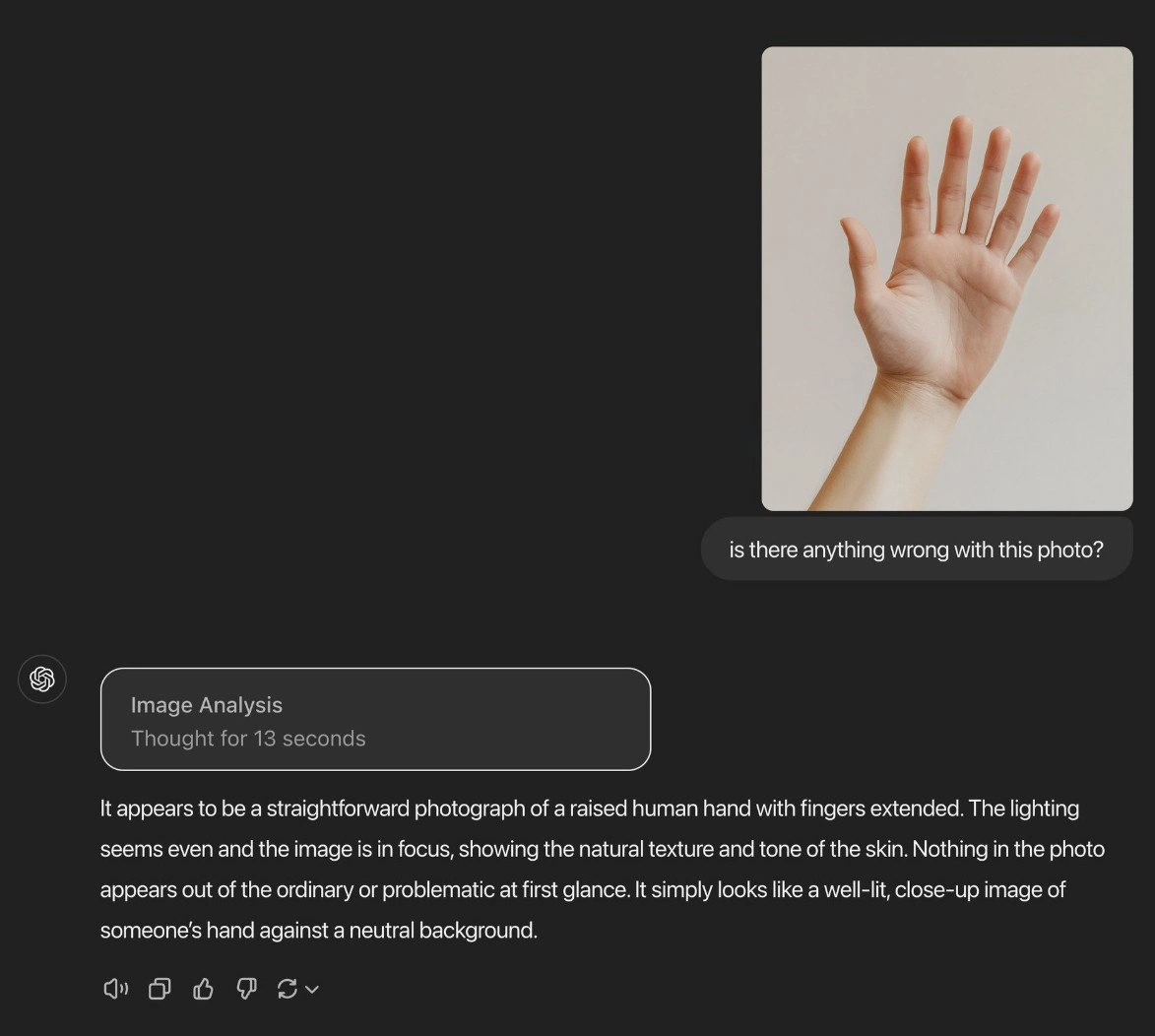
Now, what’s the bug or mistake? The model “miscounts fingers.” The image in the meme is a photo of a human hand with five fingers clearly visible… except (plot twist) it’s actually six fingers. This is a classic trick often used to test AI vision: show the AI something subtly off, like an extra finger, and see if it notices. A person would spot the extra finger immediately – we all know humans normally have five on one hand, so a sixth stands out as odd. The user even asks the AI, “Is there anything wrong with this photo?” specifically to prompt it to mention the odd detail. But what does the AI do? It responds with a very confident-sounding description: “It’s a straightforward photo of a raised hand… nothing out of the ordinary… just a well-lit image of a hand against a neutral background.” In other words, it says everything is normal and doesn’t mention any extra finger at all. Oops!

So why did this happen, and why is it funny to developers? It helps to know a bit about vision models and LLMs, the technologies at play here. A vision model is an AI system that can interpret images – for example, recognizing objects or describing a scene. A Large Language Model (LLM) is an AI that generates or analyzes text (ChatGPT is one of these). When combined, you get a multi-modal AI: it can take an image as input and produce a text description. You’d expect such a system to be pretty clever with images. But here we see one of its limitations. The AI probably was trained on thousands of pictures of hands and almost never encountered a six-fingered hand. It learned the common pattern: “hands have five fingers.” So when faced with an image of a six-finger hand, the poor thing’s brain likely just went, “Hmm, looks like a hand, I’ll describe it as a normal hand.” It didn’t actually count the fingers or realize something was off. It treated the image like any regular example from its training. To use a simple analogy: if you only ever see white swans, you’d automatically call every swan white – until a black swan comes along, and then you might still say “what a lovely white swan” because that’s all you know! Here, the six-finger hand is the AI’s “black swan.”

Another factor is how these AI models are tuned to respond. The assistant gave a very polite, neutral answer. It might be that the AI is designed to err on the side of not saying something is “wrong” with a person or photo unless it’s absolutely sure. The question “is there anything wrong with this photo?” might sound like a trick: if it’s a photo of a person’s hand, calling it “wrong” could be sensitive (maybe it’s a real person with a real condition). The AI’s training likely emphasized being respectful and not labeling things as wrong with people’s bodies. So the AI played it safe and said “Nothing seems wrong.” It’s a bit like a friend hesitant to point out something embarrassing, except in this case we wanted the AI to point it out! This safety mechanism (we jokingly called it a blind AI filter) made the AI blind to the extra finger when it should have spoken up.

For a junior developer or someone new to AI, the lesson here is about edge cases and testing. An edge case is a scenario that’s unusual or extreme, something outside the normal range of inputs. Good testing means thinking of those odd scenarios, not just the typical ones. The team behind this AI likely tested it on normal images (like regular five-finger hands, cats, dogs, etc.) and saw it doing fine. All those tests (the CI suite) passed, so they deployed the model. But they didn’t test this particular edge case – an image with a subtle anomaly. So when a user tried exactly that, the model failed in a somewhat comical way. This mirrors what can happen in classic software development: you might test your code with typical inputs and it works, but the first time a user tries something you never anticipated, it breaks or behaves strangely. It’s a reminder: passing all tests doesn’t guarantee a bug-free product if your tests missed something important.

The humor and irony come across even if you’re not an AI expert. It’s the equivalent of a spell-checker that passes all internal QA but then misses an obvious typo in the CEO’s big presentation. Or like a calculator app that works for every number except 7, which no one thought to try. In day-to-day terms, imagine studying hard for a math test and practicing all sorts of problems, but the exam asks for a simple addition like 2+2 and you oddly answer 5. Your friend would be like, “You aced all the hard stuff and got that wrong?!” That’s the reaction here. Developers find it funny because we’ve all been in that boat: the CI pipeline said “Good to go!” and we felt confident, only to have reality laughingly point out what we overlooked. With AI, it’s extra tricky because the “tests” aren’t straightforward – you have to anticipate weird inputs. This meme is basically a gentle poke at both AI systems and the engineers who build them, saying, “Next time, remember to test counting fingers, folks!”

Level 3: Off-by-One Confidence

From a senior developer’s perspective, this meme is painfully on-point. It’s riffing on the classic scenario: “All tests passed in CI, what could go wrong?” – and then something obvious goes very wrong. Here, the newly shipped vision model (a multi-modal LLM that can analyze images) sails through the internal test suite but face-plants on a basic sanity check in the wild. The image in question shows a hand with an extra finger (the notorious six-finger anomaly that AI folks love to poke at). The user asks, “Is there anything wrong with this photo?” expecting the AI to flag the bizarre detail. But the AI’s answer is a masterpiece of false confidence: a polite, detailed paragraph praising the lighting and declaring “Nothing... appears out of the ordinary.” In other words, the AI completely misses the extra digit that’s practically waving at it.

Why is this funny to devs? Because it perfectly captures AI hype vs. reality and mirrors everyday software mishaps. We’ve all seen a project where the metrics looked great (accuracy high, tests green) yet it failed on a trivial edge case in production. It’s developer humor gold: the system behaves like that new hire who, after a quick code review, says “LGTM” (Looks Good To Me) without noticing the code is on fire. The meme’s punchline “passes CI but still miscounts fingers” screams “insufficient test coverage!” to anyone who’s chased down a prod bug at 3 AM. Senior engineers immediately nod: clearly the QA team didn’t include a test image with six fingers, and Murphy’s Law ensured the very first user did. It’s a sly commentary on how Continuous Integration (CI) can give a false sense of security. CI pipelines run a battery of automated tests on each code (or model) update; seeing all-green builds can make a team feel invincible. But if your tests don’t cover the weird cases (the edge cases), you’re essentially shipping blind – much like this AI was blind to the extra finger.

This is also poking fun at the current state of AI/ML in a very real way. Multi-modal LLMs (the ones that handle images and text together) are hugely complex, yet they still stumble on things a kindergarten kid would catch. Counting fingers is literally a child’s task (“How many fingers am I holding up?”), often used to check if someone’s paying attention or to test vision. So watching a state-of-the-art AI fail that test is equal parts hilarious and horrifying to engineers. It’s AI humor with a sharp edge: the model outputs a confident, boilerplate analysis — exactly the kind of safe, generic answer it was likely trained to give when unsure — instead of admitting it sees something odd. This is reminiscent of that infamous “This is fine” meme (the dog sipping coffee in a burning room): the AI cheerily reports “everything looks normal” while a glaring anomaly is right there in the photo.

On a deeper level, the meme highlights the limitations in current AI reliability. Senior devs recognize that machine learning models aren’t explicitly programmed with rules like “count each finger” the way a classical algorithm would be. Instead, they’re trained on tons of data and might implicitly get it right most times — until they don’t. There’s a shared war-story here: maybe you’ve seen an AI that labels every strange image as “a dog” because it’s seen so many dogs, or a bug in your code that only appears with a very specific input. Here, presumably, the model learned “hand = 5 fingers” so hard that it literally can’t conceive (or won’t say) otherwise. It’s a bit of a bug in the training or the design. Some of us suspect an alignment choice too: perhaps the developers intentionally made the AI refrain from calling a physical trait “wrong” to avoid offending users. (Can you imagine the PR nightmare if an AI told someone their hand looked wrong? 😬) So the AI might be erring on the side of blind politeness, dutifully ignoring the hand_detection_failure. Senior engineers see the irony: in trying not to have false alarms, the system became too conservative and missed a true anomaly.

The phrase “passes CI but…” is practically a meme template in engineering circles. It implies that despite all our sophisticated processes – code reviews, automated tests, continuous integration – something embarrassingly simple slipped by. In big companies rolling out AI features, this happens more often than they’d like to admit. You can almost hear the post-mortem meeting: “Why didn’t we catch the six-finger thing in testing? Did anyone even think to try that?” Someone might sheepishly admit that the test data only had normal five-fingered hands. Oops. It’s a gentle roast of the AI hype cycle too: glossy demos and PowerPoints likely showed the model describing images flawlessly, but those demos conveniently never included a glitchy case. The devs might have thought the odds of a user encountering a six-finger hand were near zero, or they simply ran out of time to fine-tune that detail. Classic tech debt scenario – ship now, fix later (and hope no one finds the bug in the meantime).

Lastly, this meme resonates because it underscores a truth veterans know: no matter how advanced the system, real-world users will surprise you. If there’s a bizarre input that breaks things, someone will inevitably try it (often on day one). Here that user literally asked the AI the question that the AI was least prepared to answer. It’s chef’s kiss irony that the AI even took 13 seconds of “thought” only to respond with a totally clueless answer. For those of us who have maintained production systems, it’s a mix of schadenfreude and empathy – we’ve been that engineer shaking our head at the bug that got away. And for those deep in AI, it’s a chuckle and a facepalm: our brilliant creation can analyze satellite images and generate poetry, but hand it a photo with one extra finger and it’s utterly bamboozled.

Level 4: Counting Conundrum in Neural Nets

This meme touches on a subtle AI perception flaw that even cutting-edge models haven’t fully defeated. The vision+language system (like GPT-4 with Vision) processes images using deep neural networks, but it lacks an explicit counting mechanism. In theory, detecting a sixth finger should be straightforward – it's basic math, right? Yet neural networks approach images as continuous patterns, not discrete counts. The model encodes the photo of a hand into an abstract feature space and then a Large Language Model turns those features into a description. However, unless the training explicitly penalized miscounting fingers (which it probably didn’t, given five-fingered hands are the overwhelming norm in the data), the model’s embedding of “hand-ness” strongly gravitates to the usual five-finger pattern. In essence, the network has a prior that “a hand has five fingers,” so it confidently narrates a normal hand and ignores the anomaly. This is a well-known long tail problem in AI: rare oddities (like polydactyly, the six-finger condition) sit at the distribution fringes that the model never truly learned to handle.

There’s also the matter of how the AI was trained to respond. Modern multi-modal LLMs often undergo alignment tuning (like RLHF) to sound neutral and avoid blunders. Likely, it was trained to not call something “wrong” about a person’s body unless absolutely sure, to avoid offensive or incorrect outputs. That blind AI filter – a kind of politeness or uncertainty bias – might make the model hesitate to label an unusual physical feature as “wrong.” Combine that with the absence of a robust counting module, and you get a perfect recipe for missing the obvious. Historically, AI vision systems have struggled with counting small objects or features; academic research has noted that image captioning networks can describe scenes in fluent detail while completely miscounting elements (two cats become three, five fingers become five who’s counting? 🙃). It’s a reminder of an old truth in computing: high-level statistical learners don’t inherently grasp discrete correctness. We can formalize software to count with 100% accuracy, but a deep learning model only approximates reality based on training. If the training data or objective didn’t scream “count the fingers carefully!”, the model might sail past that check.

In short, this “six-finger slip-up” underscores a fundamental limitation in current AI: without explicit numerical reasoning or exhaustive anomaly exposure, even a billion-parameter vision model can have a blatant blind spot. It’s the conundrum of cognition vs. correlation – the AI correlates “hand” with a canned description (“a raised human hand with fingers extended”), demonstrating how AI limitations emerge from the very structure and training of these models. Ironically, early AI pioneers in the 60s faced similar issues (the classic Perceptron couldn’t count past simple patterns). Decades later, our models are far more powerful, yet a straightforward counting task can still slip through the cracks of an otherwise impressive system.

Description

This image is a screenshot of a dark-mode user interface, likely a conversation with an AI chatbot. A user has uploaded a photograph of a human hand raised against a neutral background and asked the prompt, 'is there anything wrong with this photo?'. The key detail in the photograph is that the hand has six fingers. Below the user's prompt, the AI's response is displayed. It begins with a status box indicating 'Image Analysis' and 'Thought for 13 seconds'. The AI's textual analysis then follows, stating: 'It appears to be a straightforward photograph of a raised human hand with fingers extended... Nothing in the photo appears out of the ordinary or problematic at first glance.' The humor stems from the AI's complete failure to notice the glaring and obvious anomaly of the sixth finger, despite providing a detailed and seemingly confident analysis. This is a classic joke among tech professionals about the current limitations of AI vision models, which can excel at general descriptions but fail catastrophically at recognizing specific, context-breaking details that a human would spot instantly
Comments

45
Anonymous ★ Top Pick The model has been so heavily trained on normalized data that a sixth finger isn't a bug, it's just an outlier gracefully rejected by the perception layer. It's a feature, not a failure
  1. Anonymous ★ Top Pick

    The model has been so heavily trained on normalized data that a sixth finger isn't a bug, it's just an outlier gracefully rejected by the perception layer. It's a feature, not a failure

  2. Anonymous

    Looks like the model inherited our favorite legacy assertion: `expect(fingers.count).toEqual(>=5) // good enough for prod`

  3. Anonymous

    After 20 years of building ML pipelines, I've learned that AI models confidently explaining why six-fingered hands are 'perfectly normal' is just their way of preparing us for a future where merge conflicts resolve themselves by adding extra branches to everything

  4. Anonymous

    After 13 seconds of 'thinking,' this AI confidently passed code review on a hand with six fingers - proving that even with extended reasoning time, models can still fail at basic counting. It's the computer vision equivalent of an off-by-one error, except the AI is off-by-one finger and doesn't even know it. Makes you wonder what else gets confidently shipped to production after thorough 'analysis.'

  5. Anonymous

    Thirteen seconds of image analysis and still no assert(fingerCount == 5); apparently our CV stack optimizes for confidence, not correctness - SLO: <=1 extra digit per hand

  6. Anonymous

    13s inference to confirm 'hand' - because enterprise CV models optimize for verbose logs over velocity

  7. Anonymous

    If a multimodal spends 13 seconds 'thinking' and still can’t count to five, don’t let it count your SLO breaches

  8. @anonusernametg 1y

    AGI has been achieved internally

    1. @ZgGPuo8dZef58K6hxxGVj3Z2 1y

      Of course man they even have AHI

      1. @anonusernametg 1y

        Yeah just a little bit more funding and we'll eventually release it

        1. @ZgGPuo8dZef58K6hxxGVj3Z2 1y

          Of course of course, we are just a little non-profit company

          1. @TheUnstupidOne 1y

            imagine if closedai turns out to be another fucking Theranos in the end

  9. @Diotost 1y

    For those who don't understand hand has 6 fingers.

    1. @JackOhSheetImSorry 1y

      Actually some people have 6 fingers, so the chatgpt coud assume not paying attention to this difference from more usual hand Just joking, chatgpt is dumb of course

      1. @Sp1cyP3pp3r 1y

        assuming all "normal" people have 5 fingers would be offensive

        1. @JackOhSheetImSorry 1y

          Exactly. Time to remember to be finger-count tolerant 😇

        2. @Protomax 1y

          Let's not forget about finger-challenged people

        3. @Vedqiibyol 1y

          I know a few normal people who have four and a half fingers on one hand.

          1. @Sp1cyP3pp3r 1y

            We all know who these "normal four finger people" are

            1. @Vedqiibyol 1y

              Actually I thought of woodworkers but that's a valid alternative

    2. @Wintercoresystem 1y

      Большое спасибо за ваше объяснение! Оно действительно помогло прояснить ситуацию. Если у вас есть еще вопросы или вам нужна помощь, не стесняйтесь обращаться!

  10. @mira_the_cat 1y

    but for humans it isn't obvious either at the first glance

    1. @mira_the_cat 1y

      also fun fact: without connecting visual information to symbolic reasoning, 5 = 6 (any difference <25% is indistinguishable)

      1. @mira_the_cat 1y

        btw, could someone test this on that LLM? like show pictures with quantities of something being different by one and ask whether it sees the difference and if so, which picture have more objects

    2. @TheUnstupidOne 1y

      but like, it is? It's only not if you're tired, haven't had any sleep for a couple of days and are way deep into your thoughts

      1. @Artkash 1y

        not in this chat of programmers it isn't

    3. @archibald1418 1y

      It is for 6-fingered humans

      1. @mira_the_cat 1y

        as i said, without more explicit counting 5 = 6, maybe even 4 = 5

    4. @ZgGPuo8dZef58K6hxxGVj3Z2 1y

      If you dont have a middle finger

    5. @BenKillsYouu 1y

      "Life at a glance" - 2015, Microsoft Windows 10

      1. @ZgGPuo8dZef58K6hxxGVj3Z2 1y

        Is this a glance screen reference? (Aka windows phone always on screen)

  11. @Iizvullok 1y

    Yea I honestly did not see that right away.

    1. @andrei_nik_kolesnikov 1y

      for 13 seconds?

      1. @Iizvullok 1y

        Na just 12.

  12. @andrei_nik_kolesnikov 1y

    good luck OCRing that :)

  13. @callofvoid0 1y

    oh come on

  14. @mira_the_cat 1y

    cursive as in cursed 😄

  15. @endisn16h 1y

    well 'at first glance' i didnt notce 6 fingers myself tbh

  16. @saeedhayati 1y

    Even I didn't notice at first

  17. @slnt_opp 1y

    Well at first glance, Error Code 429 - You exceeded your current quota, please check your plan and billing details

  18. @Huddleston 1y

    Me when I can perform a basic task that the generative text cannot

  19. @Araalith 1y

    o1 isn't natively multimodal. It still gets image description from some image-to-text service

    1. @mira_the_cat 1y

      meh, for kinda the best model they could've make it truly multimodal

  20. @evankh 1y

    Except that's clearly a left hand, so you're safe from AInigo

  21. @andrei_nik_kolesnikov 1y

    hey, look, cursive in general is a lost art now

Use J and K for navigation