Gemini's Clean Sweep on the AI Leaderboard
Why is this AI ML meme funny?
Level 1: Perfect Report Card
Imagine you’re in a school competition with a bunch of different games and contests – running, painting, math quiz, storytelling, you name it. Lots of students are taking part, and usually, you’d expect different kids to win different contests because everyone has their own strengths. Maybe Sam runs the fastest, Priya might be best at the math quiz, and Alex tells the coolest story. But now picture this: one student, let’s call him Gary, says he got first place in absolutely everything. 🏆🥇 Every single contest – he claims he outran everyone, solved the hardest math problem, painted the best picture, wrote the most creative story, all of it. And not only that, Gary’s mom is the one who organized the contests and handed out the grades. She even made a big poster highlighting Gary’s name with “#1 in ALL categories!” in bright sparkly letters.
How would the other kids feel about that? Pretty suspicious, right? It’s like, “Really, Gary? You won every single prize? There wasn’t a single thing that someone else did better?” It would seem almost too perfect to be true. The kids might whisper, “Well, of course he got first in everything – his mom picked the games and judged them. Kinda unfair, isn’t it?” They might want to see the actual score sheets or maybe have another go with an independent judge, just to check if Gary is truly that amazing or if the contests were sort of set up in his favor.
This meme is basically showing that kind of situation, but with AI models (like very advanced talkative computers) instead of school kids. Google’s new AI model (Gemini) is like Gary in our story, and the contests are different skills like math, writing, coding, etc. The meme jokes that Google gave its AI a perfect report card, claiming it came in first place in every subject. To people familiar with these things, that’s a little funny and fishy at the same time – kind of how you’d feel if one kid in class supposedly aced everything because their parent graded the tests. It makes you smile and think, “Hmm, something’s going on here,” which is exactly why the meme is both humorous and a bit snarky.
Level 2: Benchmark Showdown Basics
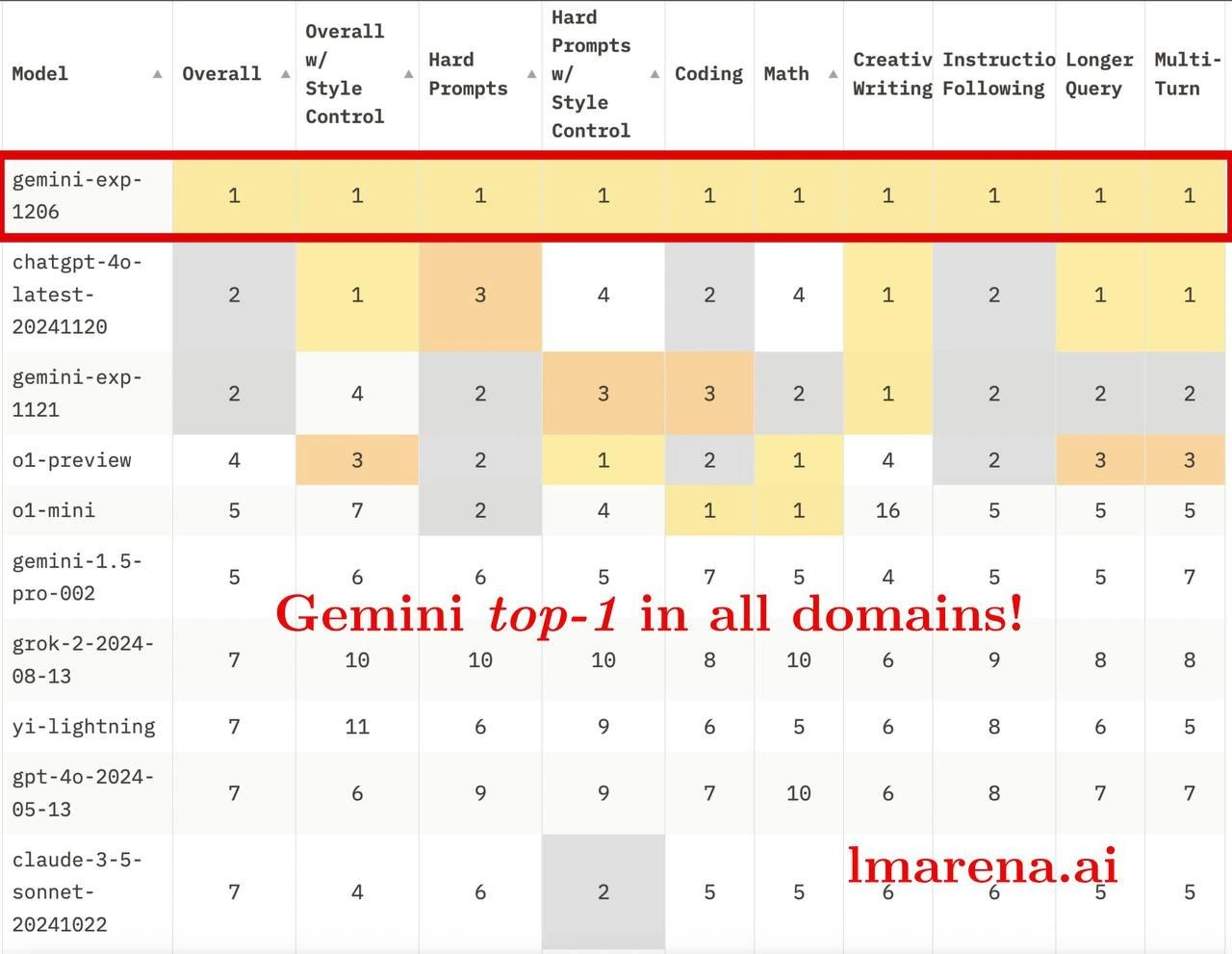
Let’s break this meme down in simpler terms. The image looks like a scoreboard or report card comparing different AI models (think of them as different AI chatbots or assistants) across various skill categories. The leftmost column lists model names – for example, Gemini-exp-1206 (which is Google’s new model called Gemini, in an experimental version dated 12/06), chatgpt-4o-latest-20241120 (this appears to be a version of OpenAI’s ChatGPT or GPT-4 model, dated 2024-11-20), and others like o1-preview, Claude-3.5-Sonnet (Claude is an AI model from Anthropic, and “Sonnet” might be a version name), etc. Each of the other columns is a category or type of test: “Overall” performance, “Overall w/ Style Control” (overall performance when the model is asked to follow a specific style or tone), “Hard Prompts” (really tricky questions or instructions), “Hard Prompts w/ Style Control” (tricky questions plus specific style requirements), then categories like Coding, Math, Creative Writing, Instruction Following, Longer Query (handling long, complex questions or lots of information at once), and Multi-Turn (being able to carry on a back-and-forth conversation over multiple exchanges). Each cell in the table contains a rank number – 1 means that model took first place in that category, a 2 means second place, and so on. They’ve also used shading: the Gemini row is highlighted in pale yellow for all its cells and outlined in red (to show it off), while other models have mixed results (some gray or orange shading to indicate 2nd or lower ranks in various categories).
Now, what is it saying? It claims that Gemini-exp-1206 got rank 1 in every single category. Literally, for all ten columns listed, Gemini is number 1. For example, in Coding, Gemini is 1; in Math, Gemini is 1; in Creative Writing, again 1; all the way to Multi-Turn, still 1. Meanwhile, the other models like that ChatGPT variant or Claude might have a mix of 2’s, 3’s, etc., in different columns (the details are a bit small in the image, but you can see none of them have a straight line of 1’s). The big red text below shouting “Gemini top-1 in all domains!” is basically like a trophy announcement: “Hey, our model won first place in every event!” and it’s labeled with lmarena.ai, which suggests this was presented as part of some AI arena or benchmarking tool (maybe a website or internal platform where they compare models).
For someone new to this: a benchmark in AI is a test or set of tests used to measure how good a model is at certain tasks. Companies and researchers often evaluate their models on common benchmarks (like asking a coding model to solve programming problems from a known set, or a language model to answer questions from a trivia dataset, etc.) to see how it stacks up against others. Performance metrics from these benchmarks can then be displayed in tables or charts. A leaderboard is basically a ranking of models by their performance on such tests. It’s very much like a game scoreboard or a competition ranking.
So, this table is a leaderboard that was probably put together by Google (or someone affiliated) to show off that their new Gemini model is superior to others (like OpenAI’s and Anthropic’s models) in all the tested areas. To a newcomer, that might sound amazing – “Wow, Gemini is best at everything!” But to those with some experience, it’s actually a bit suspicious. Why? Because usually models have different strengths. One might be really good at straightforward question-answering and math, another might be better at creative storytelling, another might excel at coding. It’s unusual for one model to beat all others at every single category, especially when the categories are this diverse (math vs. creative writing are very different challenges!).
The meme is poking fun at this scenario because it’s likely an example of AI hype or a marketing exaggeration. In the context provided, people have been talking about another AI model referred to as “o1” (which sounds like a competitor, possibly something related to OpenAI’s models given the mention of a “monthly price for o1 pro” – maybe a premium AI service that’s expensive and a bit of an inside joke). And also “Sonnet,” which refers to Anthropic’s Claude model. So by now (end of 2024), there are a few major AI models in the wild: OpenAI’s GPT-4 (and variants), Anthropic’s Claude 2 or 3 (Claude 3.5, code-named Sonnet), and Google’s freshly released Gemini. The meme’s poster commented that Google is “finally” releasing something good – implying Google was a bit late to the party – and that on their own tests, Gemini performed great (though not perfectly at code generation and it sometimes made stuff up when the prompt was very long, i.e., it hallucinates under big contexts). They mention “now we have 3 of them”, meaning three comparable top-tier AIs to choose from, which is actually exciting for the industry competition.
However, back to the meme image: it basically embodies industry hype by showing an almost comically perfect result for Google’s model. It’s essentially self-congratulatory. Think of it like a company making a poster that says “We’re #1 in all these categories!” based on their own testing. Seasoned engineers find this a bit humorous because they know companies often tweak tests to make their product look best. For example, maybe Google’s team chose exactly the kind of questions that Gemini excels at. If Gemini has a special feature for Style Control (perhaps it was trained to change its writing style on command), they made sure to include categories for that and highlight how others might not do as well. If Gemini was trained heavily on math problems, include more math tests. It’s sometimes cynically called cherry-picking – selecting only favorable evidence while ignoring where you don’t do so well.
The presence of that red outline and bold text is very telling: it’s styled like a slide one might see in a closed-door meeting or a press release draft: “Look, we beat OpenAI at their own game, in every way!” To a junior developer or someone new to AI, the key takeaway is: when you see a claim like “X is #1 at everything”, it’s wise to be a bit doubtful and dig deeper. Usually, you’d want to ask: “Who ran these tests? Was it a neutral party or the company itself? What tasks exactly were used? Are there published results or a paper?” In the AI community, truly trustworthy benchmarks are either peer-reviewed or done by independent evaluators.
So this meme is a form of AI humor or industry satire. It highlights how, especially during hype cycles, companies might present glowing benchmarks that make their AI look unbeatable. And the dev community often reacts with “Uh-huh, sure… let’s test it ourselves, shall we?” A junior developer might not have seen this pattern before, but trust us, it happens all the time. It’s similar to when a new phone comes out and the manufacturer’s chart shows it’s faster and better camera than all competitors – you expect a bit of bias. Here it's just in the AI domain with terms like LLM (Large Language Model) performance, and categories that sound technical.
To sum up in plain terms: Google’s new AI model Gemini is being shown in an internal-looking chart as outperforming every other model on a bunch of tests. The meme is funny because it’s so perfect that it feels staged, and developers are joking about how marketing teams love to declare victory like this. The reality is usually more nuanced, and the community tends to be wary of these one-sided claims. In other words, take such tables with a grain of salt – they might be more about bragging rights than objective truth.
Level 3: Clean Sweep Skepticism
This meme captures that classic senior-engineer skepticism when faced with marketing-driven benchmarks. The image is basically a leaderboard_table of various AI models across a bunch of categories, and surprise! Google’s new Gemini-exp-1206 model is ranked #1 in every single column. Every category — Overall, Hard Prompts, Coding, Math, Creative Writing, you name it — has a bright yellow “1” for Gemini. They even drew a thick red box around that row and slapped a triumphant caption “Gemini top-1 in all domains!” at the bottom, just in case you missed the subtlety. 🙄 For anyone who’s been around tech long enough, this rings all the alarm bells of a suspicious_internal_benchmarks presentation. It looks exactly like those internal KPI slides where a company’s product magically outperforms all competitors on every metric — something that rarely, if ever, happens in reality.
Why is this funny (and a bit cringey)? Because seasoned developers and researchers have seen this play out repeatedly. A company’s marketing_benchmarks will hand-pick the metrics and tuning such that their latest gizmo shines in the spotlight. It’s like how every database vendor’s powerpoint claims they’re the fastest (on queries they specifically optimized), or every browser once boasted best performance (on a test suite they created). Here, Google is essentially saying, “Our Gemini model is the absolute best at everything — don’t even bother using those other guys.” The meme’s humor comes from that too-perfect result: a clean sweep. As a wise, cynical voice in the back of our heads says, “Sure, and I bet my code has zero bugs too.”
Let’s break down some specifics. The table lists a bunch of models in the rows: besides the almighty gemini-exp-1206 (outlined in red), we see entries like chatgpt-4o-latest-20241120 (which looks like a variant of OpenAI’s GPT-4 model, perhaps a specific snapshot from Nov 20, 2024), another older gemini-exp-1121 (Gemini experimental version from Nov 21, presumably), o1-preview and o1-mini (likely referring to some competitor’s models dubbed “O1” — possibly a rival AI service that people have been fine-tuning and even joking about the monthly price for o1 pro subscription), gemini-1.5-pro-002 (maybe an earlier large Gemini-based model or a mid-generation version), grok-2-2024-08-13 (sounds like yet another model, perhaps from a smaller player or open source community, dated August 13, 2024), yi-lightning (no idea, but could be an AI model from maybe a Chinese company or a lab nicknamed “Yi Lightning”), gpt-4o-2024-05-13 (another GPT-4 variant dated May 2024), and claude-3.5-sonnet-20241022 (Anthropic’s Claude 3.5, possibly an iteration nicknamed “Sonnet” from Oct 22, 2024). So we have a roster of many contenders in the LLM arena. This table is essentially a mini “Model Olympics” across ten different events (the columns). A normal outcome would be a mix of rankings: maybe GPT-4 is 1st on coding, Claude might be 1st on creative writing, etc., reflecting each model’s strengths. Instead, this slide presents Gemini as the gold medalist across the board.
As any engineer might ask: “Okay, what’s the catch?” It’s extremely unlikely for one model to sweep every category unless the evaluation is, shall we say, rigged or heavily biased. Perhaps the tasks chosen align extraordinarily well with Gemini’s training. For instance, if Google knew the eval suite, maybe they made sure Gemini was fine-tuned on those types of questions. Or the scoring might be done in a way that favors certain styles (maybe Gemini is optimized for those exact style-controlled responses). The presence of columns like “Overall w/ Style Control” and “Hard Prompts w/ Style Control” is interesting — style control implies the model can adhere to a requested style or tone (like, “Answer as a pirate” or “Use a formal academic style”). Not all models have strong style-transfer abilities, so maybe Gemini has a new feature there, and the tests emphasized it. Hard Prompts likely means especially challenging or tricky queries (potentially ones that models often fail). If Gemini’s team crafted or picked those “hard prompts”, they might be types that their model particularly excels at (or conversely, ones that stump other models due to some quirk). It’s a classic move: define “hard” in a way that just happens to be where others trip up and yours doesn’t.
The Coding and Math columns stand out too. Historically, OpenAI’s GPT-4 has been a leader in coding tasks and math word problems, while Google’s previous models (like PaLM/Bard) were decent but not clearly better. So seeing Gemini ranked 1 in Coding and Math over chatgpt-4o-latest and claude-3.5-sonnet raises eyebrows. It could mean Gemini is genuinely very strong there (which would be exciting), but the cynical take: maybe the coding problems were ones Gemini saw in training or solved by brute force, or maybe competitor models weren’t given as much time or context. Real code evaluation, such as running programs or complex debugging, is hard to measure just by a rank number, so we’d love to see actual scores or success rates. The meme suggests that any engineer worth their salt, upon seeing this slide, would immediately want to dig into the raw evaluation scripts or data. In fact, the description joked that a perf-obsessed dev would “reach for the raw eval scripts” – translating to: “I don’t believe these ranks until I see exactly how you measured them.”
The big red text “Gemini top-1 in all domains!” feels exactly like a boastful internal announcement. It’s IndustrySatire 101: poke fun at how companies hype up their products. We’ve seen similar victory laps in other areas of tech. Remember the browser wars? Each company would demo a chart where their browser miraculously leads in every performance metric (startup time, page load, JavaScript speed, etc.), often by choosing just the right tests and ignoring the rest. Or in hardware, a GPU manufacturer might show a graph of select game frame rates where their card is always on top, because they cherry-picked games optimized for their architecture. Here it’s the same vibe but for AI models. Google surely wants to claim a big win with Gemini (since OpenAI and others have been dominating mindshare). An internal slide leaking or being shared externally that shows Gemini as unbeatable in all categories smells like AIHype. It’s almost too on-the-nose. Engineers immediately suspect that the evaluation wasn’t exactly an unbiased third-party bake-off, but rather an in-house marketing_benchmark likely run on a carefully curated prompt set.
The meme also resonates because of timing and context. By December 2024, the community has been eagerly awaiting Google’s response to OpenAI’s GPT-4 and Anthropic’s Claude. Google I/O and other events had teased Gemini as the next big thing (a multimodal AI model combining strengths of their previous large models). So when it arrives and someone posts this “#1 across the board” result, the seasoned crowd smirks: “Ah, there it is – the bold claim that Google’s model beats everyone at everything. Called it!” There’s even a subtle jab in the text accompanying the meme: the original poster says they tested it and found it “great” on their own tasks (so Gemini might indeed be very good), but they noticed it wasn’t as strong in writing code and that it “hallucinates a little too much when there’s a big context”. That’s telling, because the official chart shows Gemini ranked 1 in Coding and presumably in handling Longer Query contexts and Multi-Turn dialogues. The user’s real experience didn’t 100% line up with the perfect scores — an engineer’s way of saying, “It’s good, but not flawless as the slide suggests.” This reinforces the meme’s satirical point: internal numbers can paint a rosier picture than the messy reality. The poster’s conclusion: “it’s definitely worth a shot, since it’s finally something from Google on the level of o1 and Sonnet. So now we have 3 of them.” In other words, welcome Google to the AI Big Leagues, joining the ranks of OpenAI (the o1 model everyone’s been fine-tuning and joking about) and Anthropic’s Claude (nicknamed Sonnet in that version). We’re witnessing a classic hype-cycle moment: a new challenger appears, and the PR machines declare victory, but the dev community is wisely cautious, preferring to verify through hands-on trials.
All in all, the humor targets that gap between marketing and engineering. The slide screams confidence – every number one, look at our supremacy! – but the savvy dev reading it chuckles, knowing how these things usually work. It’s technical satire: a wink and nudge encouraging us not to take such leaderboard slides at face value. Real engineers will test things themselves. After all, if something looks too good to be true in tech, 99% of the time… it is.
Level 4: No Free Lunch in AI
At the most fundamental level, this meme hints at a basic truth of machine learning: there’s essentially no free lunch when it comes to model performance across diverse tasks. In theory, if one model truly ranks #1 in every single category from coding to creative writing, it implies an almost Pareto-optimal dominance over all other models – a sort of AI unicorn. Seasoned ML researchers will recall the No Free Lunch Theorem, which in simple terms means no one model or algorithm can be best at everything without trade-offs. In a broad space of possible problems, if an algorithm is superhuman on some tasks, inevitably there should be tasks where another algorithm outperforms it. Usually, Large Language Models (LLMs) exhibit specialization trade-offs: a model fine-tuned for math precision or logical reasoning might not be as imaginative in creative writing, and a model great at following strict instruction guidelines might produce duller, overly-safe outputs in open-ended tasks. So when we see a result claiming Gemini is top-ranked across all domains, it raises a skeptical eyebrow from a theoretical standpoint. Is Gemini a singular super-model that has somehow achieved a new global optimum across every axis of language ability? Or, more likely, have the evaluation goalposts been arranged such that Gemini’s particular strengths align perfectly with the tested metrics?
In academia and industry, evaluation benchmarks for AI are notoriously tricky. Researchers design suites of tasks (like code challenges, math word problems, creative writing prompts, etc.) to measure a model’s capabilities. However, how you choose these tasks and metrics can heavily influence which model comes out on top. A truly rigorous evaluation tries to cover wide ground and remain fair, but when a specific lab or company (especially one with a marketing agenda) curates the tests, you often end up with self_reported_metrics that favor their own model. It’s a classic case of Goodhart’s Law: when a performance metric becomes a target (especially for PR), it often ceases to be a good metric. Models can be tweaked or overfit on those exact benchmarks, achieving impressive rank-1 across the board in the chosen “arena” while maybe not being as universally strong in the real world.
The meme’s highlighted row of all 1’s for gemini-exp-1206 screams “domination” in every category, which just doesn’t happen without some caveats. Either Gemini is a genuine breakthrough that shifted the paradigm – like a leap to near-AGI performance – or, far more plausibly, the evaluation was cherry-picked. Perhaps the tasks are a bit niche or closely related (meaning it’s not as broad as it looks), or maybe competing models weren’t fully optimized in those tests. The image even references an official-sounding lmarena.ai, suggesting an evaluation leaderboard environment. If this is an internal or affiliated benchmarking platform (which it appears to be), we have to question how the tests were run. For instance, did they use the latest version of each competitor (the table lists chatgpt-4o-latest-20241120, presumably a ChatGPT variant from Nov 2024, and claude-3.5-sonnet-20241022 for Anthropic’s Claude)? Are those truly the strongest versions or configurations of those models? Were the prompts fair and identical? Without open methodology and raw data, a clean sweep result is scientifically suspect.
To an expert eye, the tally_of_ones in that red-outlined Gemini row practically glows with “too good to be true” energy. It hints at the eternal tension in AI evaluation between marketing gloss and genuine innovation. If Google’s new Gemini model really has overcome every trade-off to be top-1 in all domains, it would defy the common understanding of model trade-offs and benchmarking nuance. More likely, this is a tongue-in-cheek commentary: the meme is pointing out that such a perfect scorecard probably reflects suspicious_internal_benchmarks rather than a miraculous all-powerful AI. In other words, even if Gemini is a very advanced model (which it certainly might be), any claim that it’s categorically the best at everything should be taken with a grain of salt until independent evaluations confirm it. The laws of computational learning theory and plain old engineering cautiousness demand that we ask: “Show me the actual data and tests.” Until then, we intuit the underlying principle: in AI as in life, you rarely get something for nothing – every strength comes with some compromise elsewhere, and benchmark slides that pretend otherwise are usually hiding the fine print.
Description
The image displays a leaderboard-style comparison of various large language models (LLMs) on a light-themed table. The top row, for the model 'gemini-exp-1206', is highlighted with a bright yellow background and shows a rank of '1' in every single category across the board. The categories include 'Overall', 'Coding', 'Math', 'Creative Writing', 'Instruction Following', and others. Competing models listed below it, such as 'chatgpt-4o-latest', 'gemini-exp-1121', 'o1-preview', and 'claude-3-5-sonnet', all have varying, higher numerical ranks, indicating lower performance. Overlaid on the image in a large red font is the text 'Gemini top-1 in all domains!'. In the bottom right corner, the watermark 'lmarena.ai' is visible. This image is a benchmark result, likely from a platform like LMSys Arena (lmarena.ai), which pits LLMs against each other. The visual unequivocally declares that a new experimental Gemini model has achieved the top rank in all measured capabilities, a significant event in the highly competitive field of AI development. For developers, this signifies a potential new state-of-the-art model to experiment with or integrate into their workflows
Comments
27Comment deleted
The 'gemini-exp-1206' model's performance is so dominant, its developers are probably running benchmarks now to see if it can achieve a rank of 0
Pretty sure the query behind this slide was just `SELECT 1 AS rank FROM benchmarks;` - marketing-driven AGI achieved!
Ah yes, the quarterly 'our model is #1' leaderboard shuffle - where every vendor cherry-picks their benchmarks until everyone's simultaneously winning. Next week's update: 'Actually, we meant #1 on Tuesdays, evaluated on palindromes, with style control set to 'baroque.'
When your model achieves perfect 1s across all benchmarks, you know it's either genuinely revolutionary or the evaluation criteria were suspiciously well-aligned with your training data. Either way, the marketing team is already drafting the 'AGI achieved' press release while the engineers nervously check if anyone tested adversarial prompts
Great - Gemini is #1 everywhere; wake me when there’s a column for “writes idempotent migrations, respects rate limits, and doesn’t hallucinate new APIs during a Sev‑1.”
Gemini crushes arena benchmarks in coding and math - too bad it can't outlast your monolith in a production outage
Great - rank‑1 across every column; Goodhart’s Law just filed a Sev‑2: “optimized for the leaderboard, regressed in production.”
All my experience with Gemini is worse than even GPT-3.5. It's bullshitting everything, effectively transforming every request into some kind of trendy social media agenda. Comment deleted
try api version of gemini, it should solve some of them with prompt, however totally agree about those weird formatting Comment deleted
I even tried ScholarAI Comment deleted
Yeah, same here, that’s why I posted it since it finally something Comment deleted
Aider Code editing benchmark Comment deleted
To me it's kinda the best benchmark out there right now in regard of coding capabilities Totally aligned with my own experience of models usage Comment deleted
Oh, here's an example from today: I asked Gemini how to enable caching for requests with authorization using OutputCache in C#, .NET 8. It took me 5 attempts. Three of the answers were just hallucinations and syntax errors (lol), one was complete BS with a lecture about caching, and on the fifth attempt, it gave me an answer about custom policies - but Gemini didn't override the default behavior (excludeDefaultPolicy), so that was a fail too. I'm glad Gemini can handle childish coding tasks with a 70% success rate, but beyond that, its coding capabilities are a joke. Comment deleted
Why did you asked Gemini about something? Comment deleted
Or you’re talking about 1206? Comment deleted
Nope, it's gemini-pro-experimental-0827. My bad. It seems I don't have access to the latest one Comment deleted
sonnet still the real goat tho fr 🙏🙏 Comment deleted
my own flesh-bag brain beats all of these, checkmate Comment deleted
do you know what version is on the google assistant on pixel phones? Comment deleted
Disabled. Really, who uses it? Comment deleted
I try it Comment deleted
Tested. Nope. Same BS and hallucinations. I usually ask LLMs for how-to instructions to avoid reading tons of documentation. They provide code snippets I can use or modify, but for anything more complex than basics, they mix up everything and include unnecessary code. While o1 might try to debug the issues, Gemini just goes off the rails and produces even more hallucinations. Claude, however, is still the best. Comment deleted
Gemini also has a very low response size limit Comment deleted
Also, with ChatGPT o1 or even 4o, if you role play a bit and are willing to go back and forth with revisions, it can actually be useful. It works great if you don't have somebody that can help you debug for instance, but you shouldn't expect it to just spit out a fully functional app first try Comment deleted
In my experience if you actually want it to write some code, you have to be very specific with your design requirements, as in, you have to offer it implementation options to your best understanding. You actually need to know what roughly it has to write for it to write anything remotely useful. Comment deleted
After all, an LLM is not an engineer, you are the engineer. Garbage in, predicted garbage out Comment deleted