The 10x Price Jump to AI Pro Tier
Why is this AI ML meme funny?
Level 1: The Pricey Helper
Imagine you have a little toy car to play with, and it costs only a bit of your allowance. Now, suppose there’s a special remote control that can drive the car for you and even do some cool tricks – but this remote control costs ten times more than the car itself! 😮 Kinda funny, right? You’d scratch your head thinking, “Why is the controller more expensive than the toy it controls?” That’s exactly the joke here. Developers have their own “sandbox” – think of this as their play area or tool for building stuff (like the toy car). It’s usually cheap or something they already have. Then there’s this fancy AI helper (like the remote control) that can answer questions and help them build things faster. The meme is saying this AI helper wants a lot of money each month, even more than the whole cost of the developer’s sandbox. It feels upside-down and silly. The reason it’s funny is because usually the main thing (the car or the sandbox) should be the costly part, and the helper or add-on should cost less. When the helper’s price overshadows the main setup, it’s like a big fancy golden wrench that costs more than all the regular tools in your toolbox. It makes people laugh and groan at the same time, thinking, “Wow, helping me is expensive!”
Level 2: From Plus to Pro
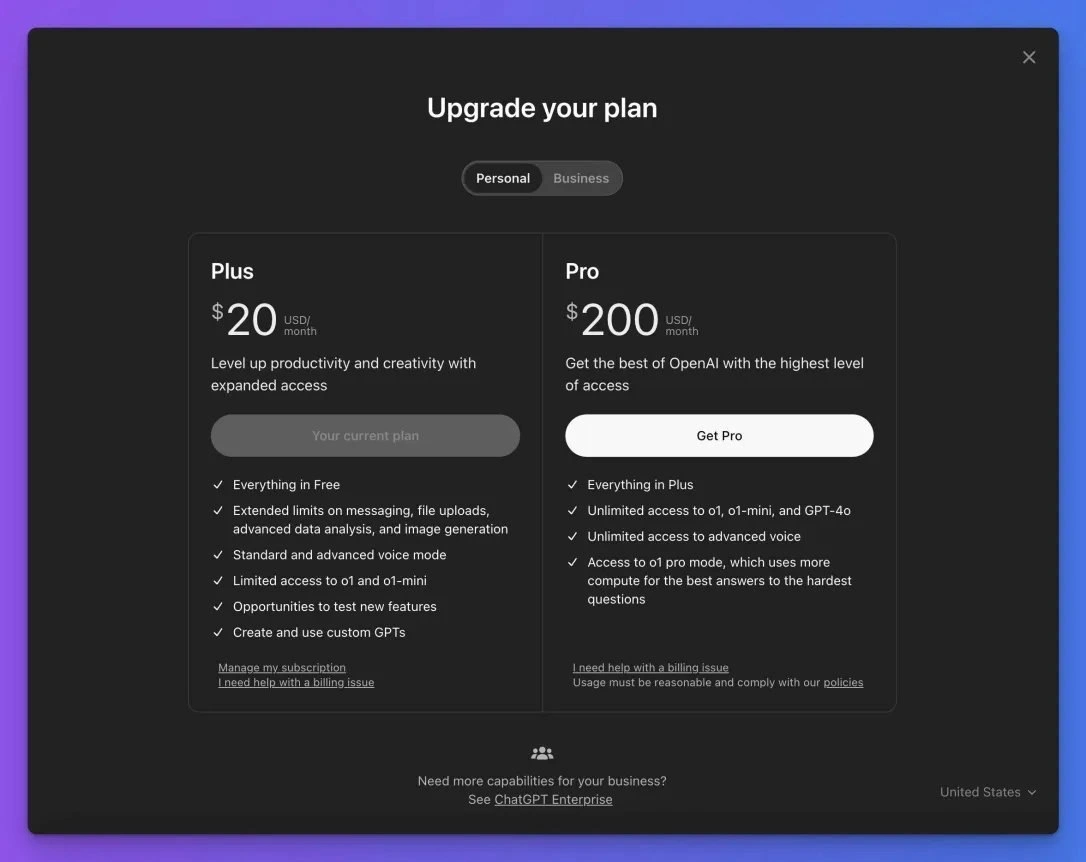
Let’s unpack the meme in simpler terms. It’s showing the ChatGPT “Upgrade your plan” screen – basically a menu of what you get if you pay more for this AI service. ChatGPT is an AI model (a Large Language Model, or LLM for short) that developers use to help with tasks like writing code, debugging, or getting answers to technical questions. Think of it as a very advanced assistant that you can talk to via text (and now even voice). There are different subscription levels: Free, Plus ($20/month), and now Pro ($200/month). The meme highlights how shockingly expensive that Pro tier is by joking that it costs more than the “dev sandbox” – which usually means a developer’s own testing environment or server. A dev sandbox can be a small cloud server or local machine where you try out code safely. Often, that sandbox might be cheap or even free (especially if it’s just your local computer or a tiny cloud instance). So it’s funny to imagine that access to an AI could cost more per month than the actual space where you run and test your code.
Now, what’s in these plans? The Plus plan at $20 already gives a lot of goodies that go beyond the free version of ChatGPT. With Plus, you usually get access to more powerful AI models (for example, GPT-4 instead of just GPT-3.5), meaning the AI’s answers are smarter and you have bigger limits (you can send more messages before hitting a cap). Plus users also recently got things like voice mode, where you can actually talk and it talks back (kind of like a supercharged Siri or Alexa). The meme description lists features: “extended limits on messaging, file uploads, advanced data analysis, and image generation” – so basically more freedom to use ChatGPT for coding or data tasks without getting cut off. Plus also gets new features first: “Opportunities to test new features” means if OpenAI is trying something experimental, Plus subscribers often get a sneak peek. For many devs, that $20 is already another little line on their personal or team budget, but it’s arguably worth it if ChatGPT helps them work faster. It’s advertised as a productivity booster: “Level up productivity and creativity with expanded access” is the tagline for Plus. In practice, a developer might justify this cost by saying, “It helps me solve problems quicker than digging through docs or Google.”
Then comes Pro at $200/month – a tenfold jump in price. 😱 Why would anyone pay that? The Pro plan includes everything in Plus, of course, and then some exclusive perks. According to the screenshot, one big perk is unlimited access to some new models: it mentions o1, o1-mini, and GPT-4o. These sound like newer or more specialized versions of OpenAI’s models. For example, GPT-4o might be an optimized or upgraded GPT-4 (the naming isn’t super clear to us outsiders, but it implies something better or different about it). “o1” could be a code name for the next major model (maybe “OpenAI-1” or just an internal name) and “o1-mini” perhaps a lighter version. The key point is that on Plus, users only have limited access to those – maybe they can only try them a bit or at certain times – whereas Pro gives unlimited access. That means if you’re a Pro subscriber, you can use those fancy new models as much as you want. Another perk: “Access to o1 pro mode, which uses more compute for the best answers to the hardest questions.” In plain terms, that suggests if you have a really complex or difficult query, Pro will throw more computing power at it to get an even better answer. It’s like having an ultra-powerful setting unlocked. Additionally, Pro offers “unlimited access to advanced voice.” So while Plus might let you talk to ChatGPT with voice to some extent, Pro presumably removes any caps – you could have it talk all day if you wanted. Essentially, Pro is targeting power users and professionals who rely on ChatGPT heavily and might even integrate it into their daily workflow in a big way.
For a developer who’s newer to this, here’s why it’s amusing: usually, developers spend money on servers, cloud services, or their development tools, not on asking questions to an AI. The meme points out that we’ve reached a point where an AI subscription might cost more than, say, renting a development server on AWS. Imagine a junior dev who sets up a personal server or uses a cloud sandbox for learning – maybe that costs $10-$50 a month depending on usage. Now an AI helper service is asking $200/month for its top tier! It’s a bit of a role reversal: the helper app is more expensive than the thing you’re building on. It highlights a trend in the industry: AI is becoming a big part of the developer experience. Companies and individuals are actually considering separate budgets for AI tools – sometimes jokingly called a “prompt engineering budget”, meaning money set aside for using AI prompts and services. We’re treating AI like a resource or a tool, much like we pay for cloud databases or code editors. The AI_ML boom has turned services like ChatGPT from just cool demos to essential daily tools for coding, testing, writing documentation, etc.
From a junior perspective, you might also notice the interface design in the meme. It’s very much like other software you may have seen: one column for a standard plan and one for a premium plan, with feature checkmarks. This is deliberate – companies design these to make the pricier plan look tempting. The Pro plan here highlights that it’s “the best of OpenAI with the highest level of access.” It’s the equivalent of a “Pro edition” of an IDE or a “Premium” tier of a cloud service. Often, businesses will pay for this top tier if they truly need those features or if they have many team members using the service. The meme even hints at another level: “ChatGPT Enterprise” is mentioned as an option for businesses. That’s likely even more expensive, aimed at entire companies with admin features, higher data privacy, or bulk licenses. So Pro is more like for individual power users or small teams, whereas Enterprise is negotiations-on-a-phone-call pricing.
Let’s define a couple of terms in case they’re new:
- LLM (Large Language Model): This is a type of AI model trained on tons of text data. It can generate human-like text and answers. ChatGPT is an example of an LLM. When people say “LLM access,” they mean using these AI models via an API or interface.
- Prompt engineering: This is the craft of writing effective prompts (questions or instructions) to get the best output from an AI. If you’ve ever rephrased a question to get a better answer from ChatGPT, congrats, you’ve done prompt engineering! Some companies now consider this a skill and even assign a budget to it – meaning they expect to spend a certain amount on AI usage while employees tinker with prompts to solve problems.
- Usage-based pricing: This means paying based on how much you use a service (like per API call or per GB of data). Interestingly, OpenAI’s ChatGPT for individuals uses subscription pricing (flat monthly fee for a set of capabilities), whereas if you use OpenAI’s APIs directly, you pay by usage (per token of text). The meme touches on this indirectly: those subscribing to Pro don’t have to count each API call, they just pay a big flat fee for presumably unlimited use within “reasonable” limits.
So, a junior dev might look at this and learn two things. First, AI tools can be super helpful but they’re becoming commercial products like any other, with tiered pricing. Second, there’s a bit of a sticker shock/humor in how the narrative has flipped: it used to be that your cloud server or development software license was the expensive part of building software, and any Q&A or help (like Stack Overflow, or asking a colleague) was free. Now, the help (via an AI) can have a higher price tag than some of your infrastructure. It’s a sign of how valuable AI assistance is perceived to be – or at least how much companies think we’re willing to pay for extra convenience and speed. And from the reactions (like “who cares about benchmarks, lol”), you can tell there’s a mix of skepticism and acceptance: some are not convinced the Pro tier’s new models are actually that much better (benchmarks are tests to compare model performance), but others say “Eh, who cares, it’s the new cool thing.” That’s very much the hype vs reality tension: is Pro truly worth it, or is it just shiny hype to make money? The meme leans on the comedic side of that debate.
Level 3: SaaS Upsell Déjà Vu
This meme hits experienced developers right in the budget. The screenshot is the ChatGPT pricing modal doing its classic SaaS upsell dance: side-by-side Plus vs Pro plans, slick marketing copy (“Level up productivity!”), and a big fat $200/month tag on the Pro column. If you've been around the tech block, you’ve seen this playbook before. Remember when every dev tool went from free beta to a tiered subscription? Now LLM access is just another line on the engineering budget, alongside AWS bills and observability tools. “Need GPT-4o with Pro Mode? That’ll be extra.” It’s giving off heavy AI_HypeVsReality vibes – as in, the hype is real, and so is the price tag.
Let's break down the humor: the title jokes “When the AI subscription costs more than your dev sandbox.” Many devs have cheap or free development sandboxes (like a small cloud VM or local server) that cost, say, tens of dollars a month – if not zero. Suddenly, OpenAI wants up to $200/month per person for a chatbot assistant. That’s more than some teams spend on their entire test environment! It’s like telling a carpenter their fancy new hammer’s monthly lease costs more than the workshop rent. Seasoned engineers find this hilarious and painfully familiar. Today it's AITools; yesterday it was some enterprise IDE or a “dev productivity suite” with a similarly steep premium. The pattern repeats: initial free candy, then the pricey gourmet meal. IndustryTrends_Hype in action – we knew the AI gold rush would come with subscription plans, but the sticker shock is still real.
The Plus vs Pro comparison is a textbook upsell. The left side (“Plus – $20”) is what a lot of devs already begrudgingly pay for GPT-4 access, reasonable message limits, and the new toys like voice mode. The right side (“Pro – $200”) cranks it to 11: basically everything in Plus plus “unlimited” access to shiny new models (the mysterious o1 and o1-mini) and a special “Pro mode” that uses more compute for “the hardest questions.” That last bit got a chuckle out of the senior crowd – it’s essentially saying if your question is really tough, better pay up to get the best answer. 🤑 It’s a bit pay-to-win for coding advice: Got a gnarly bug or an obscure error? Oh sorry, that answer lives behind the Pro paywall. The meme nails this irony. Developers love to gripe about how answering hard questions used to mean diving into docs or Stack Overflow, not swiping the company credit card for extra AI brainpower. Now here we are in 2024: debugging memory leaks with the aid of a cloud AI that costs more per month than the test server with the memory leak.
From a senior engineering perspective, there’s also a dark comedy in how DeveloperExperience_DX improvements get monetized. ChatGPT was hailed as a game-changer for DeveloperProductivity – your AI pair programmer that never sleeps. But surprise: the more productive you want to be (unlimited top-tier model usage, faster responses, new features), the more you have to fork over. It’s the classic “free tool becomes indispensable, then starts charging” plot. Many of us have seen internal tools or open-source projects get acquired and slapped with enterprise pricing. Seeing it with an AI assistant is both fascinating and cynically expected. The meme’s backdrop – that purple-blue gradient, the slick dark theme – even parodies how polished the upsell is. It’s practically whispering, “All the cool devs have Pro… you don’t want to be stuck on basic, do you?” Meanwhile, the dev is checking their “prompt_engineering_budget” (yes, that’s a thing now) and thinking, “Our entire staging environment costs $100 a month, and this chatbot wants $200… seriously?”
The real kicker: devs know that AI_ML hype can outpace reality. The post text jokes about benchmarks not looking great and “Sonnet still seems like a king.” In other words, even if OpenAI’s new o1 model isn’t demonstrably superior to existing ones (or some open-source model nicknamed Sonnet), they still slapped a premium price on it. And the commenter’s like “Who cares about benchmarks, lol.” That cynicism is gold – it implies everyone knows this could be more about monetization than actual merit. For battle-scarred engineers, it’s déjà vu. We’ve seen mediocre “enterprise editions” pushed out just to create a higher pricing tier. The AIHypeVsReality gap becomes a joke: the reality is you might be paying mostly for bragging rights and FOMO, not a magically 10x better coding assistant. After all, “Opportunities to test new features” and “Custom GPTs” sound cool, but will they save your bacon during a 3 A.M. outage? Probably not – and you’ll still be on call while your expensive AI buddy cheerily suggests turning it off and on again.
In summary, at the senior level this meme is a knowing smirk at how AI tools have graduated from fun freebies to serious budget line items. It’s poking fun at the Pro plan absurdity and the inevitability of usage_based_pricing or subscriptions creeping into every developer tool. The veteran devs reading this are nodding, maybe laughing ruefully, because they’ve seen trends come full circle: today’s fancy LLM subscription is just the latest flavor of expensive enterprise software. Same upsell, new label. And of course, a final dollop of irony – OpenAI calls it “Get the best of OpenAI” for $200, conveniently implying that if you stick with the $20 plan, you’re second-tier. Nothing like a little monetary guilt-trip to go with your morning stand-up. Cue the eye-rolls and the CFO’s twitching eye. In the end, it’s equal parts funny and frustrating: the AI revolution is here, and it charges by the month.
Description
A screenshot of a dark-mode user interface for an OpenAI subscription upgrade page, titled 'Upgrade your plan'. It presents two options side-by-side. On the left, the 'Plus' plan is priced at '$20 USD/month', with a button below it indicating this is the 'Your current plan'. On the right, the 'Pro' plan is priced at a significantly higher '$200 USD/month', with a bright white 'Get Pro' button. The page details the features of each plan, with the Pro plan offering access to more advanced models like 'o1, o1-mini, and GPT-4o' and a special 'o1 pro mode'. The visual joke and point of discussion in the tech community is the steep, tenfold price increase between the consumer-grade and professional tiers. This highlights the high cost of cutting-edge AI model access and OpenAI's strategy to segment the market between casual users and high-demand professional or enterprise clients who require the highest level of performance and are willing to pay a premium for it

Comments
42Comment deleted
The $20 plan helps you write code. The $200 plan is for when you need an AI that can withstand the existential dread of reading through your legacy codebase without crashing
Sure, $200 a month sounds steep - until you remember it’s still cheaper than the Kubernetes cluster you spun up last year to generate haikus for the marketing team
Remember when we complained about $10/month for GitHub Copilot? Now we're casually dropping $200/month for an AI that still hallucinates package names and confidently explains why your perfectly valid regex is actually summoning Cthulhu
When your AI assistant costs more per month than your entire AWS bill, you know we've entered the 'compute as a luxury good' era. That $180 delta between Plus and Pro is essentially paying for the privilege of watching o1 think longer before telling you your architecture is still wrong - just with more confidence and token budget
“Access to o1 pro mode, which uses more compute” is the new -O3 flag - except turning it on opens tickets with Finance, Legal, and Procurement
Plus vs Pro: pick your bottleneck - tokens per minute or dollars per minute
$200 Pro plan: Unlimited o1 for when GPT-4o still hallucinates your microservices as a monolith
OMFG you really pay for this shit? Comment deleted
ye, its like ollama with qwq does not exist or something Comment deleted
Ngl QwQ is top shit Comment deleted
I still pay for Sonnet though. There’s still nothing is above Sonnet O1/qwq 32b are somewhat close but meeeeh Comment deleted
Jessie, what the f are you talking about? Comment deleted
Yes all of us have the hardware to run ai models locally how'd you know Comment deleted
I mean, you probably could rent a VPS with a GPU on it, and it might be much cheaper than 200$/mo Comment deleted
Ahem Comment deleted
So, o1-preview could start a docker container much better than o1? Am I reading this right? Comment deleted
yep, this stat make o1 look fucked up Tbh like almost all benchmarks looks like o1-release is messed up shit Comment deleted
That's why I would be especially curious to try it out since it seems it was trained without any benchmarks in mind Comment deleted
Or o1-release is just a failure lol Comment deleted
This may be related https://openai.com/index/openai-o1-system-card/ Comment deleted
What does the task "OpenAI API proxy" refer to? And why are there different levels? Comment deleted
Of vram, no Comment deleted
That leads you nowhere. Even 20 GB doesn't. I haven't yet seen a model that preforms comparable to or above ChatGPT 3.5 with these limitations. Have you? Comment deleted
Idk what's the model size of gpt 4 or o1, but rumors say those take like 100+ GB. Comment deleted
Yes, and that's either 26 GB or 80 GB in size. Not 8 GB. Comment deleted
https://smcleod.net/2024/12/bringing-k/v-context-quantisation-to-ollama/ Comment deleted
Now that sounds very interesting! Gotta test it later on. Thanks for sharing! Glad we had this talk, guys 😁👌 Comment deleted
https://t.me/istorium_net/8458 Comment deleted
"""""Unlimited""""" within reason. Tf does that mean? Comment deleted
On "plus" subscription you have 50 req/day for mini and 50 req/week for release I think, on "pro" they've deleted these limites Comment deleted
What the fuck can you do with 50 requests? Comment deleted
I use plus subscription, and o1 mini is really good. I didn't find any competitors to solve math and comprog tasks as good as o1 mini/prev/release Comment deleted
Also, i use chatgpt not to do all my work, just some help for me. So, 50 req/day is more than enough Comment deleted
ChatGPT 4 can't even replace numbers in a number array Comment deleted
Chatgpt 4 was like year ago.... Comment deleted
4o now is: Free Fast And smart enough for free model Comment deleted
Clearly not because they had to ass the "within reason label". Like my ISP has the "Unlimited" which is actually only 5TB Comment deleted
Maybe it's not unlimited, idk, i use plus, not pro. You can try and pay 200$, only than we will know, is it really unlimited Comment deleted
It says it in the screenshot Comment deleted
And maybe it really is unlimited. You can check if you want Comment deleted
*for several years Comment deleted
And, don't get me as a corpo defender, but chatgpt o1(mini and release) has 0 competitors in math/compprog. It's literally the best Comment deleted