The Piracy Paradox: Anti-Piracy Campaign Caught Using Pirated Font
Why is this Security meme funny?
Level 1: Breaking Their Own Rule
Imagine a teacher tells the class, “Never ever copy someone else’s homework,” but then you find out that the teacher copied their lesson plan from someone else without asking. It wouldn’t feel fair, and you’d probably laugh because the teacher isn’t following their own rule! This meme’s story is like that. The people who made a big advertisement saying “stealing is wrong” actually used something they didn’t pay for – a font (a special style of lettering) – to make that very ad. In simple terms, they broke the same rule they were trying to teach everyone else. It’s funny to people because it’s a clear case of someone not practicing what they preach. Just like you’d shake your head and giggle if a rule-maker got caught breaking their own rule, developers are amused that an anti-stealing ad itself was made with a bit of stealing.
Level 2: Font Licensing 101
Let’s break it down in simpler terms. An anti-piracy campaign is basically a marketing effort (like an ad or public service announcement) that tries to discourage people from pirating content. Pirating means copying or downloading things like movies, music, or software without paying for them – essentially stealing digital property. The famous slogan from this campaign was “You wouldn’t steal a car,” comparing downloading a movie to stealing a physical car, to make people realize software licensing and media rights are serious.
Now, the funny twist: the people who made that “don’t pirate” campaign used a pirated font in their own promotional material. A font is the design of text characters (for example, Arial and Times New Roman are fonts). Fonts aren’t just free-for-all; they are usually considered creative work and part of intellectual property. Many fonts require you to buy a license or get permission if you want to use them commercially (especially in a big campaign). In this story, the font used for the campaign’s text was originally designed by a guy named Just van Rossum. But instead of using a properly licensed copy of his font, the campaign designers ended up with an unauthorized copy known as “XBAND Rough.” In plain terms, XBAND Rough was a knock-off version of Just’s font that had been released illegally for free. Using that in the campaign means they didn’t pay for or ask permission to use the font – exactly the kind of theft their video was telling people not to do.
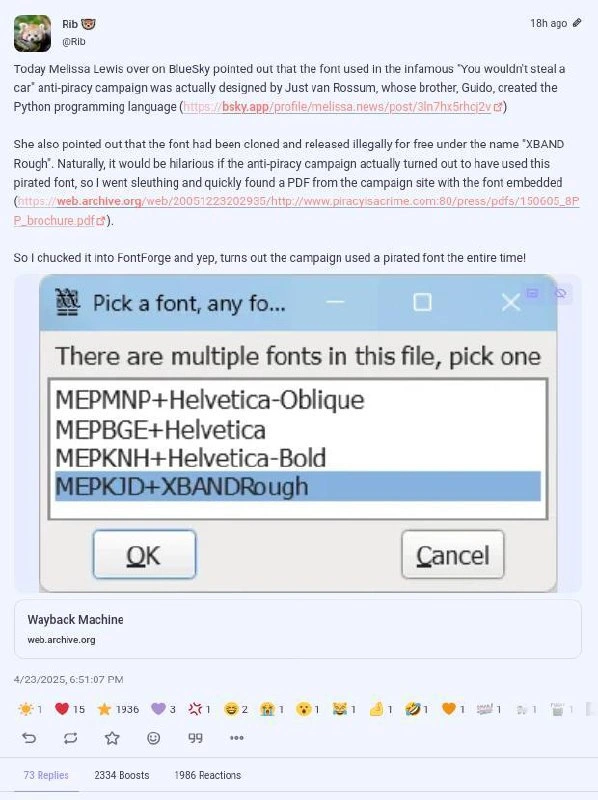
How did we find this out so many years later? A developer on BlueSky (a new social network, similar to Twitter) spotted something odd about the font. To confirm it, they used FontForge, which is an open-source tool for editing and inspecting fonts. You can actually open a PDF file with FontForge to see what fonts are embedded inside it. See, PDF files often embed fonts inside themselves so that the text will display with the correct style even on computers that don’t have those fonts installed. In the screenshot shared, FontForge showed a list of fonts used in the campaign’s PDF brochure. Among the list (which included ordinary fonts like Helvetica for the basic text) was the name XBANDRough. That was a big “gotcha” moment – it revealed that the PDF contained the XBAND Rough font file within it. In other words, the anti-piracy brochure literally carried the evidence of the pirated font.
To get hold of that old PDF, the community turned to the Wayback Machine. The Wayback Machine is an online archive that keeps snapshots of websites from the past (it’s like a time machine for the internet). The original campaign website (often cited as piracyisacrime.com) isn’t around anymore, but the Wayback Machine had saved a copy of it from 2005, including that PDF brochure. By retrieving the PDF from the archive and opening it in FontForge, the developer could see the font details and confirm the use of the unauthorized font.
One more interesting tidbit: Just van Rossum (who made the original font) has a brother named Guido van Rossum – and Guido is famous in the programming world as the creator of Python. That family connection is a fun piece of trivia for tech folks. It doesn’t change the fact that the campaign makers goofed up, but it’s a neat connection between the story and programming history.
In summary, what seemed to be a straightforward anti-piracy message turned into an example of “do as I say, not as I do.” The campaign intended to teach about respecting content licenses, but ended up violating a license (for a font) themselves. That’s why developers and designers are laughing about it: it’s a perfect illustration of why paying attention to licenses and permissions matters, served with a big scoop of irony. Always double-check the license of assets (even fonts!) you use – otherwise you might become the punchline of an industry joke years later.
Level 3: You Wouldn't Steal a Font
Piracy is a crime – that was the loud tagline of a mid-2000s anti-piracy campaign, remembered for the ominous line “You wouldn’t steal a car.” This was the era of DVDs that would force you to watch a dramatic PSA with intense music, equating movie piracy to grand theft auto. It turns out that slogan is now steeped in delicious irony. In a revelation that has senior devs smirking, the very campaign preaching about IntellectualProperty and theft ended up pirating a font for its own materials. Yes, the anti-piracy folks stole a typeface. You can’t make this up. That kind of IndustryIrony practically writes itself.
Here’s what happened: a bit of digital detective work exposed the hypocrisy. An enterprising developer dug up an old campaign PDF brochure (via the trusty Wayback Machine archive) and opened it in a font-inspection tool called FontForge. In the screenshot above, FontForge lists all the fonts embedded in that PDF: mostly standard stuff like Helvetica (a common default font) for body text, but one entry stands out – XBAND Rough. That name might not mean much at first glance, but it’s the smoking gun. XBAND Rough is the title of an illegally cloned copy of a font originally designed by type designer Just van Rossum. In other words, the campaign’s graphics used a bootleg font file, likely downloaded for free without permission. They literally incorporated stolen design work into an ad about not stealing.
For added geek trivia, Just van Rossum (the font’s creator) happens to be the brother of Guido van Rossum, the creator of the Python programming language. It’s a small tech world indeed. The irony here is thick: an anti-piracy marketing team either unknowingly or brazenly bypassed SoftwareLicensing rules in the name of a snazzy font style. Perhaps someone in a rush thought, “It’s just a font, who will notice?” Well, about 20 years later, developers did notice, and now we’re all chuckling.
This revelation hits classic IndustrySatire territory. The phrase “You wouldn’t steal a car” became a running joke in MemeCulture (“You wouldn’t download a car,” tech folks parodied – and when 3D printing advanced, some of us muttered, “Actually… maybe you would!”). But none of that tops the campaign itself effectively downloading a font illegally. It’s a plot twist no one expected: the digital sheriffs turned out to be a bit of a bandit. Seasoned developers have seen patterns like this before – the louder the moral high-ground shouting, the funnier it is when a silly oversight undermines it. The tech community loves this story because it’s equal parts TechHistory lesson and TechHumor punchline. In software and media, you have to practice what you preach… or the internet will eventually find out. Here, the anti-piracy crusaders became accidental pirates, and this whole affair is now a legendary piece of tech folklore.
Description
A screenshot of a social media post by a user named 'Rib' that exposes a case of digital hypocrisy. The post explains that the iconic font from the 'You wouldn't steal a car' anti-piracy campaign was designed by Just Van Rossum (brother of Python creator Guido van Rossum), but was later cloned and illegally distributed as 'XBAND Rough'. The user then details their investigation, using the Wayback Machine to find a PDF from the original campaign, and analyzing it with the font editor FontForge. The climax of the post is an embedded screenshot of a FontForge dialog window titled 'Pick a font, any fo...'. This window lists the fonts embedded in the PDF, with the last one highlighted: 'MEPKJD+XBANDRough'. This provides definitive proof that the anti-piracy campaign ironically used a pirated font. The humor stems from the perfect, real-world example of institutional hypocrisy, discovered through some light digital forensics, a story particularly amusing to developers who appreciate irony and the complexities of software licensing
Comments
31Comment deleted
It's the ultimate licensing violation: your entire anti-piracy campaign has a circular dependency on piracy
The “You wouldn’t steal a car” ad shipping with a pirated font is peak irony - proof that if you skip the SBOM, even your ethics become an unlicensed dependency
The most reliable way to detect pirated software in your organization? Check what your legal department is using for their anti-piracy campaigns. It's like finding your security team's passwords on a Post-it note, but with better typography
The anti-piracy campaign's use of a pirated font is peak "do as I say, not as I do" energy - especially ironic given it was designed by Python creator Guido's brother. It's like discovering your security consultant left their AWS credentials in a public GitHub repo, except this one's been immortalized in pop culture for two decades. The real kicker? Someone had to fire up FontForge and dig through archived PDFs to catch them red-handed. Nothing says "you wouldn't download a car" quite like downloading a font you didn't license
You wouldn’t steal a car, but apparently you’d ship a pirated font in the brochure; proof that our zero‑trust architecture trusts PDFs
We’ve got SBOMs for containers and npm, but marketing shipped a PDF with MEPKJD+XBANDRough - apparently our supply‑chain policy doesn’t include fonts
PDF font subsets: the original code obfuscator, predating JS minifiers by decades - still unreadable after all these years
Do as we say, not as we do ahh campaign Comment deleted
I'll be completely honest, I like piracy. I don't justify it morally, it just reminds me of my childhood. A simpler time when programs didn't rely on servers and thus there was no need to sell them as subscriptions... Ah... Sweet memories Comment deleted
Piracy to me is morally justified when mega corporations are impacted by it. Same thing for preserving the past, or making accessible for poor countries where education or other things are not accesible easily to everyone (just see Cuba). I obviously pay for things, don't get me wrong, but I still pirate some others when needed and I don't condone who make use of it Comment deleted
If buying is not owning, piracy is not stealing Comment deleted
Pirating isn't stealing. But using a copyrighted font without acknowledgement is copyright infringement, not piracy Comment deleted
Usage of copyrighted intellectual and artistic property is always under a strict control. Restreaming shows, usage of arts including fonts have to be acknowledged and sometimes may also require you to pay residuals Comment deleted
Pirate everything possible is my motto Comment deleted
🏴☠️ Comment deleted
Btw, there are a lot of research that piracy actually help, because its free advertising Comment deleted
aren't fonts, like, un-copyright-able? Comment deleted
You gotta be surprised how crazy and expensive fonts licensing models Comment deleted
The result of a text being rendered with a given font isn't copyrightable. The font itself is. Comment deleted
Its getting really complicated here, licensing models for many fonts include total amount of copies allowed to be produced using font Comment deleted
Sure, although that's unrelated to copyright, really Comment deleted
The licensing models are directly related to and enabled by the copyright held in the font software (and sometimes the design itself, depending on jurisdiction). The license is the mechanism through which the copyright holder controls the use of their protected work. Comment deleted
Although it's a little ambiguous to refer to "the font itself." It's more accurate to say, the sequence of bytes making up a font file (ttf, otf, or whatever) is copyrightable, but the resulting letterforms aren't. A single glyph is generally too small to qualify as a creative work, just like a single note or chord isn't a copyrightable song. Comment deleted
One significant part of any investigation is not to find yourself guilty Comment deleted
They also pirated the music used in the ad Comment deleted
People just overreact to any piracy https://x.com/HakitaDev/status/1797245014268891236 Comment deleted
original post: https://fedi.rib.gay/notes/a6xqityngfubsz0f Comment deleted
https://torrentfreak.com/rights-group-fined-for-not-paying-artist-for-anti-piracy-ad-120717/ Comment deleted
To be aware of the fact that some font was illegally re-released as a freeware, one has to be familiar enough with the topic (the fonts in public access), which most people are not. Comment deleted
the jingle they used was also pirated tho so its just a lovely lil extra Comment deleted
Was gonna say Comment deleted